Introduction
Altus Airflow understands that validation is an essential part of developing a reliable and controlled fertility laboratory. A Modular IVF Lab Turnkey Project Company provides specialised validation services to verify whether laboratory infrastructure, ventilation systems, filtration arrangements, and environmental controls perform according to the required specifications. Proper validation helps maintain suitable conditions for sensitive embryology procedures, supports contamination control, and ensures that laboratory systems function consistently before clinical operations begin.
Validation also involves systematic testing, performance documentation, and technical verification. These activities help fertility centres identify potential issues, maintain laboratory quality, and establish a suitable environment for reproductive medicine procedures.
1. Understanding Validation in Modular IVF Laboratories
Validation is a structured process used to confirm that laboratory infrastructure and installed systems perform according to predefined requirements.
IVF laboratories require carefully controlled environmental conditions because eggs, sperm, and embryos are sensitive to changes in temperature, air quality, humidity, and chemical contamination.
A comprehensive validation process generally examines:
HVAC system performance.
HEPA filtration efficiency and integrity.
Airflow distribution and pressure differences.
Temperature and humidity control.
Particulate contamination levels.
Environmental monitoring systems.
Electrical and emergency power arrangements.
Laboratory equipment functionality.
The purpose is to verify that the installed infrastructure meets the approved design specifications and supports the intended laboratory activities.
Validation should be planned according to the laboratory's intended use, project specifications, applicable standards, and equipment manufacturers' recommendations.
2. HVAC System Validation Services
Heating, ventilation, and air-conditioning systems play an important role in maintaining controlled conditions inside IVF laboratories.
HVAC validation checks whether the installed system delivers the required air supply, temperature, humidity, and pressure conditions.
Important validation activities include:
Airflow measurement: Technical teams measure the airflow supplied to different laboratory areas and compare the results with the approved HVAC design.
Air changes assessment: The air change rate is evaluated to determine whether the ventilation system provides the specified air replacement performance.
Temperature verification: Temperature sensors are used to assess whether the laboratory maintains its specified temperature range.
Humidity monitoring: Relative humidity is measured to verify environmental control performance.
Pressure differential testing: Pressure differences between laboratory rooms and adjoining spaces are checked to confirm the intended airflow direction.
HVAC functional testing: Control panels, sensors, dampers, and other system components are checked for proper operation.
These tests help identify ventilation problems and confirm whether the installed HVAC infrastructure performs according to project requirements.
3. HEPA Filter Integrity and Filtration Validation
HEPA filtration is an important component of controlled IVF laboratory environments. These filters help remove airborne particulate contaminants from supplied air.
However, the presence of HEPA filters does not automatically guarantee effective filtration. Their installation, sealing, and operating performance must be verified.
HEPA validation services generally include:
Filter installation inspection.
Filter identification and specification verification.
Filter housing inspection.
Leakage and integrity testing.
Examination of filter sealing arrangements.
Differential pressure measurement.
Documentation of test results.
Integrity testing helps identify possible leakage through the filter media, seals, or housing connections.
The testing procedure should follow the applicable filter classification, testing standard, and manufacturer's recommendations.
Proper filtration validation supports the laboratory's contamination control strategy and helps maintain the intended air quality.
4. Airborne Particle Count Testing
Airborne particle monitoring is another important validation activity for IVF laboratories.
Microscopic particles may enter laboratory environments through personnel movement, equipment, materials, and ventilation systems.
Particle count testing measures the concentration of airborne particles of specified sizes in designated locations.
The process generally involves:
Selecting appropriate sampling locations.
Preparing the laboratory according to the testing protocol.
Using a calibrated airborne particle counter.
Measuring particles of specified sizes.
Recording particle concentrations.
Comparing the results with the required classification or project acceptance criteria.
Preparing a particle monitoring report.
Testing may be performed under different occupancy conditions depending on the validation protocol.
The results help laboratories evaluate whether their filtration and environmental control arrangements achieve the specified particulate cleanliness levels.
5. Airflow Visualization and Smoke Studies
Airflow visualization studies help demonstrate how air moves through different areas of an IVF laboratory.
These studies are useful for identifying unwanted turbulence, stagnant zones, and airflow patterns that may affect contamination control.
During testing, specialised visualization equipment or an appropriate test medium is used to make airflow movement visible.
Important areas of assessment include:
Air supply direction: Confirms whether supplied air follows the intended distribution pattern.
Air movement around workstations: Evaluates airflow behaviour near laboratory benches and designated work areas.
Potential stagnant areas: Helps identify locations where air movement may be insufficient.
Doorway airflow: Examines air movement between the laboratory and adjoining spaces.
Equipment interference: Checks whether laboratory furniture, equipment, or fixtures affect the intended airflow pattern.
Smoke studies should be performed using an appropriate non-contaminating method that is compatible with the laboratory environment.
The findings can help engineering teams identify opportunities to improve airflow distribution and contamination control.
6. Temperature and Humidity Validation
Maintaining stable environmental conditions is important for IVF laboratory operations.
Changes in temperature and humidity may affect laboratory equipment, working conditions, and the stability of environmental parameters.
Temperature and humidity validation generally includes:
Verification of installed sensors.
Comparison with calibrated reference instruments.
Measurement at designated locations.
Assessment of temperature uniformity.
Evaluation of humidity control.
Verification of alarm settings.
Documentation of monitoring results.
Temperature mapping may be conducted to identify variations between different laboratory locations.
Where required, monitoring should cover representative operating conditions and appropriate testing durations.
Hospitals and fertility centres should establish acceptable environmental limits according to equipment requirements, laboratory protocols, and applicable technical guidance.
7. VOC and Chemical Contamination Assessment
Volatile organic compounds (VOCs) are chemical substances that can evaporate into the surrounding air.
Potential sources include construction materials, adhesives, paints, furniture, cleaning products, and laboratory consumables.
Chemical contamination assessment is particularly relevant during the development or renovation of IVF laboratories.
Validation-related activities may include:
VOC measurement: Sampling and analysis help determine the concentration of selected volatile compounds in the laboratory environment.
Material assessment: Interior materials are reviewed for suitability and potential chemical emissions.
Ventilation evaluation: The effectiveness of ventilation arrangements is assessed in relation to environmental control requirements.
Post-construction assessment: Testing may be conducted after installation and before laboratory operations begin.
Documentation: Findings are recorded and compared with the specified acceptance criteria.
Material selection and proper ventilation planning should be considered from the beginning of the project rather than addressed only after construction is completed.
8. Differential Pressure and Room Integrity Testing
IVF laboratories may contain different functional areas, including embryology rooms, andrology rooms, preparation areas, and supporting spaces.
Maintaining appropriate pressure relationships between these areas helps control the direction of air movement.
Differential pressure validation examines the pressure difference between selected rooms.
Testing activities generally include:
Measuring pressure differences between adjoining spaces.
Checking installed differential pressure sensors.
Verifying pressure monitoring displays.
Inspecting door sealing arrangements.
Checking the performance of ventilation controls.
Confirming alarm functionality.
Room integrity inspections also help identify gaps, poorly sealed joints, and other construction issues that may affect environmental control.
The required pressure arrangement should be established during the design stage according to the laboratory layout and contamination control strategy.
9. Electrical Systems and Emergency Power Validation
IVF laboratories depend on sensitive equipment that requires stable and reliable electrical supplies.
Microscopes, incubators, refrigerators, laboratory workstations, and monitoring devices may require continuous electrical availability.
Electrical validation services can include:
Electrical safety inspection: Checks electrical connections, protective devices, earthing, and other safety provisions.
UPS testing: Evaluates the operation of uninterruptible power supply systems and their ability to support designated critical equipment.
Generator integration checks: Verifies the coordination between emergency generators and electrical distribution systems.
Alarm verification: Checks electrical and equipment-related warning systems.
Power distribution assessment: Examines the distribution of electrical supplies to designated laboratory equipment.
Emergency power testing: Verifies that identified critical circuits receive backup power according to the approved design.
These activities help reduce the risk of electrical interruptions affecting laboratory operations.
10. Laboratory Equipment Installation and Performance Qualification
Validation is not limited to the building infrastructure. Critical laboratory equipment must also be checked before routine operations begin.
Equipment qualification helps verify that instruments are installed correctly and operate according to their intended specifications.
Common equipment requiring installation and performance checks includes:
CO2 incubators.
Benchtop incubators.
Inverted microscopes.
Micromanipulation systems.
Refrigerators and freezers.
Laboratory centrifuges.
Laminar airflow workstations.
Environmental monitoring devices.
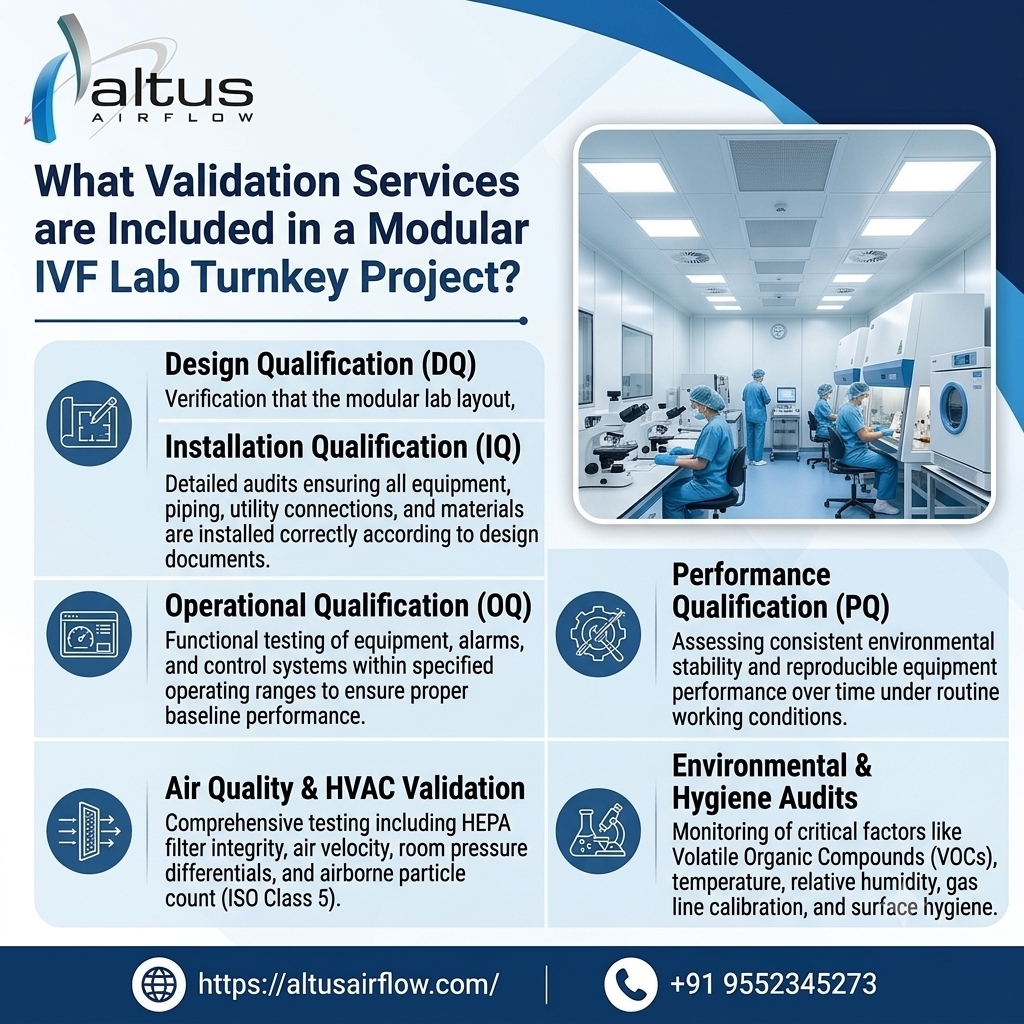
Equipment qualification may involve three stages:
Installation Qualification (IQ): Confirms that equipment is installed correctly according to the manufacturer's specifications.
Operational Qualification (OQ): Verifies that equipment functions within its defined operating parameters.
Performance Qualification (PQ): Evaluates whether equipment performs consistently under representative operating conditions.
Calibration of temperature sensors, pressure gauges, and other measuring instruments should also be documented.
Equipment-specific acceptance criteria should be established using manufacturer instructions and laboratory quality procedures.
11. Documentation and Validation Reports
Documentation is an essential part of laboratory validation because it provides evidence that the required testing activities have been completed.
A professional validation process should produce organised records that can be reviewed by laboratory managers, quality personnel, and relevant auditors.
Typical documentation includes:
Approved validation protocols.
HVAC performance reports.
HEPA filter integrity reports.
Airborne particle count results.
Airflow visualization reports.
Temperature and humidity mapping records.
Differential pressure measurements.
VOC assessment reports, where applicable.
Electrical safety and UPS testing records.
Equipment qualification documents.
Calibration certificates.
Corrective action reports.
Final validation summaries.
Reports should identify the testing method, instruments used, calibration status, sampling locations, measured results, and acceptance criteria.
Any deviations identified during testing should be documented, investigated, and resolved before the relevant system is approved for its intended use.
12. Why Should Hospitals Select an Experienced Turnkey Project Partner?
Choosing an experienced turnkey project partner can help fertility centres coordinate laboratory construction, infrastructure installation, equipment integration, and validation activities.
A Modular IVF Lab Turnkey Project Company should understand the technical requirements of embryology and andrology environments.
Hospitals should evaluate project partners based on:
Experience in IVF laboratory infrastructure.
Understanding of HVAC and HEPA filtration systems.
Knowledge of environmental monitoring requirements.
Ability to coordinate laboratory equipment installation.
Availability of technical testing and commissioning support.
Quality of engineering documentation.
Understanding of laboratory workflow requirements.
After-installation technical support.
It is also important to clarify which validation activities are included in the project scope and which require independent specialist testing agencies.
The hospital should receive a clear validation plan, defined responsibilities, acceptance criteria, and documented handover records.
Conclusion
Validation services are essential for confirming that an IVF laboratory's infrastructure and equipment operate according to their intended specifications. HVAC testing, HEPA filter integrity checks, particle count measurements, airflow visualization, temperature and humidity mapping, electrical safety inspections, and equipment qualification help establish a controlled laboratory environment.
A reliable Modular IVF Lab Turnkey Project Company should coordinate these activities with proper technical documentation, commissioning procedures, and corrective action processes.
Altus Airflow specialises in modular healthcare and laboratory infrastructure, helping fertility centres develop organised IVF laboratory environments. With attention to ventilation, filtration, modular construction, equipment integration, and technical coordination, Altus Airflow supports the development of functional laboratory facilities.
Frequently Asked Questions (FAQs)
1. What validation services are included in an IVF laboratory turnkey project?
A Modular IVF Lab Turnkey Project Company may provide HVAC validation, HEPA filter integrity testing, particle count testing, airflow visualization, temperature mapping, and equipment qualification.
2. Why is HVAC validation important in IVF laboratories?
It verifies that ventilation systems maintain the specified airflow, temperature, humidity, and pressure conditions.
3. What is HEPA filter integrity testing?
It checks whether HEPA filters and their sealing arrangements are free from unacceptable leakage.
4. Why is particle count testing performed in IVF labs?
It measures airborne particulate levels to assess environmental cleanliness.
5. What is airflow visualization testing?
It demonstrates air movement patterns and helps identify unwanted turbulence or stagnant areas.
Read Our Previous Blog --------------->How do Turnkey Modular IVF Lab Solutions ensure timely project completion?