Introduction
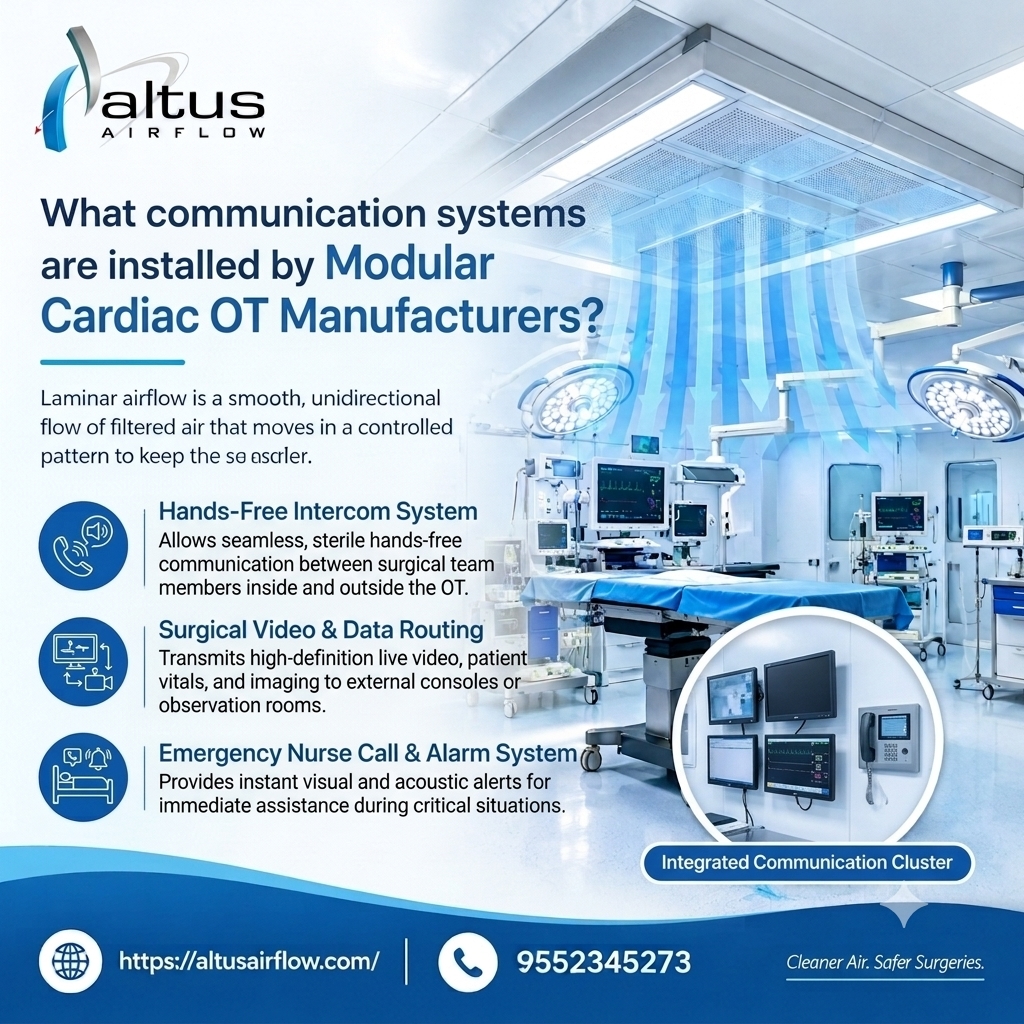
Altus Airflow recognizes that effective communication is essential for coordinating complex cardiac surgical procedures and maintaining an organized operating environment. Modular Cardiac OT Manufacturers incorporate communication technologies that help surgical teams exchange information, respond to emergencies, and coordinate with supporting departments. These systems may include hands-free intercoms, nurse call interfaces, emergency alert panels, public address connections, and integrated operating theatre control panels. When carefully planned, these technologies improve communication between surgeons, anesthesiologists, nurses, and hospital personnel while supporting efficient workflows, timely responses, and reliable coordination throughout the surgical process.
1. Why Are Communication Systems Important in Cardiac Operating Theatres?
Cardiac surgery requires close coordination between surgeons, anesthesiologists, perfusionists, nurses, biomedical engineers, and other healthcare professionals. Clear communication helps these teams exchange instructions, request equipment, report technical issues, and coordinate activities without unnecessary interruptions.
Modern operating theatres contain multiple connected systems, including surgical lights, anesthesia workstations, patient monitors, ventilation controls, and medical gas services. Communication technology helps staff coordinate the use of these resources and contact support personnel when assistance is needed.
A well-planned communication arrangement can provide several benefits:
Faster exchange of information between clinical teams.
Clearer communication between the operating theatre and external departments.
More organized emergency notifications.
Reduced need for staff to leave their designated work areas to relay routine messages.
Better coordination of equipment servicing and technical support.
Communication systems should be selected according to clinical requirements, room layout, hospital protocols, and applicable safety standards. They must complement clinical procedures rather than interfere with critical medical equipment or the sterile workflow.
2. Hands-Free Intercom Systems
Hands-free intercoms are among the most useful communication technologies for operating theatres. They allow staff to communicate with designated locations without repeatedly handling a telephone or leaving their workstation.
An intercom installation may connect the operating theatre with the nursing station, anesthesia room, recovery area, equipment control room, or other approved hospital locations.
How Intercom Systems Work
Depending on the design, an intercom may use wall-mounted stations, ceiling speakers, microphones, desk consoles, or network-connected communication terminals. Authorized staff can initiate calls to selected destinations or respond to incoming calls.
Hands-free functionality is especially useful when staff members need to keep their hands available for clinical tasks. However, microphone placement, background noise, acoustic performance, and privacy must be considered during planning.
Benefits for Surgical Teams
Intercoms help reduce delays associated with finding a telephone or sending someone outside the operating room to deliver a message. For example, the surgical team may need assistance from a technical department or coordination with staff preparing the next stage of care.
A dedicated intercom can provide a direct communication route, provided that the destination is staffed and the system is configured appropriately.
The installation should include clearly identified stations, suitable audio quality, and a defined procedure for handling urgent and routine calls.
3. Nurse Call and Assistance Communication Interfaces
Nurse call systems provide a structured way for patients or authorized personnel to request assistance in designated clinical areas. Their precise use in an operating theatre depends on the hospital's design and operating procedures.
While a nurse call system is commonly associated with patient rooms, recovery areas, and other care spaces, communication interfaces may also be coordinated with operating theatre support areas where required.
Main Components
A nurse call arrangement may include call buttons, assistance request points, visual indicators, central display panels, and communication terminals. Some systems support two-way voice communication or mobile notifications.
The system can identify the location or category of a call so that designated staff can respond appropriately. Escalation functions may be available where specified.
Integration with the Operating Theatre
During planning, the project team should determine which areas require nurse call functionality and how these systems will communicate with nursing stations or other designated locations.
For instance, a recovery area associated with cardiac surgery may require a different arrangement from the operating room itself. The design should reflect patient care requirements rather than applying the same configuration to every room.
Interfaces must be tested during commissioning to confirm that call signals reach the intended destinations and that staff understand how to respond.
4. Emergency Alert and Code Notification Systems
Emergency communication systems help authorized personnel notify relevant teams when urgent assistance is required. In a cardiac surgical environment, the hospital may need coordinated procedures for clinical emergencies, equipment failures, fire events, or other incidents.
The installed technologies depend on the hospital's emergency response plan and applicable regulations.
Emergency Alerts
Emergency alert arrangements may include dedicated call points, visual indicators, audible notifications, and connections to approved hospital communication platforms.
Where appropriate, these systems can help notify designated clinical teams or technical personnel. The alert should communicate the required information clearly and reach the people responsible for responding.
Code Notifications
Hospitals may use designated code notification procedures for emergencies requiring a coordinated response. The communication infrastructure may support these procedures through approved paging, telephone, or alerting systems.
The exact code structure and escalation process are hospital-specific. Staff training is important to ensure that messages are understood and actions follow established clinical policies.
Safety and Reliability
Emergency communication equipment should be installed and tested according to the approved design. Where critical functions require backup power or alternative communication routes, these provisions should be specified and verified.
Emergency notification systems should also remain appropriately separated from other safety systems unless a permitted, specifically engineered interface is required. Unapproved interconnections can create operational or compliance risks.
5. Operating Theatre Control Panels with Communication Functions
An operating theatre control panel can bring selected room controls and status information together at a convenient location. Depending on the model, it may include communication functions alongside environmental monitoring and other operational controls.
These panels can help staff view essential room information without relying on separate displays for every function.
Common Control Panel Features
A project-specific control panel may incorporate:
Intercom or nurse call interfaces.
Digital clock and elapsed-time displays.
Temperature and humidity indicators.
Differential pressure displays.
Surgical light controls.
HVAC status indicators.
Filter or medical gas alarms where supported by the design.
Not every panel includes all these features. The actual configuration depends on the manufacturer, selected equipment, and approved project specifications.
Advantages of Integrated Controls
Combining selected functions can simplify the operating room layout and help staff access relevant information quickly. It may also reduce the need for separate wall-mounted devices.
However, integrating multiple functions into one interface requires careful design. Critical alarms must remain clear, control functions should be easy to distinguish, and staff must understand which system is responsible for each notification.
Commissioning should verify both the communication features and any integrated environmental or equipment controls.
6. Telephone, VoIP, and Network-Based Communication
Hospitals may use conventional telephone systems, voice over Internet Protocol (VoIP), or a combination of communication technologies to connect operating theatres with other departments.
VoIP systems transmit voice over an IP network and can support communication through compatible desk phones, wall terminals, or approved mobile devices.
Communication Across Departments
A telephone or VoIP connection can provide access to departments such as the intensive care unit, blood bank, laboratory, radiology department, pharmacy, and biomedical engineering team.
The availability of direct extensions or predefined contact lists can help staff reach the appropriate destination without navigating a complex telephone directory.
Network Design and Reliability
Network-based communication requires appropriate network capacity, configuration, cybersecurity controls, and technical support. The hospital's IT team should review network segmentation, access permissions, software updates, and equipment compatibility.
Where communication is essential to clinical operations, the design should consider what happens during network interruptions or power failures. Backup arrangements should be established for critical functions based on risk assessment and facility requirements.
The installation should also distinguish between general administrative communications and systems intended for emergency notifications, as their performance and reliability requirements may differ.
7. Public Address and Paging Interfaces
Public address and paging systems allow designated personnel to broadcast announcements or send targeted messages to selected hospital zones.
These systems can be useful for general operational coordination, including calling support personnel, announcing routine service information, or distributing approved emergency messages.
Zone-Based Paging
A zone-based system divides the facility into designated areas, allowing messages to be sent to relevant locations instead of the entire hospital. The configuration may include clinical departments, corridors, staff areas, or other approved zones.
This approach can reduce unnecessary disruption in sensitive clinical spaces.
Planning Considerations
Operating theatres require careful management of noise. Public address speakers and paging functions should therefore be planned so that routine announcements do not unnecessarily disturb clinical communication.
The hospital should establish which messages can be broadcast into an operating room and which should be directed to a control desk or designated staff area.
Emergency announcements must follow the hospital's approved communication and life-safety procedures. Where different alert systems are required, their functions and interfaces should be documented clearly.
8. Audio-Visual Communication and Camera Systems
Some operating theatres use audio-visual technologies to support teaching, specialist consultation, clinical documentation, or communication with remote experts.
Depending on the clinical purpose, these systems may include cameras, microphones, video displays, image-routing equipment, and secure network connections.
Remote Consultation and Teaching
Video communication may allow an authorized specialist to participate in a discussion or provide input from another location. Teaching systems may also transmit approved surgical views to a separate learning or conference area.
The design should identify which video sources are required and how the signals will be routed to authorized displays.
Privacy and Information Security
Audio and video systems in clinical spaces raise important privacy considerations. Recording or transmitting identifiable patient information should follow applicable laws, hospital policies, consent requirements, and access controls.
Cameras should be positioned according to their intended function, and access to recordings or live feeds should be limited to authorized personnel.
Where network-connected devices are installed, cybersecurity, system maintenance, and compatibility should be assessed before commissioning.
9. Integration with Building Management and Hospital Information Systems
Communication technologies may exchange selected information with a building management system (BMS) or other approved hospital platforms. The purpose is to improve coordination and visibility without creating unsafe dependencies between unrelated systems.
Building Management System Integration
A BMS generally monitors and manages building services such as HVAC equipment and environmental controls. Where supported, it may provide centralized visibility of selected operating theatre alarms or system statuses.
For example, an approved interface may allow engineering staff to receive a notification about a ventilation fault. The communication pathway should be designed so that the correct team receives the alert and understands the required response.
Hospital Information and Clinical Systems
Certain hospital communication platforms may integrate with hospital information systems or electronic medical records, subject to technical compatibility and data governance requirements.
Such integration can support approved workflows, staff notifications, or information exchange. It should not be assumed that every operating theatre control panel needs direct access to clinical records.
Interoperability and Testing
Before installation, the hospital should confirm interface requirements, communication protocols, data permissions, and responsibilities for technical support.
Testing should verify that each approved connection works as intended, that alerts reach the correct destination, and that failure of one non-critical system does not create an unacceptable risk to another.
10. How Are Communication Systems Selected and Installed?
The selection process should begin with an assessment of the hospital's clinical workflow, communication needs, existing infrastructure, and planned equipment.
A coordinated approach generally includes the following steps:
Clinical requirement assessment: Identify who needs to communicate, with whom, and for what purpose.
System selection: Choose suitable intercoms, telephones, alerting systems, control panels, and approved interfaces.
Infrastructure planning: Coordinate cabling, network connections, power supplies, device locations, and equipment mounting.
Technical coordination: Check compatibility with existing hospital systems and medical equipment.
Installation and configuration: Install devices, configure destinations and alert priorities, and apply required security settings.
Testing and commissioning: Verify audio quality, call routing, alarm functions, backup provisions, and approved integrations.
Training and handover: Provide operating instructions, maintenance documentation, and staff training.
The design should account for cleanability, electrical safety, acoustic performance, ease of use, and access for maintenance. Communication devices must not obstruct clinical movement or compromise the intended hygienic design of the operating room.
Conclusion
Communication systems are an important part of modern cardiac operating theatre infrastructure. Hands-free intercoms, nurse call interfaces, emergency alerts, telephone systems, paging, audio-visual equipment, and integrated control panels can help healthcare teams coordinate their work and respond to operational needs. The right combination depends on the hospital's clinical workflow, safety requirements, and existing technology.
Altus Airflow emphasizes coordinated planning for functional and well-organized surgical environments. Altus Airflow recommends assessing communication requirements early, verifying compatibility between systems, and completing appropriate testing and staff training before clinical use.
Frequently Asked Questions
1. What communication systems are installed by Modular Cardiac OT Manufacturers?
Modular Cardiac OT Manufacturers may integrate hands-free intercoms, emergency alert interfaces, nurse call connections, telephone systems, paging, and operating theatre control panels according to project requirements.
2. Why are intercom systems used in cardiac operating theatres?
They enable staff to communicate with designated departments without unnecessarily leaving the operating room.
3. Are emergency alert systems included in modular operating theatres?
They may be included where required by the hospital's emergency procedures and project specifications.
4. Can operating theatre communication systems integrate with a BMS?
Yes. Compatible systems may share selected alarms or status information through approved interfaces.
5. Are video communication systems necessary in every cardiac OT?
No. They are installed when clinical consultation, teaching, or other approved requirements justify their use.
Read Our Previous Blog --------------->What are the benefits of upgrading to a Cardiac Modular Operation Theatre?