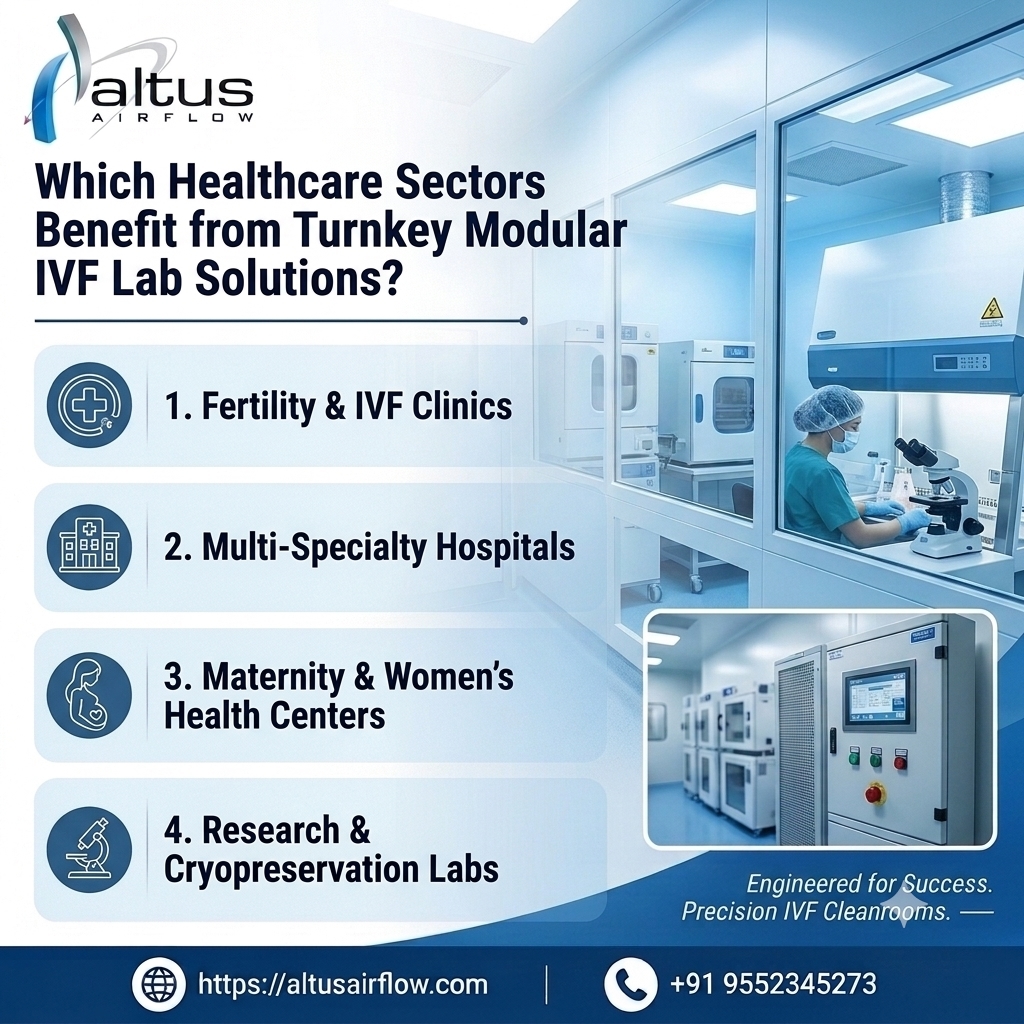
Introduction
Altus Airflow understands that modern fertility treatment requires specialised laboratory infrastructure, advanced equipment, and carefully controlled environmental conditions. Turnkey Modular IVF Lab Solutions provide healthcare institutions with an integrated approach to developing functional IVF laboratories through coordinated planning, modular construction, HVAC systems, HEPA filtration, and equipment integration. These solutions can benefit fertility clinics, multispecialty hospitals, reproductive medicine centres, women's healthcare facilities, and specialised research institutions that want to establish or upgrade their assisted reproductive technology facilities.
With increasing demand for fertility services, healthcare providers need laboratory environments that support embryology workflows, hygiene, environmental stability, and efficient operations. Selecting the right infrastructure helps institutions prepare their laboratories for current and future clinical requirements.
1. Fertility Clinics and IVF Centres
Fertility clinics are among the primary healthcare sectors that benefit from specialised modular IVF laboratory infrastructure. These facilities provide assisted reproductive treatments, including in vitro fertilisation, embryo culture, and other fertility-related procedures.
An IVF laboratory requires a carefully planned environment where temperature, humidity, air quality, and cleanliness are managed according to laboratory requirements.
Modular solutions can support fertility clinics through:
Specialised embryology laboratory layouts.
Controlled HVAC and ventilation systems.
HEPA filtration arrangements.
Suitable electrical and utility infrastructure.
Hygienic wall, ceiling, and flooring systems.
Dedicated areas for laboratory equipment.
Organised movement between laboratory zones.
A properly designed facility helps embryologists perform their activities in an organised environment. Separate functional areas can be planned for oocyte handling, sperm preparation, embryo culture, and cryopreservation, depending on the clinic's treatment services.
For newly established fertility clinics, modular construction also provides an organised approach to developing laboratory infrastructure. Existing clinics can consider modular upgrades when expanding their treatment facilities or improving their laboratory layouts.
2. Multispecialty Hospitals
Multispecialty hospitals provide different medical services under one healthcare facility. Adding IVF and reproductive medicine departments allows these institutions to expand their healthcare offerings and address fertility-related patient requirements.
However, establishing an IVF laboratory within a multispecialty hospital requires specialised planning. The laboratory must function independently while remaining coordinated with the hospital's existing infrastructure.
Important requirements include:
Dedicated laboratory spaces: IVF activities require appropriately designed spaces for embryology, andrology, sample preparation, and related laboratory functions.
Environmental management: HVAC systems, filtration, temperature monitoring, and humidity control should be designed according to laboratory requirements.
Electrical infrastructure: Critical laboratory equipment requires reliable electrical connections and suitable backup arrangements.
Medical and laboratory equipment integration: Incubators, microscopes, workstations, and cryopreservation equipment should be positioned according to operational workflows.
Hygiene management: Interior materials should support routine cleaning and appropriate laboratory hygiene procedures.
By incorporating modular laboratory infrastructure, multispecialty hospitals can establish specialised fertility departments while coordinating them with their broader healthcare facilities.
3. Reproductive Medicine and Advanced Fertility Centres
Reproductive medicine centres focus on diagnosing and managing fertility-related conditions. These institutions may provide specialised treatments and laboratory services that require dedicated embryology and andrology infrastructure.
Such centres benefit from laboratory designs that accommodate different clinical and technical activities.
A specialised IVF laboratory may include:
Embryology workstations.
Oocyte handling areas.
Sperm preparation laboratories.
Embryo culture facilities.
Cryopreservation areas.
Sample storage arrangements.
Laboratory monitoring systems.
Each area should be planned according to its intended function and operational requirements.
For example, embryo culture areas require carefully controlled environmental conditions and suitable equipment arrangements. Similarly, andrology laboratories need appropriate workstations and facilities for semen analysis and sperm preparation.
Modular infrastructure allows these functional areas to be organised within a coordinated laboratory layout. It also supports the integration of essential utilities, ventilation, electrical systems, and specialised equipment.
4. Women's Healthcare and Gynaecology Hospitals
Women's healthcare facilities and specialised gynaecology hospitals can also benefit from establishing dedicated fertility treatment departments.
These institutions may already provide reproductive health consultations, menstrual health services, pregnancy-related care, and gynaecological treatments. Introducing assisted reproductive technology services can help them expand their specialised healthcare facilities.
An IVF laboratory requires infrastructure that supports both clinical and laboratory activities.
Important design considerations include:
Patient consultation areas: Dedicated spaces for fertility consultations and treatment planning.
Laboratory infrastructure: Properly designed embryology and andrology facilities.
Sample handling arrangements: Organised spaces for receiving, preparing, and processing laboratory samples.
Environmental controls: Suitable ventilation, filtration, and monitoring systems.
Equipment placement: Proper arrangements for incubators, microscopes, and other laboratory instruments.
A coordinated laboratory design helps women's healthcare institutions establish fertility services while maintaining a clear distinction between patient-facing clinical areas and specialised laboratory environments.
5. Academic Medical Institutions and Teaching Hospitals
Academic medical institutions and teaching hospitals play an important role in medical education, clinical training, and reproductive medicine research.
These institutions may require IVF laboratory infrastructure for specialised training programmes, embryology education, and supervised laboratory activities.
A modular laboratory can support multiple educational and operational requirements.
Some important applications include:
Embryology training facilities.
Reproductive medicine education.
Laboratory technique demonstrations.
Andrology training environments.
Practical learning spaces.
Research-related laboratory activities.
The laboratory layout should provide appropriate workstations, equipment access, and environmental controls.
Academic institutions should also consider the number of students, researchers, laboratory professionals, and supervisors who may use the facility.
Separate teaching and clinical laboratory arrangements may be necessary depending on institutional objectives and applicable regulatory requirements.
A well-organised laboratory environment can support practical learning while maintaining the operational requirements of specialised reproductive medicine facilities.
6. Reproductive Health Research and Scientific Institutions
Research institutions working in reproductive biology, embryology, and fertility science may require specialised laboratory environments.
These facilities conduct research activities that involve biological samples, laboratory instruments, controlled environmental conditions, and specialised technical procedures.
Modular laboratory infrastructure can support research institutions through flexible layouts and coordinated utility arrangements.
Important requirements may include:
Controlled laboratory environments: Temperature, humidity, ventilation, and air quality should be managed according to research activities.
Specialised equipment arrangements: Workstations should accommodate microscopes, incubators, analytical instruments, and other research equipment.
Sample management areas: Dedicated spaces can support sample preparation, handling, and storage.
Electrical infrastructure: Reliable electrical connections are important for laboratory instruments and monitoring systems.
Adaptable layouts: Laboratory arrangements should allow future changes according to research requirements.
Research institutions should ensure that their laboratory infrastructure is designed according to the specific activities being conducted rather than assuming that every research facility requires the same configuration as a clinical IVF laboratory.
7. Andrology and Embryology Laboratories
Andrology and embryology laboratories are essential components of many fertility treatment facilities. These specialised departments require different work areas, equipment arrangements, and environmental considerations.
Andrology laboratories generally support semen analysis, sperm preparation, and related laboratory activities. Embryology laboratories focus on oocyte handling, fertilisation procedures, embryo culture, and other specialised activities.
A properly planned modular laboratory can provide dedicated spaces for these functions.
Important infrastructure requirements include:
Suitable laboratory workbenches.
Specialised lighting arrangements.
Appropriate air filtration.
Controlled temperature and humidity.
Dedicated electrical connections.
Equipment-specific utility provisions.
Organised sample handling areas.
The relationship between these departments should also be considered during the layout planning stage.
For example, laboratory workflows should minimise unnecessary movement of samples and personnel. Equipment placement should allow embryologists and laboratory technicians to perform their activities efficiently.
Integrating these requirements into the initial design helps create a functional laboratory environment.
8. Hospital Groups Planning Multi-Location Fertility Services
Large hospital groups and healthcare networks may plan to establish fertility departments across multiple locations.
For such organisations, standardised laboratory infrastructure can help maintain consistency in planning, construction, and equipment integration.
A modular approach can support these projects through:
Standardised layouts: Similar functional arrangements can be developed for different facilities while allowing location-specific adjustments.
Coordinated engineering: HVAC, filtration, electrical, and utility systems can be planned using consistent technical principles.
Equipment compatibility: Laboratory equipment specifications can be considered during infrastructure planning.
Quality documentation: Standardised technical documents help coordinate installation and commissioning activities.
Future adaptability: Modular designs can accommodate changes in laboratory requirements and technology.
However, each facility should undergo an individual site assessment. Building conditions, available space, electrical infrastructure, and local regulatory requirements may differ between locations.
Standardisation should therefore provide a consistent planning framework without compromising individual facility requirements.
9. Why Are Turnkey Modular IVF Laboratory Solutions Suitable for Different Healthcare Sectors?
Different healthcare institutions have different operational objectives, but most require coordinated laboratory infrastructure, reliable environmental controls, and suitable equipment integration.
Turnkey Modular IVF Lab Solutions provide an integrated project approach that brings multiple infrastructure activities together under coordinated planning and execution.
The major advantages include:
Integrated project planning
Architectural layouts, engineering requirements, laboratory workflows, and equipment arrangements can be considered together during the initial design stage.
Coordinated HVAC and filtration
Ventilation systems, HEPA filtration, temperature control, and humidity management can be planned according to the intended laboratory functions.
Functional modular construction
Modular wall panels, ceiling systems, flooring, and laboratory interiors can be selected to support hygiene and maintenance requirements.
Equipment integration
Electrical connections, utility provisions, and equipment placement can be coordinated before installation begins.
Organised project execution
Planning, construction, installation, testing, and commissioning can be managed through a structured project process.
Future expansion
Modular infrastructure can be designed with adaptability in mind, allowing institutions to consider additional equipment and changing operational requirements.
These benefits make integrated laboratory planning relevant to different types of healthcare institutions rather than only newly established IVF clinics.
10. Important Factors to Consider Before Selecting an IVF Laboratory Solution
Although several healthcare sectors can benefit from modular IVF infrastructure, the final design should always reflect the institution's actual requirements.
Before starting a project, healthcare organisations should evaluate the following factors.
Clinical requirements: Identify the fertility services, laboratory procedures, and specialised activities the institution intends to provide.
Available space: Assess the building layout, room dimensions, structural conditions, and access arrangements.
Laboratory workflow: Plan separate functional areas and appropriate movement between departments.
Air quality management: Evaluate ventilation, filtration, pressure relationships, and environmental monitoring requirements.
Equipment specifications: Consider the dimensions, electrical requirements, utility connections, and operating conditions of laboratory equipment.
Regulatory requirements: Review applicable healthcare regulations, laboratory guidelines, and relevant accreditation requirements.
Installation expertise: Select an experienced project partner capable of coordinating modular construction and specialised engineering systems.
Testing and commissioning: Ensure that the completed laboratory undergoes appropriate environmental, electrical, and equipment-related verification before operational use.
A detailed assessment helps ensure that the laboratory infrastructure supports the institution's intended services and operational objectives.
Conclusion
Turnkey modular IVF laboratory infrastructure can benefit several healthcare sectors, including fertility clinics, multispecialty hospitals, reproductive medicine centres, women's healthcare facilities, academic institutions, research laboratories, and specialised andrology and embryology departments. Each sector has different functional requirements, making proper planning, environmental management, modular construction, and equipment integration essential.
Selecting suitable Turnkey Modular IVF Lab Solutions helps healthcare organisations establish organised laboratory environments that support specialised fertility services and future operational requirements.
Altus Airflow focuses on specialised modular healthcare infrastructure, providing coordinated planning and engineering support for IVF and fertility laboratory projects. With attention to HVAC integration, HEPA filtration, modular construction, and project execution, Altus Airflow supports healthcare institutions in developing functional and well-planned laboratory facilities.
Frequently Asked Questions (FAQs)
1. Which healthcare sectors can benefit from turnkey modular IVF lab solutions?
Turnkey Modular IVF Lab Solutions can benefit fertility clinics, multispecialty hospitals, reproductive medicine centres, gynaecology hospitals, academic institutions, and specialised research laboratories.
2. Can multispecialty hospitals establish their own IVF laboratories?
Yes. Multispecialty hospitals can develop dedicated IVF laboratories with suitable infrastructure, equipment, and environmental controls.
3. Are modular IVF laboratories suitable for new fertility clinics?
Yes. They provide an organised approach to planning and developing specialised fertility laboratory infrastructure.
4. Can academic institutions use modular IVF laboratory infrastructure?
Yes. Academic institutions can use specialised laboratory facilities for embryology education, training, and research activities.
5. Why is HEPA filtration important in IVF laboratories?
HEPA filtration helps remove airborne particles and supports the required laboratory air quality.
Read Our Previous Blog --------------->How does an Andrology Room Setup Company ensure seamless project execution?