
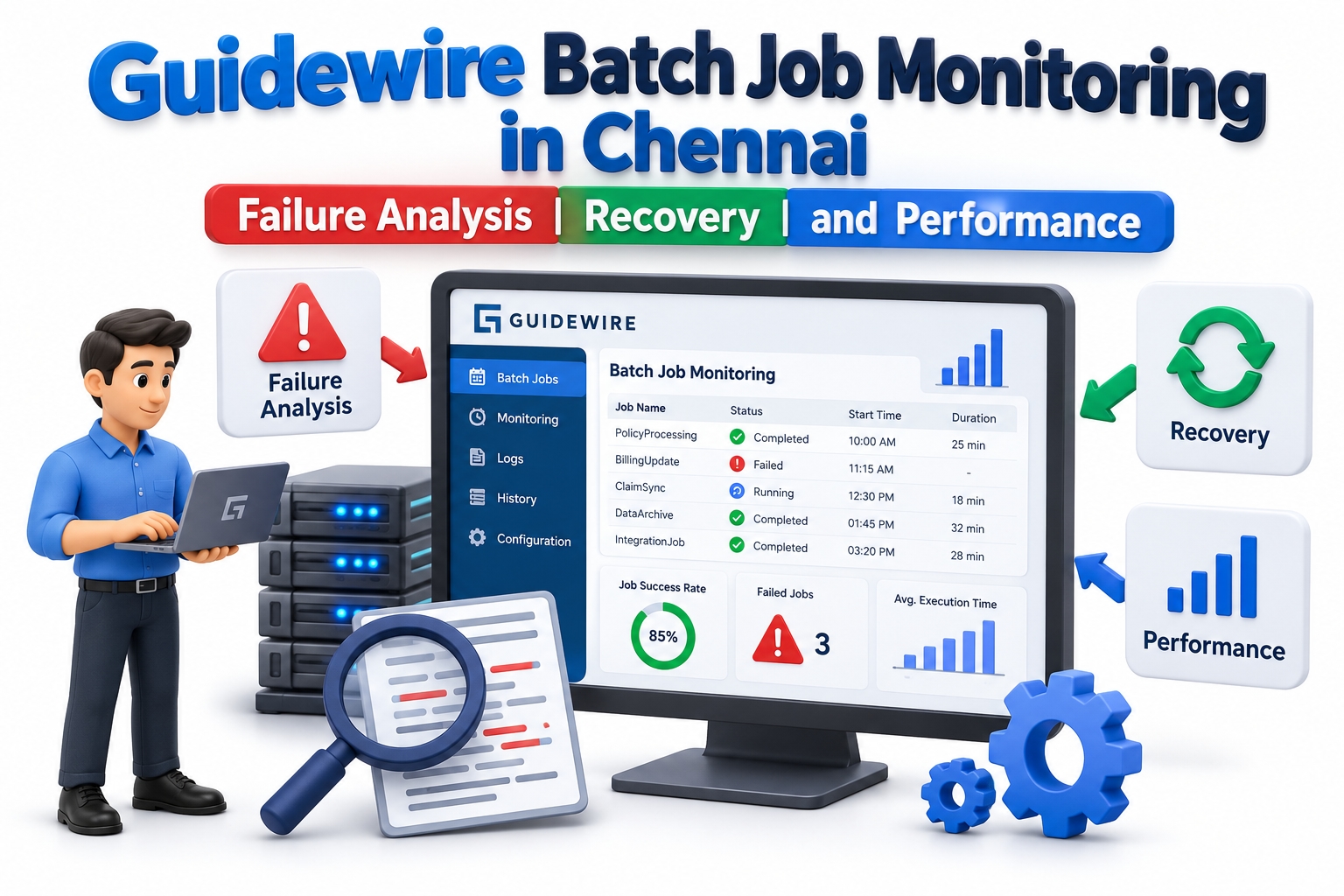
A Guidewire batch job may run successfully for months before suddenly failing during a critical insurance operation. What happens when thousands of policies remain unprocessed, billing updates are delayed, or background tasks stop unexpectedly? Understanding batch job monitoring is essential for maintaining reliable insurance applications.
In Chennai’s growing insurance technology sector, Guidewire professionals need more than configuration knowledge. They must understand how batch processes execute, why failures occur, and how to restore operations safely. These skills help developers, support engineers, and technical analysts manage complex insurance systems.
Understanding Guidewire Batch Jobs and Their Role in Insurance Operations
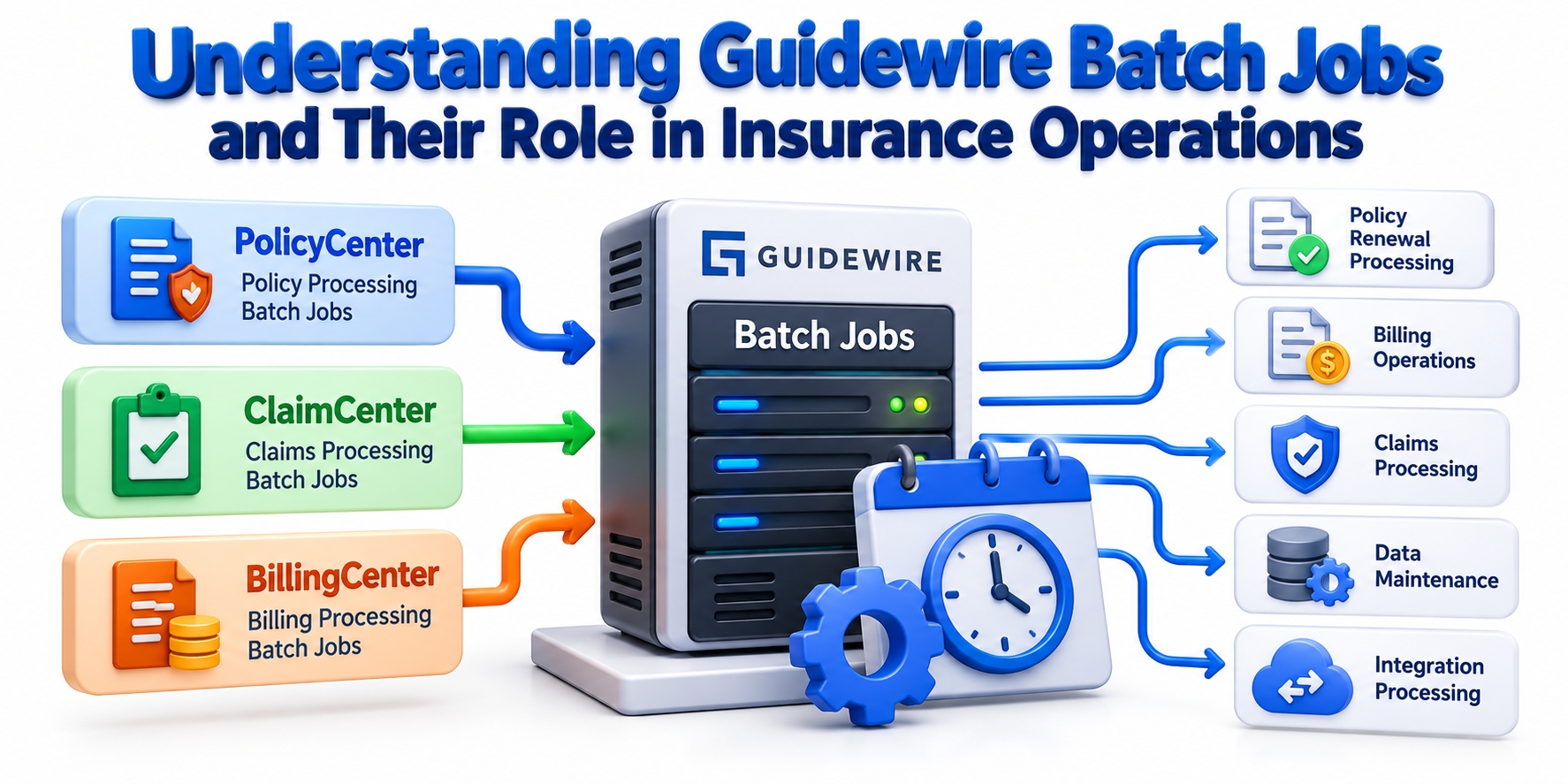
Guidewire applications depend on background processing to execute insurance activities without requiring continuous user interaction. These operations are commonly handled through batch processes that perform scheduled, administrative, or large-scale data-processing tasks.
Guidewire InsuranceSuite includes PolicyCenter, ClaimCenter, and BillingCenter, each supporting different insurance workflows. Batch processes help maintain operational efficiency by handling activities that would otherwise require substantial manual intervention.
Common batch-processing activities include:
Policy processing: Supporting scheduled policy-related operations, including renewal activities.
Billing operations: Processing billing-related background tasks and financial updates.
Claims processing: Supporting automated claim-related maintenance and operational activities.
Data maintenance: Performing cleanup, archival-related operations, and database maintenance tasks.
Integration processing: Supporting data exchanges between Guidewire applications and connected systems.
Batch execution behavior depends on the application, product version, configuration, and deployment architecture.
In enterprise environments, developers must understand how batch processes interact with application services, database transactions, and external integrations.
For professionals pursuing guidewire training chennai, learning batch architecture provides a practical foundation for production support, troubleshooting, and application maintenance.
Monitoring Guidewire Batch Jobs Through Logs, Status, and Execution Metrics
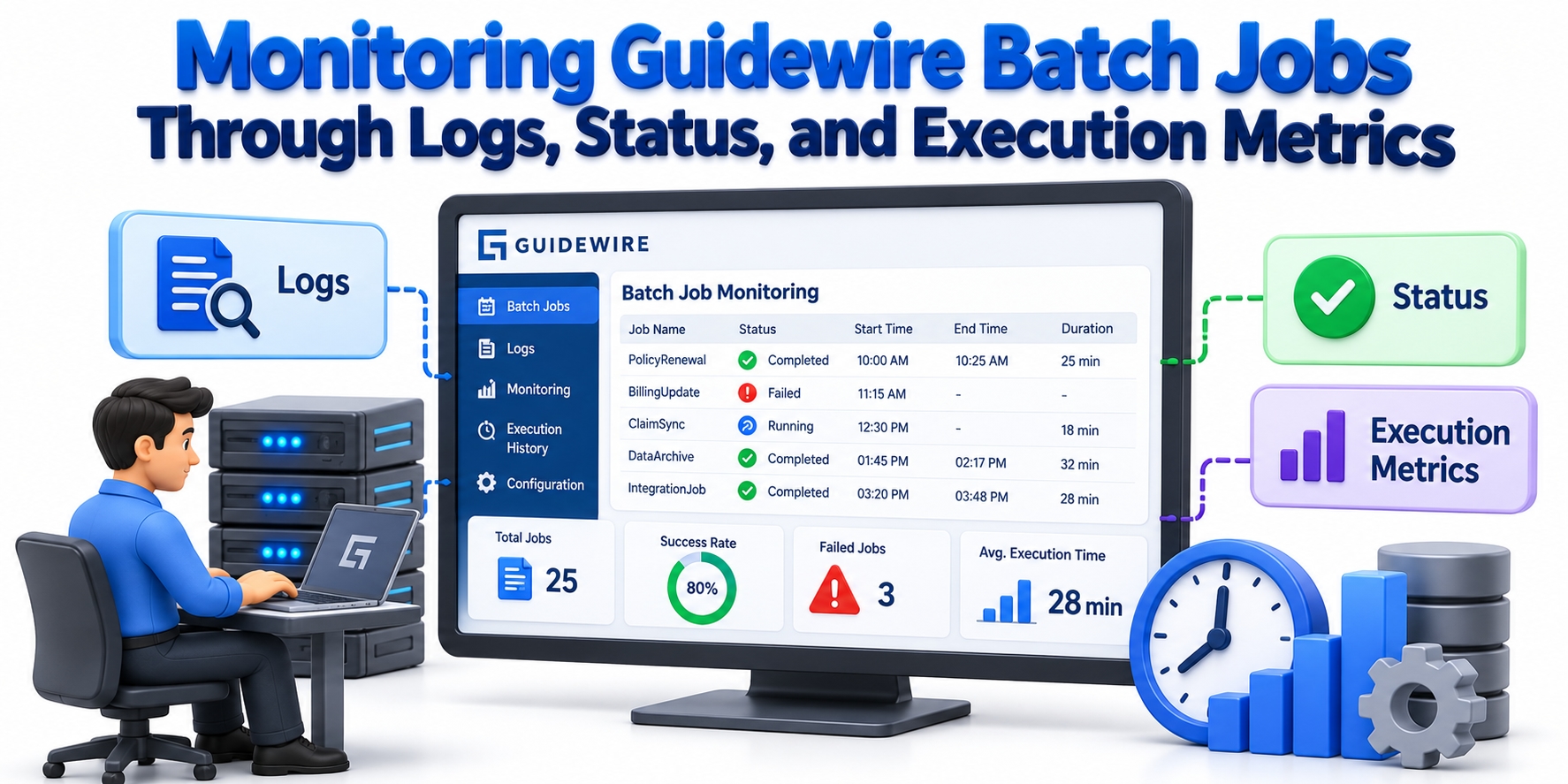
Effective batch monitoring begins with understanding how jobs are initiated, executed, and completed.
Guidewire environments provide administrative capabilities for managing and observing batch processes. Available monitoring interfaces and operational tools vary according to the application version and deployment model.
Monitoring should focus on more than whether a process reports successful completion.
Important monitoring parameters include:
Execution status: Whether a process is running, completed, failed, or otherwise reported by the platform.
Start and completion time: Identifying unusual execution delays.
Processing volume: Measuring the number of records processed.
Error logs: Identifying exceptions and operational failures.
Database activity: Detecting slow queries, locking, or transaction delays.
Resource consumption: Monitoring CPU, memory, and application performance.
For example, suppose a policy-related batch process normally completes within 20 minutes but suddenly requires 75 minutes.
Even if the job finishes successfully, the increased execution time may indicate database contention, growing data volumes, or inefficient processing logic.
Monitoring teams should compare current execution metrics against historical baselines rather than relying exclusively on fixed thresholds.
Alerts can be configured through supported monitoring infrastructure to identify abnormal execution duration, repeated failures, and resource bottlenecks.
This approach enables Chennai-based Guidewire support teams to detect operational problems before they significantly affect insurance workflows.
Identifying Guidewire Batch Job Failures Through Root Cause Analysis
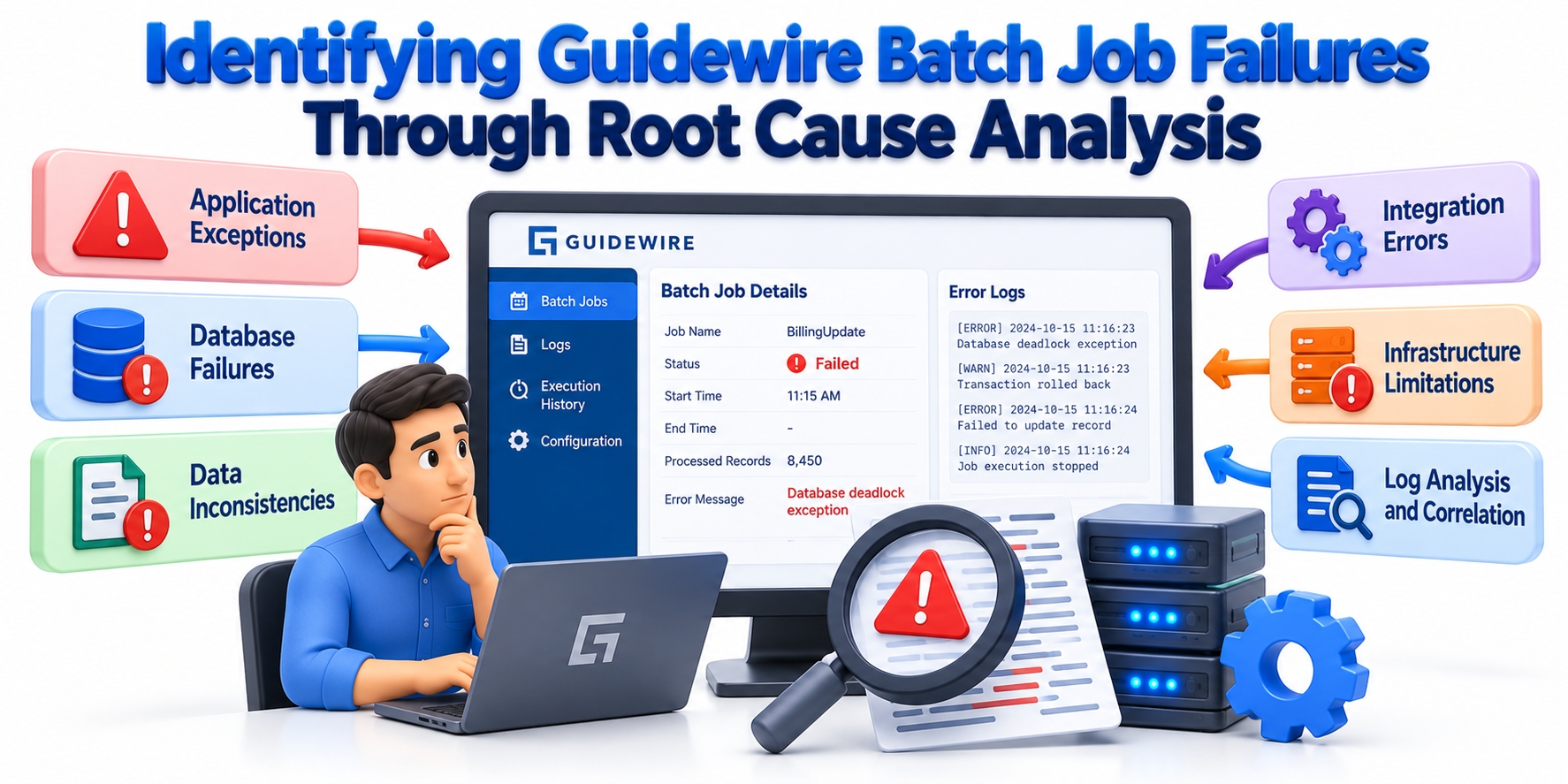
Batch job failures can originate from application logic, database operations, infrastructure limitations, or external system dependencies.
Effective troubleshooting requires identifying the actual failure mechanism rather than repeatedly restarting the affected process.
Consider a billing-related batch process that stops while processing payment information.
The initial error may indicate a database exception, but the underlying problem could involve transaction contention, invalid data, or an unavailable external service.
A structured failure investigation should examine:
Application exceptions: Review stack traces, error messages, and relevant execution logs.
Database failures: Investigate deadlocks, connection problems, and transaction timeouts.
Data inconsistencies: Identify missing references, invalid values, or unexpected entity relationships.
Integration errors: Examine failed API requests, unavailable endpoints, and response timeouts.
Infrastructure limitations: Review memory pressure, resource exhaustion, and service availability.
Understanding Guidewire Integration Challenges is particularly important when batch processes depend on payment gateways, document services, or external insurance platforms.
A failed integration request may interrupt processing even when the internal Guidewire configuration is functioning correctly.
Developers should correlate application logs, database diagnostics, and integration traces using available timestamps and correlation identifiers.
The investigation should establish which records were processed successfully, where execution stopped, and whether any external operations completed before the failure.
Documenting these findings helps prevent repeated incidents and improves future troubleshooting efficiency.
Recovering Failed Guidewire Batch Jobs Without Creating Data Inconsistencies
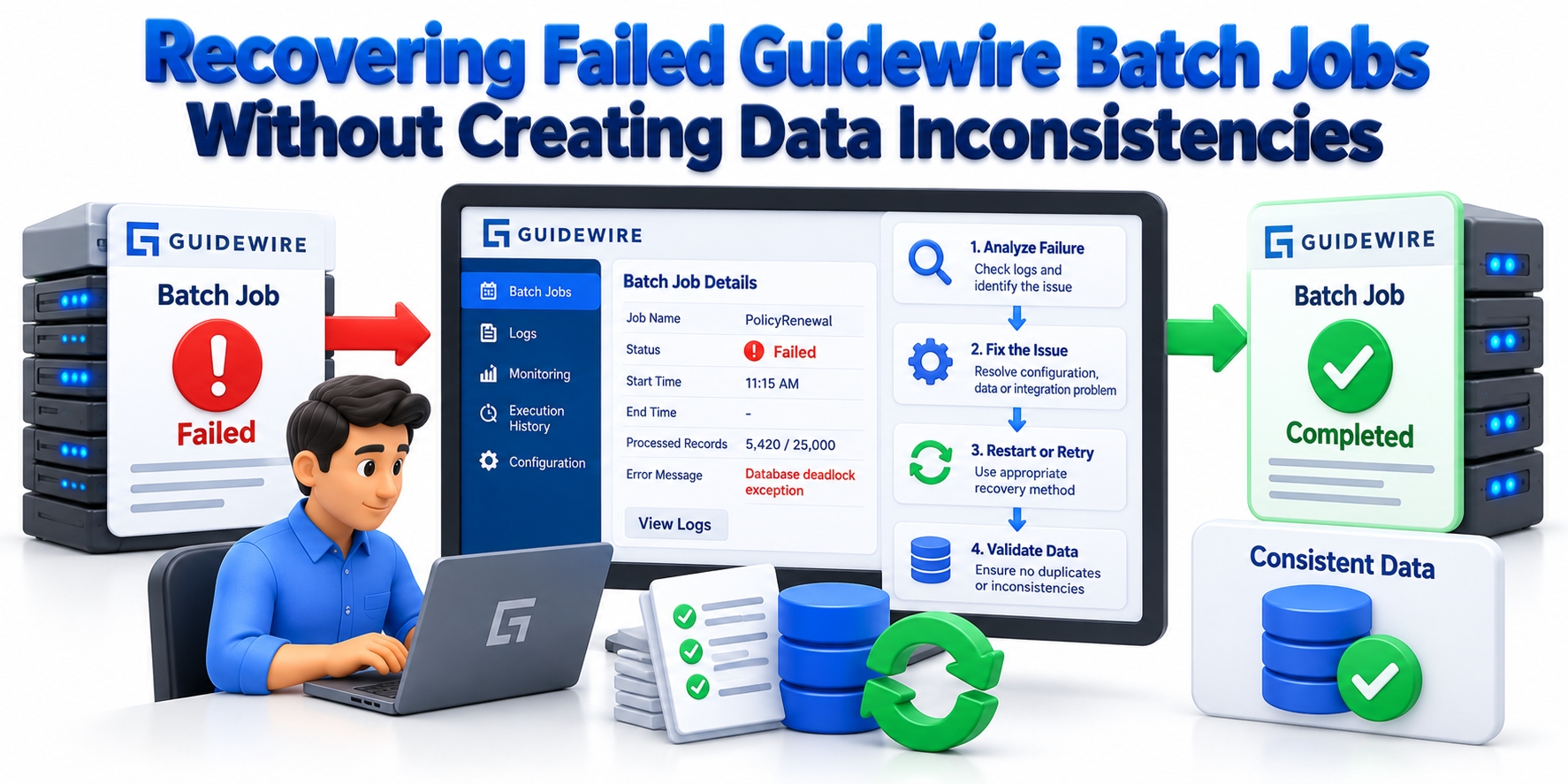
Restarting a failed batch process without examining its previous execution can introduce serious operational risks.
Some jobs may have committed database changes or triggered external transactions before encountering an exception.
Repeating those operations without appropriate safeguards could create duplicate requests, inconsistent records, or unintended financial transactions.
A reliable recovery procedure should follow a controlled sequence:
Identify the failure: Determine the exception, affected process, and execution stage.
Assess processing progress: Identify completed, pending, and potentially partially processed records.
Verify transaction outcomes: Check committed database changes and external system responses.
Correct the underlying issue: Resolve configuration, data, infrastructure, or integration problems.
Select the recovery method: Use supported restart, retry, or reconciliation procedures.
Validate the results: Confirm processing completeness and business data consistency.
Recovery behavior varies between batch implementations. A process that safely retries individual records may require a different approach from one performing non-idempotent external operations.
For example, if a billing process successfully sends a payment request before losing its response, blindly retrying could create duplicate payment instructions.
The support team must first reconcile the transaction with the external payment system.
Recovery procedures should therefore consider idempotency, transaction boundaries, and application-specific restart capabilities.
Production teams should also preserve diagnostic evidence and follow approved operational procedures before making corrective changes.
Successful recovery means restoring the intended business outcome, not merely changing the batch status to completed.
Improving Guidewire Batch Processing Performance and Operational Efficiency
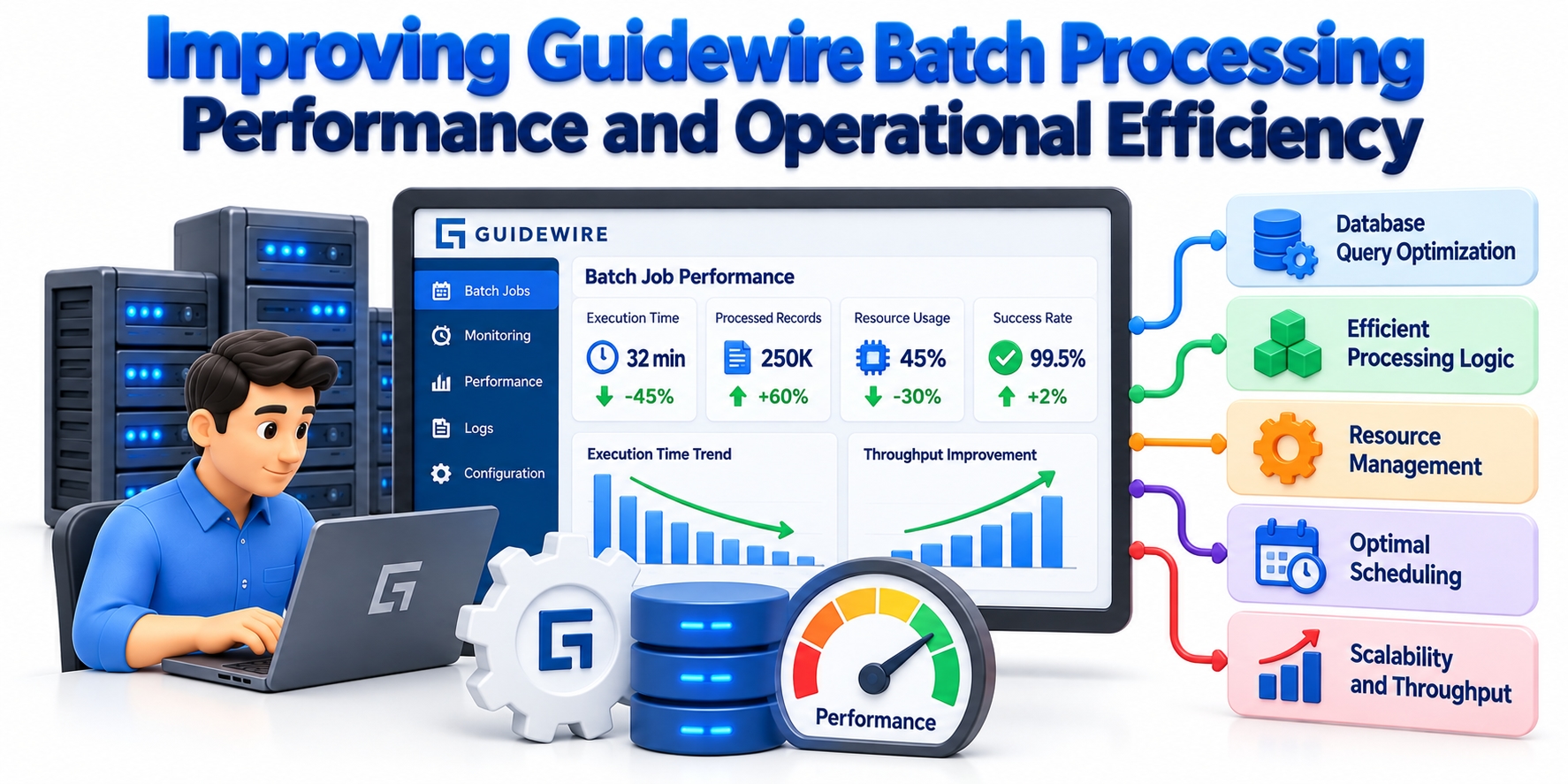
Batch performance becomes increasingly important as insurance applications handle larger policy portfolios, claims histories, and billing datasets.
A process that performs adequately with thousands of records may experience significant delays when processing millions.
Performance optimization begins by identifying the actual bottleneck.
Common improvement opportunities include:
Database query optimization: Reduce unnecessary queries and investigate inefficient execution plans.
Controlled processing volumes: Use appropriate chunking or pagination strategies where supported.
Transaction management: Avoid unnecessarily large transactions and excessive lock durations.
Memory efficiency: Prevent excessive object retention during large-scale processing.
Execution scheduling: Reduce contention between resource-intensive background processes.
Integration efficiency: Apply appropriate timeouts, retry policies, and request-handling strategies.
Parallel processing can improve throughput for suitable workloads, but it must be implemented carefully.
Increasing concurrency without considering database locks, transaction dependencies, or external service limits can actually reduce performance.
Similarly, processing larger batches does not automatically improve efficiency.
Developers should evaluate throughput, execution duration, resource consumption, and error rates together.
Performance improvements must also preserve functional correctness.
A faster process that skips records or produces inconsistent insurance data cannot be considered successful.
Testing should use representative data volumes and realistic workload conditions before changes reach production.
Building Practical Guidewire Batch Monitoring Skills for Chennai Careers
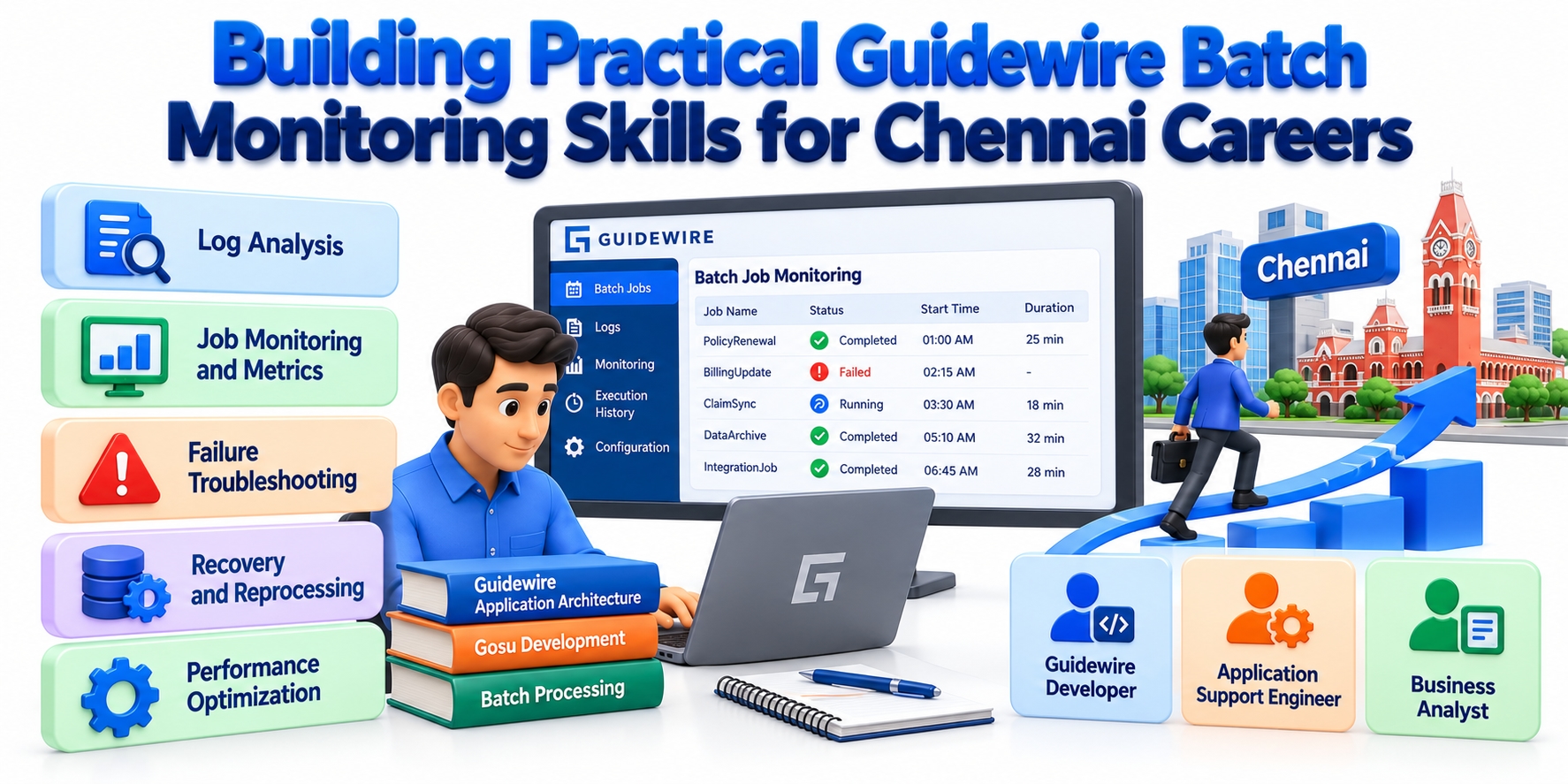
Guidewire professionals working on insurance technology projects in Chennai benefit from combining development knowledge with operational troubleshooting skills.
Understanding Gosu, Guidewire entities, database interactions, logging, and integration architecture provides a strong technical foundation.
However, practical experience becomes more valuable when professionals can investigate realistic production scenarios.
A structured learning project could involve configuring an appropriate background-processing workflow in an authorized training environment, introducing controlled failures, and analyzing recovery behavior.
Learners should practice identifying exceptions, evaluating execution metrics, and validating processed records.
Jasttech emphasizes industry-oriented technical learning that connects Guidewire concepts with practical insurance application scenarios.
Alongside developer-focused learning, Guidewire Business Analyst Training can help professionals understand how background-processing failures affect business requirements, operational workflows, and insurance service delivery.
For example, a technical analyst may identify a failed renewal-related process, while a business analyst evaluates the resulting impact on policy servicing and customer communication.
Both perspectives contribute to effective incident resolution.
Chennai professionals preparing for Guidewire development, application support, or production engineering roles should build confidence in:
Interpreting application logs and operational metrics.
Investigating database and integration-related failures.
Understanding safe recovery and reconciliation procedures.
Evaluating batch performance under realistic workloads.
Communicating technical incidents and business impacts clearly.
These capabilities support career growth across development, testing, application maintenance, and enterprise insurance technology operations.
Conclusion
Guidewire batch job monitoring is essential for maintaining reliable insurance operations. Effective monitoring, systematic failure analysis, controlled recovery, and performance optimization help organizations reduce processing delays and protect business data integrity. Understanding how batch processes interact with databases, integrations, and application services enables technical teams to resolve incidents more efficiently.
For aspiring Guidewire professionals in Chennai, practical batch-processing knowledge provides valuable exposure to real-world insurance application challenges. Developing troubleshooting skills, understanding production workflows, and learning safe recovery techniques can strengthen readiness for Guidewire development and support roles. With structured technical learning and hands-on practice, professionals can contribute to more reliable, scalable, and efficient insurance platforms.






