
Search for the best Guidewire course in Hyderabad and you will find dozens of institutes promising placements, certifications and live projects. On paper they look the same. The gap appears later, when one learner handles a PolicyCenter interview calmly and another cannot explain what a rule does. Good Guidewire training in India starts with knowing what to look for.
Guidewire is a niche skill, so a poor course choice costs months. A few honest questions before you pay can save that time.
What Guidewire Is and Why Hyderabad Keeps Hiring for It

Guidewire is a software platform used by property and casualty insurers to run their core operations. Its InsuranceSuite has three main applications. PolicyCenter manages policies from quote to renewal. ClaimCenter handles claims from first notice of loss to settlement. BillingCenter looks after invoices, payments and collections.
An insurer rarely builds these systems from scratch. It buys the platform and then customises it heavily for its own products, states, rules and workflows. That customisation is where most Guidewire jobs come from. Developers write Gosu code, analysts translate business needs into configuration, and testers confirm that a changed rule does not break a renewal or a claim payment.
Hyderabad fits this picture well. The city has a large base of global delivery centres, and insurance technology work is part of what many of them do. Implementation partners, consulting firms and in-house technology teams all need people who understand both insurance and the platform. Career-switchers also find Hyderabad practical, because training institutes, interview circuits and project teams sit close together.
One caution: demand is steady rather than explosive. Guidewire roles are specialised, and employers screen for real understanding, not course completion. That is why the quality of your training matters more here than in a general programming course. If you want to see how one structured programme is laid out for local learners, the Guidewire training in Hyderabad page is a useful reference point.
What the Best Guidewire Course in Hyderabad Should Actually Cover

A strong course teaches insurance first and software second. Learners who skip the domain basics can write code but cannot explain why a policy change needs an effective date, or why a claim has exposures. Expect the opening weeks to cover how a policy is issued, what a coverage is, how a claim moves through its lifecycle and how billing relates to both.
After that, the technical foundation should include several pieces:
The Guidewire data model, including entities, extensions and how data is stored and retrieved
Typelists, typecodes and how categories are extended without breaking upgrades
The PCF framework that defines screens, widgets and navigation
Gosu programming, covering classes, enhancements, queries and collections
Business rules, validation and workflows
Integration concepts such as messaging, plugins and web services
Effective-dated data deserves special attention, because it is the idea that trips up most beginners. In PolicyCenter, a change to a policy is not simply overwritten. It applies from a particular date, and the system keeps track of how the policy looked before and after. A course that rushes past this leaves learners lost in real projects.
Look for coverage of the current direction of the platform too. Guidewire has moved much of its customer base towards cloud delivery, and its tooling and development practices have shifted with it. A course built only around older on-premise habits will leave gaps. Ask the institute directly how recent its material is and who updates it.
Finally, a good syllabus shows depth in the order of topics. If configuration and Gosu appear in week one with no insurance foundation, the course is built for speed rather than understanding.
Gosu: The Skill That Separates Trainees From Hires
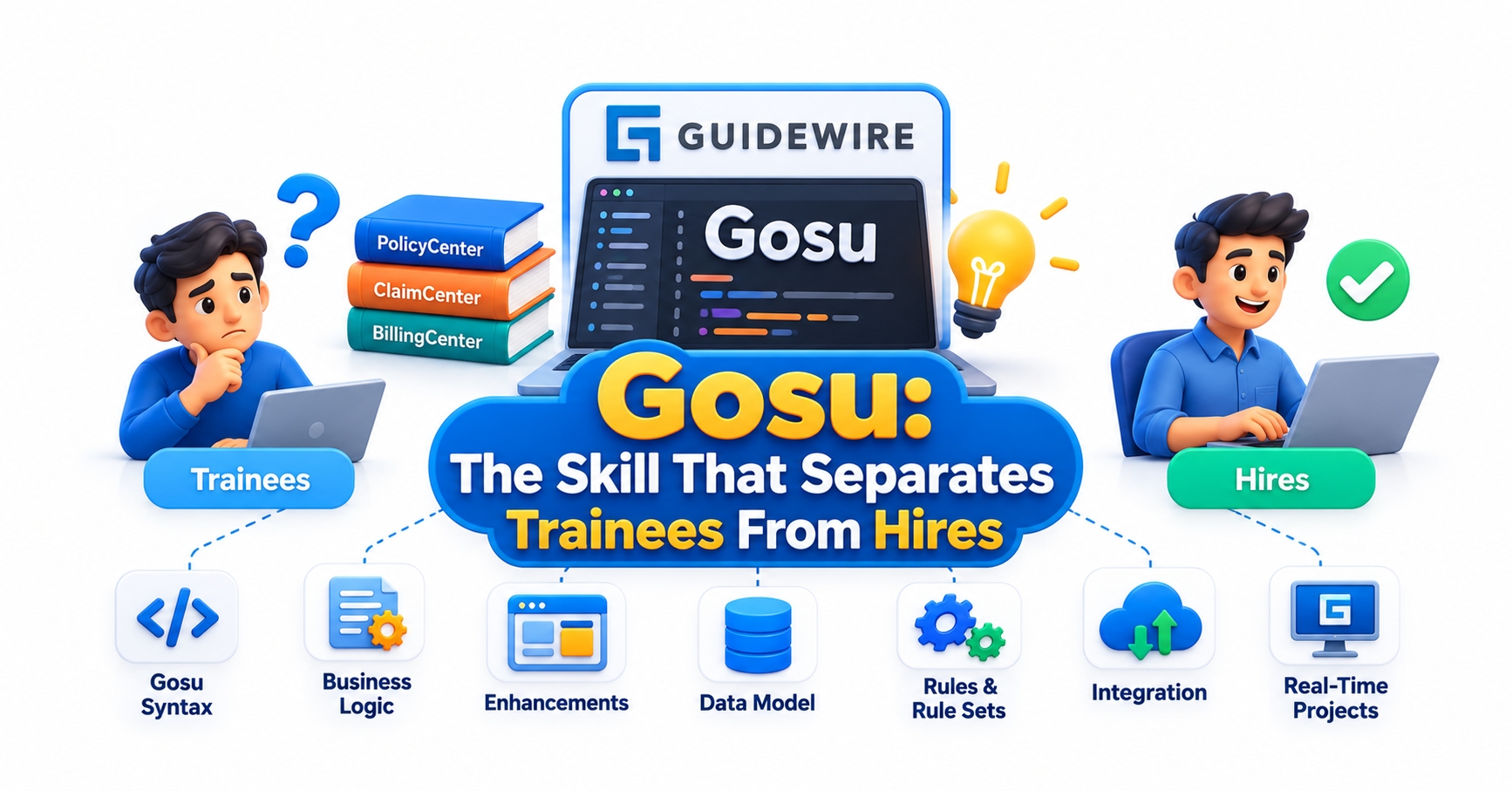
Most Guidewire developer interviews eventually reach Gosu. It is the language the platform uses for rules, validation, calculations and custom logic. It runs on the Java Virtual Machine and feels familiar to anyone who has written Java or C#, but it has its own features, such as enhancements, type inference and concise collection handling.
Picture a typical task. A business user wants a warning when a driver under 21 is added to a personal auto policy without a prior-experience note. A developer has to find the right entity, write a validation rule in Gosu, return a clear message and make sure it fires only when it should. The code might be ten lines. The difficulty lies in knowing where it belongs and how it interacts with the data model.
Learners often make two mistakes. They memorise syntax without practising on a realistic data model, or they rely on copied snippets and cannot debug when something fails. Interviewers spot both quickly. They ask why a query returns nothing, why a bundle was not committed, or how to avoid loading thousands of rows into memory.
A good course therefore teaches Gosu through small, specific exercises. Writing a rule, extending an entity, querying claims by status and testing the result all build the right habits. Structured Gosu programming training should include debugging practice, not only code walkthroughs.
If you already know Java, you will pick up the syntax within a few weeks. The slower part is learning how Guidewire expects code to be organised, and that only comes from hands-on work.
Developer, Business Analyst or QA: Choosing Your Path
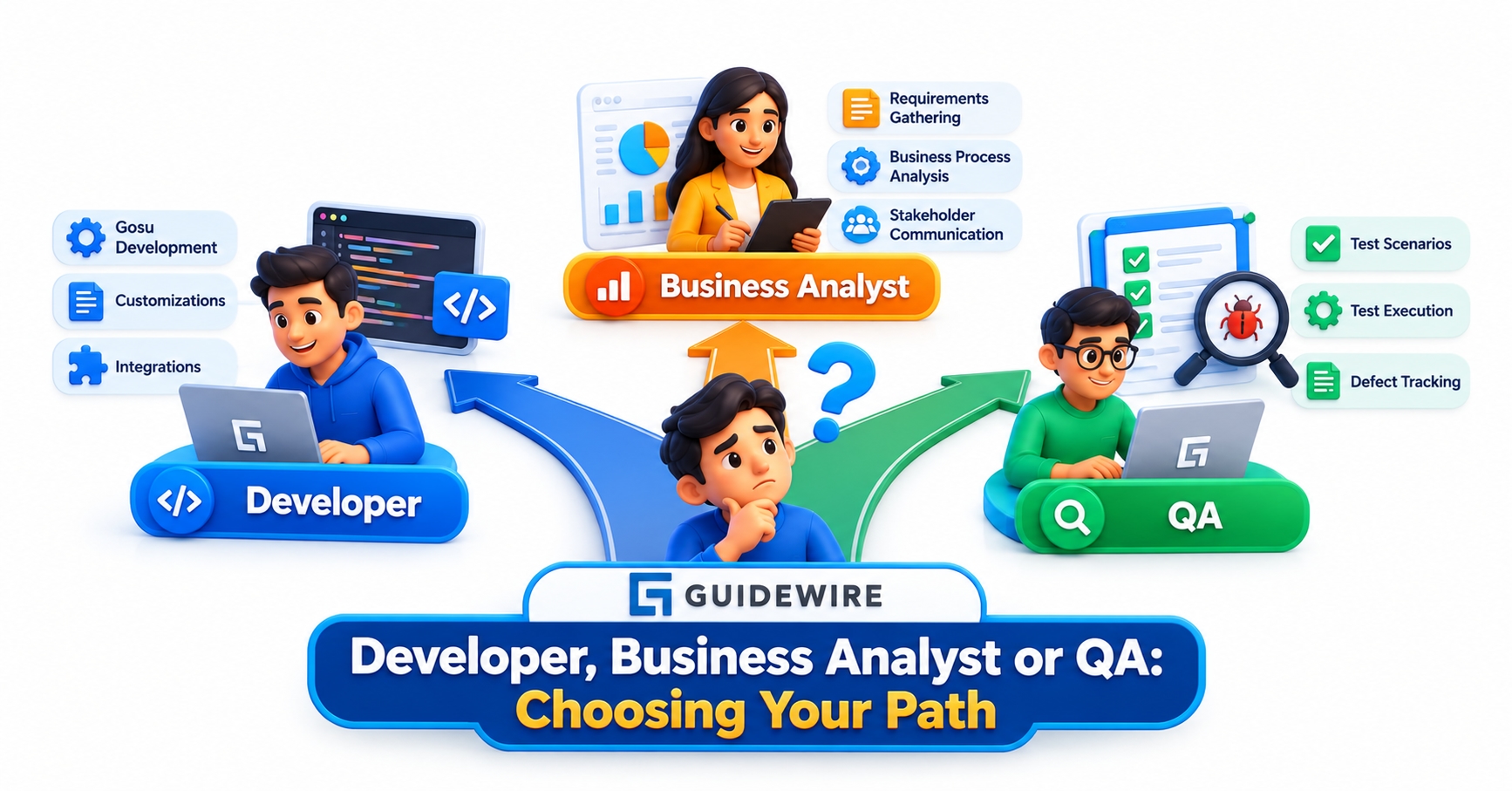
Many people assume Guidewire means coding. In practice, projects need at least three kinds of contributor, and the right course depends on which one you want to be.
Developers configure and extend the application. They write Gosu, build PCF screens, define entities and work on integrations. This path suits people comfortable with programming logic and debugging.
Business analysts sit between the insurer and the delivery team. They gather requirements, write user stories, map insurance processes to what the platform can do and review configuration. Strong domain knowledge and clear writing matter more than code, although understanding the data model helps a great deal.
QA testers validate that configured behaviour matches requirements. They write test cases for policy transactions, claim scenarios and billing events, and they often use automation as projects mature. Insurance understanding again sets good testers apart.
A useful self-check is to ask what you enjoy most. If you like building and fixing, start with development. If you prefer structuring problems and talking to stakeholders, analysis may suit you. If you like finding the gap between what was promised and what was built, testing is a natural fit.
Some institutes teach all three tracks in a single batch, which can leave each one thin. Ask whether your chosen role gets its own projects and its own interview preparation. Also be wary of any course that promises the same outcome for every learner regardless of background. A fresh graduate, a Java developer with three years of experience and a former insurance operations executive need different routes into the same ecosystem.
How to Judge a Training Institute Before You Pay
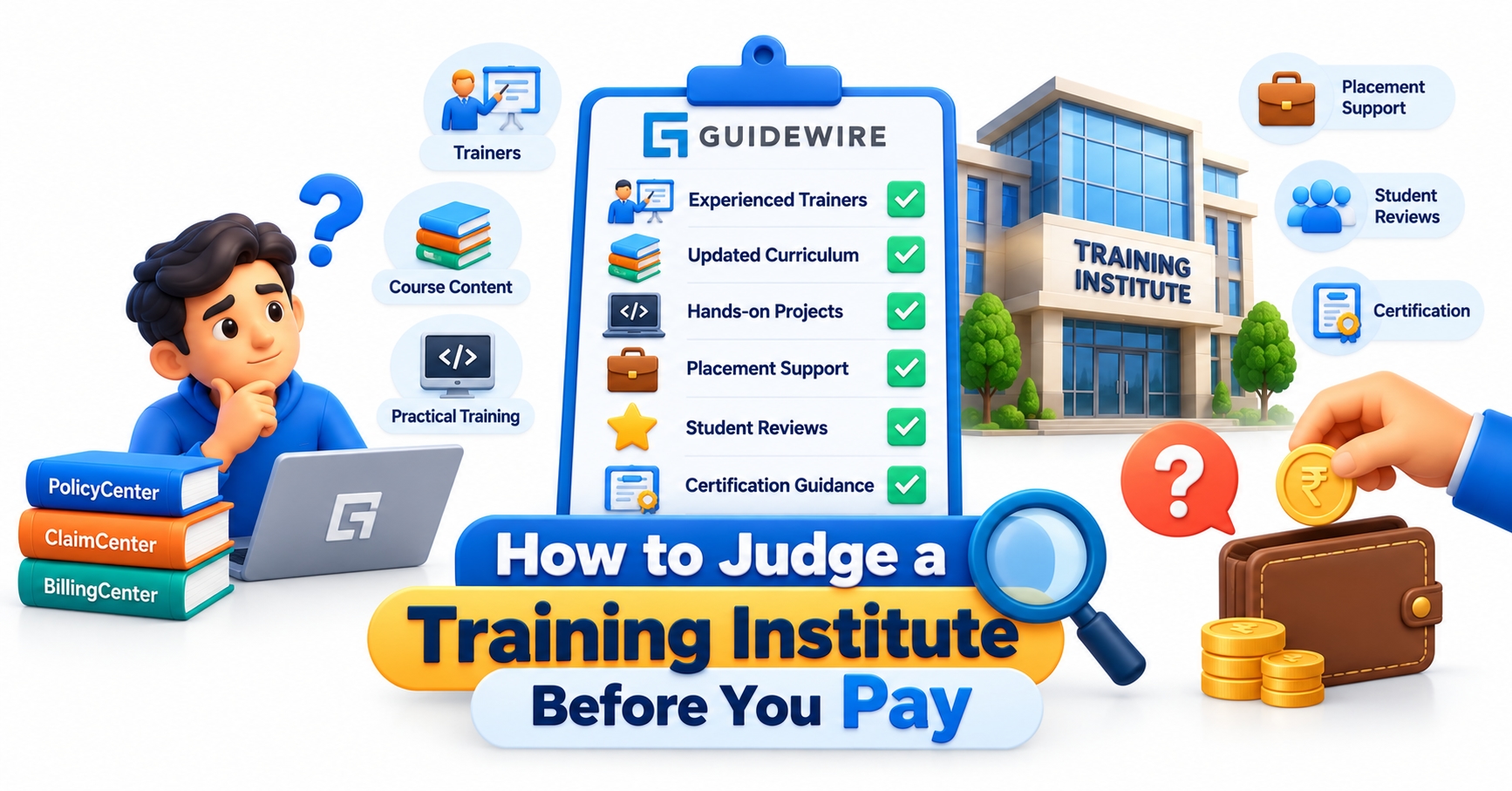
Brochures sound alike, so judge on evidence you can check. Start with the trainer. Ask whether they have worked on live Guidewire implementations, which applications they handled and which versions. A trainer who has only taught the course can recite concepts, but one who has fixed production issues can explain why things break.
Next, ask about the practice environment. Guidewire software is licensed, so institutes use training setups of different quality. Find out how many hours you will spend working inside a real application, whether you can practise outside class hours and whether you build features yourself or only watch demos.
Then examine the project work. A credible project involves several connected tasks, such as adding a new coverage to a policy, extending the data model, writing a rule and testing the outcome. If the project is a single exercise repeated across the batch, it will not prepare you for an interview.
Placement claims need care. No honest institute can guarantee a job, because hiring depends on the employer, the market and your own preparation. What a good institute can offer is interview practice, resume guidance and honest feedback on where you stand. Ask for the support process in detail, not a promise.
Finally, speak to former learners if you can. Ask what they found useful, what was missing and how they felt in their first interviews. A provider such as JastTech, or any other, should be comfortable with those questions. If answers stay vague, that tells you something.
Batch size, schedule flexibility and fees also matter, but they come after trainer quality and hands-on access.
A Realistic Learning Plan and the Mistakes to Avoid
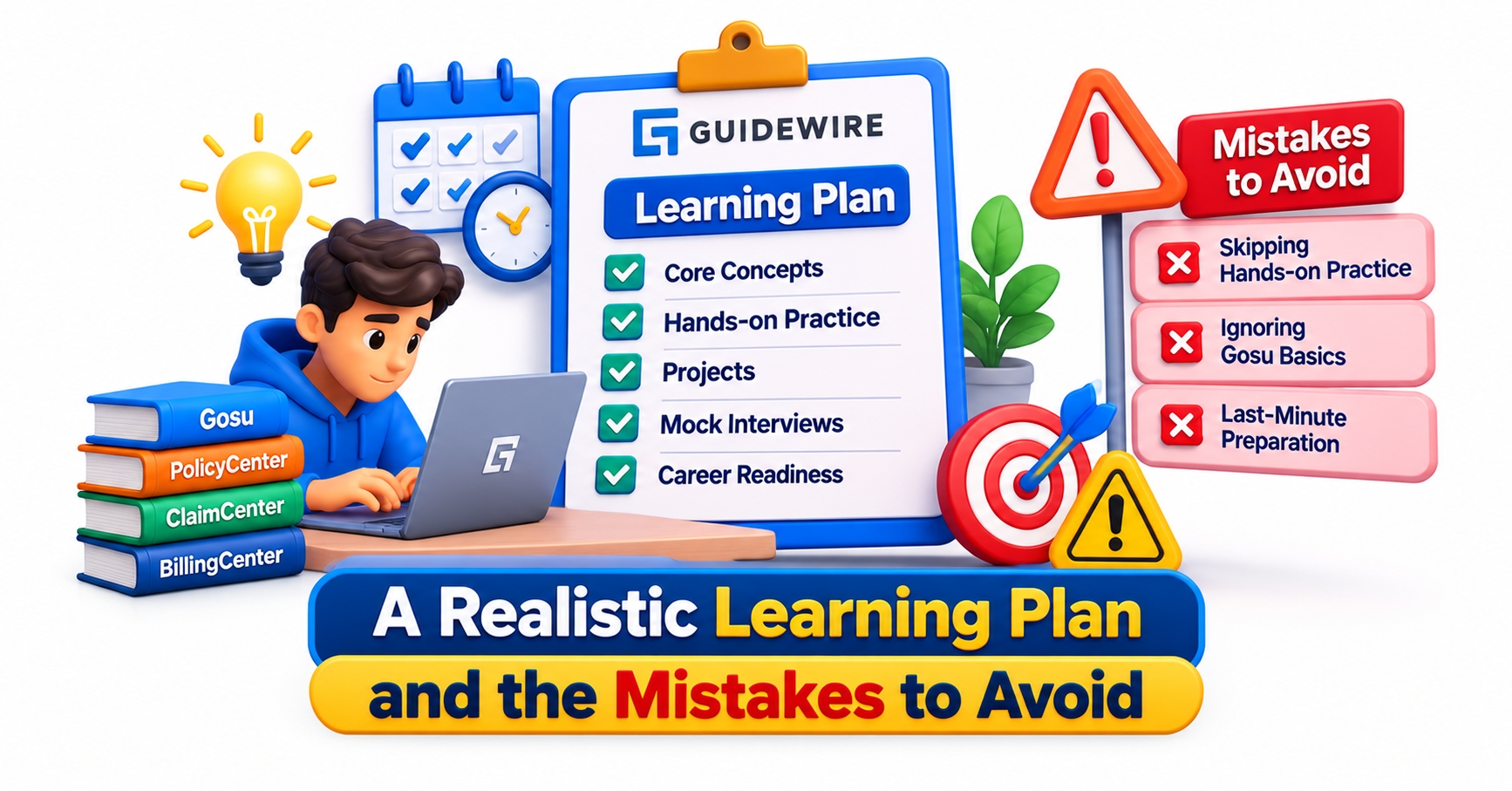
A sensible timeline for a beginner runs three to six months, depending on background and hours of practice. The first month should go to insurance basics and the data model. The second and third should focus on Gosu, configuration and rules. Later weeks belong to integration concepts, project work and interview preparation. Experienced Java developers may move faster, but the domain still takes time to absorb.
Certification deserves a realistic view. Official Guidewire certifications are controlled by Guidewire, and access depends on your employer or partner relationship. Ask any institute how it prepares you for certification-style questions and what it can and cannot arrange. Do not accept a vague statement that certification is included.
Several mistakes come up again and again:
Choosing on fees alone, then finding the course lacks hands-on practice
Skipping insurance fundamentals and struggling in interviews
Copying solutions without understanding why they work
Learning only one application and ignoring how PolicyCenter, ClaimCenter and BillingCenter relate
Stopping practice the day classes end
The last mistake costs the most. Guidewire skills fade quickly without use. Set aside time each week to rebuild a small feature from scratch, explain a rule out loud or revisit an effective-dating scenario. Learners who keep practising through the job search usually interview with more confidence than those who wait for calls.
Finally, set honest expectations. A first Guidewire role may be as a trainee or junior associate on a support or enhancement team. That is normal, and the experience compounds quickly once you are on a real project.
Conclusion
The best Guidewire course in Hyderabad is the one that teaches insurance logic, hands-on Gosu and real project thinking, with honest support. Compare trainers, practice access and project depth before you compare price. Guidewire rewards learners who understand why the platform behaves as it does, and the right course builds that understanding before the first interview.