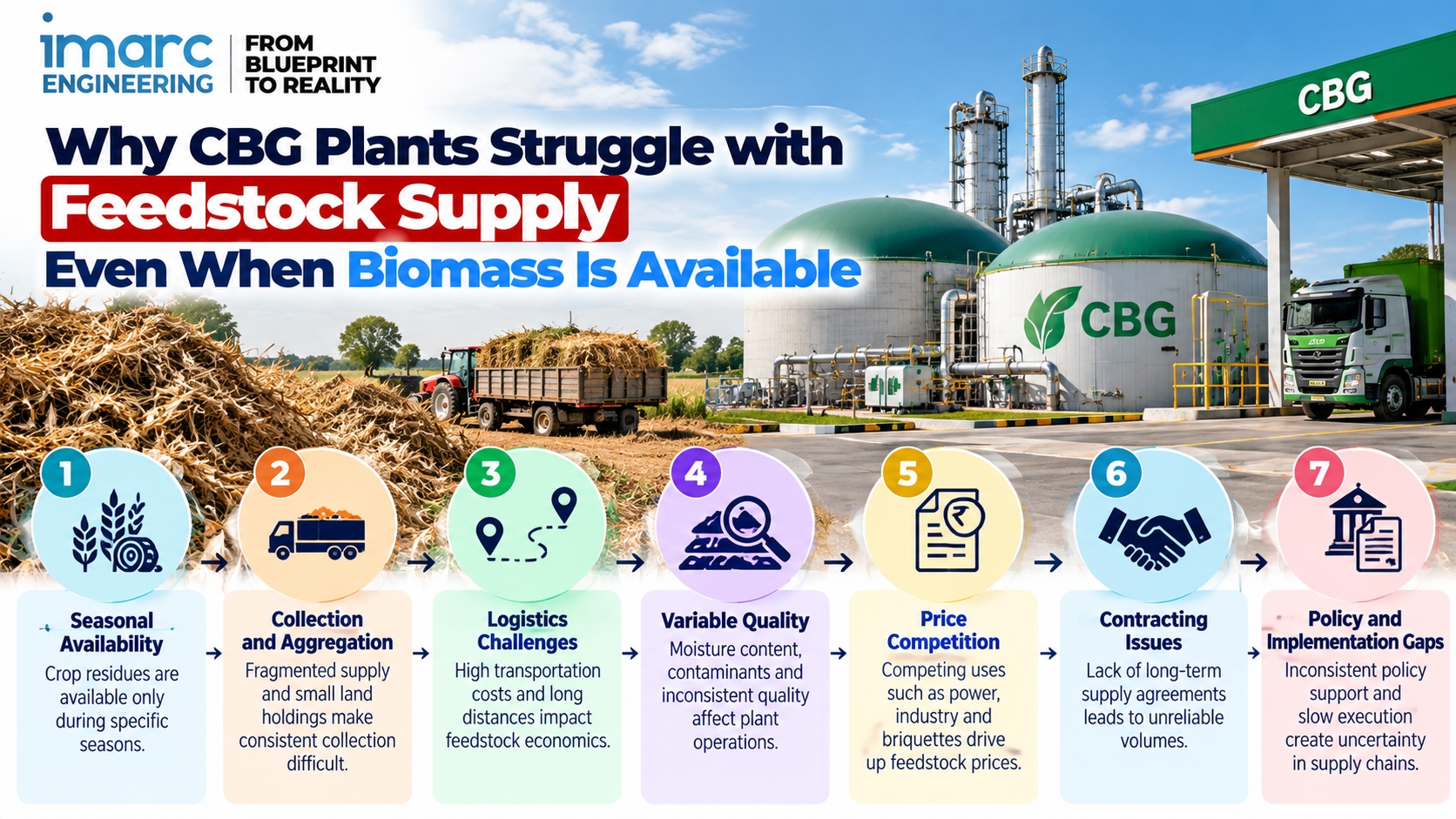
The district has surplus crop residue, dung or press mud on paper. The CBG plant is designed for a steady daily intake. After commissioning, trucks arrive irregularly, moisture and contamination swing, prices spike in lean months, and digester loading falls below design. Output and offtake commitments suffer even though “biomass is available” in the region.
CBG plants struggle with feedstock supply even when biomass is available because availability in the landscape is not the same as bankable, day-to-day delivery of suitable material at a workable cost. Aggregation, seasonality, competing uses, logistics and quality control sit between the field and the plant gate. Location analysis and site selection services can help assess whether a proposed site aligns with feedstock availability and logistics requirements.
What the Feedstock Problem Actually Means
For a CBG project, feedstock security means:
Enough material every operating day, not only on an annual average
Quality within the range the process can handle (moisture, impurities, consistency)
Delivered cost that still supports project economics
Contracts or collection systems that survive competing demand and seasonal gaps
Regional biomass maps answer a different question: what exists in theory. Plant operations need what arrives on the weighbridge.
Why “Available Biomass” Does Not Become Reliable Supply
1. Biomass is dispersed; the plant needs concentrated daily flow
Agricultural residue and dung are spread across many farmers and villages. Without organised collection, storage and transport, theoretical surplus never becomes a continuous queue.
2. Seasonality breaks the annual average story
Paddy straw, wheat straw and many crop residues peak in short windows. A plant sized on yearly totals faces glut, storage cost and fire risk after harvest—and scarcity later unless inventory and alternate feeds are planned.
3. Competing uses raise price and divert material
Fodder, mulching, brick kilns, other bioenergy users and open burning alternatives compete for the same residue. “Available” biomass is often already claimed when the plant starts buying at scale.
4. Delivered cost dominates gate cost
Loading, baling or aggregation, transport distance, handling losses and moisture penalties can exceed the farm-gate price. Sites chosen only on cheap land without feedstock logistics in mind inherit high landed cost.
5. Quality varies more than design assumptions
Sand, plastics, high moisture, mixed species and inconsistent particle size reduce gas yield, increase digester problems and raise pre-treatment cost. Volume without specification is not usable feedstock.
6. Informal supply chains lack enforceability
Verbal arrangements with traders or farmers rarely guarantee volume, quality or price through difficult months. When demand tightens, the plant is the flexible buyer that loses supply.
7. Single-feedstock dependence magnifies risk
A plant designed only for one seasonal residue without a documented alternate slate faces planned under-utilisation every off-season.
8. Storage and preprocessing were under-scoped
Without adequate covered storage, drying or size reduction, the plant cannot convert seasonal peaks into steady feed—and cannot reject off-spec loads without stopping production.
How to Diagnose and Strengthen Feedstock Security
Separate theoretical yield from collectible surplus
Assess what can realistically be aggregated after competing uses, farmer retention and access constraints—not only crop statistics.Build a month-by-month supply calendar
Map volume, moisture and logistics by month for primary and secondary feedstocks. Design capacity and storage to the weak months, not the harvest peak.Define specifications and rejection rules
Moisture, contamination, size and exclusive use rules should be clear before contracts and before process guarantee assumptions are frozen.Model delivered cost, not farm-gate price
Include aggregation, transport, handling loss and quality penalties in the operating model.Design the collection radius deliberately
Beyond a practical distance, logistics cost and reliability worsen. Site selection and capacity must fit a workable catchment.Secure supply with layered sources
Combine farmer groups, institutional sources (e.g. sugar press mud, dairy clusters), and documented seasonal alternates rather than one informal channel.Size storage and preprocessing for the gap between harvest and demand
Inventory and conditioning are part of feedstock security, not optional add-ons.Test contracts against lean-season behaviour
Ask what happens to volume and price when competing buyers appear or when residue is wet. Weak answers mean weak security.Align plant capacity with proven supply
Oversizing relative to secure feedstock is a common path to low utilisation and stressed offtake economics.
Practical Scenarios
Scenario A: Straw “surplus,” empty monsoon months
Post-harvest surveys look strong. By late monsoon, stored material is depleted or spoiled; alternate feed was never contracted.
Scenario B: Cheap land, expensive trucks
The site won on land cost. Daily haul distances make landed feedstock cost unworkable when diesel and labour move.
Scenario C: Trader-dependent supply
A single aggregator supplies the plant. When another buyer pays more, loads divert; the plant has no direct farmer network.
Scenario D: High moisture, design yield missed
Tonnage arrives, but excess water and inert load cut gas production. The feedstock plan counted tonnes, not effective dry organic matter.
Decision Point: Is the Constraint Biomass or the Supply System?
Ask:
Is collectible, in-spec material short—or is aggregation and logistics the failure?
Can the plant run through the lowest three supply months on contracted and stored feed?
Does delivered cost still work at realistic quality and distance?
Is capacity matched to secure supply or to optimistic district totals?
If biomass exists but the supply system does not, more digester volume will not fix utilisation.
Feedstock Security Checklist for CBG Projects
Collectible surplus estimated after competing uses
Month-wise supply and moisture profile completed
Primary and alternate feedstocks specified
Delivered cost modelled for real catchment distances
Collection/aggregation model defined (who, how, assets)
Storage and preprocessing sized for seasonal gaps
Quality specs and rejection rules documented
Contracts or institutional sources cover lean periods
Plant capacity aligned to secure daily feed, not peak theory
Site location tested against feedstock logistics, not only land price
When Feedstock Must Be Proven
Complete this work:
before final capacity selection
before site freeze and major civil commitment
before financing assumptions on plant load factor
before process guarantees that assume a fixed feedstock slate
whenever the project relies on a new or informal collection geography
Feedstock is not a post-commissioning purchasing task. It is a design input.
How IMARC Engineering Can Help
IMARC Engineering supports CBG developers and investors who need feedstock reality reflected in site, capacity and operating plans. Location and catchment assessment, supply-side structuring and project planning help move from regional biomass claims to plant-gate security.
Relevant support can include feedstock-aware site and project evaluation through location analysis and site selection services.
Talk to IMARC Engineering if your CBG project shows biomass “available” on paper but feedstock delivery, cost or quality remains uncertain—and you need that gap closed before capacity and site are locked.
Conclusion
CBG plants struggle with feedstock supply even when biomass is available because surplus in the district is not the same as reliable, in-spec, affordable material at the gate every day. Dispersion, seasonality, competing uses, logistics, quality and weak contracts explain most of the gap.
Projects that design collection, storage, alternates and capacity around collectible supply achieve stable loading. Projects that size digesters on theoretical biomass discover the shortage in the operating year.
The practical takeaway is clear: do not ask only whether biomass exists nearby. Ask whether a defined system will deliver the right feedstock, at the right cost, through the hardest months of the year.
Contact Us:
IMARC Engineering
Phon:e +91-120-433-0800
Email: sales@imarcengineering.com
India: C-130, Sector 2, Noida, Uttar Pradesh 201301
LinkedIn: https://www.linkedin.com/showcase/imarc-engineering/