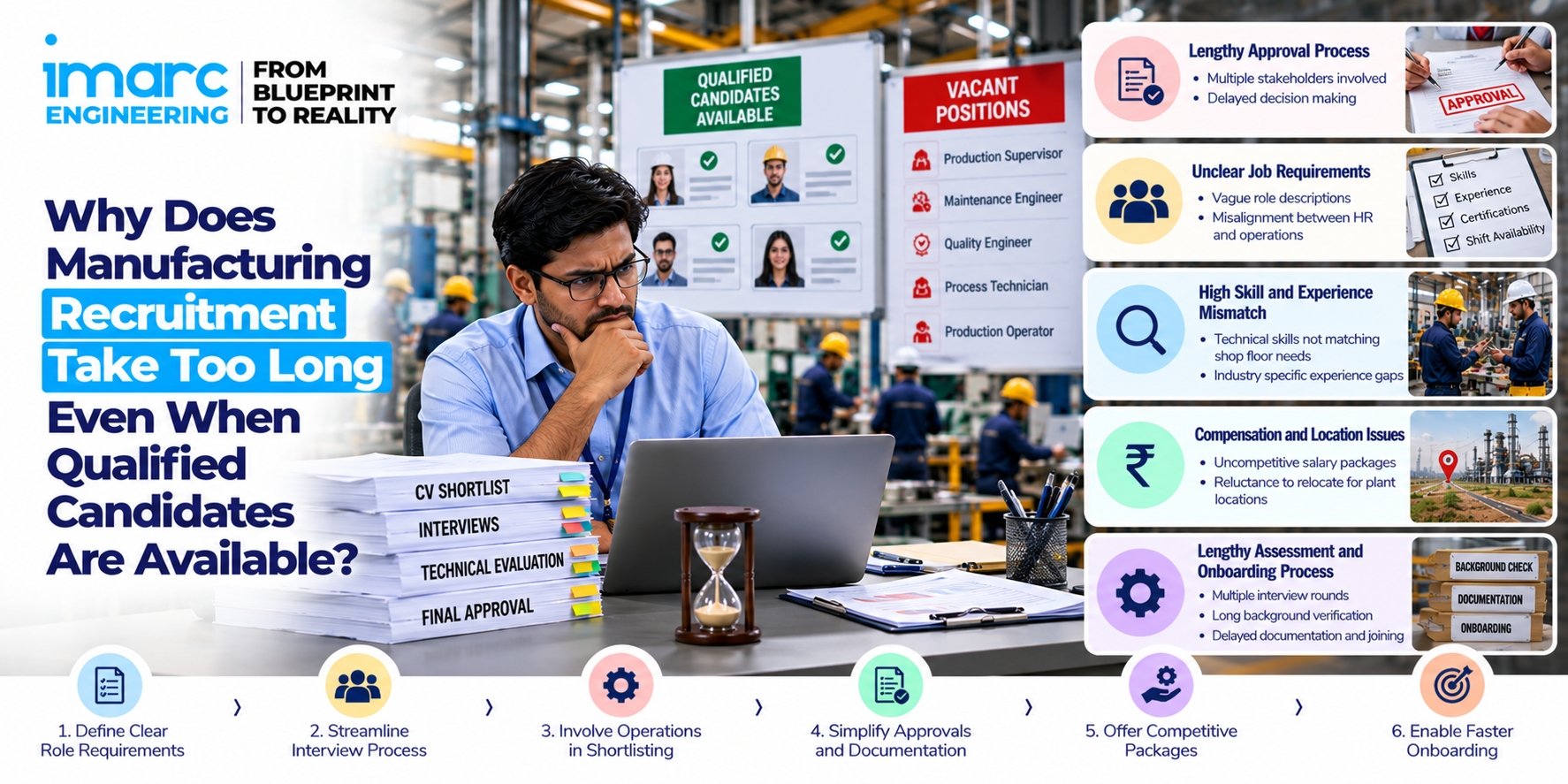
The role is open. Profiles look suitable. Shortlists exist. Yet weeks pass before an offer goes out, and strong candidates drop away or accept elsewhere. The plant still runs short-handed. Overtime rises. Projects slip. The delay is not always a shortage of talent. It is often a slow internal path from shortlist to decision.
Manufacturing recruitment takes too long even when qualified candidates are available because hiring is treated as a sequence of handoffs—HR, plant head, functional heads, finance and leadership—without fixed cycle times, clear ownership or decision rules. Candidates wait while the organisation coordinates. Structured workforce planning and technical staffing services can help manufacturers align role requirements, technical assessments and hiring priorities with plant and project timelines.
What This Delay Actually Means
“Qualified candidates available” does not mean “hire ready.”
Typical delay patterns include:
Applications or agency shortlists sitting unreviewed
Multiple interview rounds with long gaps between them
Hiring managers unavailable because of production pressure
Conflicting feedback with no single decision owner
Compensation or grade approvals after final interview
Background checks and offer letters starting only after late consensus
Candidates withdrawing during silence
The funnel has people. The process cannot convert them at the speed the market requires.
Why Recruitment Stalls Despite Available Talent
1. Role definition is incomplete at the start
Vague JD language, unclear shift expectations, or unresolved “must-have vs nice-to-have” skills force repeated screening resets. Candidates are evaluated against a moving target.
2. Too many sequential interviews without parallel scheduling
Each additional panel adds calendar friction. In plants, key interviewers work shifts or outages, so a “simple” three-step process becomes multi-week by default.
3. Hiring manager bandwidth is the hidden bottleneck
Production priorities routinely push interview slots and feedback to the end of the day—or the next week. Recruitment loses to the line.
4. Assessment criteria are not agreed upfront
HR screens for one profile; operations wants another. Candidates pass early stages and fail late stages for reasons that should have been filtered earlier.
5. Approval chains start too late
Budget, band and headcount confirmation often begin after the preferred candidate is chosen. That is when competing offers are already in play.
6. Communication gaps look like rejection to candidates
Silence between rounds is interpreted as disinterest. Skilled technicians and engineers rarely wait indefinitely when other plants are hiring.
7. Technical evaluation is slow or inconsistent
Practical assessments, plant visits or skill demos are valuable—but poorly scheduled ones add days without improving decision quality.
8. Offer and joining process is treated as admin, not part of hiring speed
Delayed offer letters, unclear joining timelines or slow documentation undo months of sourcing.
How to Shorten Time-to-Hire Without Lowering Quality
Freeze the role scorecard before sourcing
Define outcomes, must-have skills, shift constraints, location reality and decision criteria in one page.Set a maximum cycle time per stage
Example discipline: screen within 48 hours, first interview within a fixed window, final decision within a defined number of days after last interview.Name a single decision owner
One accountable hiring manager owns yes/no. Advisors can input; they should not create endless loops.Pre-approve compensation bands and headcount
Do commercial and grade clearance before final interviews, not after.Batch interviews and protect calendar blocks
Reserve recurring interview slots so plant leaders are not scheduling from zero every time.Align HR and operations filters early
Run a short calibration on the first few profiles so screening matches what the floor will accept.Keep candidates informed on a fixed cadence
Even a brief status update reduces drop-off during internal delays.Start offer paperwork in parallel with final checks
Prepare templates, approvals and documentation paths so the offer is not invented at the last step.Measure stage-wise ageing
Track where profiles age: sourcing, screening, interview, offer, joining. Fix the longest queue first.
Practical Scenarios
Scenario A: Strong shortlist, slow feedback
Three suitable maintenance candidates are identified. Feedback takes ten days. Two accept other offers. The third renegotiates harder.
Scenario B: Extra interview added late
After two rounds, leadership requests “one more discussion.” The process restarts calendar coordination. The preferred candidate exits.
Scenario C: Budget confirmed after selection
The plant selects a supervisor. Finance then debates the band. By the time approval arrives, the candidate has joined a competitor.
Scenario D: Interviewers unavailable on shift pattern
Night-shift or shutdown-heavy leaders cannot meet daytime interview slots. Scheduling alone consumes weeks.
Decision Point: Is the Problem Talent Supply or Decision Speed?
Ask:
Are qualified candidates entering the process regularly?
Where do profiles age the longest—screen, interview or offer?
Are decision criteria and compensation clear before final rounds?
Can the hiring manager commit time on a fixed rhythm?
If candidates exist and still drop out, the constraint is process speed and ownership, not only the labour market. Adding more resumes will not fix a slow decision system.
Manufacturing Hiring Speed Checklist
Role scorecard locked before sourcing
Must-have skills and shift constraints explicit
Stage-wise target timelines defined and tracked
Single hiring decision owner named
Compensation band and headcount pre-approved
Interview slots reserved on a recurring calendar
HR–operations calibration completed on early profiles
Candidate communication cadence defined
Offer and documentation path prepared in advance
Ageing report reviewed weekly until the role is closed
When Hiring Speed Matters Most
Tighten the process:
before commissioning or ramp-up when roles are on the critical path
when overtime and contractor spend are rising due to vacancies
for scarce technical roles where candidates hold multiple options
during multi-role hiring drives where sequential processing multiplies delay
whenever offer-stage losses become a pattern
A slow hire is not neutral. It is lost capacity, delayed projects and higher cost per filled role.
How IMARC Engineering Can Help
IMARC Engineering supports manufacturers who need technical roles filled against project and plant timelines, not open-ended hiring cycles. Structured workforce planning, role definition and technical recruitment support help align sourcing, assessment and decision speed for industrial positions.
Relevant support can include workforce planning and technical hiring support through workforce planning and technical staffing services.
Talk to IMARC Engineering if qualified candidates are available but manufacturing roles still take too long to close because of process and decision delays: https://www.imarcengineering.com/contact?service=workforce-planning-and-technical-staffing
Conclusion
Manufacturing recruitment takes too long even when qualified candidates are available when the organisation cannot decide and offer at market speed. Talent supply is only half the equation. The other half is role clarity, interview discipline, pre-approved compensation and a single accountable decision path.
Teams that fix stage ageing and ownership convert shortlists into joiners. Teams that keep adding interviews and late approvals keep losing the same candidates they worked hard to find.
The practical takeaway is clear: do not only ask whether candidates exist. Ask where your process loses days—and who is empowered to end the delay.
Contact Us:
IMARC Engineering
Phone: +91-120-433-0800
Email: sales@imarcengineering.com
India: C-130, Sector 2, Noida, Uttar Pradesh 201301
LinkedIn: https://www.linkedin.com/showcase/imarc-engineering/