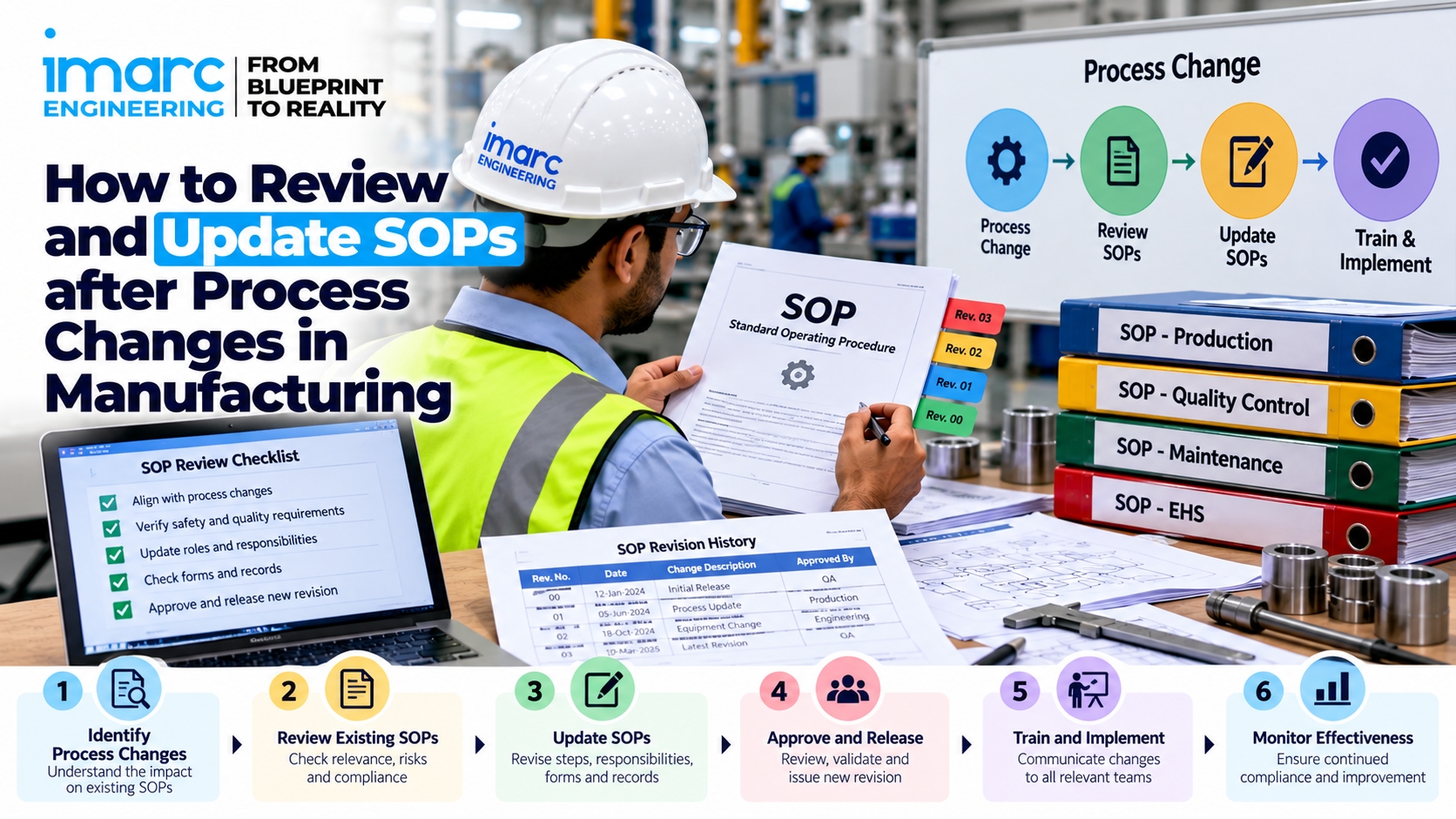
A process change can improve output and still create quality risk if the SOP remains unchanged. Operators continue with old steps, records still ask for removed checks and supervisors train new joiners on obsolete methods. The change may be visible on the machine and invisible in the controlled document system.
How to review and update SOPs after process changes in manufacturing is a controlled sequence of impact assessment, revision, training, version control and floor verification. The objective is alignment: the way the process runs, the way it is written and the way it is recorded must match again. This process can be supported through Standard Operating Procedure Development, particularly when revised procedures need to be aligned with current processes, documentation and implementation requirements.
Why SOP Updates Must Follow Process Changes
SOPs are the reference method for controlled work. When process conditions change and documents lag, plants face:
Mixed methods across shifts
Incorrect entries in production or quality records
Deviations caused by outdated instructions
Audit findings on practice-versus-procedure gaps
Failed investigations because the documented baseline is wrong
India’s manufacturing sector continues to expand under policy support and investment momentum:
Manufacturing growth is estimated at around 7% at constant prices in FY 2025-26 (MoSPI First Advance Estimates).
FDI into manufacturing rose 18% in FY 2024-25 to US$19.04 billion (Ministry of Commerce & Industry / DPIIT).
PLI cumulative investment has exceeded ₹2.16 lakh crore, with cumulative production and sales surpassing ₹20.41 lakh crore as of December 2025 (PIB).
Logistics costs have improved to an estimated 7.97% of GDP (DPIIT-NCAER study).
As plants introduce new products, equipment and line modifications more frequently, SOP update discipline becomes a core operating control.
Which Process Changes Should Trigger SOP Review
Not every minor adjustment needs the same depth of revision, but review should be triggered by changes that affect method, risk or evidence.
Typical triggers include:
New or modified equipment
Changes in process parameters or set points
Raw material or packaging specification changes
Line layout or material-flow changes
New in-process checks or release criteria
Software or system workflow changes affecting records
Safety, cleaning or changeover method changes
CAPA actions that alter the controlled method
If the operator must do something differently, the SOP should be reviewed.
Step 1: Capture the Change Under Formal Control
Before editing an SOP, define the change clearly.
Record:
What changed in the process
Why the change was made
Where it applies
When it becomes effective
Who owns implementation
What risk it introduces to quality, safety or compliance
SOP revision should follow change control, not informal verbal instruction.
Step 2: Identify All Affected Procedures and Linked Documents
One process change often touches more than one SOP.
Search for impact in:
Core operating SOPs
Setup and changeover instructions
Cleaning and clearance procedures
In-process quality checks
Maintenance or calibration interfaces
Forms, logbooks and batch-record sections
Training modules and visual aids
Partial updates create contradictory instructions. Map the full document set before rewriting.
Step 3: Review the Current SOP Against the New Method
Walk the process as it will be performed after the change.
Check:
Which steps are added, removed or reordered
Which checks remain valid
Which tools, settings and acceptance criteria changed
Where old warnings or notes no longer apply
Whether roles and responsibilities shifted
Do not revise from memory alone. Observe the intended method and compare it with the current controlled text.
Step 4: Update the SOP With Clear, Executable Language
Revise the procedure so it can be followed under normal production conditions.
Ensure the updated SOP includes:
Revised step sequence
Updated operating parameters and limits
New materials, tools or equipment references
Clear reaction steps for abnormal results
Revised records to be completed
Safety points linked to the new method
Avoid vague instructions such as “as required” where measurable criteria are needed.
Step 5: Align Forms, Records and System Entries
An updated SOP with an outdated form will generate errors.
Update linked evidence tools:
Checklists and production log fields
In-process data capture points
Labels and status markers where relevant
Electronic fields or workflow steps
Sampling and inspection record formats
The record must make the new method easy to follow and hard to document incorrectly.
Step 6: Approve, Version and Set an Effective Date
Release discipline matters as much as content quality.
Control:
Review and approval by process and quality owners
New version number
Effective date
Withdrawal date of the old version
Distribution to point-of-use locations
Archive of the superseded SOP
If old copies remain on the floor, the plant does not have version control in practice.
Step 7: Train Affected People Before the Change Goes Live
Training must be tied to the new version and the people who use it.
Cover:
What changed and why
Critical new steps or checks
New failure modes or safety points
How records must be completed
When the old method must stop
For high-risk changes, verify understanding before independent operation. Attendance alone is not competence.
Step 8: Verify Implementation on the Floor
After the effective date, confirm that practice matches the revised SOP.
Check:
Operators are using the current version
Old steps are no longer followed
Records reflect the new requirements
Supervisors enforce the revised method
Any practical difficulty is captured and corrected under control
Verification closes the loop between document update and process adoption.
Step 9: Monitor Early Performance After the Change
SOP update is not complete at training sign-off.
Monitor for a defined period:
First-run defects or deviations linked to the change
Operator queries and near-misses
Record completion errors
Throughput or quality effects related to the new method
If indicators worsen, reopen the change and adjust method or documentation through formal control.
Common Mistakes After Process Changes
Changing the process first and updating SOPs later under audit pressure
Revising one SOP while leaving linked forms unchanged
No effective date or continued use of old printouts
Training completed after the new method is already live
No floor verification of adoption
Treating temporary work instructions as permanent control
Failing to archive superseded versions with traceability
These mistakes recreate process variation under a new document number.
Practical SOP Update Checklist
Process change is formally defined and approved.
All affected SOPs and forms are identified.
Revised method is reviewed on the floor.
SOP language is clear and executable.
Linked records and system fields are updated.
Version number and effective date are controlled.
Old copies are withdrawn from point of use.
Affected personnel are trained on the new version.
Implementation is verified in live operation.
Early performance is monitored for residual risk.
If several points are missing, the SOP update is incomplete.
How IMARC Engineering Can Help
IMARC Engineering supports manufacturers who need stronger process discipline when operations change. SOP review and update after process changes is most effective when method, documentation, training and floor verification are handled as one control sequence.
Support may include:
Process and documentation readiness inputs for manufacturing plants
Identification of practice-versus-procedure gaps after changes
Advisory on controlled implementation of revised operating standards
Experience across pharmaceuticals, food and beverage, chemicals, auto components, electronics, FMCG and discrete manufacturing
If your plant needs a practical system to review and update SOPs after process changes in manufacturing, IMARC Engineering can help structure the approach: https://www.imarcengineering.com/contact?service=standard-operating-procedure-development
Conclusion
How to review and update SOPs after process changes in manufacturing is a controlled workflow: assess impact, revise all affected documents, align records, train on the new version, withdraw obsolete copies and verify that practice follows the updated method. A process change is unfinished until the controlled procedure catches up.
Plants that update SOPs with change control protect consistency and audit confidence. Plants that rely on verbal instructions and delayed documentation often operate with mixed methods until a deviation or external audit exposes the gap.
The standard operating procedure remains effective only when it describes the process as it is actually run today.
Contact Us:
IMARC Engineering
Phone: +91-120-433-0800
Email: sales@imarcengineering.com
India: C-130, Sector 2, Noida, Uttar Pradesh 201301
LinkedIn: https://www.linkedin.com/showcase/imarc-engineering/