
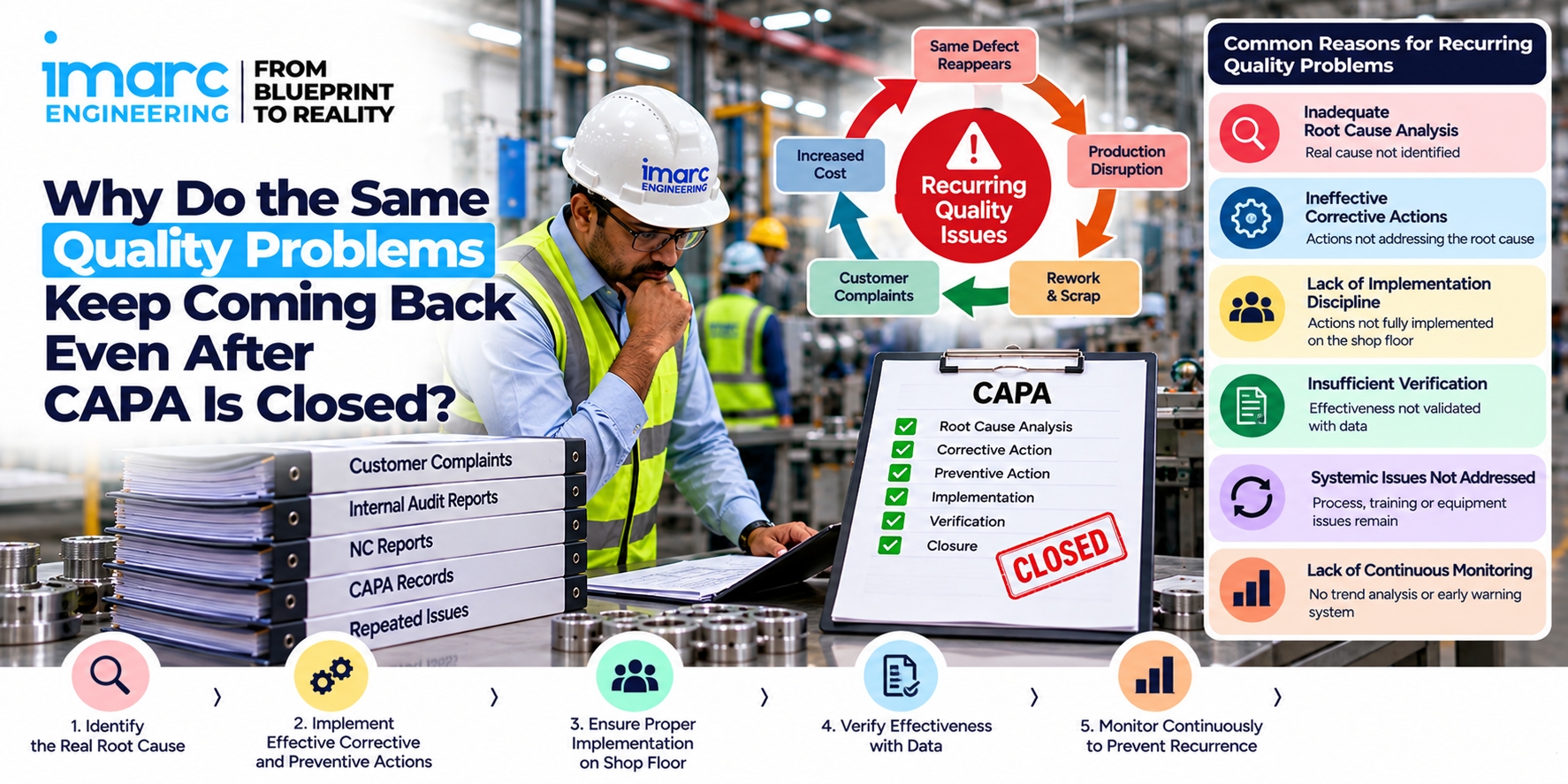
The CAPA file is closed. Actions are signed off. Training is recorded. A few weeks or months later, the same defect, deviation or complaint returns. The quality team is frustrated, operations feel the system is bureaucratic, and inspectors treat recurrence as evidence that earlier corrective action did not work.
Quality problems keep returning after CAPA closure when the system closes on completed tasks instead of proven elimination of the cause. Closure is an administrative status. Effectiveness is an operational result. CAPA support services can help manufacturers strengthen root-cause investigation, corrective action planning and effectiveness verification so recurring problems are addressed at the system level.
What Recurring Problems After CAPA Actually Mean
A closed CAPA that is followed by the same issue usually means one of these is true:
The investigation stopped at a symptom, not the system cause
The action fixed one event, not the conditions that allow the event
Effectiveness was assumed from action completion, not measured
The same failure mode exists in other products, lines or shifts and was never scoped
The “fix” was retraining or reminder, while process design still permits error
Recurrence is not always proof of negligence. It is proof that the previous CAPA did not change the conditions that generate the problem.
Why the Same Issues Return After Closure
1. Root cause is written as “human error” or “procedure not followed”
These statements describe what happened, not why the system allowed it. If the process, instruction clarity, tooling, workload or detection method remains unchanged, people will fail in the same place again.
2. Correction is mistaken for corrective action
Replacing a bad part, rejecting a batch or cleaning a spill removes the immediate issue. It does not remove the cause. When CAPA closes after correction only, recurrence is likely.
3. Investigation is narrow and time-pressed
Teams stop at the first plausible explanation because open CAPA metrics create pressure. Worn tooling, supplier drift, unstable set-points or weak in-process checks stay hidden behind a convenient local cause.
4. Effectiveness checks are vague or skipped
Many files say “monitor for recurrence” with no defined period, data source or acceptance threshold. The CAPA is closed because actions were done, not because defect rates, complaints or process signals improved.
5. Scope stays limited to the batch or station that failed
The same material, method or equipment logic may affect other SKUs or lines. Isolated remediation leaves the failure mode alive elsewhere and it reappears under a different record number.
6. Actions are implemented on paper, not in daily control
SOP updates exist, but floor practice, forms, set-point control or incoming checks do not fully change. The controlled document moves; the process behaviour does not.
7. CAPA system metrics reward speed over resolution
When overdue reduction is the main KPI, teams optimise for closure dates. Recurrence then becomes a separate new CAPA instead of a failed effectiveness outcome on the old one.
How to Diagnose Why a CAPA Did Not Hold
Restate the original problem in measurable terms
What failed, where, under which conditions, how often, and what risk it created.Separate correction, containment, corrective action and preventive action
Confirm what actually changed in the process, detection method or design, not only what was cleaned or rejected.Challenge the root-cause statement
Ask whether a different investigator would reach the same cause from the same evidence. If the cause could fit almost any deviation, it is too shallow.Map the evidence chain
Problem definition → contributing factors → root cause → action → process change → measurable outcome. Any weak link explains recurrence.Review the effectiveness plan that was used
Was there a predefined indicator, observation window and pass/fail rule? If not, closure was not verification.Compare the new event with the old CAPA
Same failure mechanism, or only similar wording? Same line, material, shift or method? This decides whether to reopen, extend or open a deeper system CAPA.Check whether related processes were assessed
Supplier lots, sister products, equivalent machines and alternate shifts often carry the same latent cause.Decide whether the process needs redesign, not reinforcement
If error is easy under normal operating pressure, reminders will not hold.
Practical Scenarios
Scenario A: Retraining after dimensional rejects
Operators are retrained. Tooling wear continues. Rejects return because the cause was process capability, not awareness.
Scenario B: CAPA closed after pipe replacement
A leak is fixed. No review of inspection frequency, corrosion risk or similar lines is done. A related failure appears later in another section.
Scenario C: Effectiveness based on “no issue in 15 days”
A monthly failure mode is checked for two weeks and closed. The next monthly cycle brings the same event back.
Scenario D: One SKU fixed, family left open
A packaging defect is corrected on one product. Shared sealing parameters remain weak. Complaints shift to adjacent SKUs.
Decision Point: Reopen, Extend or Redesign the CAPA?
Ask:
Did the earlier action change the process condition that created the failure?
Was effectiveness defined in data, not in task completion?
Is the new event the same mechanism under the same controls?
Could the same cause affect other products or equipment right now?
If the mechanism is the same and the process did not materially change, reopening with a deeper investigation is more honest than opening a disconnected new CAPA. If actions were implemented but indicators never improved, the issue is effectiveness failure, not lack of paperwork.
CAPA Recurrence Prevention Checklist
Problem statement is specific and measurable
Root cause goes beyond human error or “SOP not followed”
Correction and corrective action are clearly separated
Actions change process, detection, design or supplier control
Related products, lines and shifts are reviewed for the same cause
Effectiveness criteria are defined before implementation
Monitoring window matches the failure frequency
Closure requires evidence of reduced recurrence risk
Failed effectiveness triggers reopen or escalation
Management review tracks recurrence themes, not only open-CAPA count
When This Should Be Checked
Review CAPA strength:
when the same defect code or complaint theme repeats
before closing high-risk CAPAs
during management review of quality trends
after customer or regulatory observations on repeat issues
when CAPA volume is high but process performance is flat
before inspections, where recurrence history will be examined
The cost of a weak CAPA is paid twice: once in the original failure, and again when the same failure returns under greater scrutiny.
How IMARC Engineering Can Help
IMARC Engineering supports manufacturers who need CAPA systems that close on effectiveness, not only on completed tasks. Structured investigation support, action design and verification logic help reduce repeat deviations and inspection exposure.
Relevant support can include root-cause quality, action planning and effectiveness review through CAPA support services.
Talk to IMARC Engineering if closed CAPAs are recurring as the same quality problems across batches, lines or audit cycles: https://www.imarcengineering.com/contact?service=corrective-and-preventive-action-support
Conclusion
The same quality problems return after CAPA closure when investigations stop at symptoms, actions stop at correction, and effectiveness is assumed from paperwork. A closed file is not the same as a controlled process.
Teams that define measurable causes, change the conditions that create failure and verify results over a realistic window reduce recurrence. Teams that optimise for closure speed often rebuild the same CAPA under a new number.
The practical takeaway is direct: do not ask whether the CAPA was closed. Ask whether the failure mode is still possible under normal operating conditions.
Contact Us:
IMARC Engineering
Phone: +91-120-433-0800
Email: sales@imarcengineering.com
India: C-130, Sector 2, Noida, Uttar Pradesh 201301
LinkedIn: https://www.linkedin.com/showcase/imarc-engineering/



