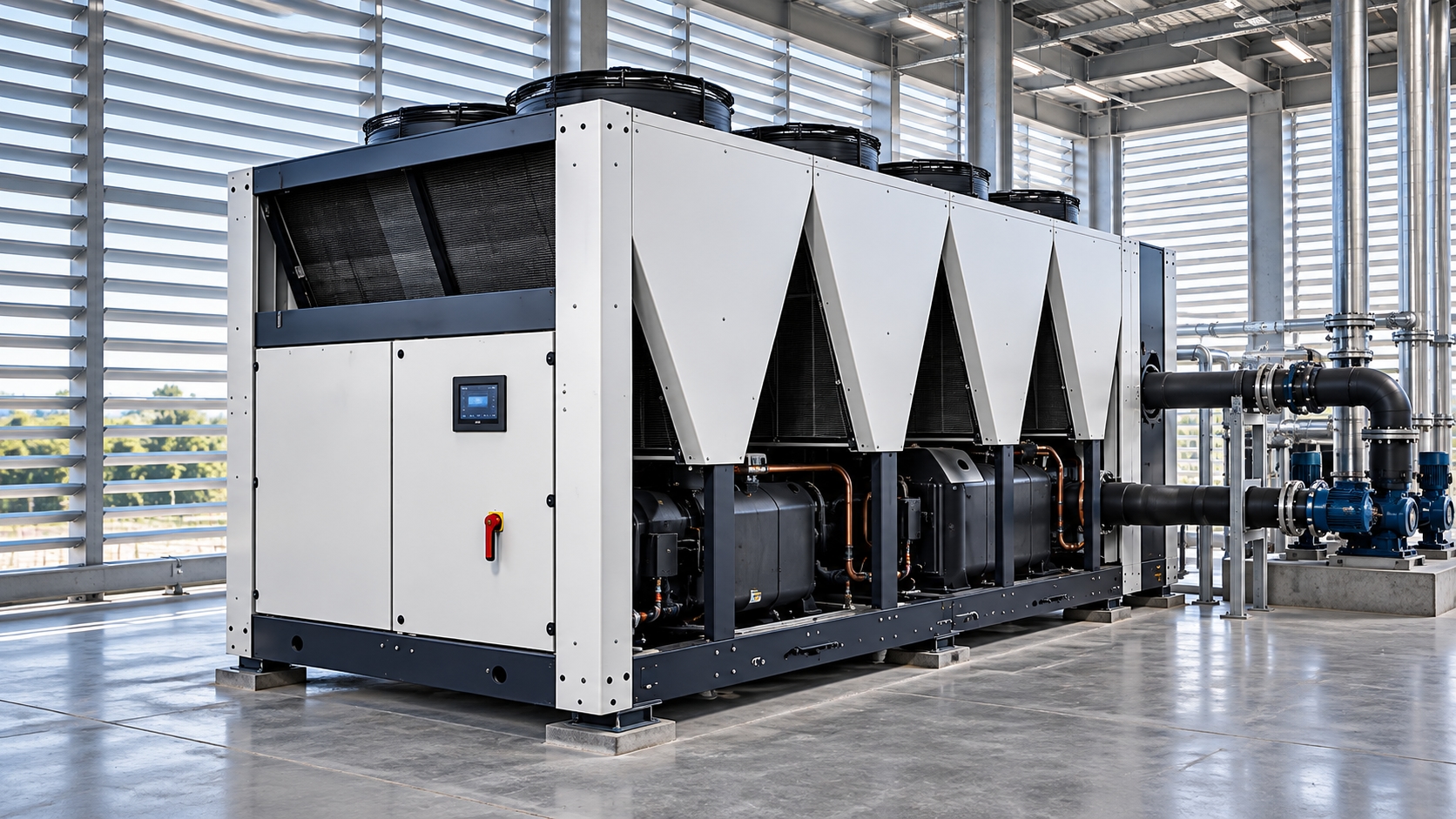
Picture a 250 TR chiller bought for a plant that touches 250 TR on six afternoons a year. The other 360 days it idles at 40% load, short-cycles, and wastes power. Nobody calls that a defect. It's a sizing decision, and it's the most common way a buyer picks the wrong HVAC chiller.
How to Choose the Right HVAC Chiller: Start With Load, Not Brand
Brands come later. Load comes first.
Build a Real Load Profile
Log your actual heat load for at least a week, across shifts. Nameplate figures from process equipment overstate demand, and getting an honest profile is harder than any catalogue comparison. Most buyers skip it because it takes time.
Check the Temperature Split
Here's the detail that gets overlooked: chilled water delta-T. One TR equals 3.517 kW, so at a 5°C split you circulate about 0.6 m³/h per TR. Widen the split and pumps shrink and pumping energy drops. Pick it before the quote, not after.
Decide Redundancy Early
Two 50% machines often beat one 100% machine. A single compressor fault then costs you half your cooling, not all of it.
Five Checks to Run on Any HVAC Chiller Supplier
Which means asking questions that price lists can't answer.
Similar installations. Good: references from your industry, with site names you can call. Bad: a logo slide and "confidential clients."
Control integration. Good: Modbus or BACnet points mapped to your BMS before dispatch. Bad: "integration is the electrician's job."
Spare parts list. Good: a priced list attached to the quote. Bad: "we'll advise at commissioning."
Factory testing. Good: a witnessed performance test with your engineer invited. Bad: a test certificate with no data.
Water-side support. Good: guidance on tower, treatment and filtration. Bad: "that's outside our scope." Fouled condensers eat efficiency faster than any compressor fault.
Skipping these to save two percent on price is how buyers end up paying for a chiller twice.
What Choosing Correctly Saves You
Each point below ties to cost or risk.
Lower capex: a right-sized unit avoids paying for 60 TR you never use.
Lower running cost: matched part-load performance keeps kW per TR low through the year.
Code compliance: India's ECBC applies to commercial buildings with a connected load of 100 kW or more, and a well-chosen chiller clears it without retrofits.
Process protection: stable chilled water keeps pharma and food batches inside spec.
Room to grow: modular selection lets you add a second unit instead of replacing the first.
Predictable maintenance: known parts and service intervals turn breakdowns into scheduled work.
Why Monsoon Wet-Bulb Matters for Indian Sites
Roughly three-quarters of India's annual rainfall arrives in the monsoon, and the humidity that comes with it raises wet-bulb temperature. Cooling towers lose approach, so a water-cooled HVAC chiller sized on dry summer data can underperform in August. Check capacity at monsoon wet-bulb, not May heat.
Geography shapes support too. Pharma clusters in Baddi, Vapi, Pune and Hyderabad each have different water quality and ambient profiles.
When you shortlist HVAC chiller manufacturers in India, ask which of these regions their service teams already cover. Do the same with HVAC chiller suppliers in India. A great machine with no engineer nearby is a liability, and it shows up the first time a compressor trips on a Sunday night.
Why We Ask for a 24-Hour Load Log
We're Aquatech Plus. We design customized industrial cooling and water-treatment systems for pharma, food and beverage, chemical and commercial HVAC clients across India. We don't size a chiller off a tonnage figure alone; we ask for a 24-hour load log first. We've seen oversized units cost plants more in power than the saving on the purchase order. As HVAC chiller manufacturers, we'd rather quote smaller and be right.
What to Lock Down Before You Sign
The right HVAC chiller is the one sized for your real load, tested at your real conditions and serviced by someone nearby. Settle those three and brand preference barely matters. As energy codes tighten, facilities that document their load now will find the next upgrade far cheaper.
FAQs
How do I size an HVAC chiller for my facility?
Start with a measured load log, then add a modest margin for growth. Adding 30% "to be safe" usually backfires through short-cycling and wasted capex.
Are HVAC chiller manufacturers able to customise for process cooling?
Yes. Fluid temperature, refrigerant, coatings, controls and redundancy can all change. Compressor frame sizes can't; they follow component catalogues.
What separates good HVAC chiller suppliers from average ones?
They ask about your load before they quote. If the first question is your budget, you're talking to a salesman, not an engineer.
Is a water-cooled or air-cooled HVAC chiller better for my site?
Water-cooled draws less power at larger loads but needs reliable water and treatment. Air-cooled suits limited water or space. Past roughly 300 TR, water-cooled usually wins.
What is the lead time?
Standard units ship faster than custom ones. We give a written date with the quote, though compressor availability can move it.