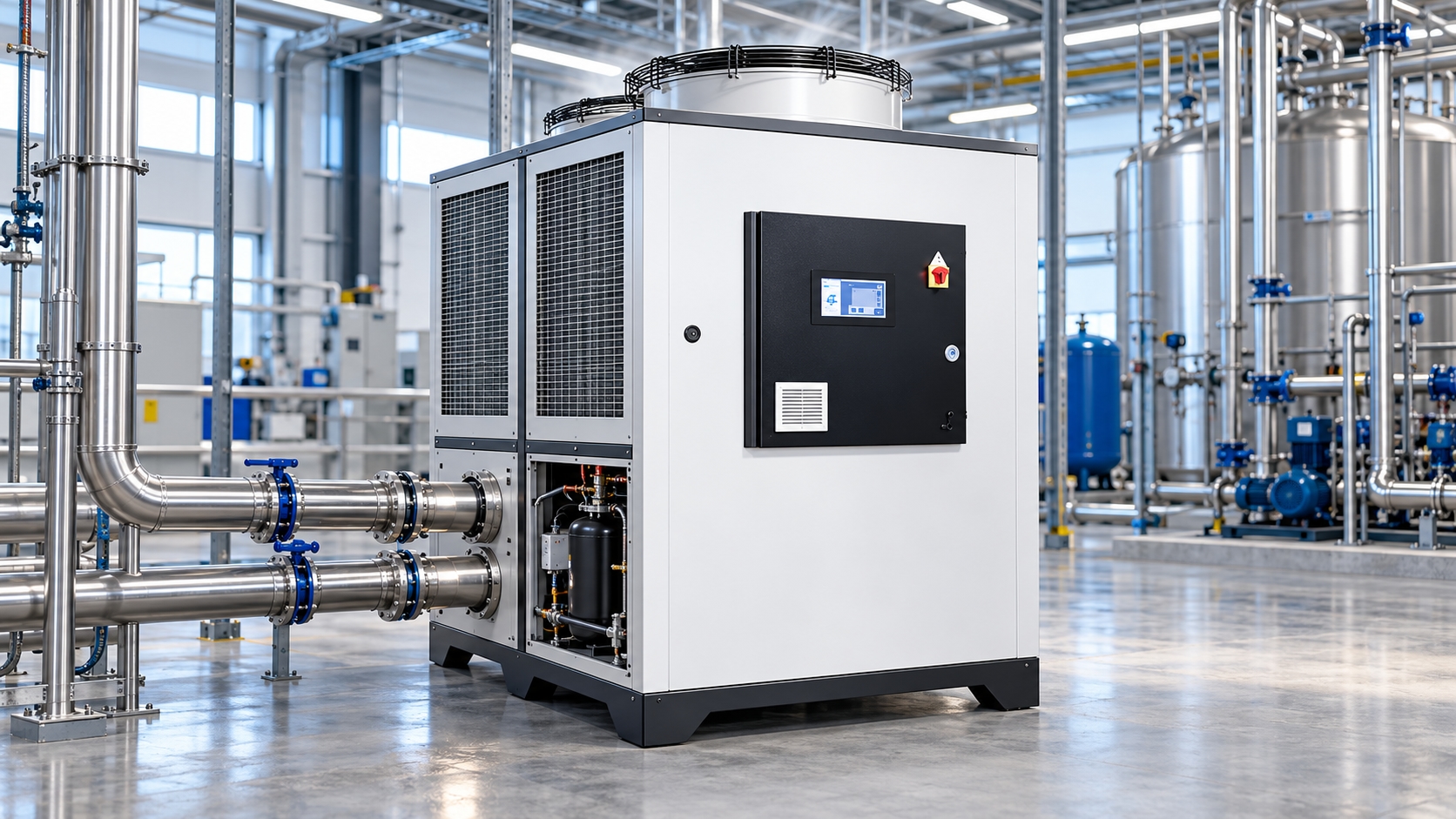
One compressor fault. One chiller serving the whole line. Production stops until a part arrives, and the purchase price you negotiated so hard stops mattering.
That's the real test for air cooled chillers: not what they cost on day one, but what a bad day costs you.
Most buyers compare quotations. Few compare outcomes.
Air Cooled Chillers: What They Cost Over Ten Years, Not Just at Purchase
Over a typical lifespan, electricity usually outweighs the purchase price. Here's an illustration. A 150 TR unit averaging 1.1 kW/TR across 6,000 hours a year consumes about 990,000 kWh. At ₹8 a unit, that's roughly ₹79 lakh annually. Even a 5% efficiency difference between two quotations is worth more than most discounts. These are example assumptions, so run your own tariff and hours.
Configuration and Compressor Choice
Scroll compressors suit smaller packaged units. Screw compressors take over at higher capacities and handle part-load better. One TR equals 3.517 kW, so size from your measured load in kW, not from whatever the last plant bought.
Controls and Monitoring
Look for BACnet or Modbus integration so the chiller talks to your BMS or SCADA. Remote alarms catch low refrigerant pressure or fan faults before they become shutdowns. A chiller with only a local display is a chiller you'll discover has failed when the process drifts.
The Detail Most Buyers Skip
Redundancy. One 150 TR unit is a single point of failure. Two 75 TR units cost more upfront, but when one trips, you still hold half your cooling. Harder than it sounds: this means convincing finance to pay for capacity that sits idle until the worst day. Nobody tells you that the idle capacity is the insurance.
Five Checks to Run on Air Cooled Chiller Manufacturers
Lifecycle cost. Good: a five-year running and service estimate beside the price. Bad: unit price only.
Control protocol. Good: named BMS protocols, tested integration. Bad: "we can add that later."
Staging and redundancy. Good: they discuss N+1 or two-unit options for critical loads. Bad: they simply push the biggest single unit.
Refrigerant and leak detection. Good: type specified, leak monitoring included, phase-out status explained. Bad: refrigerant listed as "standard."
Service reach. Good: named engineers and a stated response time for your region. Bad: "we'll send someone."
Where Air Cooled Chillers Protect Margin and Uptime
Less downtime exposure. Redundancy and remote alarms shorten and often prevent stoppages.
Lower energy spend. Part-load control and EC fans cut the biggest ongoing cost.
Predictable maintenance. A coil-cleaning and leak-check schedule replaces emergency calls.
Scalable capacity. Modular units let you add a chiller as production grows, not buy ahead.
Audit-ready data. Logged temperatures and alarms simplify pharma and food-safety inspections.
Less water risk. No tower means no dependence on tanker supply or treated make-up water.
Air Cooled Chillers Suppliers in India: Service Distance Matters More Than Brochure Distance
Air cooled chillers suppliers in India are easy to find. Suppliers with an engineer within a few hours of your plant are not. That distance decides whether a fan failure costs you an afternoon or three days.
Ask air cooled chillers manufacturers in India where their service engineers are based, not just where the factory is. Air cooled chiller manufacturers with regional teams in Gujarat, Maharashtra or Delhi NCR will state response times. Those who can't are quoting a promise, not a service.
About Us
We're Aquatech Plus, and we've learned that single large chillers on critical loads are a risk worth discussing before the order, not after. We now raise two-unit options with every buyer running a continuous process, and we put the cost difference on the quotation so you can decide with numbers. [Confirm this fact before publishing.]
Before You Sign
Air cooled chillers pay off over years, so judge them over years. Compare lifecycle cost, ask about redundancy, and check where the service engineer lives. Plants that do this now will spend the next decade running cooling, not chasing it.
FAQs
1. How long do air cooled chillers last?
Well-maintained units often run well over a decade. Dusty or coastal sites shorten that unless coils and cleaning are managed. Maintenance records matter more than age.
2. Is a two-unit setup worth the extra cost?
For continuous or batch-critical processes, usually yes. For a comfort-cooling load that can pause, probably not. We'll tell you which one you are.
3. Can air cooled chillers connect to my BMS?
Most modern units support BACnet or Modbus. Confirm the protocol before ordering, because older models may not.
4. How should I compare air cooled chiller manufacturers on maintenance cost?
Ask for a written annual service scope and spare parts list with prices. A manufacturer who can't give those hasn't planned for your second year.
5. What refrigerant should I expect?
Common choices include R134a, R407C and newer lower-GWP options. Availability and regulation change, so confirm current status before you commit.