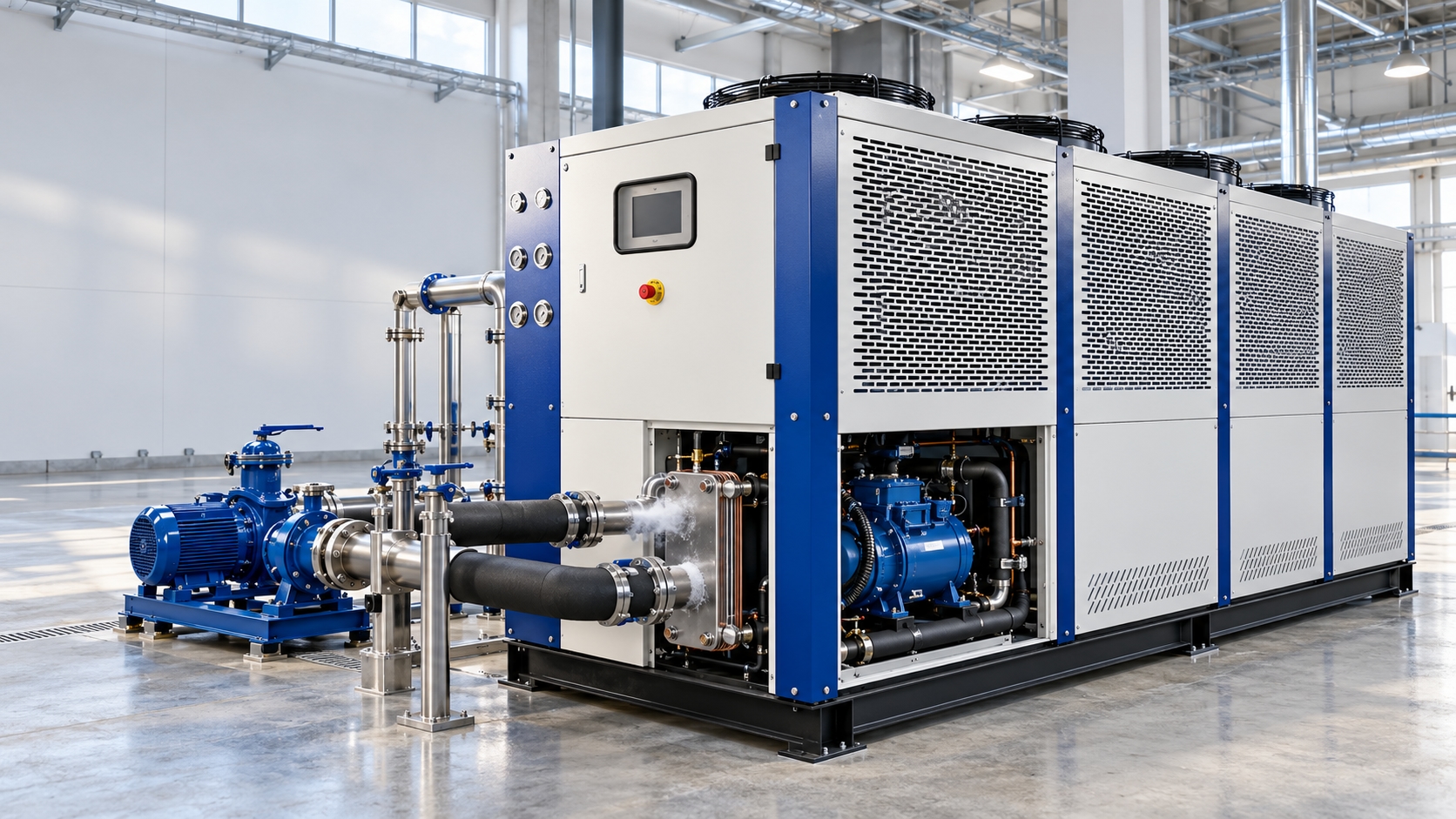
An API plant in Baddi buys a glycol chiller for reactor jackets at −10°C. On paper, the capacity is right. On the floor, the load swings from 80 kW to 20 kW within minutes, the compressor short-cycles, and the setpoint hunts all shift. Nobody had asked about the load profile. That's the real question behind choosing a glycol chiller: not "how many TR," but "how does my process actually behave?"
Capacity answers one question out of four.
Glycol Chiller Specifications: Four Things to Define First
Temperature Band
Write down the lowest outlet temperature you need, not the one you hope for. Down to about −10°C, standard refrigerants work comfortably. Below that, R134a loses efficiency fast, and plants move to R404A or R507. Here's the catch: R404A carries a global warming potential of 3,922, against 1,430 for R134a, so your refrigerant choice has regulatory consequences too.
Load Profile
Steady load is simple. Batch and swinging loads need compressor staging, capacity control and a buffer tank so the unit isn't starting and stopping every few minutes. Most buyers describe their average load and forget the peaks.
Loop Volume: The Detail Most Buyers Skip
Ask for the minimum loop volume in litres. Too little glycol in the system means no thermal mass, and the chiller reacts to every fluctuation. It's cheap to fix at design stage and painful to fix after installation.
Evaporator and Safety Controls
Brazed plate and shell-and-tube evaporators behave differently when glycol concentration drifts. Low-temperature cut-out and flow-switch protection are non-negotiable, because a frozen evaporator means a rebuild, not a repair.
Five Checks That Separate Glycol Chiller Manufacturers from Resellers
Did they ask about your load swings, not just your load? Good: questions about batch cycles and minimum load. Bad: a quote built on peak TR only.
Is the refrigerant matched to your temperature? Good: refrigerant named, with reasoning at your outlet temperature. Bad: "same machine works for everything."
Is there standby or dual-circuit capacity? Good: dual circuits or an N+1 option offered upfront. Bad: single circuit for a line that can't stop.
Do controls log temperature and alarms? Good: trend data you can show an auditor. Bad: a basic thermostat and a promise.
What do warranty and spares actually say? Good: written terms, spares list, named service contact. Bad: "we'll handle defects case by case." That isn't a policy. It's a negotiation you'll lose when production stops.
What Choosing Correctly Protects
Cold-process failures are expensive, which is why the right selection pays back in avoided losses first and energy savings second.
No short-cycling. Correct staging and loop volume extend compressor and starter life.
Batch protection. Stable setpoints reduce rejected reactor and fermenter batches.
Lower power at your real duty point. As a rule of thumb, each degree of lower evaporating temperature adds about 2–3% to compressor power, so don't specify colder than needed.
Audit-ready records. Logged temperatures help pharma and food plants answer inspection questions quickly.
Planned redundancy. A dual-circuit unit keeps half the capacity alive during a fault.
Predictable service cost. Defined intervals prevent surprise invoices.
Glycol Chiller Availability Across India
Glycol chiller manufacturers in India are strongest near their customers: Nashik and Pune for breweries and wineries, Baddi and Hyderabad for pharma, Vapi, Ankleshwar and Dahej for chemicals, and the Delhi-NCR belt for food processing. Glycol chiller suppliers in India vary widely on spares stock, so ask where parts physically sit. Glycol chiller dealers in India suit standard packaged units, while custom low-temperature duty needs the maker involved. If you're comparing glycol chiller exporters in India, check documentation and voltage and frequency options early.
A supply chain insight most buyers miss: ship the unit dry and fill glycol at site. It avoids transit leaks and lets you source food or pharma-grade glycol locally, with certificates you can show an auditor.
What We Fit on Every Unit Whether or Not You Asked
We fit a flow switch and a low-temperature cut-out on every glycol chiller we build, even when the quote didn't ask for them. A frozen evaporator costs far more than the part. That's the kind of lesson that shapes how we do customized cooling and water treatment: we'd rather quote slightly higher than ship an unprotected machine.
Conclusion
The right glycol chiller is the one matched to your temperature band, your load swings and your risk tolerance, not the one with the biggest nameplate. Choose on those and the machine becomes an unremarkable part of the plant, which is exactly what you want. Next, expect refrigerant rules in India to tighten, so ask every vendor about the refrigerant path today.
FAQs
1. How big should a glycol chiller be for a 50 kW process load?
Usually larger than 50 kW, since glycol at low temperature derates capacity. Quote at your outlet temperature and add margin for peaks.
2. How do I verify glycol chiller manufacturers?
Ask for a factory visit or a witnessed test at your conditions. Real manufacturers say yes. Resellers stall.
3. Are glycol chiller suppliers cheaper for standard sizes?
Often, for catalogue units. For special duty, that saving disappears once you add engineering changes and the delays that follow.
4. Can glycol chiller dealers handle after-sales service?
Some can. Ask for the engineer's name and response time in writing, because "dealer support" often means a phone number.
5. Do glycol chiller exporters add much lead time?
Yes. Expect several extra weeks for freight and paperwork, and confirm whether glycol is shipped or sourced at destination.