
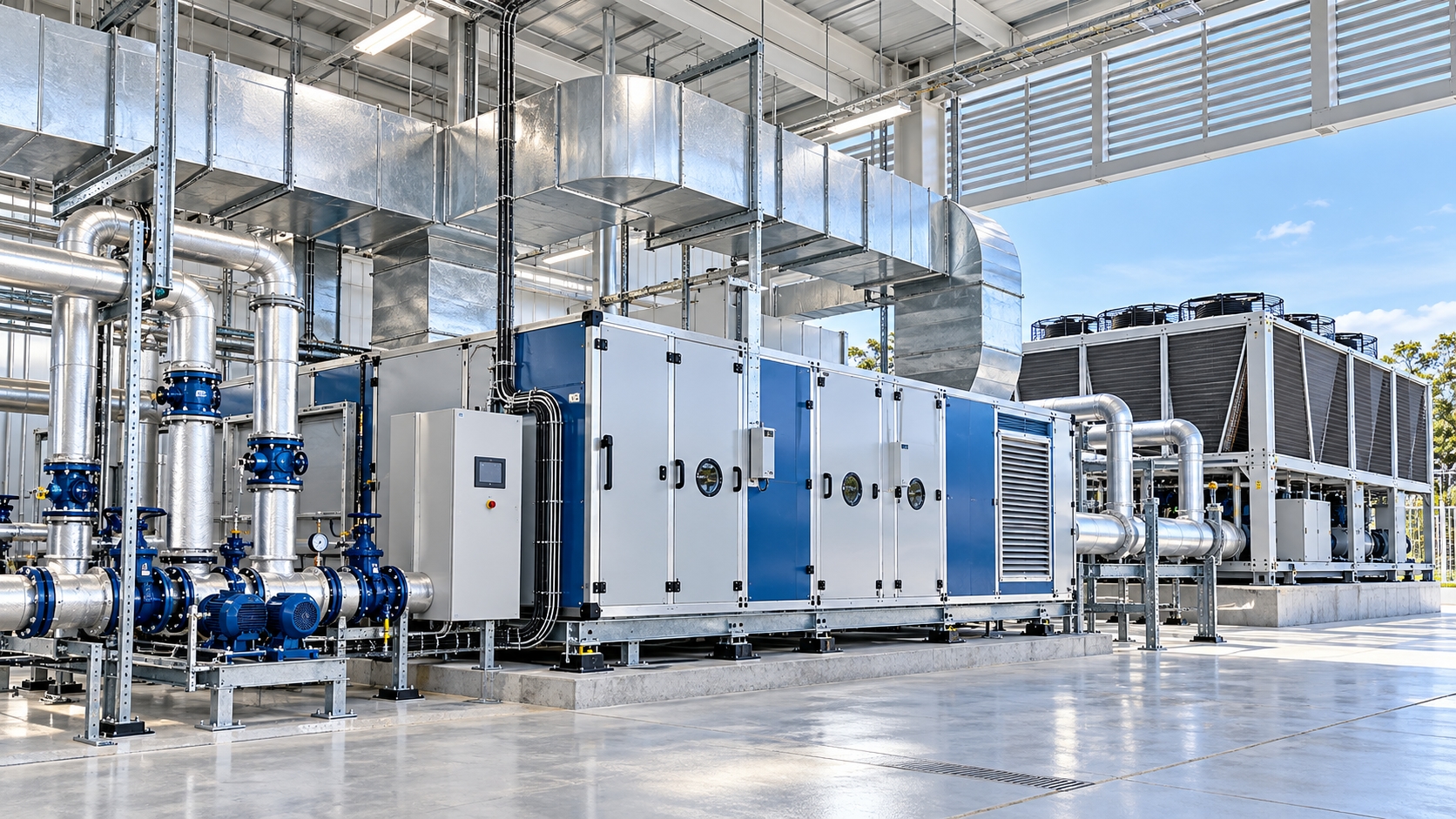
Most plants find out their cooling is inefficient from the electricity bill, not from the equipment. By then the damage is a decade old. HVAC systems often take a third or more of an industrial site's power, yet they get specified once, installed and forgotten. That's an expensive habit. Efficiency is decided at the load calculation stage, long before a compressor arrives.
HVAC Systems Specification: Where the Power Bill Is Decided
Chilled Water or Direct Expansion
Chilled water plants suit large, continuous loads like pharma blocks and process halls. Direct expansion packages suit smaller zones. Choose wrong and you pay for it in kWh for fifteen years.
Controls, VFDs and Heat Recovery
Variable frequency drives on fans and pumps, plus heat recovery from condenser water, is where most savings sit. The India Cooling Action Plan expects cooling demand to grow roughly eightfold by 2037–38. Power cost per TR will matter more every year.
The Part-Load Detail Buyers Skip
Chillers rarely run at full load. Most operating hours sit well below it. Ask for IPLV or ISEER, not just full-load COP. A unit that looks efficient on the datasheet can be mediocre exactly where it actually runs.
Harder than it sounds: part-load data needs your real load profile, and most plants have never logged one.
Five Questions to Ask Any HVAC Systems Supplier
How was the load calculated? Good: from your process heat, occupancy and ambient data. Bad: "We use 1 TR per 100 sq ft." That's a guess wearing a formula.
What's the part-load efficiency? Good: IPLV or ISEER at stated conditions. Bad: peak COP only, quoted at ideal temperatures.
Where do VFDs and controls sit? Good: fans, pumps and compressors, with a written sequence of operation. Bad: "We can add that later." You'll pay twice.
Who handles water quality? Good: treatment is in scope. Bad: "That's the plant's job." Scale on condenser tubes quietly eats efficiency.
Who services it in your city? Good: a named engineer and a stated response time. Bad: "Call the dealer."
A supplier who says "we'll size it on site" hasn't done the calculation. You'll own the oversizing.
Where Efficient HVAC Systems Protect Your Margin
Lower kWh per TR. Under the fan affine laws, cutting speed by 20% cuts fan power by roughly half. That's a recurring saving, not a one-off.
Fewer rejected batches. Stable temperature and humidity protect pharma and food output.
Lower peak demand charges. Staged capacity flattens the spike your utility bills you for.
Longer compressor life. Fewer hard starts mean fewer breakdowns and fewer emergency calls.
Less water wasted. Properly treated condenser water means fewer blowdown cycles.
Predictable maintenance cost. A planned schedule beats a failure-driven one.
HVAC Systems Availability Across India
HVAC system manufacturers in India cluster around Delhi NCR, Pune, Ahmedabad and Chennai. Spares and engineers travel shorter distances to those belts. HVAC system suppliers and HVAC system dealers cover the tier-two cities, but service quality varies sharply. Ask who actually commissions the plant.
Here's the geographic catch. Summer ambient above 45°C is routine in Gujarat and Rajasthan, and air-cooled equipment derates badly there. Water-cooled plants earn their extra piping.
HVAC system exporters in India also ship to Africa and the Middle East, where the same heat and dust problems apply.
About Us
We design and build industrial cooling and water-treatment systems, and we don't issue a quotation until we've seen your actual load data. Sometimes that means telling a client their planned plant is one size too big, and losing the larger order. We'd rather lose the order than the reference.
Conclusion
Good HVAC systems don't win on the datasheet. They win on the twelfth month's power bill and the fifth year's breakdown log. Specify for part-load, demand proof, and audit your plant before the next summer peak.
FAQs
1. How much energy can HVAC systems save in an existing plant?
Typically 15–30% once VFDs, controls and coil cleaning are done properly. A neglected plant saves more, and a well-run one saves less.
2. How do I shortlist HVAC systems manufacturers?
Ask for load calculations, test reports and two reference plants in your industry. If they can't produce them, move on.
3. Are HVAC system suppliers cheaper than direct manufacturers?
Often, upfront. But the warranty chain gets longer, and a fault can bounce between three parties before anyone fixes it.
4. Do HVAC system dealers handle commissioning?
Some do. Many subcontract it. Get the commissioning scope in writing before you place the order.
5. Can HVAC system exporters in India supply custom plants?
Yes, but lead times depend on the spec. A custom plant takes longer than a catalogue unit, and shipping documents add time.



