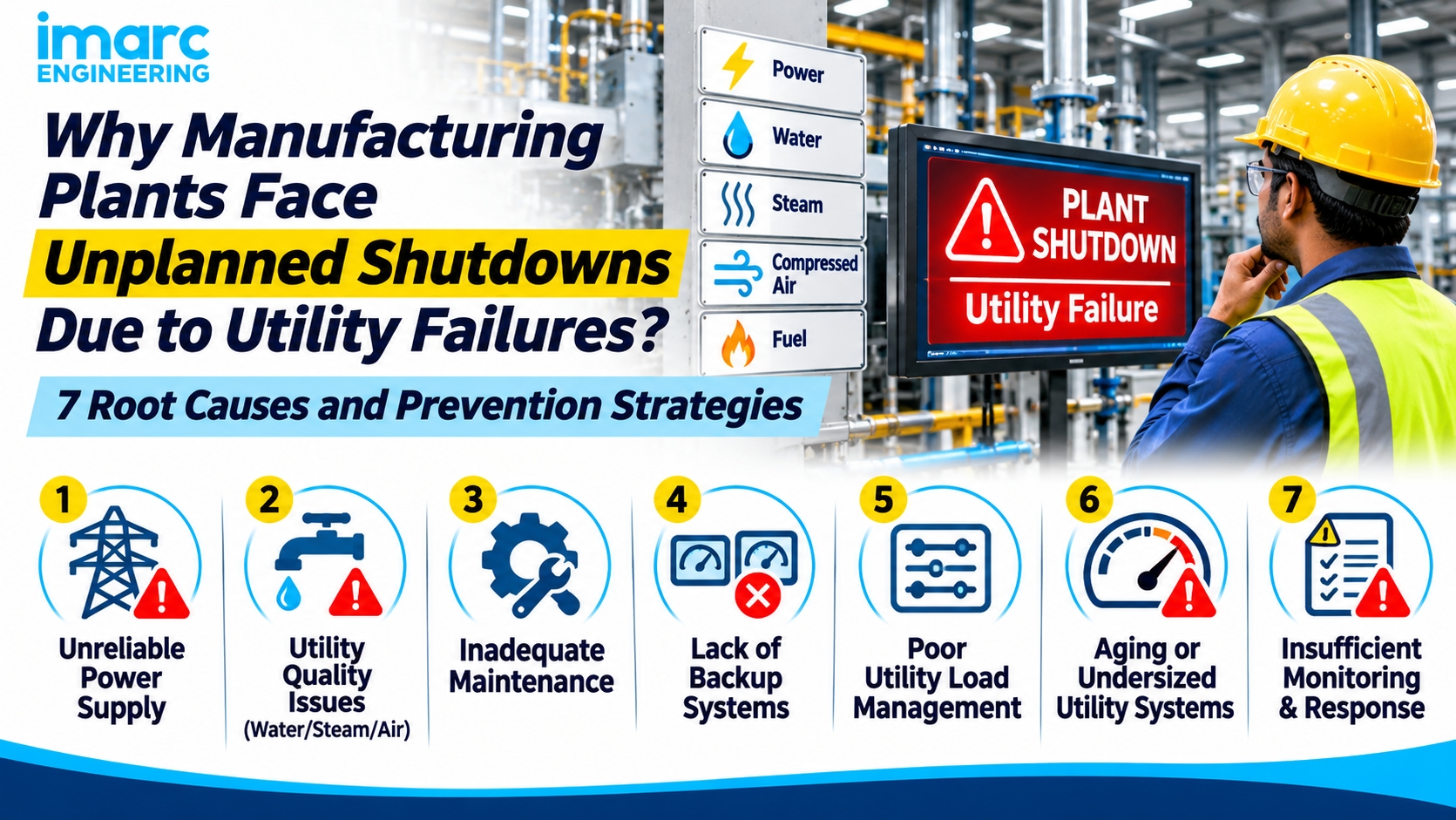
A production line stops suddenly. The machines themselves are in working order, yet output halts because compressed air pressure has dropped, cooling water is unavailable, or a power quality disturbance has tripped critical equipment. These unplanned shutdowns are often blamed on “utility issues,” but the underlying causes are rarely random. They stem from capacity shortfalls, missing redundancy, weak maintenance, or incomplete monitoring of the systems that keep the plant running.
Manufacturing plants face unplanned shutdowns due to utility failures when supporting infrastructure — power, water, compressed air, steam, HVAC or process gases — cannot deliver stable performance under real operating conditions. Effective Utilities Planning (Water, Power, HVAC, Steam) Services in India help manufacturers assess utility capacity, identify infrastructure gaps and improve system reliability. The production equipment may be ready, but the utilities must be equally reliable to maintain continuous operations.
What Utility-Driven Shutdowns Actually Look Like
Utility failures interrupt production in different ways:
Sudden loss of compressed air causing pneumatic systems and process equipment to stop
Cooling water or process water interruption leading to overheating or process abort
Power quality events (voltage dips, harmonics or unbalanced supply) tripping drives and controls
Steam pressure or temperature drop affecting process heating and sterilisation
HVAC or cleanroom condition failures forcing production holds in controlled environments
Cascading stops when one utility failure triggers protective shutdowns in multiple areas
These events create scrap, lost hours, missed deliveries and higher recovery costs.
7 Root Causes of Utility-Related Unplanned Shutdowns
1. Utility capacity no longer matches actual plant load
Original utility systems were sized for an earlier production level. Expansions, new equipment or higher utilisation push demand beyond design capacity. Peak loads then cause pressure drops, voltage dips or flow shortages.
2. Single points of failure with no redundancy
Critical utilities often rely on a single compressor, pump, transformer or cooling tower. When that unit fails or requires maintenance, the entire dependent process stops.
3. Inadequate maintenance of utility equipment
Compressors, pumps, cooling towers, boilers and electrical systems need regular attention. Deferred maintenance leads to unexpected breakdowns at the worst possible time.
4. Power quality problems
Voltage fluctuations, harmonics from variable frequency drives, or unstable supply from the grid or internal distribution can trip sensitive controls and drives even when total power capacity appears adequate.
5. Water quality, pressure or temperature instability
Process and cooling water systems suffer from scaling, contamination, pump wear or inadequate storage. Resulting pressure or quality deviations stop equipment that depends on stable water supply.
6. Compressed air leaks, pressure loss or poor air quality
Leaks, undersized distribution, inadequate drying or filtration cause pressure drops or moisture/oil contamination. Pneumatic tools, actuators and process equipment then fail to operate correctly.
7. Weak monitoring and early-warning systems
Many plants lack real-time visibility of utility parameters. Problems develop gradually — rising temperature, falling pressure, increasing vibration — and become visible only when a shutdown has already occurred.
How to Diagnose and Prevent Utility-Driven Shutdowns
A practical prevention approach focuses on capacity, reliability and visibility:
Map every critical production process to the utilities it depends on and identify single points of failure.
Compare current and projected peak demand against the actual capacity of power, water, air, steam and cooling systems.
Review maintenance history and condition of compressors, pumps, transformers, boilers and cooling equipment.
Assess power quality at key distribution points, especially where sensitive drives and controls are installed.
Measure compressed air pressure, leak rates and air quality at the point of use, not only at the compressor.
Check water systems for pressure stability, temperature control, scaling and contamination risks.
Install or improve monitoring of critical utility parameters with alarms that allow intervention before a full stop.
Develop contingency plans for the most likely utility failure modes, including temporary backup or load-shedding options.
When these steps are completed, most utility-related shutdowns become predictable and preventable.
Practical Scenarios
Scenario A
A new production line was added without upgrading the compressed air system. During peak shifts air pressure fell below the required level and multiple machines stopped. The root cause was capacity shortfall, not equipment failure.
Scenario B
A single cooling water pump served an entire process area. When the pump failed, production halted for hours. No redundant pump or quick changeover arrangement existed.
Scenario C
Voltage dips from the grid repeatedly tripped variable frequency drives. The power capacity was adequate, but power quality at the equipment terminals was not. Production stopped even though the main supply remained available.
Scenario D
Utility parameters were monitored in real time and capacity had been verified against peak load. Early alarms allowed operators to adjust load or switch to backup before any production stop occurred.
Decision Point: Is the Shutdown Caused by Capacity, Reliability or Visibility?
Ask these questions:
Does current peak utility demand still fall within the design capacity of each system?
Are there single points of failure whose loss would stop critical production?
Is maintenance of utility equipment current and condition-based?
Are power quality, air pressure, water pressure and temperature stable at the point of use?
Do operators receive early warning before a utility parameter reaches a trip level?
Have recent expansions been checked for their impact on existing utility systems?
If capacity, redundancy or monitoring gaps are present, utility failures will continue to cause unplanned stops.
Practical Utility Reliability Checklist
Peak demand mapped against capacity for power, water, air, steam and cooling
Single points of failure identified and prioritised
Maintenance status of critical utility equipment reviewed
Power quality checked at sensitive equipment locations
Compressed air pressure and quality verified at point of use
Water system stability (pressure, temperature, quality) confirmed
Monitoring and alarm systems in place for key utility parameters
Contingency actions defined for the most likely failure modes
When Utility Reliability Should Be Reviewed
After any significant production expansion or addition of new equipment
When unplanned stops linked to utilities become recurring
Before peak production seasons or high-demand periods
During annual maintenance planning
As part of any operational excellence or uptime improvement programme
Reviewing utilities only after a major shutdown is far more costly than verifying capacity and reliability in advance.
How IMARC Engineering Can Help
IMARC Engineering supports manufacturing plants that need to eliminate unplanned shutdowns caused by utility failures. The work focuses on assessing utility capacity against actual load, identifying single points of failure, reviewing system condition and monitoring, and developing practical prevention measures so that power, water, air and other utilities support continuous production.
Relevant support is available through utilities planning for water, power, HVAC and steam systems.
If your plant is experiencing recurring unplanned stops linked to compressed air, power quality, water or other utilities, a structured utility reliability review with IMARC Engineering can identify the root causes and the most effective prevention steps: https://www.imarcengineering.com/contact?service=utilities-planning-water-power-hvac-steam-services
Conclusion
Unplanned shutdowns caused by utility failures are rarely sudden or unavoidable. They result from capacity that no longer matches load, missing redundancy, deferred maintenance, power quality issues, unstable water or air systems, and lack of early warning. Production equipment may be reliable, yet the plant still stops when the supporting utilities cannot keep up. The practical solution is to treat utilities as critical production assets: verify capacity, eliminate single points of failure, maintain the systems properly and monitor them in real time. When these steps are in place, utility-related shutdowns decline sharply and overall plant uptime improves.