
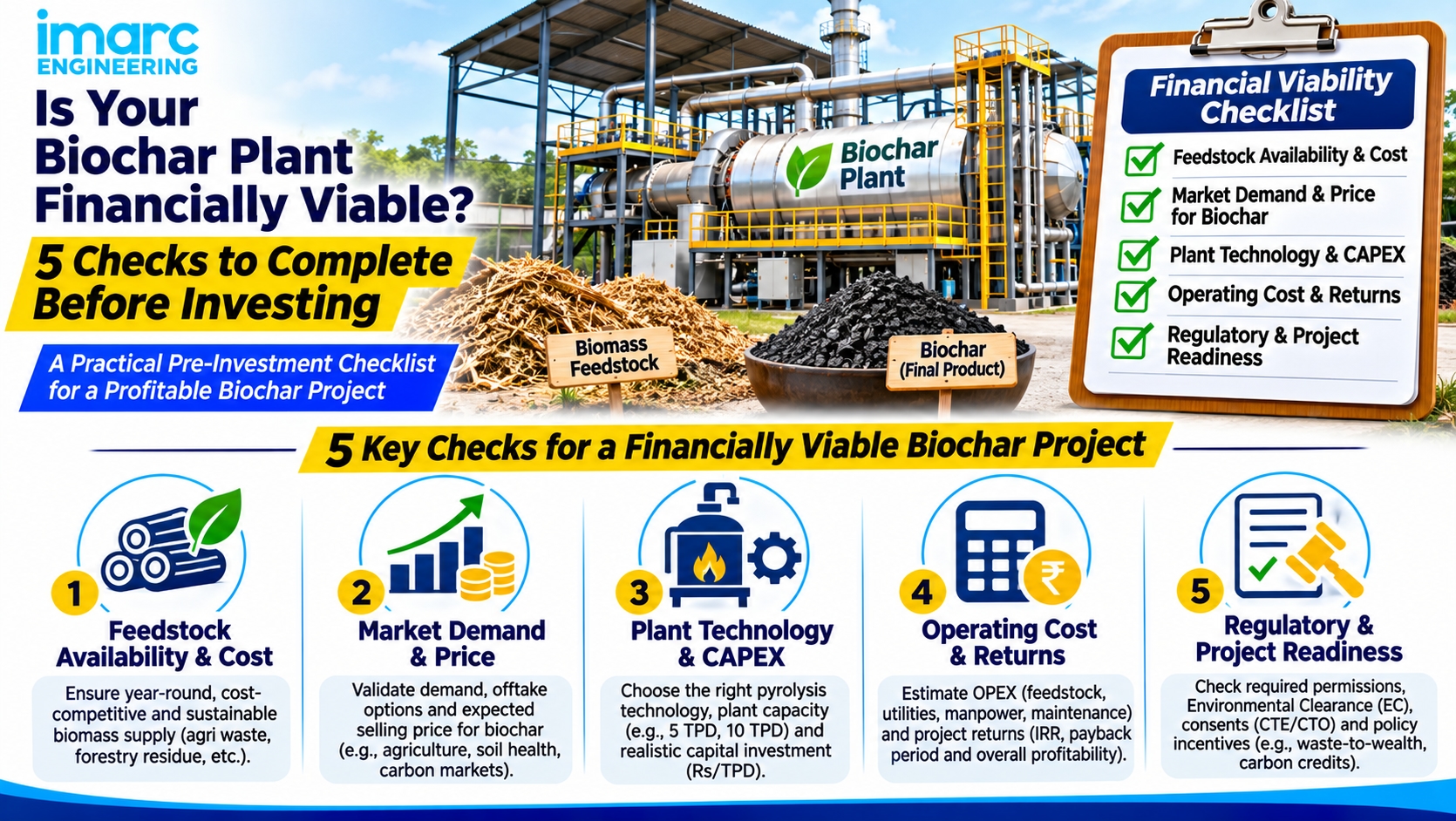
Financial viability in biochar depends on more than projected revenue or expected market demand. Investors need to validate feedstock availability, technology performance, realistic biochar yields, offtake opportunities and complete project costs before committing capital. A detailed biochar plant feasibility study helps project developers assess these critical factors, identify financial risks and determine whether the proposed investment can deliver sustainable returns.
What Financial Viability Actually Means for a Biochar Plant
A biochar plant is financially viable when it can:
Secure feedstock at a cost and consistency that supports the target production cost
Achieve realistic biochar yields and energy balance under the chosen technology and operating conditions
Sell the product (and any co-products) at prices and volumes that cover full operating costs plus an acceptable return
Absorb normal variations in feedstock quality, equipment performance and market conditions without repeated cash shortfalls
Operate within the regulatory and site constraints that were assumed during planning
When any of these elements is based on optimistic or incomplete information, the project becomes vulnerable even if the technology itself is sound.
Why Projects Struggle Despite Positive Initial Projections
Common causes include:
Feedstock availability assessed only at a high level without delivered cost, seasonal variation or competing demand
Technology yields and energy consumption taken from supplier claims without independent validation for the specific feedstock
Offtake assumed at premium or carbon-credit-linked prices without firm agreements or realistic market evidence
CapEx and OpEx estimates that omit or understate logistics, utilities, labour, maintenance and working capital
Scale and site selected for convenience rather than for feedstock logistics, offtake access and regulatory fit
These gaps convert an apparently positive investment case into operational pressure after commissioning.
5 Checks to Complete Before Investing
1. Feedstock Availability, Quality and Delivered Cost
Confirm that sufficient suitable biomass can be secured year-round or in a planned seasonal pattern. Verify moisture, ash, particle size and contamination levels against the requirements of the chosen pyrolysis technology. Calculate the true delivered cost at the plant gate, including collection, transport, handling and any pre-processing. Assess competition from other users of the same biomass.
2. Technology Performance and Yield Realism
Examine the expected biochar yield, energy balance and co-product generation for the specific feedstock and operating conditions, not only for ideal or laboratory results. Confirm whether the technology has demonstrated stable performance at a comparable scale. Identify the sensitivity of yield and energy use to variations in feedstock quality.
3. Offtake Security and Realistic Pricing
Identify who will buy the biochar and under what terms. Distinguish between assumed market prices and prices supported by letters of intent, offtake agreements or demonstrated local demand. Evaluate whether carbon-credit or other premium revenue streams are additional upside or have been treated as base-case income. Assess logistics and quality specifications required by offtakers.
4. Complete CapEx, OpEx and Working Capital
Build a full cost picture that includes land development, equipment, utilities, emission control, feedstock handling, product storage, civil works and contingency. On the operating side, include feedstock, energy, labour, maintenance, consumables, logistics, compliance and realistic capacity utilisation. Ensure working capital for feedstock inventory and receivables is not omitted.
5. Site, Scale and Regulatory Fit
Confirm that the proposed location supports feedstock inflow, product outflow, utility availability and environmental clearances. Check whether the chosen scale matches both feedstock catchment and offtake capacity. Verify that the project can meet applicable environmental, land-use and safety requirements without major redesign or unexpected conditions.
How to Perform These Checks Practically
Map feedstock sources within a realistic transport radius and obtain cost and quality data from actual suppliers.
Request technology performance data referenced to similar feedstock and scale; treat pure marketing figures with caution.
Speak directly with potential offtakers and document volume, specification and price indications.
Prepare a bottom-up CapEx and OpEx model rather than relying solely on high-level vendor estimates.
Conduct a site-level review of logistics, utilities, environmental sensitivity and consent requirements.
Run simple sensitivity cases on feedstock cost, yield and selling price to see where the project remains viable.
Only after these checks show acceptable resilience should major equipment orders or construction commitments proceed.
When any of the five checks remains weak, the investment decision should be paused or the project configuration revised.
Practical Scenarios
Scenario A
Feedstock was assumed available at low cost from agricultural residues. Once operations started, collection and transport costs were substantially higher and quality varied seasonally. Margins disappeared.
Scenario B
Technology yield claims were taken at face value. Actual biochar output on the available feedstock was lower, raising the effective production cost above the achievable selling price.
Scenario C
Offtake was planned around premium soil-amendment and carbon prices. Firm demand materialised only at lower volumes and prices. Cash flow became constrained.
Scenario D
All five checks were completed with evidence before investment. Feedstock contracts, realistic yields, offtake indications and full cost modelling supported a more conservative but achievable financial case.
Decision Point: Proceed, Revise or Pause?
Ask:
Is feedstock volume, quality and delivered cost supported by actual supplier data rather than regional averages?
Are technology yields and energy figures referenced to comparable feedstock and scale?
Does offtake rest on more than assumed market prices?
Does the cost model include full CapEx, OpEx and working capital under realistic utilisation?
Does the site and scale fit feedstock logistics, offtake access and regulatory requirements?
If several answers remain uncertain, the project is not yet ready for investment commitment.
Biochar Financial Viability Checklist
Feedstock sources, quality and delivered cost verified
Technology yield and energy balance assessed for the specific feedstock
Offtake volume, specification and price indications documented
Complete CapEx, OpEx and working capital modelled
Site, scale and regulatory fit confirmed
Sensitivity to feedstock cost, yield and selling price tested
Major gaps closed or project configuration adjusted before investment
When These Checks Must Be Completed
Before approving the final investment decision
Before placing long-lead equipment orders
Before finalising land acquisition or major site development
Before signing feedstock or offtake agreements that lock in unfavourable terms
During preparation of the detailed project report or bankability assessment
Completing the checks after capital is already committed is far more expensive than doing them properly at the planning stage.
How IMARC Engineering Can Help
IMARC Engineering supports investors and project developers who need to determine whether a biochar plant is financially viable before major capital is committed. The work focuses on feedstock and logistics assessment, technology and yield realism, offtake evaluation, and complete CapEx–OpEx modelling so that investment decisions rest on evidence rather than optimistic assumptions.
Relevant support is available through biochar plant project planning and feasibility services.
If you are evaluating a biochar investment and need a clear view of the five viability checks before proceeding, a structured review with IMARC Engineering can identify the critical gaps while the project can still be adjusted: https://www.imarcengineering.com/contact-us
Conclusion
A biochar plant is financially viable only when feedstock, technology performance, offtake, full costs and site–scale fit have been verified with evidence rather than assumptions. Projects that skip or superficially complete these five checks frequently encounter margin pressure after commissioning. Completing the checks rigorously before investment does not eliminate all risk, but it significantly improves the probability that the plant can operate within a workable financial envelope. The practical takeaway is simple: treat the five checks as a gate that must be passed before capital is locked in.
Contact Us:
IMARC Engineering
Phone: +91-120-433-0800
Email: sales@imarcengineering.com
India: C-130, Sector 2, Noida, Uttar Pradesh 201301
LinkedIn: https://www.linkedin.com/showcase/imarc-engineering/



