
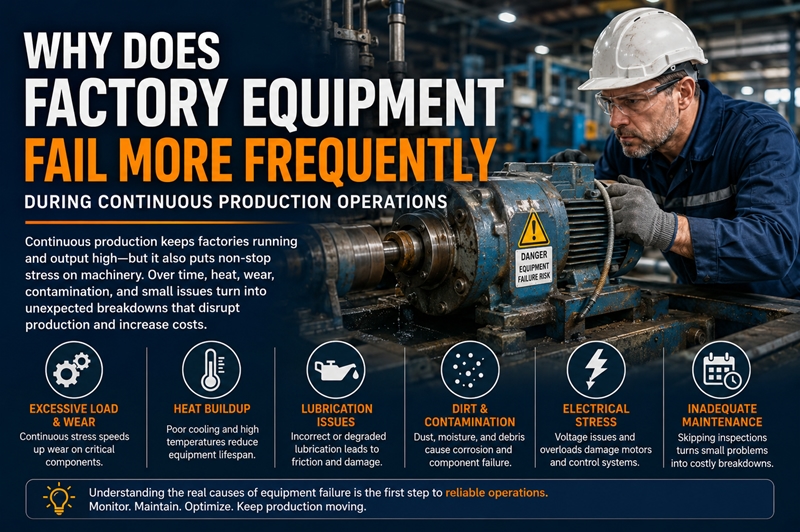
Continuous production helps manufacturing plants meet growing demand, maintain output targets and utilise installed equipment more efficiently. However, operating machinery for extended periods can expose weaknesses that may not become apparent during shorter production cycles. Motors may overheat, bearings may deteriorate, pumps may lose performance and production lines may experience unexpected shutdowns. These problems can become particularly difficult to manage when the same equipment develops recurring faults despite regular maintenance.
The issue is not simply the number of hours a machine operates. Equipment reliability also depends on operating loads, cooling arrangements, lubrication, installation quality, environmental conditions and the suitability of machinery for its intended duty cycle. When these factors are not properly evaluated, continuous production can accelerate component deterioration and increase the likelihood of unplanned failures.
For manufacturers, understanding why equipment fails during extended operations is important for maintaining production schedules, controlling maintenance expenditure and avoiding repeated machinery breakdowns. A systematic approach to industrial equipment troubleshooting can help identify the underlying causes before they develop into more serious operational problems.
Why Does Continuous Production Put Additional Stress on Factory Equipment?
Industrial machinery is designed to operate within specified performance and operating conditions. However, continuous production exposes equipment to sustained mechanical loads, heat generation, friction and environmental influences. If the machine's operating conditions differ from its design assumptions, components may deteriorate faster than expected.
The International Electrotechnical Commission's IEC 60034-1 standard recognises different operating duty classifications for rotating electrical machines. These include continuous running duty (S1), short-time duty (S2) and intermittent periodic duty (S3), among others. This distinction highlights why equipment selection should consider actual operating requirements rather than relying only on rated power or capacity.
Several technical factors can explain why machinery experiences more frequent problems during extended manufacturing operations.
Continuous Mechanical Loading Accelerates Component Wear
Industrial equipment contains moving components that experience friction, contact stress and mechanical loading during operation. Bearings, shafts, gears, couplings and conveyor rollers are particularly exposed to these conditions.
During continuous production, these components operate for extended periods without significant interruption. If the equipment experiences excessive loading, misalignment, inadequate lubrication or vibration, component deterioration may accelerate.
For example, a bearing supporting a continuously rotating industrial motor experiences repeated rolling-contact stresses. If the bearing is incorrectly installed or operates under unsuitable conditions, its surfaces may develop fatigue damage. Initially, the machine may continue functioning, but progressive deterioration can eventually result in abnormal noise, vibration, temperature increases or bearing failure.
SKF identifies fatigue, lubrication problems, contamination and incorrect fitting among the major contributors to premature bearing failures.
Manufacturers should therefore investigate:
Bearing condition and lubrication effectiveness.
Shaft and coupling alignment.
Mechanical loading and operating speed.
Excessive vibration and abnormal noise.
Signs of wear in gears, rollers and rotating assemblies.
Ignoring these indicators can result in repeated component replacements without resolving the underlying mechanical problem.
Heat Accumulation Affects Equipment Performance
Heat generation is a normal part of industrial equipment operation. Electric motors, gearboxes, compressors, hydraulic systems and electrical panels generate heat through electrical losses, friction and mechanical energy transfer.
Under suitable operating conditions, cooling arrangements remove this heat and maintain equipment within acceptable temperature limits. However, continuous production can expose weaknesses in these arrangements, particularly when machinery operates under heavy loads or in high-temperature environments.
Common contributing factors include:
Blocked motor ventilation openings.
Dust accumulation on cooling surfaces.
Restricted cooling-water circulation.
Contaminated heat exchangers.
Inadequate ventilation around electrical panels.
Operating temperatures exceeding design assumptions.
For instance, an industrial motor may operate normally during shorter production periods but experience excessive temperature rise when required to run continuously under heavy loading. Prolonged overheating can accelerate insulation ageing and affect bearing lubrication.
Manufacturers should not assume that every temperature increase indicates motor failure. The actual cause may involve electrical supply conditions, mechanical loading, cooling performance or environmental factors.
Monitoring operating temperatures and investigating unusual changes can help identify developing problems before they result in unexpected shutdowns.
Lubrication Problems Develop During Extended Operating Hours
Lubrication reduces friction, limits wear and helps protect moving components in industrial machinery. Bearings, gearboxes, compressors and hydraulic equipment depend on appropriate lubrication to maintain reliable performance.
During continuous production, lubricants remain exposed to operating temperatures, mechanical stress and potential contamination for extended periods. Their effectiveness can decline when lubrication practices do not reflect actual operating conditions.
Common lubrication-related problems include:
Insufficient lubricant supply.
Incorrect oil viscosity or grease selection.
Excessive lubrication.
Lubricant oxidation and deterioration.
Contamination from dust, moisture or process materials.
Inappropriate lubrication intervals.
SKF's bearing maintenance guidance explains that operating temperature and environmental conditions influence grease service life and relubrication requirements.
A common maintenance mistake is following the same calendar-based lubrication schedule for equipment with significantly different operating hours and loading conditions.
For example, two identical machines may require different maintenance attention if one operates intermittently while the other runs continuously under heavier loads. Their lubrication requirements should be assessed using manufacturer recommendations, operating conditions and actual equipment performance.
Regular lubrication inspections, lubricant-condition checks and appropriate maintenance planning can help reduce premature component deterioration.
Production Demands Exceed the Equipment's Designed Capacity
Manufacturing requirements can change after equipment installation. Companies may increase production speeds, process heavier materials or extend operating hours to meet higher customer demand.
However, increasing production output without reassessing equipment capability can create additional mechanical and electrical stress.
Consider a conveyor system originally selected to handle a particular material flow rate. If production demand increases, the conveyor may experience higher loading, increased drive requirements and additional stress on rollers, bearings and supporting structures.
Similar problems can occur in pumps, compressors, industrial motors and processing machinery.
Potential consequences include:
Motor overload and repeated protective trips.
Excessive vibration in rotating equipment.
Increased bearing and gearbox wear.
Reduced machine performance.
Higher operating temperatures.
Frequent maintenance interventions.
Manufacturers should compare actual production requirements with equipment ratings and approved operating limits. A machine operating below its rated capacity is not necessarily free from stress, particularly when other operating conditions are unsuitable.
Before increasing production speeds or loads, engineering teams should evaluate whether the installed equipment can safely support the revised operating requirements.
Dust, Moisture and Contamination Affect Equipment Reliability
Manufacturing environments can expose machinery to dust, moisture, chemicals, metal particles and process residues. During extended production, these contaminants may accumulate around equipment or enter sensitive mechanical and electrical components.
For example, dust entering motor ventilation passages can restrict cooling. Contaminated lubricants can increase abrasive wear in bearings and gearboxes. Moisture inside electrical enclosures can affect insulation and electrical connections.
These problems are particularly relevant in manufacturing facilities handling powders, bulk materials, chemicals or moisture-sensitive products.
Equipment reliability may be affected by:
Damaged seals and protective enclosures.
Inadequate filtration arrangements.
Poor housekeeping around machinery.
Moisture entering lubrication systems.
Contaminated cooling arrangements.
Dust accumulation around electrical components.
Manufacturers should evaluate environmental conditions when selecting equipment, planning inspections and determining maintenance requirements.
The appropriate protection level, filtration arrangements and sealing provisions should reflect the actual conditions in which the machinery operates.
Equipment Is Not Suitable for the Actual Operating Duty Cycle
One important reason for repeated equipment failures is incorrect equipment selection.
Not every industrial machine is designed for continuous operation. Some motors and other equipment are intended for intermittent or short-time duty, while others are designed for sustained operating conditions.
IEC 60034-1 classifies electrical machine operating duties, including:
S1 – Continuous running duty: Operation at a constant load for sufficient time to reach thermal equilibrium.
S2 – Short-time duty: Operation for a limited period, followed by sufficient rest for cooling.
S3 – Intermittent periodic duty: Repeated operating and rest cycles.
Problems can arise when production requirements change after installation and machinery is operated beyond its intended duty conditions.
For example, a motor selected for intermittent operation may experience excessive temperature rise if subsequently used for prolonged production cycles without reassessing its suitability.
Before extending equipment operating hours, manufacturers should review:
Motor and equipment duty classifications.
Rated operating conditions.
Expected load variations.
Ambient temperature and cooling requirements.
Manufacturer recommendations.
Actual production schedules.
This evaluation helps identify whether recurring failures are associated with equipment selection or changes in operating requirements.
Problems in Connected Equipment Interrupt Production Operations
Industrial production systems rarely operate through independent machines. Manufacturing lines depend on interconnected equipment, electrical controls, compressed air, cooling water, hydraulic systems and material-handling arrangements.
A fault in one supporting system can affect several connected machines.
For example, insufficient compressed air pressure may interrupt pneumatic operations across a production line. Similarly, unstable cooling-water circulation can affect equipment that depends on controlled operating temperatures.
Other examples include:
Conveyor motor failures disrupting downstream material supply.
PLC communication problems affecting coordinated machine operation.
Hydraulic pressure fluctuations affecting production equipment.
Electrical supply interruptions causing repeated machine trips.
Central lubrication failures affecting multiple rotating components.
These situations demonstrate why investigating only the machine that stops working may not reveal the actual cause of production interruptions.
Manufacturers should examine the relationships between equipment, utilities and control systems when recurring faults affect multiple production operations.
A system-level investigation can help distinguish individual machine failures from problems originating in shared supporting infrastructure.
Maintenance Schedules Do Not Reflect Actual Equipment Conditions
Regular maintenance is important, but following a fixed schedule does not automatically ensure equipment reliability.
Some manufacturing plants perform inspections and component replacements according to predefined intervals without considering actual operating hours, production loads, temperature changes or previous failure patterns.
This can create gaps between maintenance activities and the equipment's actual requirements.
For example, a machine operating continuously under heavy loading may experience faster component deterioration than another machine operating intermittently. Applying identical inspection intervals without evaluating these differences may result in delayed identification of developing problems.
The US Department of Energy identifies reactive, preventive, predictive and reliability-centred maintenance as different approaches to operations and maintenance management.
Manufacturers can improve maintenance planning by combining scheduled inspections with condition-based monitoring where appropriate.
Relevant monitoring parameters include:
Vibration levels.
Bearing and motor temperatures.
Electrical current and voltage.
Lubricant condition.
Hydraulic and discharge pressure.
Equipment operating hours.
Previous fault and breakdown records.
The purpose is to identify changes in equipment condition and determine whether maintenance intervention is required before a developing fault causes production disruption.
Early Warning Signs Are Ignored During Production
In many manufacturing plants, production targets and delivery commitments create pressure to keep equipment running.
As a result, operators may continue using machinery despite minor abnormalities that require technical investigation.
These warning signs may include unusual noise, increasing vibration, lubricant leakage, fluctuating pressure, repeated alarm indications and inconsistent machine speeds.
Although these symptoms may not immediately stop production, they can indicate developing mechanical, electrical or process-related problems.
For example, abnormal vibration may be associated with shaft misalignment, imbalance, bearing deterioration or loose mechanical connections. Similarly, repeated motor trips may indicate overload, electrical supply problems or excessive mechanical resistance.
The correct response depends on the equipment and the severity of the condition. Safety-critical warnings and manufacturer shutdown instructions should never be ignored to maintain production.
Establishing clear reporting procedures helps operators communicate abnormal equipment behaviour to maintenance and engineering teams before the problem becomes more serious.
How Can Manufacturers Investigate Recurring Equipment Failures?
When equipment repeatedly fails during continuous production, replacing the damaged component may provide only temporary relief. Manufacturers need to investigate the operating conditions and identify the underlying cause.
A structured technical assessment can include the following activities:
1. Review equipment operating history: Examine previous breakdowns, maintenance records, alarm logs, production schedules and operating hours to identify recurring patterns.
2. Measure operating parameters: Check relevant temperatures, vibration levels, electrical readings, pressure, flow rates and machine loading against manufacturer specifications.
3. Inspect mechanical and electrical components: Evaluate bearings, shafts, couplings, gearboxes, motors, electrical connections and cooling arrangements as applicable.
4. Examine connected systems: Investigate whether utility supply, automation controls, supporting equipment or upstream and downstream processes contribute to recurring failures.
5. Identify underlying causes: Distinguish between the immediate component failure and the actual technical reason behind it. Consider equipment selection, installation, operating conditions and maintenance practices.
6. Verify corrective actions: After implementing suitable interventions, assess equipment behaviour under representative production conditions and document the results.
This approach helps manufacturers move beyond repeated repairs and make decisions based on equipment condition, operating evidence and technical findings.
When Should Manufacturers Seek External Engineering Support?
External engineering support becomes relevant when recurring equipment failures cannot be resolved through routine maintenance activities. Manufacturers may require an independent technical assessment when machinery repeatedly develops faults, equipment performance remains below expectations or problems involve interconnected mechanical, electrical and process systems.
Specialist support can also be useful when internal teams lack the resources or expertise to investigate complex failures, evaluate installation-related problems or verify equipment performance under actual operating conditions.
The objective should be to establish the underlying technical cause, identify practical corrective actions and reduce the likelihood of repeated production interruptions.
How IMARC Engineering Can Help
IMARC Engineering provides On-Site Troubleshooting & Technical Support to help manufacturing businesses investigate equipment-related problems and operational difficulties. The support focuses on assessing equipment conditions, examining mechanical and electrical issues, identifying potential causes of recurring failures and evaluating relevant operating parameters. By reviewing machinery performance and associated technical arrangements, engineering specialists can help manufacturers understand unresolved problems and determine appropriate corrective measures. This supports better-informed maintenance decisions, improved equipment reliability and more stable manufacturing operations.
Connect with an expert: https://www.imarcengineering.com/contact?service=on-site-troubleshooting-technical-support
Conclusion
Factory equipment failures during continuous production are rarely attributable to operating hours alone. Unsuitable duty cycles, excessive loading, heat accumulation, lubrication problems, contamination and interconnected system faults can all contribute to recurring breakdowns. Manufacturers should investigate these factors rather than relying exclusively on repeated component replacements. Reviewing operating history, monitoring equipment conditions and verifying corrective actions can help identify underlying problems. A systematic engineering assessment also supports better maintenance planning, more reliable machinery performance and fewer avoidable production interruptions.
Contact Us:
IMARC Engineering
Phone: 917827860593
Email: sales@imarcengineering.com
India: C-130, Sector 2, Noida, Uttar Pradesh 201301
LinkedIn: https://www.linkedin.com/showcase/imarc-engineering/




