
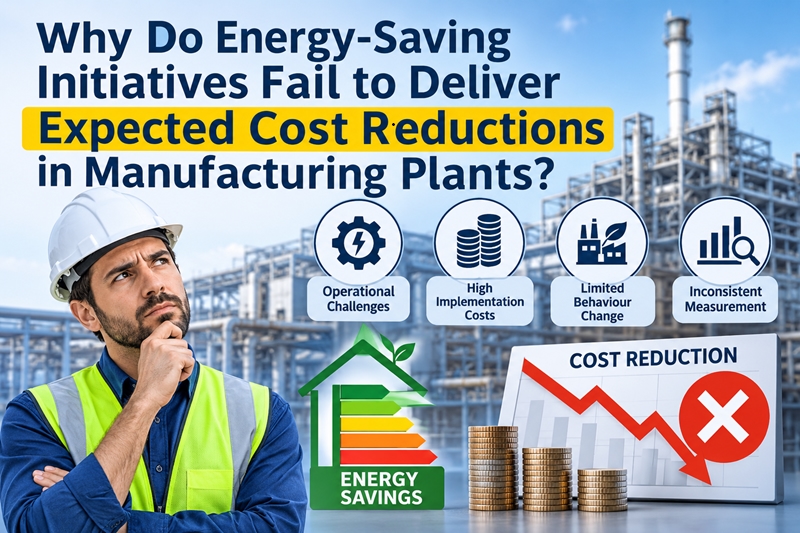
Manufacturing companies invest in energy-efficient motors, automated controls, compressed-air systems and upgraded utilities to reduce operating expenses. However, the expected financial benefits do not always appear after implementation. Electricity bills may remain high, equipment may consume more power than anticipated, or projected savings may disappear as production requirements change.
This gap between expected and actual performance creates a difficult situation for management. Although the investment has been completed, manufacturers may struggle to determine whether the problem lies in equipment selection, operating conditions, maintenance practices or the original savings estimates.
Energy efficiency improvements require more than replacing inefficient machinery. Their financial performance depends on how accurately energy consumption is assessed, how equipment operates under actual production conditions and whether savings are measured after implementation. Understanding these factors helps manufacturers identify underperforming initiatives and make better decisions about future investments.
Inaccurate Energy Assessments Lead to Unrealistic Savings Expectations
One of the main reasons energy-saving projects underperform is that investment decisions are sometimes based on incomplete consumption data. Manufacturers may evaluate electricity bills, equipment ratings or estimated operating hours without examining how energy demand changes throughout production cycles.
For example, a compressor may operate at different loading levels depending on the number of production lines running. Similarly, cooling systems may consume more electricity during certain shifts or seasons. Using a single average consumption figure can overlook these operating variations, making it difficult to identify actual inefficiencies during Energy Efficiency Audits.
Equipment nameplate ratings also do not necessarily reflect actual energy consumption. A motor rated at a particular capacity may operate under varying loads, while auxiliary equipment may continue consuming electricity during production interruptions.
Consequently, an upgrade selected using estimated consumption figures may deliver less savings than initially projected.
Manufacturers should establish an accurate picture of energy use before approving improvements. This involves reviewing equipment-wise consumption, operating schedules, production volumes and significant utility loads. Comparing these factors helps identify where energy is being used unnecessarily and whether the proposed investment addresses the actual source of inefficiency.
Increased Production Can Offset Energy Savings
An energy-efficient system may reduce the electricity required to manufacture each unit without reducing the facility's total electricity consumption. This often happens when improved equipment enables manufacturers to increase production capacity or operate machinery for longer periods.
Consider a manufacturing facility that produces 10,000 units monthly using 100,000 kWh of electricity. Its initial energy consumption is 10 kWh per unit. Following equipment improvements, monthly production increases to 13,000 units while electricity consumption reaches 117,000 kWh.
The facility now consumes 9 kWh per unit, representing a 10% improvement in energy intensity. However, total electricity consumption has increased by 17%.
This illustrates why evaluating energy efficiency through monthly electricity bills alone can produce misleading conclusions.
Research conducted by Nicholas Ryan on energy-intensive Indian manufacturing plants found that improvements in physical efficiency were accompanied by increased capacity utilisation. The additional operating activity offset some of the energy savings that might otherwise have occurred.
Manufacturers should therefore monitor both total energy consumption and energy consumption per unit of production. These indicators help management distinguish between genuine efficiency improvements and increases in energy demand caused by higher manufacturing output.
Equipment Upgrades Without System-Level Evaluation Limit Savings
Replacing an inefficient machine does not automatically improve the performance of the entire utility system. Manufacturing equipment operates within interconnected networks, meaning inefficiencies elsewhere can reduce the benefits of an individual upgrade.
Compressed-air systems provide a practical example. A company may install a more efficient compressor but continue experiencing high electricity consumption because of leaking pipelines, excessive operating pressure or unnecessary air demand.
Similar problems occur in other utility systems:
Motors and pumps: Incorrect sizing, unsuitable operating speeds and throttling can increase electricity consumption.
Boilers and steam networks: Poor insulation, steam leakage and inadequate combustion control can increase fuel requirements.
Cooling systems: Fouled heat exchangers, unsuitable temperature settings and poor equipment sequencing can reduce cooling efficiency.
HVAC systems: Inappropriate operating schedules and inefficient ventilation controls can increase electricity demand.
These problems demonstrate why equipment selection should be supported by a broader evaluation of the systems in which the equipment operates.
Manufacturers need to examine energy demand, supporting infrastructure, operating conditions and interactions between utilities before approving upgrades. Addressing the complete system can prevent investments from improving one component while leaving significant energy losses unresolved.
Incorrect Commissioning and Operating Settings Reduce Equipment Performance
Even when suitable energy-efficient equipment is installed, its performance may remain below expectations if commissioning and operating parameters are not properly managed.
New equipment must be configured according to actual process requirements. Otherwise, the difference between its rated efficiency and its performance under factory conditions can become significant.
For instance, variable frequency drives may be installed to regulate motor speed, but unsuitable control settings can prevent the equipment from operating at its most efficient point. Cooling systems may maintain unnecessarily low temperatures, while compressors may operate at higher pressure than production equipment requires.
In some facilities, control systems are also configured without considering variations in production demand. As a result, several machines may operate simultaneously even when the process requires only partial capacity.
Manufacturers should verify equipment performance during commissioning rather than relying exclusively on supplier specifications. Functional testing, operating parameter checks and performance measurements help determine whether the installed system meets its intended requirements.
Operators should also receive appropriate training so that new equipment is used according to its design and operating requirements.
Poor Maintenance Causes Energy Performance to Deteriorate
Energy-saving initiatives are sometimes evaluated immediately after installation, when equipment is relatively new and operating conditions are carefully monitored. However, efficiency can deteriorate if maintenance practices do not support the upgraded systems.
For example, dirty filters can restrict airflow, fouled heat exchangers can reduce heat-transfer performance and compressed-air leaks can increase compressor operating hours. Similarly, poor pump alignment, damaged insulation and neglected cooling-system components can increase energy requirements.
These problems may develop gradually and remain unnoticed when maintenance teams focus primarily on equipment availability rather than energy performance.
Manufacturers should integrate energy-related checks into preventive maintenance schedules. Maintenance teams can monitor pressure differences, leakage, operating temperatures, motor loading and equipment performance against established reference conditions.
This approach helps identify deterioration before it results in substantial additional consumption. It also ensures that the benefits achieved through equipment upgrades are maintained during routine manufacturing operations.
Manufacturers Do Not Verify Actual Energy Savings
Another important reason for underperforming projects is the absence of a reliable process for measuring savings after implementation.
Management may compare electricity bills from two different months and use the difference to evaluate project performance. However, such comparisons do not necessarily establish whether an improvement has reduced energy consumption.
Several factors can influence the result, including production volumes, operating hours, product specifications, weather conditions and changes in manufacturing schedules.
A more reliable approach involves establishing an energy baseline before implementation and comparing subsequent consumption against that reference under comparable operating conditions.
The US Department of Energy's industrial energy-management guidance recommends monitoring energy performance before and after an improvement while accounting for relevant operating variables such as production, weather and operating hours.
Manufacturers should evaluate the following indicators:
Performance indicator | Purpose |
|---|---|
Baseline energy consumption | Establishes the reference level before implementation. |
Production output | Accounts for changes in manufacturing activity. |
Operating hours | Identifies variations in equipment utilisation. |
Energy consumption per unit | Measures energy efficiency relative to production. |
Post-implementation consumption | Evaluates actual equipment and process performance. |
Electricity and fuel expenditure | Measures the financial impact of the improvement. |
Measurement and verification should also account for changes in tariffs and maximum demand charges when evaluating financial outcomes.
This distinction is important because reduced energy consumption does not necessarily produce an equivalent reduction in the electricity bill. Manufacturers need to understand both technical performance and the financial impact of an improvement.
Energy Investments Are Prioritised Without Considering Operational Requirements
Manufacturers frequently have several opportunities to improve energy efficiency but limited capital expenditure budgets. Selecting projects solely on estimated payback periods can result in investments that do not address the most significant operational losses.
For example, replacing a relatively efficient machine may offer a shorter estimated payback than correcting persistent losses in a compressed-air network. However, the latter may provide greater overall savings if the network operates continuously across multiple production lines.
Investment decisions should therefore consider more than the initial cost and projected return.
Before approving an energy-saving project, management should evaluate:
Actual energy consumption and potential savings.
Equipment utilisation and operating hours.
Installation costs and production downtime.
Compatibility with existing infrastructure.
Maintenance and lifecycle requirements.
Expected financial returns under realistic operating conditions.
Comparing these factors helps manufacturers identify improvements that are technically suitable and financially justified.
Energy Management Responsibilities Are Not Clearly Defined
Energy performance is influenced by decisions across production, maintenance, procurement, utilities and finance departments. When these functions operate independently, energy-saving initiatives may not receive the attention required after implementation.
For instance, production teams may prioritise uninterrupted equipment availability, while energy managers focus on reducing consumption during idle periods. Without agreed operating procedures, equipment may continue running unnecessarily.
Similarly, procurement teams may select equipment based primarily on purchase price, without adequately considering its expected energy consumption over its operating life.
Manufacturers should assign clear responsibility for energy performance and establish coordination between departments. Regular reviews of consumption data, improvement targets and corrective actions can help ensure that energy efficiency remains part of routine operational management.
Why Lower Energy Consumption Does Not Always Mean Lower Energy Bills
Energy performance and financial performance should be evaluated separately. A facility may reduce electricity consumption per unit while experiencing higher total expenditure because production has increased or electricity tariffs have changed.
Maximum demand charges, power factor-related charges and time-of-day tariffs can also influence the final bill. Consequently, an equipment upgrade that reduces overall electricity consumption may deliver less financial savings than initially expected if peak demand remains unchanged.
Manufacturers should assess energy consumption, electricity demand and applicable tariffs together. This provides a more realistic understanding of project returns and helps management identify whether further improvements are required in equipment operation, load scheduling or utility management.
How Can Manufacturers Improve the Performance of Energy-Saving Initiatives?
Manufacturers can improve project outcomes by establishing reliable energy baselines, examining significant consumption areas and identifying the actual causes of operational losses. Proposed upgrades should be evaluated against production requirements, technical feasibility, capital expenditure and expected financial returns. After implementation, actual performance should be measured against adjusted baseline conditions. Regular equipment maintenance, operator training and coordination between production and utility teams further help sustain improvements. This structured approach allows management to identify performance gaps and make informed decisions about future energy investments.
How IMARC Engineering Can Help
IMARC Engineering supports manufacturers in evaluating energy consumption, identifying operational inefficiencies and assessing opportunities for improving utility performance. Its engineering-led approach helps businesses examine equipment requirements, production conditions and energy-saving opportunities before prioritising improvement measures. By connecting technical assessments with operational and financial considerations, IMARC Engineering helps manufacturers understand where energy losses occur and which improvements warrant further evaluation. This supports more informed investment decisions and a structured approach to improving manufacturing energy performance.
Connect with an expert: https://www.imarcengineering.com/contact?service=utility-cost-energy-efficiency-audits
Conclusion
Energy-saving investments deliver meaningful financial results only when equipment improvements are supported by accurate assessments, suitable operating conditions and continuous performance monitoring. Manufacturers should look beyond equipment replacement and evaluate how production requirements, utility systems, maintenance practices and energy costs influence actual outcomes. Comparing energy consumption with production output and verifying savings after implementation helps management identify underperforming initiatives. A systematic approach to energy management enables manufacturers to protect existing investments, reduce avoidable losses and make better decisions about future efficiency improvements.
Contact Us:
IMARC Engineering
Phone: 917827860593
Email: sales@imarcengineering.com
India: C-130, Sector 2, Noida, Uttar Pradesh 201301
LinkedIn: https://www.linkedin.com/showcase/imarc-engineering/



