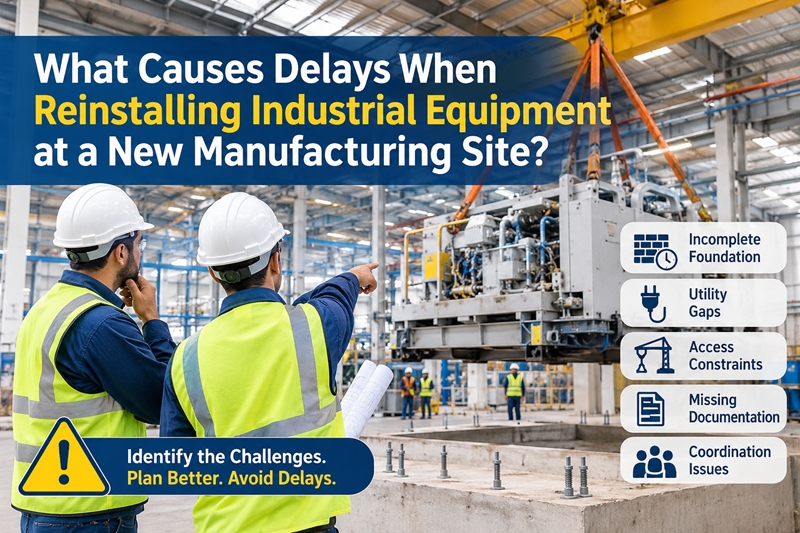
Relocating industrial equipment to a new manufacturing facility involves more than transporting machinery from one location to another. Once equipment reaches its destination, manufacturers must ensure that the receiving site is structurally prepared, utilities are available, installation drawings are accurate and technical teams are ready to complete the work. Any gap in these requirements can prevent machinery from being installed or returned to operation as scheduled.
For manufacturing companies, these delays can affect production schedules, project expenditure, customer commitments and the overall relocation programme. A machine may arrive at the new facility on time but remain unused because its foundation is incomplete, electrical connections are unavailable or specialist installation support has not been arranged.
Understanding these problems before equipment dispatch helps manufacturers prepare the receiving facility and coordinate installation activities more effectively. This article examines the major causes of industrial equipment reinstallation delays and the practical measures companies can take to avoid them.
Incomplete Foundation and Civil Work
Industrial machinery often requires foundations designed to accommodate its weight, operating loads, vibration characteristics and installation configuration. If the receiving facility is not prepared according to the equipment manufacturer's specifications, mechanical installation may have to be postponed.
Problems can arise when foundation dimensions differ from approved drawings, anchor bolts are incorrectly positioned or concrete work has not reached the required condition for installation. Heavy machinery may also require specific floor-loading capacity and additional structural support.
These issues become particularly challenging when equipment has already been transported to the new site. Correcting foundation deficiencies at this stage may involve additional civil work, inspection and changes to the installation schedule.
Manufacturers should obtain foundation drawings before relocation and verify the receiving site's structural requirements. Civil contractors should complete the necessary work and obtain engineering clearance before machinery is scheduled for final positioning.
Electrical and Utility Connections Are Not Ready
Mechanical installation does not automatically make industrial equipment operational. Machinery also requires compatible electrical supplies and supporting utilities, which may differ between the original and receiving facilities.
For example, a production machine may require a dedicated electrical feeder, compressed air, cooling water, hydraulic connections or process piping. If these facilities are unavailable or incorrectly configured, installation teams may be unable to proceed with electrical integration and functional testing.
Common problems include:
Insufficient electrical distribution capacity or incomplete feeder connections.
Incorrect voltage, frequency or electrical connection arrangements.
Incomplete cable trays, control cables and termination points.
Inadequate compressed-air pressure or flow.
Missing cooling-water supply, drainage or hydraulic connections.
Incomplete earthing and control-system integration.
The difficulty is that utility requirements are sometimes assessed only after machinery reaches the new facility. This creates additional work for electrical and mechanical contractors and can delay commissioning.
Before equipment dispatch, manufacturers should prepare an equipment-wise utility requirement schedule. It should identify electrical loads, connection specifications, compressed-air requirements, cooling arrangements and other essential services. The available infrastructure should then be compared against these requirements.
Equipment Cannot Reach Its Intended Installation Position
A receiving facility may have sufficient floor space for machinery but still lack the physical access required to move it into position.
This problem often occurs when project teams consider the machine's final footprint without assessing the complete movement route from the unloading area to the installation location.
For instance, a large machine may fit inside a production hall but cannot pass through an existing doorway because its dimensions exceed the available clearance. Similarly, overhead structures, columns, floor openings and restricted turning areas can interfere with equipment movement.
Other possible constraints include:
Insufficient ceiling height for lifting operations.
Limited crane access or inadequate lifting capacity.
Floor surfaces that cannot support transportation loads.
Restricted movement around existing production equipment.
Inadequate space for temporary storage and assembly.
These limitations can require alternative lifting arrangements, additional dismantling or changes to the installation sequence.
A physical site survey should therefore be completed before transportation planning is finalised. Engineers should measure access routes, verify floor conditions and assess the lifting arrangements required to move each machine safely into its designated position.
Missing Equipment Drawings and Dismantling Records
Industrial machinery may contain numerous mechanical assemblies, electrical connections, sensors, hydraulic lines and control-system components. Reinstalling these components becomes difficult when dismantling information is incomplete.
During relocation, cables may be disconnected, pipes removed and mechanical assemblies separated for transportation. If these components are not properly labelled and documented, installation teams may spend additional time identifying connections and confirming the original equipment configuration.
This problem is particularly relevant when machinery has undergone modifications during years of operation. Original drawings may no longer reflect its actual condition.
Important documentation gaps include:
Missing or outdated mechanical and electrical drawings.
Unlabelled cables, hydraulic lines and pneumatic connections.
Incomplete photographs of equipment before dismantling.
Missing PLC programmes or control-system backups.
Unrecorded machine settings and operating parameters.
Incomplete inventories of removed components and accessories.
Manufacturers should maintain equipment-specific dismantling and reassembly records. Every major component should be identified, and important connections should be photographed before disassembly.
The objective is to ensure that the installation team can reconstruct the equipment using verified information rather than relying on assumptions or repeated troubleshooting.
Poor Coordination Between Installation Contractors
Reinstalling industrial equipment involves several engineering disciplines. Civil contractors, mechanical installers, electrical teams, instrumentation specialists and commissioning engineers must complete their activities in a coordinated sequence.
Delays occur when these activities are planned independently rather than as connected parts of one installation programme.
For example, mechanical contractors may be ready to position machinery, but civil work may still be incomplete. Electrical contractors may be waiting for final equipment positioning before installing cable connections. Commissioning engineers may arrive before the machine is mechanically and electrically ready.
These scheduling gaps can result in idle manpower, repeated contractor mobilisation and unnecessary waiting periods.
Manufacturers should establish an integrated installation schedule that identifies:
Activities that must be completed before machinery positioning.
Responsibilities assigned to each contractor.
Required inspection and approval points.
Dependencies between mechanical and electrical work.
Dates for specialist technician mobilisation.
Commissioning and production handover requirements.
A designated project coordinator should monitor progress across all disciplines and resolve conflicts before they affect subsequent installation activities.
Unavailability of OEM Technicians and Specialist Engineers
Certain industrial machines require specialist knowledge for installation, configuration and commissioning. This is especially relevant to precision machinery, CNC equipment, automated production systems and specialised process equipment.
Although a local installation team may be capable of handling mechanical assembly, it may not have the technical knowledge required to configure machine controls, calibrate instruments or verify specialised operating parameters.
Delays can occur when:
OEM technicians are unavailable during the planned installation period.
Specialist alignment engineers have not been scheduled.
Automation programmers are unavailable.
Equipment-specific commissioning procedures require manufacturer support.
Installation teams lack experience with the particular machinery model.
Manufacturers should identify these requirements before dismantling begins. OEM support arrangements, specialist visits, technical documentation and commissioning responsibilities should be confirmed in advance.
Where equipment warranties or manufacturer requirements specify particular installation procedures, these should also be considered while selecting contractors and scheduling the work.
Incorrect Equipment Alignment and Levelling
Positioning machinery at its designated location is only one part of installation. Equipment must also be levelled, aligned and secured according to its technical requirements.
This is particularly important for rotating machinery, precision manufacturing equipment and interconnected production systems.
Problems can arise when the equipment base is uneven, foundation conditions have changed or alignment tolerances are not achieved during installation.
For example, incorrect alignment between a motor and its driven equipment can contribute to excessive vibration, bearing stress and premature component wear. Similarly, inaccurate machine levelling may affect machining accuracy or the consistency of production output.
The installation team may need to repeat measurements, adjust mounting arrangements and investigate foundation or support conditions before accepting the equipment.
Manufacturers should establish equipment-specific alignment and levelling requirements before relocation. Suitable measurement instruments should be available, and final readings should be recorded against the applicable OEM specifications.
API Recommended Practice 686 provides guidance on machinery installation and pre-commissioning for petroleum, chemical and gas industry facilities. Its principles can be a useful reference where applicable, but equipment-specific manufacturer instructions should remain central to the installation process.
Missing Spare Parts and Specialised Installation Tools
Equipment relocation can expose problems that were not identified during the initial dismantling assessment. Components may become damaged during handling, while some installation accessories may be misplaced or unavailable at the destination.
For example, damaged seals, gaskets, bearings and connectors may need replacement before equipment assembly can be completed. Special fasteners, mounting brackets and lifting fixtures may also be necessary for specific machinery.
The problem becomes more serious when replacement components have long procurement lead times or are available only through the original equipment manufacturer.
Manufacturers should prepare an inventory of critical components, spare parts, consumables and specialised tools before dismantling. Components should be inspected during packing and again after transportation.
This allows missing or damaged items to be identified early, reducing the possibility of installation work stopping because an essential component is unavailable.
Incomplete Safety Inspections and Installation Approvals
Industrial equipment must be installed and tested under appropriate safety controls. Reinstallation at a new facility may introduce different workplace hazards because equipment positioning, utility arrangements, access routes and surrounding operations have changed.
Common issues include incomplete machine guarding, unverified emergency-stop arrangements, unfinished electrical isolation systems and inadequate lifting procedures.
Stored energy also requires attention. Machinery can contain electrical, hydraulic, pneumatic, mechanical or thermal energy that must be safely controlled during installation and maintenance.
The US Occupational Safety and Health Administration's hazardous-energy standard, 29 CFR 1910.147, addresses energy isolation, lockout/tagout procedures and verification during covered servicing and maintenance activities. Indian manufacturing facilities must follow the applicable Indian legal and safety requirements.
Before installation and energisation, manufacturers should ensure that risk assessments, isolation procedures, lifting plans and required work permits are in place. Safety devices and protective arrangements should be checked before equipment is released for operation.
Commissioning Requirements Are Not Properly Planned
A machine that has been mechanically assembled and electrically connected is not necessarily ready for production.
Commissioning involves checking whether equipment operates correctly under the conditions specified by the manufacturer and the receiving facility. This may include mechanical inspections, electrical testing, control-system verification, safety checks and trial operation.
Delays occur when commissioning requirements are considered only after installation is complete.
For example, PLC settings may require modification to suit the new facility. Sensors may need recalibration, safety interlocks may require verification and production trials may reveal operating problems that were not identified during initial testing.
Manufacturers should prepare a commissioning plan before equipment relocation. The plan should identify testing responsibilities, required technical personnel, acceptance criteria and documentation requirements.
Depending on the equipment, the process may include:
Mechanical completion and inspection.
Electrical connection and verification.
Control-system and instrumentation checks.
Safety-device and interlock testing.
Functional testing under controlled conditions.
Trial production and performance assessment.
Final acceptance and operational handover.
Planning these activities in advance helps prevent commissioning from becoming an unanticipated extension of the relocation project.
How to Prepare a New Manufacturing Site Before Equipment Arrives
Preventing installation delays requires manufacturers to assess the destination facility before equipment is dispatched. The receiving site should be treated as a separate engineering workstream within the relocation project.
A practical readiness assessment should cover the following areas:
Structural readiness: Confirm foundation dimensions, concrete condition, anchor-bolt locations, floor-loading capacity and equipment mounting arrangements.
Access and lifting readiness: Verify unloading areas, internal movement routes, overhead clearance, crane access and lifting equipment capacity.
Utility readiness: Confirm electrical supply, earthing, compressed air, cooling water, drainage and other equipment-specific services.
Documentation readiness: Collect equipment drawings, dismantling records, connection diagrams, configuration backups and installation instructions.
Resource readiness: Schedule mechanical and electrical contractors, OEM technicians, specialist engineers and commissioning personnel.
Safety readiness: Complete risk assessments, isolation arrangements, lifting plans and applicable work permits.
These checks should be completed through formal handover points rather than informal confirmations. For example, civil readiness should be approved before final positioning, while electrical and utility readiness should be verified before energisation.
This approach helps manufacturers identify unresolved issues while there is still time to correct them without disrupting the installation sequence.
How IMARC Engineering Can Help
Equipment relocation requires coordination between civil, mechanical, electrical, utility and commissioning activities to ensure machinery is installed correctly at the receiving facility. IMARC Engineering supports manufacturers through equipment relocation planning, site-readiness assessment, dismantling and reinstallation coordination, foundation and utility verification, contractor management, technical alignment and commissioning supervision. This integrated engineering approach helps identify installation constraints before they affect project schedules, reduce avoidable coordination gaps and support a controlled transition towards production restart.
Connect with an expert: https://www.imarcengineering.com/contact?service=equipment-relocation-and-reinstallation
Conclusion
Industrial equipment reinstallation delays often result from incomplete site preparation, utility gaps, missing documentation and poor coordination between engineering contractors. Manufacturers should therefore assess the receiving facility before dispatching machinery and establish clear responsibilities for every installation activity. By verifying foundations, utilities, access arrangements, technical resources and commissioning requirements in advance, companies can reduce avoidable interruptions. A structured relocation programme helps protect existing equipment, control project expenditure and restore manufacturing operations with greater confidence and operational reliability.
Contact Us:
IMARC Engineering
Phone: 917827860593
Email: sales@imarcengineering.com
India: C-130, Sector 2, Noida, Uttar Pradesh 201301
LinkedIn: https://www.linkedin.com/showcase/imarc-engineering/