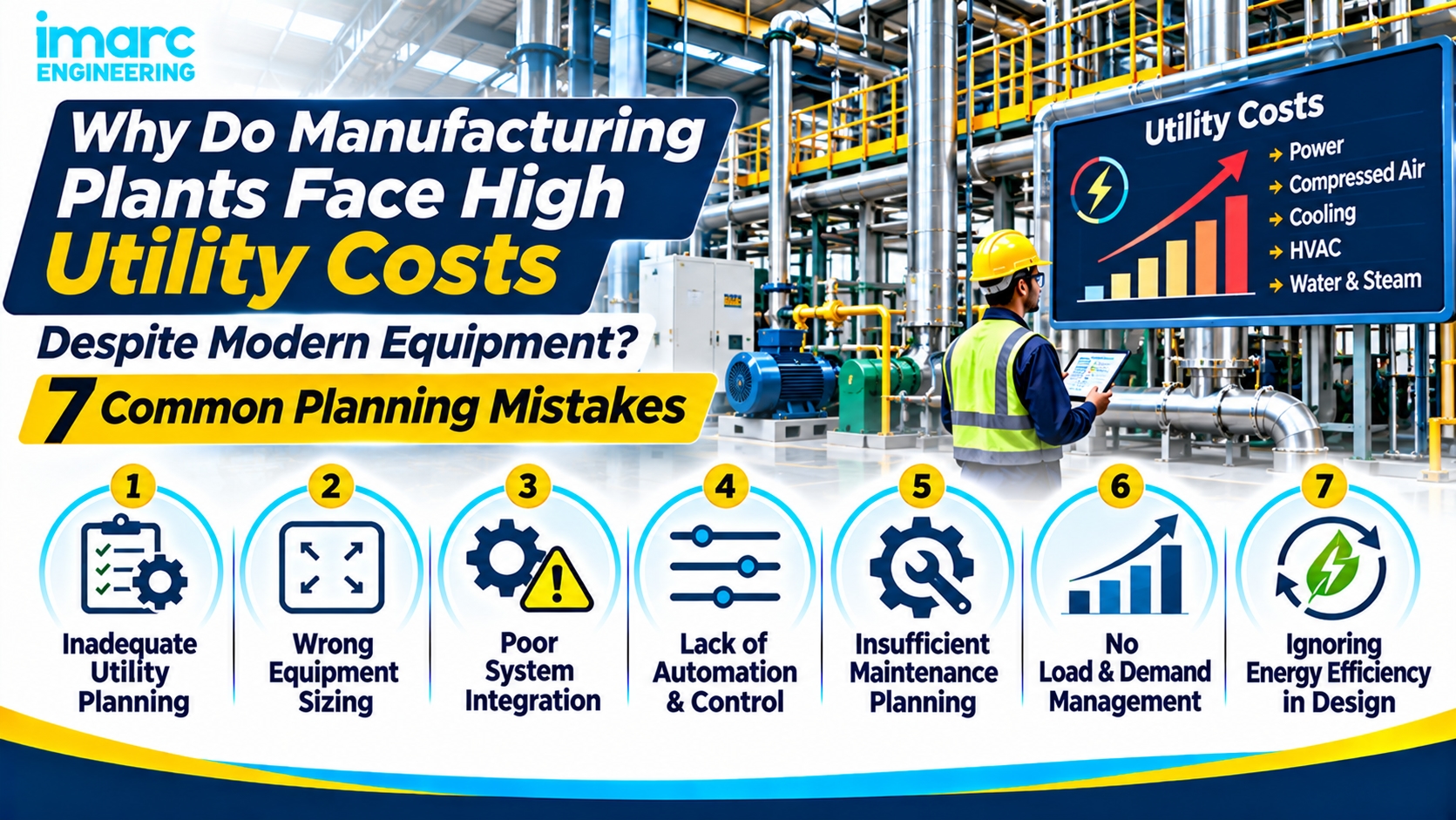
Modern production machines are often energy-efficient on paper. Yet many plants still face high and rising utility bills. The reason is rarely the equipment itself. High costs usually come from how utilities were planned, distributed, controlled and operated around that equipment. When compressed air, electrical distribution, cooling, HVAC and support systems are designed or expanded without a full operating view, even efficient machines operate inside an inefficient system.
Effective Utilities Planning (Water, Power, HVAC and Steam) Services in India help manufacturers optimise utility distribution, select appropriate system capacities and improve energy efficiency across industrial facilities. A well-planned utility infrastructure ensures that production equipment receives the required resources without unnecessary energy consumption, operational losses or excessive utility costs.
1. Treating Compressed Air as a Secondary Utility
Compressed air is one of the most expensive utilities in a manufacturing plant. A large share of the electrical energy used to generate it is lost as heat, and leaks of 20–35% are common in many facilities. When systems are planned around peak demand without proper storage, pressure control or leak management, compressors run longer and harder than necessary.
Planning mistakes include oversized compressors, long undersized distribution lines, excessive system pressure and no routine leak detection. Modern compressors cannot compensate for a poorly designed or poorly maintained air network.
2. Oversizing Equipment and Utilities “Just to Be Safe”
Safety margins are necessary, but excessive oversizing creates chronic inefficiency. Motors, pumps, compressors and chillers that run far below design load consume more energy per unit of useful output and often cycle inefficiently. Variable loads are particularly sensitive to this problem.
When capacity is selected on worst-case peaks without considering average operating conditions or part-load performance, the plant pays for capacity it rarely uses. Modern high-efficiency equipment still wastes energy if it is forced to operate outside its efficient range most of the time.
3. Neglecting Utility Distribution Layout
Long pipe and cable runs, undersized mains, sharp fittings and poorly located equipment increase pressure drops and electrical losses. Compressed air, chilled water, steam and process water systems suffer when layout is driven only by machine placement rather than by hydraulic and energy efficiency.
In many brownfield expansions, new machines are connected to existing networks without reviewing overall system resistance or balancing. The result is higher pump and compressor power, pressure instability and higher maintenance.
4. Ignoring Peak Demand and Simultaneous Start-Ups
Electricity bills in many plants are driven as much by demand charges as by total consumption. A single 15- or 30-minute peak can set the demand charge for the entire billing period. Simultaneous start-up of motors, compressors, HVAC and production lines at shift change is a classic cause.
When plant layout, control philosophy and operating procedures do not include load sequencing or soft-start strategies, modern equipment still creates costly peaks. Visibility into when and why peaks occur is often missing until the bill arrives.
5. Leaving Motors and Fans on Fixed Speed Where Load Varies
Many processes do not require full speed or full flow continuously. Fixed-speed motors and fans running against throttled valves or dampers waste energy. Variable frequency drives (VFDs) and proper control logic can deliver large savings when loads fluctuate, yet they are often omitted at the planning stage or applied inconsistently.
Installing efficient motors without matching them to the actual load profile leaves a major efficiency opportunity unrealised.
6. Weak Power Factor and Electrical Hygiene
Low power factor increases apparent power demand and can attract penalties or higher charges. Reactive power from motors, transformers and certain process loads is frequently left uncorrected or only partially corrected. Long cable runs and overloaded panels compound the problem.
Modern equipment may have better individual power factor characteristics, but the plant-level electrical system still determines what the utility meters and charges.
7. Designing Utilities Without Metering, Zoning or Idle-Load Control
Many plants still operate with limited sub-metering. Without visibility into which areas or systems consume power, water or air, waste is invisible. HVAC and lighting that continue to serve unused or lightly occupied zones, utilities that remain energised during long stoppages, and support systems that are not interlocked with production status all add avoidable cost.
When utility planning focuses only on connected load and not on operating patterns, the plant continues to pay for energy that produces no output.
How These Mistakes Compound
These issues rarely appear in isolation. An oversized compressed-air system feeding long, leaky lines, combined with unmanaged motor start-ups and limited metering, creates a cost structure that no single equipment replacement can correct. The original planning decisions lock in operating cost for years.
Practical Checks Before Blaming the Equipment
Map major utility consumers and compare energy use with production output
Measure compressed-air pressure at the farthest points of use and check for leaks
Review demand peaks against shift patterns and equipment start sequences
Assess whether major motors and fans operate at part load for long periods
Check power factor and the condition of correction equipment
Identify areas that remain conditioned or lit when production is low or stopped
Verify whether utility distribution was designed for current layout and load or simply extended
When Utility Planning Should Be Reviewed
The highest-value moments are during greenfield design, major expansion, addition of high-load equipment, or when utility bills rise without a corresponding increase in output. Waiting until costs become painful usually means living with the consequences of earlier decisions for a long time.
How IMARC Engineering Can Help
IMARC Engineering supports manufacturers in reviewing utility systems, plant layout implications, compressed-air and electrical distribution performance, and overall energy cost drivers. The focus is on identifying planning and operating gaps that keep utility costs high even when production equipment is modern, and on defining practical improvement priorities.
If your plant has invested in modern machinery yet continues to face high utility bills, a structured utility and layout assessment can reveal where planning decisions are still driving excess cost: https://www.imarcengineering.com/contact?service=utility-cost-energy-efficiency-audits
Conclusion
High utility costs despite modern equipment are usually a system problem, not a machine problem. Oversized or poorly distributed utilities, unmanaged peak demand, inefficient compressed-air networks, fixed-speed operation under variable loads, weak electrical hygiene and lack of operating visibility are the planning mistakes that most often keep costs elevated. Addressing these issues at the system level delivers lasting savings that equipment upgrades alone cannot achieve.
Contact Us:
IMARC Engineering
Phone: +917827860593
Email: sales@imarcengineering.com
India: C-130, Sector 2, Noida, Uttar Pradesh 201301
LinkedIn: https://www.linkedin.com/showcase/imarc-engineering/