
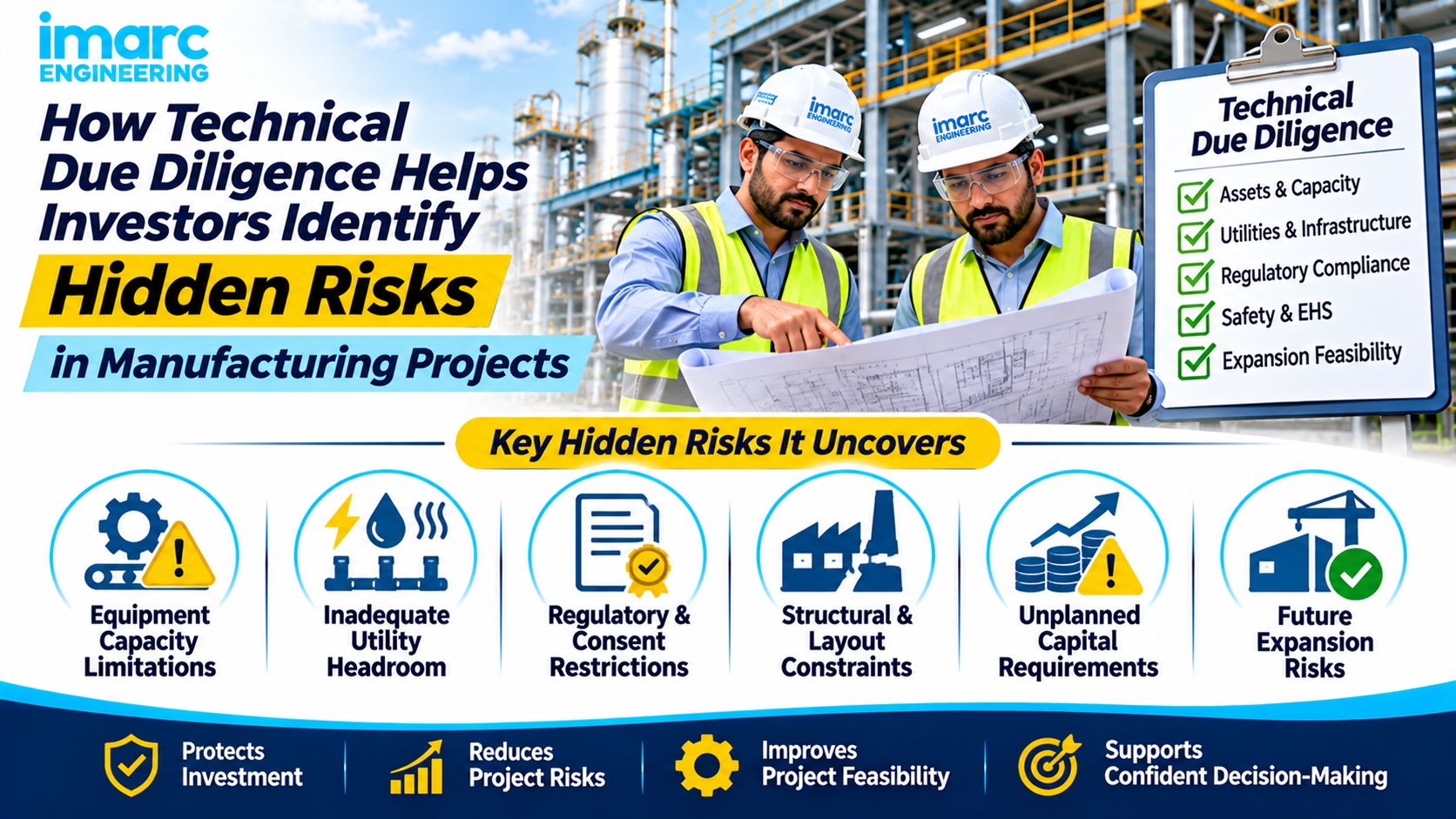
An investor evaluates a manufacturing plant that appears ready for acquisition or expansion funding. Capacity numbers look strong, the financial model is attractive, and management presentations are confident. After the transaction closes, the reality emerges: equipment cannot sustain the stated output, utilities have no headroom, critical consents carry restrictive conditions, or structural and layout limits block the planned growth. The investment case weakens and unplanned capital is required.
Technical due diligence helps investors identify these hidden risks before capital is committed. A comprehensive technical due diligence assessment for investors evaluates the physical and operational reality of a manufacturing plant against the claims supporting its valuation, helping uncover potential risks, investment requirements and operational limitations before the final investment decision.
What Hidden Risks Typically Escape Financial Reviews
Standard commercial and financial due diligence rarely surface the following issues:
Sustainable capacity that is materially lower than nameplate or peak historical figures
Critical equipment nearing end of reliable life or requiring major overhaul
Power, water, compressed air, steam or effluent systems already operating at or beyond design limits
Civil and structural constraints that restrict layout changes or additional equipment
Environmental or factory consents that are valid but heavily conditioned or partially non-compliant
Process bottlenecks and quality variability that limit throughput or raise operating cost
Safety, fire protection and hazardous-area gaps that will demand capital
Incomplete maintenance history and weak documentation that increase operational uncertainty
These gaps turn an apparently clean investment into a higher-cost project.
Why the Risks Remain Hidden
1. Capacity is presented as a statement, not as demonstrated performance
Investors are shown theoretical or best-case figures. Actual output under normal operating conditions, changeovers and quality constraints is not verified.
2. Utilities are treated as background infrastructure
Availability of power or water is noted. Spare capacity, single points of failure, reliability and the cost of upgrades are left unexamined.
3. Regulatory status is checked only for existence of licences
The presence of a Consent to Operate or factory licence is recorded. Specific conditions, monitoring records and outstanding non-compliances are often missed.
4. Remaining life of assets is not quantified
Age, condition, maintenance history and near-term replacement needs of key machines and utilities are rarely assembled into a clear capital forecast.
5. Brownfield limitations are underestimated
Existing foundations, building clearances, floor loadings, drainage and access routes quietly restrict what can be added or changed.
6. Integration and expansion assumptions go untested
Plans to increase volume, introduce new products or link the plant into a larger network rest on technical assumptions that have not been stress-tested.
7. Documentation and change-control gaps are overlooked
Incomplete drawings, missing maintenance records and weak process documentation create future operational and compliance risk that is hard to price in advance.
How Technical Due Diligence Surfaces the Risks
A focused technical review works through evidence rather than representations:
Compare claimed capacity with production records, cycle times, yields and equipment capability.
Inspect critical process and utility assets for condition, maintenance status and remaining useful life.
Assess utility systems against current and projected loads and identify single points of failure.
Review civil and structural adequacy for present operations and any intended expansion.
Map all material regulatory consents, their conditions, validity periods and compliance history.
Identify safety, environmental and hazardous-area deficiencies that will require capital or process changes.
Evaluate layout, material flow and debottlenecking potential under realistic constraints.
Translate findings into indicative cost, time and risk impact so they can be reflected in valuation or deal terms.
The result is a clear picture of what the plant can actually deliver today and what it will cost to reach the performance assumed in the investment case.
Practical Scenarios
Scenario A
Stated annual capacity could not be supported by production logs or equipment rates. The sustainable output was substantially lower. Valuation and earn-out structures were adjusted before closing.
Scenario B
Utilities appeared sufficient. A load study showed no meaningful headroom for the planned volume increase. The true expansion cost was far higher than the original model.
Scenario C
Consents were current, yet site conditions and records revealed several consent conditions were not being met. Post-deal compliance and potential liability costs were quantified in advance.
Scenario D
Technical due diligence confirmed that equipment, utilities and regulatory status could support the investment plan with only moderate, well-defined upgrades. The investor proceeded with transparent residual risk.
Decision Point: Can the Investment Case Survive Engineering Scrutiny?
Ask these questions:
Is the claimed capacity backed by actual production data and equipment capability?
Do utilities have measurable spare capacity for current and planned loads?
Are critical consents valid, fully understood and currently complied with?
What capital will be required in the next one to three years to sustain or improve performance?
Do structural or layout constraints limit the intended use or expansion?
Have safety and environmental gaps been identified and roughly costed?
If several answers are unclear or negative, material hidden risks remain.
Practical Technical Due Diligence Checklist
Demonstrated capacity verified against claims
Condition and remaining life of critical equipment assessed
Utility capacity and reliability checked for present and future loads
Civil and structural constraints for operations and expansion identified
Regulatory consents, conditions and compliance status mapped
Safety, fire and environmental gaps listed with indicative impact
Layout and material-flow limitations understood
Findings converted into cost, schedule and valuation implications
When Technical Due Diligence Should Be Completed
Before signing a share-purchase, asset-purchase or major investment agreement
When evaluating an existing plant for acquisition or significant capital injection
Before approving a large brownfield expansion or debottlenecking programme
As part of lender or board review for manufacturing project financing
Whenever financial projections depend heavily on technical performance assumptions
Conducting the review after capital is committed leaves fewer options and higher costs.
How IMARC Engineering Can Help
IMARC Engineering supports investors and project sponsors who need independent visibility of the real technical condition of manufacturing assets before committing capital. The work focuses on capacity verification, equipment and utility assessment, regulatory compliance status, structural constraints and quantification of near-term capital needs so that hidden risks become visible while the transaction can still be adjusted.
Relevant support is available through technical due diligence for investors.
If you are assessing a manufacturing plant or project and need clear engineering insight into capacity, utilities, compliance and expansion constraints before investment, a structured technical due diligence review with IMARC Engineering can reveal the issues that financial models alone do not show: https://www.imarcengineering.com/contact?service=technical-due-diligence-for-investors
Conclusion
Strong financial projections and capacity claims do not guarantee that a manufacturing plant can deliver the expected results. Hidden risks in equipment condition, utility headroom, regulatory compliance, structural limits and process capability frequently appear only after capital is locked in. Technical due diligence replaces assumptions with verified engineering evidence. When capacity, utilities, consents and physical constraints are examined before the investment decision, investors can adjust valuation, structure or plans with full visibility rather than discovering the gaps after the deal is closed.
Contact Us:
IMARC Engineering
Phone: +917827860593
Email: sales@imarcengineering.com
India: C-130, Sector 2, Noida, Uttar Pradesh 201301
LinkedIn: https://www.linkedin.com/showcase/imarc-engineering/




