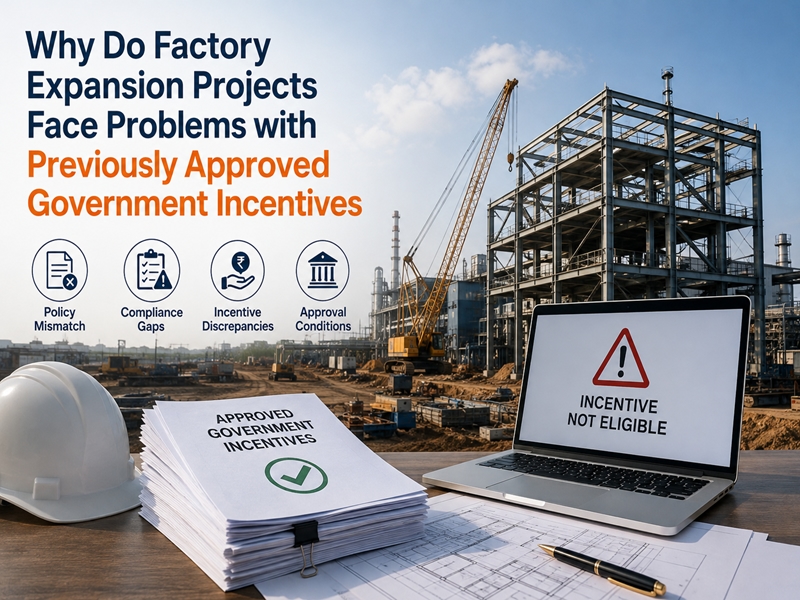
Factory expansion is often considered a sign of business growth. Manufacturers invest in additional machinery, construct new production blocks, increase installed capacity and introduce new product lines to meet rising demand. However, expanding an existing manufacturing facility can create unexpected complications when the company has previously received government incentives under an industrial policy or investment promotion scheme.
A common assumption among factory owners is that an incentive approval obtained during the initial project will continue to cover subsequent investments. In practice, this depends on the conditions of the applicable scheme. Government incentives may be linked to specific investment commitments, eligible assets, production capacity, employment levels, project locations and implementation timelines. Additional expenditure does not automatically become eligible simply because it is made within an existing factory.
For manufacturers planning expansion, understanding these conditions is important before committing capital. A mismatch between the original approval and the proposed expansion can affect subsidy eligibility, delay incentive claims and create additional documentation requirements. Seeking professional Industrial Incentive Advisory support to review existing approvals and applicable industrial incentive provisions before starting expansion activities helps businesses identify these risks and make informed investment decisions.
Why Factory Expansion Can Affect Previously Approved Government Incentives
Industrial incentive approvals are generally issued against a defined project, investment proposal or set of eligibility conditions. When a manufacturer expands an existing facility, the nature and scale of the project may change. The original approval may not automatically accommodate every additional investment or revised manufacturing activity.
For example, a company that initially established a manufacturing unit with an approved investment of ₹20 crore may later invest another ₹12 crore in production machinery and building infrastructure. Although the additional investment supports business growth, the company must establish whether the expenditure qualifies under the applicable expansion provisions.
The implementing authority may examine whether the proposed activity constitutes substantial expansion, modernisation, diversification or a separate industrial undertaking. Each classification can have different eligibility conditions.
The problem becomes more complicated when manufacturers begin expansion without reviewing the original sanction letter, scheme guidelines and requirements for revised project documentation.
1. Additional Investment May Not Meet the Scheme's Expansion Eligibility Conditions
One of the common reasons for incentive-related difficulties is the difference between a manufacturer's understanding of expansion and the definition provided under the applicable industrial policy.
A business may consider additional machinery purchases or an increase in factory space sufficient to establish expansion. However, certain government schemes prescribe specific conditions involving additional fixed capital investment, production capacity, employment generation or other operational parameters.
For example, a scheme may require an existing manufacturing unit to demonstrate a prescribed increase in eligible fixed capital investment before it can qualify for expansion-related benefits. Other schemes may also examine whether production has increased compared with the unit's previous operating performance.
The Assam Industrial and Investment Policy 2014 provides an example of a policy using multiple parameters to define substantial expansion, including investment, employment and production-related conditions. Such provisions illustrate why the eligibility definition must be checked against the relevant policy rather than assumed.
Manufacturers should therefore evaluate:
Whether additional investment meets the prescribed threshold.
Whether the expenditure qualifies as fixed capital investment.
Whether increased production capacity is required.
Whether employment commitments form part of eligibility.
Whether prior intimation or approval is necessary.
Without this assessment, a company may complete its expansion but discover that the additional investment does not satisfy the scheme's eligibility requirements.
2. Additional Machinery and Construction Costs May Fall Outside the Original Approved Project
Factory expansion frequently involves expenditure beyond the original project estimate. Manufacturers may purchase new machinery, modify production lines, construct additional buildings or install supporting infrastructure.
However, the original incentive approval may have been issued against a defined project cost and eligible investment schedule. Any additional expenditure must be examined separately to determine whether it can be included in the incentive calculation.
For instance, a manufacturer may receive approval based on an initial investment plan covering production machinery, factory buildings and eligible infrastructure. During expansion, the company may purchase additional equipment and undertake civil modifications. If these costs are not covered by the original project scope or do not qualify under the relevant policy, the company may be unable to include the entire expenditure in its incentive claim.
The Punjab Industrial and Business Development Policy 2022 provides a useful example of how industrial policies can specify eligible fixed capital investment and address expenditure beyond approved project costs.
Before undertaking additional expenditure, manufacturers should compare the original project report, approved investment schedule and proposed expansion budget. They should also establish whether a revised project report, separate registration or additional eligibility assessment is required.
3. Changes in Production Capacity Can Create Differences in Regulatory Records
An expansion project can change the manufacturing capacity, product mix and operational configuration of an existing factory. These changes may need to be reflected in relevant industrial records and statutory approvals.
Consider a manufacturing unit that originally declared an annual production capacity of 10,000 units. Following the installation of additional machinery, its proposed capacity increases to 18,000 units.
If the company continues using its earlier project details in incentive applications or other relevant records, the authorities may identify inconsistencies during verification.
Such differences can raise questions about the original project scope, actual investment, manufacturing activities and eligibility of the expanded facility.
Manufacturers should review whether amendments are required in:
Industrial Entrepreneur Memorandum (IEM) details, where applicable.
Industrial licence conditions, where applicable.
Factory licence and approved manufacturing particulars.
Pollution control permissions and production-related conditions.
Project reports and incentive applications.
Other approvals affected by revised production capacity.
The National Single Window System (NSWS) provides procedures for relevant IEM amendments, including changes to products, production capacity and investment details. However, an IEM acknowledgement is not an industrial licence or subsidy approval. Updating IEM information does not automatically amend a separate state incentive sanction.
4. Expansion May Require a Separate Eligibility Assessment
Another difficulty arises when manufacturers assume that an existing incentive approval automatically covers every subsequent phase of investment.
Industrial policies may distinguish between new manufacturing units and existing units undertaking expansion, diversification or modernisation. The eligibility conditions and incentive calculations can differ across these categories.
For example, a company may already be receiving an incentive for its original production facility. When it installs a new production line, the additional investment may need to be evaluated under the expansion provisions of the applicable policy.
The company may have to establish whether the scheme permits additional benefits, whether a fresh application is required and whether the new investment satisfies the relevant conditions.
The Government of India's UNNATI 2024 scheme is an example of an incentive framework that provides provisions for eligible expanding units alongside new units. Its geographical coverage, registration conditions, investment requirements and scheme-specific limits must be considered before assessing eligibility.
Manufacturers should not assume that the approval of an earlier project establishes eligibility for a later expansion. The relevant scheme must be examined in relation to the additional investment and the company's existing incentive history.
5. Delays in Factory Expansion Can Affect Incentive Eligibility
Expansion projects often experience delays due to machinery procurement, construction changes, financing constraints, utility connections and statutory approval requirements.
These delays can become important when an industrial incentive scheme specifies deadlines for investment, project implementation, commencement of commercial production or submission of claims.
For example, a manufacturer may receive an incentive approval based on a proposed expansion schedule. However, equipment delivery delays may postpone installation and commercial production beyond the expected date.
If the applicable scheme prescribes a completion period or a deadline for meeting specific conditions, the company may need to seek an extension or demonstrate compliance with the permitted provisions.
Manufacturers should distinguish between the original project approval date, the commencement of expansion investment, the completion of installation and the actual date of commercial production.
Maintaining these records helps businesses establish whether the expansion has met the applicable timelines and whether any formal extension or clarification is required.
6. Previous Subsidies Can Affect the Assessment of Additional Incentive Claims
Manufacturers that have already received capital investment subsidies, interest incentives or other government benefits should examine how previous assistance affects a proposed expansion.
Some schemes prescribe overall financial ceilings, restrictions on overlapping benefits or specific rules for calculating incentives on additional investment. The treatment may also differ between a new industrial undertaking and the expansion of an existing unit.
A useful legal example is the Supreme Court's January 2026 judgment in IFGL Refractories Ltd. v. Orissa State Financial Corporation & Others, Civil Appeal No. 66 of 2026.
The dispute concerned incentives under Odisha's Industrial Policy, 1989 and whether a manufacturing undertaking qualified as a new industrial unit or an expansion of an existing business. The Supreme Court held, on the facts and policy provisions involved, that the undertaking was a separate new industrial unit. It also examined the applicability of the policy's subsidy ceiling and distinguished the treatment of a new unit from expansion-related benefits.
The judgment demonstrates why the legal and operational classification of an industrial project matters when assessing subsidy entitlement. It does not establish a universal rule for all expansion projects or current state policies.
Manufacturers should maintain separate investment records for the original facility and subsequent expansion. They should also review previous sanction letters, subsidy disbursements and applicable scheme restrictions before submitting additional claims.
7. Incomplete Investment Records Can Delay Subsidy Verification
Even when an expansion appears eligible, incomplete or inconsistent documentation can complicate the incentive verification process.
Manufacturers may maintain machinery invoices, payment records, financial statements and project reports across different departments. However, these records may not always provide a consistent picture of the additional investment.
For example, the finance department may record machinery expenditure according to payment dates, while the project team tracks equipment according to installation and commissioning dates. If the incentive application uses different investment figures, the implementing authority may seek further clarification.
Common documentation gaps include:
Missing machinery purchase invoices or payment evidence.
Differences between approved and actual project costs.
Incomplete capitalisation records.
Missing certificates from chartered accountants or financial institutions, where required.
Incorrect production-capacity information.
Inadequate records of employment generation.
Failure to maintain investment-wise documentation for expansion.
Manufacturers should establish a consistent documentation system that connects expenditure, asset acquisition, installation, commissioning and production records. This makes it easier to substantiate eligible investment when submitting incentive claims.
8. Changes in Ownership or Factory Location Can Complicate Incentive Continuity
Some expansion projects involve more than additional machinery or production capacity. Companies may acquire another manufacturing facility, transfer assets, restructure ownership or relocate operations to a different industrial area.
These changes can affect the continuity of existing incentive approvals, depending on the applicable policy and sanction conditions.
For instance, a company acquiring an existing manufacturing unit may assume that the previous owner's incentive eligibility automatically transfers to the new entity. However, the scheme may impose conditions relating to legal ownership, transfer approval, project registration or continuation of operations.
Similarly, relocating a factory may change its eligibility for location-based incentives. Benefits available in one industrial area or geographical category may not apply to another location.
Before restructuring or relocating a facility, manufacturers should examine the original approval, transfer provisions and applicable policy conditions. They should also identify whether fresh registration, prior permission or revised documentation is necessary.
What Should Manufacturers Check Before Expanding an Incentive-Approved Factory?
A pre-expansion review can help manufacturers identify potential incentive-related problems before committing additional capital.
Review the original approval: Examine the sanction letter, eligibility certificate, approved project cost, eligible activities and applicable conditions.
Classify the proposed investment: Determine whether the project involves substantial expansion, modernisation, diversification or a separate new manufacturing undertaking.
Verify investment eligibility: Identify which additional assets and expenditure qualify under the relevant industrial policy.
Check previous benefits: Review subsidies already sanctioned or received and identify applicable financial ceilings or restrictions on overlapping incentives.
Compare production details: Evaluate existing and proposed production capacity, product categories and employment commitments.
Review regulatory requirements: Identify amendments required in IEM records, industrial licences, factory permissions and other applicable approvals.
Confirm applicable deadlines: Check registration windows, investment completion periods, commercial production requirements and claim submission dates.
Organise supporting documentation: Maintain invoices, payment records, asset registers, revised project reports and certificates required by the implementing authority.
This assessment should ideally take place before expansion work begins. Once machinery has been purchased and construction completed, correcting project documentation or resolving eligibility disputes can become more difficult.
How IMARC Engineering Can Help
IMARC Engineering supports manufacturers in assessing industrial licensing requirements and government incentive conditions before undertaking factory expansion. Its advisory approach can include reviewing existing approvals, evaluating proposed additional investment, identifying applicable expansion provisions and examining documentation requirements. The team can also help identify potential gaps between approved project details and revised manufacturing activities, along with relevant regulatory amendments. This enables businesses to make better-informed expansion decisions and prepare their incentive applications with greater clarity and compliance discipline.
Speak with an expert: https://www.imarcengineering.com/contact?service=industrial-licensing-incentive-advisory
Conclusion
Previously approved government incentives should not be assumed to cover every subsequent factory expansion. Additional investment, revised production capacity, previous subsidies, project timelines and changes in ownership or location can all influence eligibility under the applicable industrial policy. Manufacturers should review their original approvals and expansion plans before committing capital, rather than waiting until incentive claims are submitted. A structured pre-expansion assessment helps identify documentation gaps, understand scheme conditions and reduce avoidable regulatory and financial complications.
Contact Us:
IMARC Engineering
Phone: +91-120-433-0800
Email: sales@imarcengineering.com
India: C-130, Sector 2, Noida, Uttar Pradesh 201301
LinkedIn: https://www.linkedin.com/showcase/imarc-engineering/