Installing industrial equipment and completing its initial commissioning are important project milestones, but neither automatically confirms that machinery is ready for commercial production. A machine may start successfully, respond to control commands and complete preliminary testing while still failing to deliver the required output under actual operating conditions.
For factory owners, plant heads and project managers, the challenge is determining whether the equipment can perform consistently, safely and reliably within the production environment. Problems such as insufficient output, excessive vibration, unstable operating parameters, control-system errors and poor coordination with connected machinery may become apparent only when the equipment handles actual production loads.
This makes Installation Supervision and Equipment Commissioning more than a startup exercise. Manufacturers need to evaluate the results of technical inspections, performance trials, safety checks and integrated system testing before accepting machinery for regular operations. A structured verification process helps identify unresolved defects, clarify supplier responsibilities and reduce the risk of production interruptions after handover.
Why Is Commissioning Completion Not Enough to Confirm Production Readiness?
Commissioning generally involves checking whether installed equipment and its associated systems can operate according to the defined procedures. However, commercial production introduces additional requirements that may not be fully demonstrated during initial startup.
For example, a newly installed industrial pump may start and run without any apparent mechanical problem. However, when connected to the actual process, it may fail to maintain the required flow rate because of incorrect system configuration, inadequate suction conditions or excessive piping resistance.
Similarly, a conveyor may operate independently but struggle to maintain the required material transfer rate when connected to other production equipment.
These situations highlight three different stages of equipment acceptance:
Installation completion: Mechanical, electrical and utility connections have been completed according to approved drawings and specifications.
Commissioning completion: Initial startup, functional checks and specified commissioning activities have been performed.
Commercial production readiness: Equipment has demonstrated its ability to meet agreed performance, safety, integration and operational requirements under representative production conditions.
The distinction is important because a successful startup does not establish that equipment can maintain its specified capacity, product quality or operating stability during regular manufacturing.
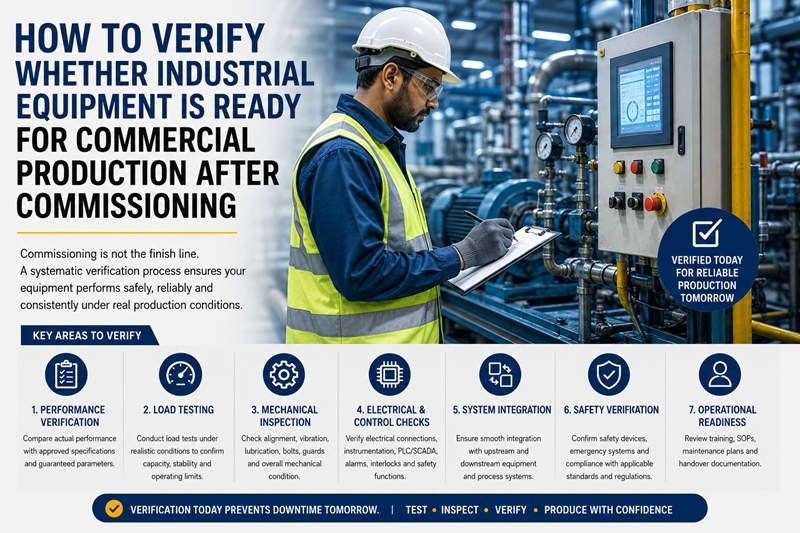
7 Checks to Verify Whether Industrial Equipment Is Ready for Commercial Production
Before releasing newly commissioned machinery for regular operations, manufacturers should evaluate the following areas against approved specifications, contractual requirements and equipment-specific acceptance criteria.
1. Compare Actual Equipment Performance with Approved Specifications
The first step is to establish whether the installed machinery delivers the performance promised during procurement and engineering.
Equipment suppliers generally provide technical specifications covering operating capacity, rated speed, motor power, pressure, flow rate, temperature and other application-specific parameters. These requirements should form the basis of performance verification.
Manufacturers should review:
Approved equipment datasheets and technical specifications.
Guaranteed production capacity and operating range.
Rated motor power, speed and operating parameters.
Required pressure, flow rate or temperature, where applicable.
Product quality and process consistency requirements.
Energy consumption commitments, where included in the contract.
Consider a manufacturing facility that installs a pump specified to deliver 100 m³/hour at a defined operating head. During initial commissioning, the pump starts successfully, but testing under actual system conditions records only 75 m³/hour.
The pump is operational, but its performance has not been demonstrated against the specified duty. The engineering team should investigate system resistance, suction conditions, valve positions, piping arrangements and measurement accuracy before accepting the result.
The important consideration is not simply whether the equipment operates, but whether it achieves the agreed operating requirements.
2. Conduct Load Testing Under Representative Production Conditions
One of the limitations of preliminary equipment testing is that machinery may perform differently without production material or operating loads.
A motor may run normally during no-load testing but draw excessive current when connected to the driven equipment. A conveyor may operate smoothly when empty but struggle when carrying its specified material volume. A compressor may maintain pressure during initial checks but fail when multiple production units demand compressed air simultaneously.
Manufacturers should therefore establish testing conditions that represent the equipment's intended application.
A suitable performance testing plan should define:
Expected operating load and production conditions.
Testing duration and operating sequence.
Required measurements and monitoring points.
Acceptance limits based on approved specifications.
Permitted operating deviations.
Responsibilities for witnessing, recording and approving results.
Testing should cover relevant operating conditions rather than relying on a single successful startup. Depending on the equipment and process, this may include minimum, normal and maximum operating loads, startup and shutdown sequences, and representative production cycles.
The purpose is to determine whether the equipment can maintain its required performance when subjected to the demands it will experience during actual manufacturing.
3. Inspect Mechanical Condition, Alignment and Operating Stability
Mechanical defects may remain unnoticed during short commissioning runs and become more apparent after machinery reaches its normal speed, temperature and load.
Incorrect shaft alignment, inadequate lubrication, loose foundation connections and unsuitable equipment positioning can affect operating stability and component life.
Before production release, engineering teams should inspect:
Shaft and coupling alignment between connected equipment.
Foundation stability, anchoring and levelling.
Bearing temperature and lubrication arrangements.
Vibration levels under relevant operating conditions.
Unusual mechanical noise or movement.
Fasteners, guards and critical mechanical connections.
Equipment support and piping connections that may introduce unwanted loads.
For rotating machinery, vibration measurements should be evaluated using suitable equipment-specific criteria. ISO 20816 provides a framework for measuring and evaluating machine vibration, but the applicable part and acceptance limits depend on machine type and operating conditions.
For example, excessive vibration in a newly commissioned motor-pump assembly may indicate misalignment, foundation problems, unbalanced rotating components or operating conditions outside the intended range.
Identifying such issues before regular production helps avoid preventable equipment deterioration and unplanned maintenance.
4. Verify Electrical Systems, Instrumentation and Control Functions
A machine can be mechanically complete and still be unsuitable for production because of electrical, instrumentation or automation problems.
These issues are particularly important in automated manufacturing facilities, where equipment depends on sensors, programmable logic controllers (PLCs), human-machine interfaces (HMIs) and interconnected control systems.
The verification process should include:
Electrical connections, earthing and protective arrangements.
Motor rotation direction and protection settings.
Instrument calibration status and measurement accuracy.
PLC and HMI functionality.
Alarm, trip and interlock operation.
Emergency stop functionality.
Manual and automatic operating modes.
Communication between connected equipment.
Response to defined fault conditions and power interruptions.
Consider a packaging machine that operates correctly in manual mode but fails to start automatically when receiving a signal from the upstream conveyor. The problem may involve incorrect PLC logic, missing permissive conditions or communication errors between control systems.
Such defects can interrupt the entire production sequence even when individual machines appear operational.
IEC 62381:2024 provides a useful reference for factory acceptance testing, factory integration testing, site acceptance testing and site integration testing of process-industry automation systems. It helps define project-specific testing responsibilities and demonstrate whether automation systems meet their applicable specifications.
5. Confirm Integration with Upstream and Downstream Production Equipment
An individual machine passing its commissioning tests does not establish that the complete production line is ready for commercial operation.
Manufacturing processes often involve multiple interconnected machines, utilities and material-handling systems. A performance limitation in one area can affect the output of several others.
For example, a production line may include raw material feeding, primary processing, inspection and finished-product handling. If the processing machine operates faster than the feeding system can supply material, production interruptions may occur. Similarly, insufficient downstream handling capacity may cause material accumulation and force upstream equipment to stop.
Manufacturers should verify:
Material movement between connected machines.
Upstream and downstream capacity compatibility.
Conveyor speeds and process synchronization.
Automation signals and operating sequences.
Availability of utilities under simultaneous demand.
Buffer capacity and material accumulation points.
Automatic shutdown and restart sequences.
Coordination between different equipment suppliers.
Integrated testing should demonstrate that connected systems operate according to the agreed production sequence. This is especially important in projects involving multiple vendors, where individual suppliers may verify their own equipment without fully establishing how it performs as part of the complete production line.
6. Check Safety Systems and Applicable Operational Requirements
Production readiness must include safety verification. Equipment should not be released simply because it achieves the required output.
Manufacturers should confirm that relevant protective arrangements are installed, functional and suitable for intended operating conditions.
Important checks include:
Machine guards and protective covers.
Emergency stop devices and accessibility.
Safety interlocks and protective systems.
Electrical safety arrangements.
Pressure and temperature protection, where applicable.
Safe operator access and maintenance clearances.
Warning indicators and operating alarms.
Emergency shutdown procedures.
Applicable statutory inspections and approvals.
For Indian manufacturing facilities, the applicable requirements should be assessed according to the factory's location, industry, equipment type and process. Relevant occupational safety, electrical safety, pressure equipment and other regulatory requirements may apply.
Equipment commissioning and statutory permission to operate a manufacturing facility are separate matters. A technically successful equipment trial does not automatically establish that all required regulatory approvals have been obtained.
7. Review Operator Training, Maintenance Arrangements and Handover Records
Even technically successful machinery can experience operational problems if the factory team is not prepared to operate and maintain it.
Before production release, factory management should establish whether operators understand the equipment's operating limits, startup and shutdown procedures, alarms and emergency responses.
The handover review should cover:
Approved operating and maintenance manuals.
Standard operating procedures (SOPs).
Startup, shutdown and emergency instructions.
Preventive maintenance schedules.
Recommended spare parts and critical spares.
Warranty and equipment documentation.
Calibration and inspection certificates.
Operator and maintenance personnel training records.
Commissioning and performance test reports.
Updated as-built drawings and equipment records.
Outstanding defects and punch-list closure status.
Documentation should reflect the equipment's final installed configuration, including approved modifications made during installation and commissioning.
This information gives maintenance teams a reliable starting point for routine servicing, troubleshooting and future equipment performance reviews.
How Should Factory Owners Evaluate Equipment Readiness Before Final Acceptance?
A documented evaluation helps project owners avoid depending solely on verbal confirmation from equipment suppliers or installation contractors.
The following matrix can be used as a practical management tool. Its acceptance requirements should be adapted to the machinery, contract and applicable technical standards.
Evaluation area | Evidence to review | Acceptance consideration |
|---|---|---|
Technical performance | Recorded results against approved specifications | Agreed performance requirements achieved |
Load testing | Documented representative-load test results | Required operating capacity demonstrated |
Mechanical condition | Alignment, vibration and inspection reports | No unresolved critical mechanical defects |
Electrical systems | Electrical test and protection records | Electrical arrangements verified |
Automation | Functional and integration test reports | Required control sequences demonstrated |
Production integration | Integrated production trial records | Connected systems operate as intended |
Safety | Inspection and protective-device test records | Applicable safety requirements satisfied |
Operational readiness | Training, SOPs and maintenance records | Plant personnel prepared |
Handover | Commissioning reports and punch-list records | Contractual acceptance conditions addressed |
This matrix should not be treated as a universal certification. A production release decision must consider the equipment manufacturer's requirements, approved project specifications, applicable standards and the factory's operating conditions.
What Happens When Equipment Enters Commercial Production Without Proper Verification?
Releasing equipment before resolving critical performance or safety issues can create problems that extend beyond the machine itself.
Insufficient load testing may result in unexpected capacity shortfalls. Unidentified alignment or lubrication problems can accelerate component wear. Incomplete automation integration may cause repeated production interruptions, while unverified instrumentation can affect process control and product consistency.
These issues may lead to:
Unplanned production stoppages and missed delivery schedules.
Increased maintenance and replacement expenditure.
Material wastage and product rejection.
Reduced equipment availability.
Repeated troubleshooting and contractor visits.
Disputes over equipment warranties and supplier responsibilities.
Additional safety and regulatory concerns.
The consequences are often interconnected. For instance, an incorrectly installed machine may produce excessive vibration, resulting in premature bearing wear and eventually an unplanned shutdown.
The practical objective of pre-production verification is to identify such deficiencies while the project team, equipment supplier and installation contractors are still available to address them.
How IMARC Engineering Can Help
IMARC Engineering supports industrial projects through installation supervision and equipment commissioning activities. Its engineering support can help project owners review installation work against approved drawings, monitor mechanical and electrical checks, coordinate equipment-related inspections and oversee planned commissioning tests. The team can also assist in identifying installation deviations, reviewing performance test documentation and tracking outstanding deficiencies before equipment handover. This structured involvement helps manufacturers make better-informed equipment acceptance decisions and assess production readiness against defined project requirements.
Speak with an expert: https://www.imarcengineering.com/contact?service=installation-supervision-and-equipment-commissioning
Conclusion
Commercial production should begin only after manufacturers have established that commissioned equipment meets its defined performance, safety and operational requirements. Successful startup alone cannot demonstrate production readiness. Load testing, mechanical inspections, control-system verification, integrated trials and documented handover checks provide a more reliable basis for acceptance. By addressing deficiencies before regular operations begin, factory owners can reduce avoidable interruptions, improve equipment reliability and establish greater confidence in their production systems. The final decision should always be supported by measurable results and agreed acceptance criteria.
Contact Us:
IMARC Engineering
Phone: +91-120-433-0800
Email: sales@imarcengineering.com
India: C-130, Sector 2, Noida, Uttar Pradesh 201301
LinkedIn: https://www.linkedin.com/showcase/imarc-engineering/