
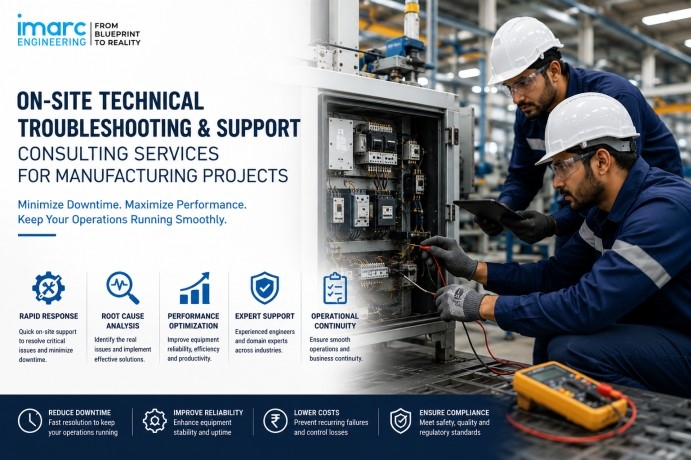
When Should Manufacturing Plants Hire External Engineering Support for Technical Troubleshooting?
Manufacturing plants depend on maintenance and engineering teams to keep machinery, production lines and utility systems operating reliably. However, some technical problems continue despite repeated inspections, component replacements and corrective maintenance. A machine may restart after a repair but develop the same fault during the next production cycle. In other cases, equipment operates continuously but fails to achieve its expected output, creating production delays and quality concerns.
These situations raise an important question: when should a manufacturing company continue troubleshooting internally, and when should it bring in external engineering support?
External engineering support for manufacturing plants, particularly through On-Site Technical Troubleshooting, becomes valuable when a problem exceeds the diagnostic capabilities of the internal team, involves multiple engineering disciplines or creates operational losses that cannot be resolved through routine maintenance. Recognising these situations early helps manufacturers avoid unnecessary repairs, identify underlying equipment problems and make better technical decisions.
When Repeated Equipment Repairs Fail to Eliminate the Problem
One of the clearest reasons to seek external engineering support is recurring equipment failure. Manufacturing plants sometimes replace damaged bearings, motors, seals, sensors or other components without investigating why those components failed in the first place. Although the equipment may return to operation, the same problem can reappear after a short operating period.
For example, an industrial pump may experience repeated bearing failures. Replacing the bearings may temporarily restore operation, but excessive vibration, shaft misalignment, incorrect lubrication or foundation problems could remain unresolved.
Similar situations occur with production conveyors, compressors, processing machinery and packaging equipment.
Warning signs that require further investigation include:
The same component fails repeatedly despite replacement.
Equipment requires increasingly frequent corrective maintenance.
Repairs restore operation temporarily but do not improve reliability.
Maintenance expenditure increases without a corresponding reduction in breakdowns.
Operators report recurring abnormal noise, vibration or temperature changes.
In these circumstances, external engineers can investigate equipment history, installation conditions, operating parameters and previous maintenance interventions. Depending on the equipment, the investigation may involve vibration measurements, alignment checks, thermal inspections or lubrication assessments.
The objective is not simply to repair another damaged component. It is to identify the conditions responsible for repeated failure and recommend corrective measures that address the underlying cause.
When the Internal Maintenance Team Cannot Identify the Root Cause
An internal maintenance team may have considerable experience with plant equipment but still encounter faults that are difficult to diagnose. This is particularly common when failures occur intermittently or depend on specific production conditions.
Consider a motor that operates normally during inspection but trips when a production line reaches a higher load. Similarly, a conveyor may stop unexpectedly without displaying a consistent fault code. Restarting the system temporarily restores operation, but the underlying issue remains.
Such problems can involve several interacting factors, including:
Electrical supply fluctuations or voltage imbalance.
Overloading under particular operating conditions.
Incorrect sensor signals or control-system configurations.
Mechanical resistance or unexpected equipment loading.
Temperature variations affecting electrical or mechanical components.
Unstable utility supply during simultaneous production operations.
Repeatedly restarting equipment or replacing suspected components without sufficient diagnostic evidence can consume valuable maintenance time.
External technical specialists can bring additional diagnostic experience and suitable measurement instruments to investigate the fault under actual operating conditions. The investigation should include a review of alarm histories, operating records, electrical measurements, equipment behaviour and relevant technical documentation.
The ISO 17359 condition-monitoring guidelines provide a useful framework for establishing machine condition-monitoring programmes, including measurement selection, baseline information, data analysis and diagnosis.
External support is particularly useful when the internal team has exhausted reasonable diagnostic methods but still cannot establish a technically supported explanation for the failure.
When Equipment Operates but Cannot Achieve Its Expected Production Capacity
Not every manufacturing problem involves a complete equipment breakdown. Sometimes machinery remains operational but produces less than its intended output.
A packaging machine may run below its specified cycle rate, a processing line may take longer to complete batches, or a filling machine may experience frequent short stoppages. Although the equipment remains available, actual production performance continues to decline.
This situation can be difficult to diagnose because several smaller losses may combine to reduce overall output.
Common causes include:
Incorrect machine operating parameters.
Frequent minor stoppages that are not recorded as major breakdowns.
Bottlenecks between interconnected production equipment.
Excessive changeover and adjustment time.
Inconsistent material feeding or processing conditions.
Utility limitations affecting machine operating speed.
Equipment wear reducing operating accuracy.
Manufacturers should distinguish between equipment availability and actual production effectiveness. A machine that runs throughout a shift does not necessarily operate at its intended speed or produce acceptable output consistently.
External engineering support can help assess machine performance, identify process bottlenecks and compare actual operating conditions with approved equipment specifications or established production baselines.
For example, if a filling line consistently achieves fewer cycles than expected, an investigation may need to examine filling accuracy, container feeding, conveyor speed, sensor response and product characteristics together.
This broader assessment helps determine whether the performance gap originates from the machine itself, connected equipment, operating conditions or process configuration.
When a Technical Problem Involves Multiple Equipment Vendors
Modern manufacturing plants frequently operate equipment supplied by different original equipment manufacturers (OEMs), system integrators and engineering contractors. Although each supplier may be responsible for its own equipment, problems can emerge at the interfaces between systems.
For example, a newly installed production machine may require more compressed air than the existing utility network can consistently supply. Another machine may experience electrical disturbances after integration with a new distribution system. Similarly, a production line may develop communication problems between PLCs supplied by different vendors.
In these situations, individual suppliers may inspect their respective equipment and confirm that it meets its own specifications. However, the complete production system may continue to malfunction.
External engineering support becomes relevant when:
Equipment specifications do not align with available utility capacity.
Electrical and mechanical systems develop interface-related problems.
Different suppliers provide conflicting technical explanations.
Control systems cannot communicate reliably.
Equipment integration creates unexpected operating conditions.
No single contractor has responsibility for investigating the complete system.
An independent engineering assessment can examine equipment specifications, electrical load schedules, utility requirements, control-system interfaces, piping and instrumentation diagrams and commissioning records.
The important distinction is between checking individual machines and evaluating how those machines operate together. A technically acceptable component does not automatically guarantee that the integrated manufacturing system will perform as intended.
When Equipment Problems Begin Affecting Product Quality
A manufacturing machine can continue operating while gradually producing inconsistent results. This creates a particularly difficult situation because the problem may initially appear to be a quality-control issue rather than an equipment malfunction.
For instance, a filling machine may produce variations in filling volume, a tablet press may show inconsistent tablet weights, or a machining centre may begin producing dimensional deviations.
Such problems can originate from several interacting conditions:
Calibration drift in measurement instruments.
Unstable temperature, pressure or flow conditions.
Mechanical wear affecting positioning or repeatability.
Incorrect machine settings or control parameters.
Inconsistent material feeding.
Variations in machine speed or processing conditions.
Quality teams may identify the deviation, while maintenance teams inspect the machinery. However, establishing the connection between equipment behaviour and product defects may require additional engineering investigation.
External specialists can assess relevant equipment, instrumentation and process conditions to help identify the technical factors contributing to inconsistent output.
For regulated manufacturing operations, this work should remain aligned with approved deviation investigations, change-control procedures and quality-system requirements. Engineering troubleshooting must not replace the quality team's responsibility for product assessment and disposition.
When Newly Installed Equipment Experiences Problems During Production
New machinery does not always perform as expected after installation. Equipment may pass initial inspections but experience repeated trips, unstable operation or production interruptions once it starts operating under actual site conditions.
These problems can arise because installation and commissioning conditions do not fully represent the demands of continuous production.
Possible causes include:
Incorrect mechanical alignment or equipment mounting.
Electrical connections that do not match approved requirements.
Insufficient compressed air, cooling water or other utilities.
Incomplete control-system configuration.
Incorrect operating parameters.
Inadequate coordination between equipment and existing production systems.
Differences between factory testing and actual site operating conditions.
For example, a machine may perform satisfactorily during an initial trial but experience overheating when operated continuously at higher production loads. This may require an assessment of cooling arrangements, operating parameters, equipment loading and installation conditions.
External engineering support can help investigate these problems independently of routine installation activities. The assessment should compare actual equipment behaviour with approved specifications, commissioning records and operating requirements.
This is especially important when the OEM has completed its installation scope but the manufacturing plant still cannot achieve stable production.
When Equipment Downtime Creates Significant Financial and Operational Losses
The decision to hire external engineering support should also consider the business impact of unresolved technical problems.
A breakdown affecting a non-critical machine may be manageable through routine maintenance. However, a failure involving a central compressor, critical processing machine or essential production-line component can interrupt several connected operations.
Manufacturers should assess the following consequences:
Production volume lost during equipment downtime.
Additional maintenance labour and overtime expenditure.
Repeated spending on replacement components.
Rejected products, rework and material wastage.
Delayed customer orders and dispatch schedules.
Increased energy consumption due to inefficient equipment operation.
Dependence on a single machine without suitable standby capacity.
Consider a manufacturing machine that experiences three breakdowns in a month, with each incident causing five hours of downtime. If the estimated production contribution lost is ₹25,000 per hour, the monthly production loss alone would be ₹3.75 lakh.
If repair expenditure is another ₹45,000, the combined estimated impact becomes ₹4.20 lakh, excluding quality losses, overtime and delivery-related consequences.
This is an illustrative calculation, not an industry benchmark.
When recurring losses reach this level, manufacturers should compare the cost of continued reactive repairs with the cost of a structured engineering investigation. The decision should also consider asset criticality, safety implications and the availability of alternative production capacity.
Connect with an expert: https://www.imarcengineering.com/contact?service=on-site-troubleshooting-technical-support
How Can Plant Managers Know When to Escalate a Technical Problem?
Manufacturing companies do not need to wait for a major equipment failure before considering specialist support. They can establish practical escalation criteria using maintenance records, equipment performance and the seriousness of unresolved faults.
The following comparison can help:
Plant situation | Recommended response |
|---|---|
Routine component replacement with a known failure cause | Internal maintenance |
Minor adjustments covered by approved procedures | Internal maintenance |
Equipment operating within normal performance limits | Routine monitoring |
Fault covered by an active OEM warranty | Coordinate with the OEM |
Repeated breakdowns after corrective repairs | Consider external root cause investigation |
Intermittent faults without a confirmed cause | Specialist diagnostic assessment |
Problems involving multiple engineering disciplines | Multidisciplinary engineering support |
Persistent production losses without a clear explanation | Independent performance assessment |
Critical equipment failure with safety implications | Follow emergency procedures and obtain qualified technical assistance |
Plant managers should also review maintenance performance indicators.
Mean Time Between Failures (MTBF): Measures the average operating time between failures for repairable equipment. A declining trend may indicate deteriorating reliability.
Mean Time to Repair (MTTR): Measures the average time required to restore equipment after a failure. Increasing MTTR may indicate diagnostic difficulties, repair delays or spare-parts constraints.
Overall Equipment Effectiveness (OEE): Combines availability, performance and quality to identify different categories of production losses.
Repeat failure rate: Helps identify equipment that continues to experience similar problems after corrective maintenance.
These indicators should be interpreted together rather than used as automatic triggers for outsourcing. A critical asset with one serious failure may require immediate specialist attention, while several minor faults on a non-critical machine may remain manageable internally.
What Should Manufacturers Expect from an External Engineering Investigation?
Before appointing an external engineering specialist, manufacturers should establish what the investigation needs to achieve. A clear scope prevents confusion between equipment repair, technical diagnosis and wider performance improvement.
A properly defined engagement should generally cover the following activities:
Problem assessment: Review equipment details, breakdown history, previous repairs, production losses and available technical documents.
On-site inspection: Examine machinery, electrical systems, instrumentation, utilities and actual operating conditions.
Diagnostic investigation: Use appropriate inspection methods and measurements to evaluate possible failure mechanisms.
Root cause identification: Assess the available evidence and distinguish confirmed causes from assumptions or unverified possibilities.
Corrective action recommendations: Develop technically appropriate recommendations, including coordination requirements involving OEMs or contractors.
Performance verification: Check whether implemented actions restore equipment operation against agreed requirements.
Technical documentation: Provide investigation findings, corrective actions, remaining risks and recommendations for future monitoring.
Manufacturers should also evaluate the provider's experience with similar equipment, access to diagnostic instruments, multidisciplinary engineering capabilities, safety procedures and reporting standards.
An external specialist should not promise that every fault can be resolved immediately. The objective should be a transparent investigation, technically justified recommendations and measurable verification of the work completed.
How IMARC Engineering Can Help
IMARC Engineering provides on-site troubleshooting and technical support to manufacturing companies facing complex equipment, operational and engineering problems. Its support covers initial site assessment, diagnostic investigation, root cause analysis, corrective action coordination and performance verification. By examining machinery, utilities, instrumentation and interconnected systems, the team helps manufacturers understand recurring faults and unresolved performance issues. Technical findings and preventive recommendations also support informed maintenance decisions and help plants address problems before they develop into larger operational disruptions.
Conclusion
External engineering support becomes valuable when recurring equipment failures, unresolved technical faults or persistent performance losses exceed the capabilities of routine internal troubleshooting. Manufacturers should assess the severity of the problem, available diagnostic expertise, equipment criticality and financial consequences before deciding to engage specialists. A structured engineering investigation can help identify underlying failure mechanisms, establish appropriate corrective actions and verify equipment performance. The objective is not to outsource every maintenance activity, but to resolve complex problems with reliable technical evidence and prevent repeated operational disruption.
Contact Us:
IMARC Engineering
Phone: +91-120-433-0800
Email: sales@imarcengineering.com
India: C-130, Sector 2, Noida, Uttar Pradesh 201301
LinkedIn: https://www.linkedin.com/showcase/imarc-engineering/





