
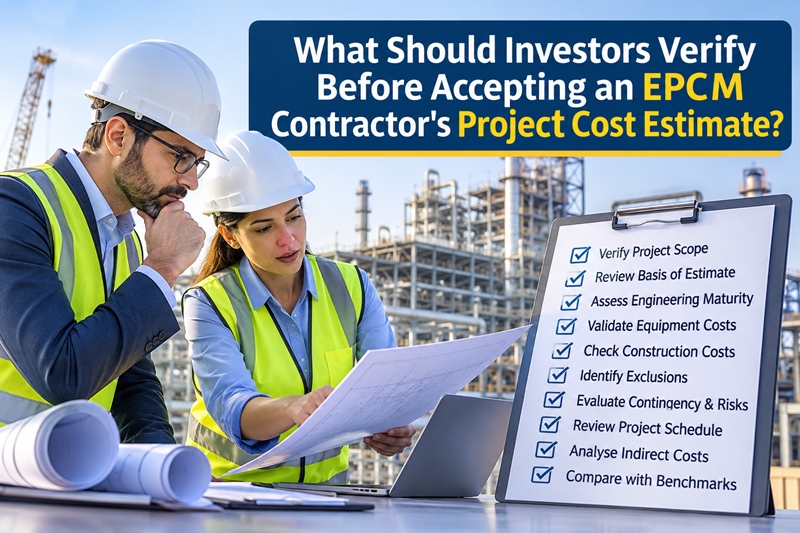
What Should Investors Verify Before Accepting an EPCM Contractor's Project Cost Estimate?
Investing in a manufacturing facility or industrial project requires more than identifying the cost of machinery, construction and installation. Investors must understand the complete financial commitment required to take the project from initial engineering to operational readiness. An Engineering, Procurement and Construction Management (EPCM) contractor may provide a detailed project cost estimate, but the estimated amount is only as reliable as the scope, technical information, pricing assumptions and project risks behind it.
A common challenge is that investors focus on the total estimated project cost without examining what the contractor has included, excluded or provisionally calculated. Equipment quotations may not cover installation requirements, utility infrastructure may be underestimated, and construction schedules may not account for procurement delays. These gaps can create additional funding requirements during execution.
Before approving an EPCM contractor's project cost estimate, investors should examine the underlying engineering scope, cost breakdown, procurement assumptions, contingency provisions and execution schedule. Understanding these elements helps determine whether the proposed budget reflects the actual requirements of the project.
Why Should Investors Carefully Review an EPCM Contractor's Cost Estimate?
An EPCM arrangement differs from a conventional Engineering, Procurement and Construction (EPC) contract. Under a typical EPC arrangement, a contractor takes responsibility for delivering an agreed scope, often against a lump-sum price. Under EPCM, the contractor generally provides engineering, procurement and construction-management services, while the project owner typically enters into separate contracts with equipment suppliers and construction contractors.
This distinction affects how project expenditure is managed. The contractor may coordinate procurement and construction, but the owner generally retains greater responsibility for actual expenditure under the separate contracts, making effective EPCM project cost estimation essential for maintaining budget visibility and financial control throughout project execution.
Consequently, reviewing the EPCM contractor's professional fees alone does not provide a complete picture of the investment. Investors need to understand the total anticipated project cost, including equipment purchases, construction packages, indirect expenses, owner-side costs and commissioning requirements.
10 Things Investors Should Verify Before Accepting an EPCM Project Cost Estimate
1. Verify Whether the Complete Project Scope Is Included
The first step is to establish whether the estimate covers every major component required to deliver the intended facility. An estimate may account for production machinery and factory construction but overlook supporting infrastructure necessary for operations.
For a manufacturing plant, this could include electrical distribution, water treatment, compressed air systems, equipment foundations, fire protection, material handling, internal roads, drainage and wastewater treatment.
Investors should compare the estimate with the approved project brief, plant layout, equipment list, process flow diagrams and preliminary utility requirements.
Each major facility and engineering package should have an identifiable cost allocation. Where an item is missing, the investor should establish whether it has been excluded intentionally or is awaiting further engineering definition.
2. Examine the Basis of Estimate (BOE)
The Basis of Estimate (BOE) explains how the contractor calculated the proposed project cost. It provides the assumptions, technical documents, pricing references and estimating methodology behind the total figure.
Investors should request a BOE covering:
Project scope and intended purpose of the estimate.
Engineering drawings and technical documents used.
Equipment quantities and material requirements.
Labour and construction rate assumptions.
Vendor quotations and pricing reference dates.
Estimating methodology and allowances.
Project assumptions and exclusions.
Contingency and identified cost risks.
For example, an electrical infrastructure estimate may use preliminary equipment loads and assumed cable-routing distances. If the final machinery layout increases electrical demand or cable lengths, the original allowance may become insufficient.
Investors should therefore check whether significant costs are supported by engineering documents, calculations, supplier quotations or clearly stated assumptions. A total figure without a documented basis is difficult to evaluate independently.
3. Check the Estimate Classification and Engineering Maturity
An estimate prepared during conceptual planning should not be evaluated in the same way as one developed after detailed engineering.
AACE International's estimate-classification framework distinguishes estimates according to the maturity of project definition. For process industries, the classification system considers the availability and development of documents such as process flow diagrams, piping and instrumentation diagrams and electrical drawings.
Investors should establish:
Which estimate class has been assigned?
What engineering information supports that classification?
Are equipment specifications sufficiently developed?
Have construction quantities been calculated?
Are utility requirements and plant layouts defined?
Is the estimate mature enough for the intended funding decision?
An estimate can contain numerous cost line items and still depend heavily on preliminary assumptions. Its level of detail should not be confused with the maturity of its underlying engineering information.
Estimate classification also does not guarantee a particular level of accuracy. Actual uncertainty depends on project complexity, scope definition, pricing information and identified risks.
4. Validate Equipment Quotations and Procurement Costs
Equipment procurement can represent a substantial proportion of manufacturing project expenditure. However, an initial supplier quotation may not reflect the complete cost of purchasing, delivering and installing a machine.
For example, a production machine quotation may cover the main equipment but exclude control panels, special foundations, transportation, installation supervision and commissioning support.
Investors should verify:
Whether quotations match the latest equipment specifications.
Whether the proposed capacity meets production requirements.
Whether auxiliary equipment and accessories are included.
Whether freight, insurance and transportation are considered.
Whether applicable duties and taxes are accounted for.
Whether spare parts and initial inventories are included.
Whether supplier delivery schedules match the project programme.
A procurement register showing equipment descriptions, quantities, suppliers, quotation status, estimated prices and delivery dates can help investors identify incomplete or outdated procurement assumptions.
5. Review Civil Construction and Infrastructure Estimates
Civil and structural costs can change when preliminary project assumptions are replaced with actual site and engineering information.
For example, foundation requirements may change after geotechnical investigations reveal different soil conditions. Similarly, preliminary factory dimensions may not reflect the structural quantities required by the final building design.
Investors should examine whether the estimate includes site preparation, excavation, foundations, structural steel, industrial flooring, drainage, internal roads and underground utility networks.
Supporting information should include available site surveys, geotechnical reports, preliminary structural drawings, bills of quantities (BOQs) and construction rate assumptions.
Particular attention should be given to lump-sum civil work allowances that lack supporting quantities or drawings. Investors should ask how these figures were developed and what conditions could cause them to change.
6. Identify Excluded Costs and Owner Responsibilities
An EPCM contractor's estimate may cover the services and project packages within its defined scope without including every expense that the project owner must incur.
Potential exclusions include land acquisition, statutory approvals, external utility connections, financing costs, owner-side project management, insurance, recruitment, employee training and initial operating inventory.
Not every item applies to every project, and some may already be included in the estimate.
Investors should request an owner-versus-EPCM responsibility matrix identifying who will arrange, manage and fund each major requirement. They should also compare this matrix with the detailed cost breakdown.
This review is particularly important for costs that do not fall directly under engineering, equipment procurement or construction contracts. Identifying responsibility before project approval reduces the likelihood of unexpected funding requirements during execution.
7. Examine Contingency and Project Risk Provisions
Industrial projects involve uncertainties that cannot always be eliminated during initial planning. Engineering changes, material price movements, construction variations, equipment delivery problems and unforeseen ground conditions can affect the final expenditure.
Investors should check whether the estimate includes a separately identified contingency provision and whether it is supported by an assessment of project-specific risks.
For example, a project involving imported machinery may face currency fluctuations and extended delivery periods. A facility with limited site investigation may carry additional uncertainty around excavation and foundation work.
The investor should examine the risk register, contingency calculation, assumptions and approval procedure for using contingency funds.
It is also important to distinguish contingency for uncertainty within the approved scope from management reserves or funds intended for future scope changes. These should not be treated as interchangeable budget provisions.
8. Check Whether the Project Schedule Supports the Estimated Costs
Cost estimation and project scheduling should be reviewed together because execution delays can increase the overall investment requirement.
Consider a manufacturing project in which civil construction is scheduled to finish before the main production machinery arrives. If the equipment supplier requires additional manufacturing time, installation and commissioning may also be delayed.
Investors should examine engineering completion milestones, vendor drawing approvals, equipment manufacturing lead times, procurement schedules, construction activities, utility readiness and commissioning dates.
They should also review the critical path to identify activities that directly influence the planned completion date.
A useful question is whether the estimate accounts for the financial consequences of the proposed project duration, including site supervision, temporary facilities, construction utilities and extended project management expenses.
Connect with an expert: https://www.imarcengineering.com/contact?service=project-scheduling-and-cost-estimation
9. Verify Indirect Costs, Escalation and Cash-Flow Requirements
Direct equipment and construction costs are only part of the overall investment. Indirect expenditure can accumulate throughout the project execution period.
Relevant items may include EPCM engineering fees, site administration, safety management, inspection and testing, mobilisation, temporary facilities, insurance and construction-period financing costs.
Investors should also examine whether the estimate distinguishes current base-date prices from anticipated future expenditure.
This is particularly important when major equipment packages involve imported components or foreign-currency payments.
A time-phased cash-flow forecast should show when funds will be required against procurement advances, manufacturing milestones, equipment deliveries, construction progress and commissioning activities.
Without this assessment, a project may have an apparently sufficient total budget but still experience funding shortages at critical execution stages.
10. Compare the Estimate with Independent Benchmarks
An EPCM contractor's estimate should not be accepted simply because it contains a detailed breakdown. Investors need to assess whether the underlying quantities, rates and assumptions are commercially reasonable.
Useful benchmarking parameters include equipment costs relative to installed production capacity, civil construction costs per square metre, utility infrastructure expenditure, installation costs and project duration.
However, comparisons must involve genuinely similar facilities. Production technology, automation levels, site conditions, location, environmental requirements and plant capacity can significantly affect project costs.
Where possible, investors should obtain an independent cost assessment and investigate substantial differences between the two estimates. The objective is not necessarily to select the lower figure but to understand why the estimates differ and which assumptions are better supported.
Red Flags to Identify Before Approving an EPCM Cost Estimate
Certain warning signs deserve additional investigation before an investor approves the proposed budget.
No detailed cost breakdown: The contractor provides a total amount without explaining the major cost components.
Missing technical support: Equipment and construction costs are not linked to specifications, drawings or quantities.
Unclear exclusions: The estimate does not identify expenses that remain the owner's responsibility.
Unverified vendor pricing: Preliminary quotations are treated as confirmed procurement costs.
Unsupported contingency: A contingency amount is included without explaining the risks it covers.
Unrealistic project schedule: Procurement and construction milestones are based on unconfirmed delivery assumptions.
No independent comparison: Significant cost assumptions have not been evaluated against comparable projects.
These warning signs do not automatically mean that the estimate is incorrect. They indicate areas where investors should request clarification and supporting evidence before making a financial commitment.
Documents Investors Should Request Before Budget Approval
Before accepting the estimate, investors should request a coordinated set of technical, commercial and project-control documents.
The most useful documents include:
Approved project scope and technical brief.
Basis of Estimate and detailed cost breakdown.
Plant layout, engineering drawings and equipment list.
Preliminary BOQ and construction quantity calculations.
Vendor quotations and procurement register.
List of assumptions, exclusions and allowances.
Project master schedule and critical path.
Project risk register and contingency calculation.
Owner-versus-EPCM responsibility matrix.
Time-phased cash-flow forecast and cost-control procedure.
These documents allow the investor to examine not just the estimated amount but also the reasoning behind it. Any missing information should be recorded, assigned to a responsible party and resolved before the relevant budget approval decision.
How IMARC Engineering Can Help
IMARC Engineering can support industrial investors and manufacturing companies through engineering-based project planning, scheduling and cost estimation. Its approach can help assess project requirements, organise cost components, review engineering and procurement assumptions, and identify potential gaps in the proposed budget. By considering project scope, construction activities, equipment requirements, utilities and execution timelines together, investors can develop a more informed understanding of anticipated expenditure. This supports better investment decisions, budget planning and project cost control.
Conclusion
Accepting an EPCM contractor's project cost estimate requires more than reviewing its total value. Investors should examine the engineering scope, estimating methodology, procurement costs, exclusions, contingency provisions and execution schedule before committing capital. The objective is to understand whether the proposed budget reflects the complete requirements of the intended facility and whether its assumptions are adequately supported. A structured review before approval can help identify financial gaps early, improve funding decisions and reduce avoidable cost surprises during project execution.
Contact Us:
IMARC Engineering
Phone: +91-120-433-0800
Email: sales@imarcengineering.com
India: C-130, Sector 2, Noida, Uttar Pradesh 201301
LinkedIn: https://www.linkedin.com/showcase/imarc-engineering/





