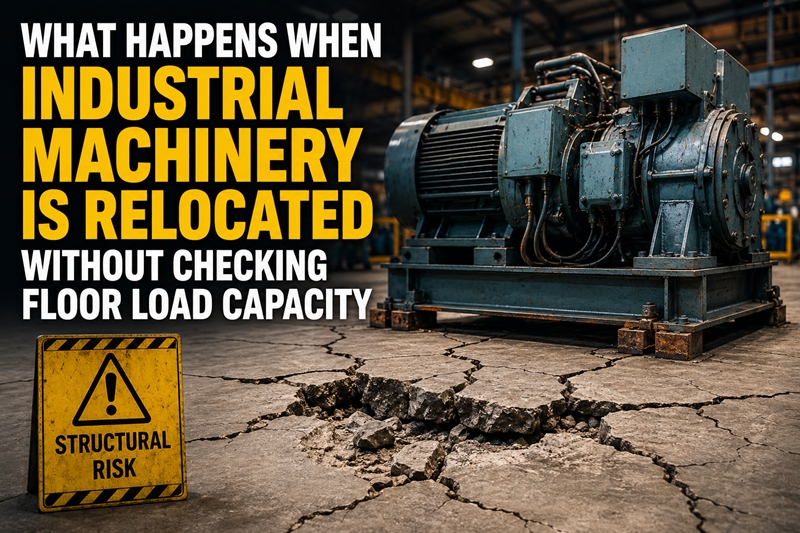
Relocating machinery to a new production area involves more than arranging transportation, dismantling equipment and preparing installation space. Manufacturers must also determine whether the receiving facility can safely support the machinery's weight and operating loads. A floor that accommodates regular production activities may not necessarily be suitable for heavy equipment with concentrated support loads or significant vibration.
This issue often becomes important during factory expansion, production-line rearrangement and relocation to multi-storey industrial buildings. Project teams may confirm machine dimensions, electrical connections and access routes but overlook the structural condition of the receiving floor. As a result, potential limitations may only become apparent when the equipment reaches the installation site.
Installing machinery without verifying floor load capacity can create problems ranging from concrete cracking and excessive deflection to equipment misalignment and costly installation delays. Understanding these risks helps manufacturers assess the receiving facility before committing to an industrial machinery relocation schedule.
Why Is Floor Load Capacity Important During Machinery Relocation?
Floor load capacity refers to the ability of a floor structure to safely resist the loads imposed on it without experiencing unacceptable structural damage or deformation. During machinery relocation, this assessment must consider more than the equipment's total weight.
Industrial machines transfer loads through supporting feet, baseplates, skids or dedicated foundations. Consequently, two machines with similar weights can create different structural demands depending on their dimensions, support arrangements and operating characteristics.
For example, consider a hypothetical machine weighing 12 tonnes and supported by four feet. If the weight were distributed equally, each support would carry approximately three tonnes under static conditions. However, actual reactions may differ because of the machine's centre of gravity, support geometry and operating forces.
The assessment must also distinguish between ground-supported concrete slabs and suspended floors. Ground-supported slabs transfer loads to the underlying subgrade, whereas suspended floors transfer loads through structural slabs, beams and columns.
What Problems Can Occur When Machinery Is Installed Without Checking Floor Capacity?
The consequences depend on the floor construction, machinery characteristics and extent of loading. Several problems may develop during installation or subsequent operation.
1. Concrete Cracking and Localised Floor Damage
Heavy machinery can create concentrated stresses around supporting feet, baseplates and anchoring points. If the existing slab is unsuitable for these loads, cracking or localised concrete damage may develop.
The risk can increase when equipment is installed on a relatively thin slab, near construction joints or close to unsupported floor edges. Existing deterioration, inadequate reinforcement or poor subgrade conditions may further affect performance.
Visible cracking should not automatically be interpreted as structural failure. Some cracks result from concrete shrinkage or other serviceability conditions. However, new or expanding cracks near machinery supports warrant investigation by a qualified structural engineer.
For manufacturers, the consequences may include floor repairs, restricted equipment operation and additional engineering work before production can resume.
2. Excessive Floor Deflection and Uneven Settlement
A floor may experience excessive movement when the applied loads exceed the capacity of its supporting system.
On suspended floors, structural members may deflect under equipment loads. In ground-supported installations, inadequate soil support or compressible subgrade conditions may contribute to settlement.
Differential settlement is particularly problematic for machinery because different support points may move by different amounts. One side of a machine may settle more than another, changing its original installation level.
This can create repeated levelling requirements, alignment difficulties and additional stress on machine connections. The issue may become more noticeable after the equipment has operated under sustained loading.
3. Machinery Vibration and Loss of Operating Accuracy
A structurally inadequate or poorly designed supporting arrangement can affect machinery stability. This is particularly important for precision equipment and machines that generate repetitive or dynamic forces.
CNC machining centres, grinding machines, compressors, pumps and high-speed production equipment may have specific foundation and vibration requirements.
If the supporting structure experiences excessive movement, vibration may interfere with machine performance. Potential consequences include dimensional inconsistencies, reduced machining accuracy, premature wear and repeated maintenance interventions.
Importantly, static load capacity and vibration suitability are separate engineering considerations. A floor may support the machine's weight but still require a specialist assessment of dynamic forces, operating frequencies and foundation stiffness.
4. Damage to Machine Foundations and Anchor Connections
Industrial machinery is often installed using concrete foundations, steel baseplates, grout and anchor bolts. These components help maintain the equipment's position and transfer loads to the supporting structure.
If the receiving floor has not been assessed against the machine's installation requirements, the anchoring arrangement may prove unsuitable.
Possible problems include concrete cracking around anchors, inadequate anchorage resistance, uneven baseplate contact and loosening of connections under operating vibration.
This becomes especially important when machinery is transferred from a purpose-built foundation to a general-purpose production floor. The original foundation arrangement should not automatically be assumed suitable for the new location.
5. Floor Damage During Transportation and Equipment Positioning
A common planning mistake is evaluating only the final machine position while overlooking the loads generated during transportation and installation.
Forklifts, hydraulic skates, mobile cranes and temporary lifting arrangements can introduce concentrated loads at different locations along the movement route.
For example, a forklift carrying heavy machinery transfers its combined weight and load through its wheels. Similarly, crane outriggers may impose substantial reactions over relatively small supporting areas.
Therefore, a floor that can accommodate the installed machine may not necessarily support the equipment and handling arrangement used to move it.
Manufacturers should evaluate floor conditions along the complete transportation route, including unloading areas, ramps, turning locations and temporary positioning points.
6. Unexpected Installation Costs and Production Delays
Structural problems discovered after equipment reaches the receiving facility can disrupt the relocation schedule.
The project team may need to arrange additional structural investigations, redesign the installation arrangement, strengthen the floor or construct a dedicated machine foundation.
In some cases, machinery may need to remain in temporary storage or be repositioned while corrective work is completed.
These activities can increase project expenditure through additional engineering, civil construction, equipment handling and commissioning work. Production restart may also be delayed if structural approval is required before the machine can operate.
The important consideration is that these problems are often easier to address during relocation planning than after machinery has arrived at the site.
Why Is a General Floor Loading Rating Not Enough?
Manufacturers sometimes evaluate floor suitability using a general loading figure expressed in kilograms per square metre or kilonewtons per square metre. Although this information is useful, it does not establish whether a particular machine can safely be installed at a specific location.
A general floor loading rating may not adequately represent the concentrated reactions created by individual machine supports.
A proper assessment should consider:
Total equipment weight: The installed weight, including relevant accessories and operational components.
Support reactions: The loads transferred through individual feet, baseplates or structural supports.
Contact area: The area through which each support transfers its load.
Centre of gravity: Its influence on the distribution of reactions between support points.
Slab thickness and reinforcement: Their contribution to structural resistance.
Beam and column arrangement: Particularly important for suspended floors.
Subgrade conditions: Relevant to ground-supported concrete slabs.
Operating forces: Including vibration, impact and repetitive loading.
Existing floor condition: Cracks, joints, deterioration and previous structural modifications.
The engineer must also evaluate the location of the machine relative to structural supports, slab edges, pits and construction joints.
Simply dividing the machine's total weight by its overall footprint can therefore produce an incomplete assessment. The actual load path and structural response must be examined before approving the installation location.
What Should Manufacturers Check Before Relocating Heavy Machinery?
A structured assessment helps identify whether the receiving facility is ready before dismantling and transportation begin.
1. Collect Accurate Equipment Loading Information
Start by obtaining the machine's technical documentation from the original equipment manufacturer (OEM).
Important details include total installed weight, dimensions, supporting footprint, individual support reactions, centre of gravity, anchoring requirements and foundation specifications.
The shipping weight should not automatically be treated as the final operating weight. Tooling, accessories, workpieces, fluids and other components may change the loading conditions.
2. Review the Receiving Facility's Structural Information
Obtain available structural drawings and construction records to understand the existing floor arrangement.
The review should identify slab thickness, reinforcement details, concrete specifications, beam and column layouts and foundation information, where applicable.
Previous structural modifications and visible signs of deterioration should also be documented. If original drawings are unavailable or do not reflect actual site conditions, further investigation may be necessary.
3. Arrange a Site-Specific Structural Assessment
A qualified structural engineer should evaluate the proposed equipment loads against the receiving structure's design and existing condition.
Depending on the installation, the assessment may include slab bending, shear, punching shear, local bearing, structural load transfer and subgrade settlement.
The engineer should also consider existing equipment, stored materials and other imposed loads rather than evaluating the relocated machine in isolation.
4. Evaluate Transportation and Installation Loads
Prepare a movement plan covering the complete route from unloading to the final installation position.
Check forklift wheel and axle loads, machinery skate contact loads, crane outrigger reactions, temporary supports and equipment positioning arrangements.
Where heavy equipment must pass across suspended floors or restricted access areas, the transportation method should receive particular attention.
5. Identify Necessary Structural Modifications
If the existing floor cannot accommodate the proposed equipment arrangement, suitable engineering solutions should be evaluated before relocation.
Depending on the findings, these may include constructing a dedicated machine foundation, providing a reinforced concrete equipment pad, strengthening structural members or selecting a different installation location.
Such modifications must be designed and approved by appropriately qualified professionals. Simply placing steel plates beneath machine supports does not automatically make an inadequate floor safe.
6. Verify Structural Readiness Before Installation
Before machinery is positioned, confirm that the approved structural work has been completed and the receiving area meets the installation requirements.
Review foundation dimensions, concrete strength and curing requirements, anchoring arrangements, support conditions and installation levels.
The structural approval should be coordinated with the machinery installation plan so that equipment is not positioned before the necessary checks are complete.
Connect with an expert: https://www.imarcengineering.com/contact?service=equipment-relocation-and-reinstallation
Which Indian Standards Are Relevant to Machinery Floor and Foundation Assessment?
Manufacturers relocating equipment in India should consider applicable Indian Standards alongside the machine manufacturer's technical requirements and site-specific engineering assessments.
Three important references include:
IS 875 (Part 2):1987 – Imposed Loads: Provides guidance on imposed loads for buildings and structures. However, a general occupancy-based floor loading value should not be treated as automatic approval for a particular heavy machinery installation.
IS 456:2000 – Plain and Reinforced Concrete: Provides the design and construction framework for relevant concrete structural elements.
IS 2974 series – Machine Foundations: Addresses the design and construction of machine foundations, including general provisions, block foundations, frame foundations and foundations for hammers and presses.
BIS introduced revised editions of the IS 2974 series in 2026. Manufacturers and engineering teams should verify the applicable current editions and amendments before using these standards for project design.
These references do not replace a site-specific assessment. The appropriate engineering approach depends on whether the equipment is installed on a ground-supported slab, suspended floor or dedicated machine foundation.
How IMARC Engineering Can Help With Equipment Relocation and Reinstallation
IMARC Engineering supports manufacturers with engineering coordination for equipment relocation and reinstallation projects. This includes reviewing equipment requirements, identifying receiving-site constraints, coordinating machinery dismantling and transportation planning, and supporting installation readiness. Where floor capacity or foundation suitability requires specialist verification, the assessment can be coordinated with qualified structural engineering professionals. By addressing site conditions, positioning requirements and reinstallation activities before machinery arrives, manufacturers can reduce avoidable project complications and plan a more controlled return to production.
Conclusion
Successful machinery relocation depends on more than transporting equipment safely and finding sufficient installation space. Manufacturers must verify that the receiving floor, supporting structure and foundation arrangement can accommodate the machine's actual loading conditions. Overlooking this assessment can lead to structural damage, vibration problems, installation delays and additional project costs. Making floor load verification part of relocation planning helps manufacturers identify constraints early, select suitable installation locations and establish the structural readiness required for reliable equipment reinstallation.
Contact Us:
IMARC Engineering
Phone: +91-120-433-0800
Email: sales@imarcengineering.com
India: C-130, Sector 2, Noida, Uttar Pradesh 201301
LinkedIn: https://www.linkedin.com/showcase/imarc-engineering/