
Colorado Springs retinitis pigmentosa is an important topic for people experiencing difficulty seeing in dim lighting, reduced peripheral vision, or gradual changes in their eyesight. Retinitis pigmentosa (RP) is a group of inherited retinal disorders that gradually damage the light-sensitive cells responsible for vision. One of its earliest and most recognisable symptoms is night blindness, which can make everyday activities increasingly difficult.
For residents of Colorado Springs, recognising these symptoms and arranging an appropriate eye examination can help identify the condition and support better long-term vision management. Although there is currently no universal cure for RP, modern diagnostic testing, genetic counselling, low vision technology, and rehabilitation services can help individuals maintain independence.
Learning about the causes, warning signs, available treatments, and practical support options is an important first step. This guide explains how retinitis pigmentosa affects night vision and what patients and families should know when seeking eye care.
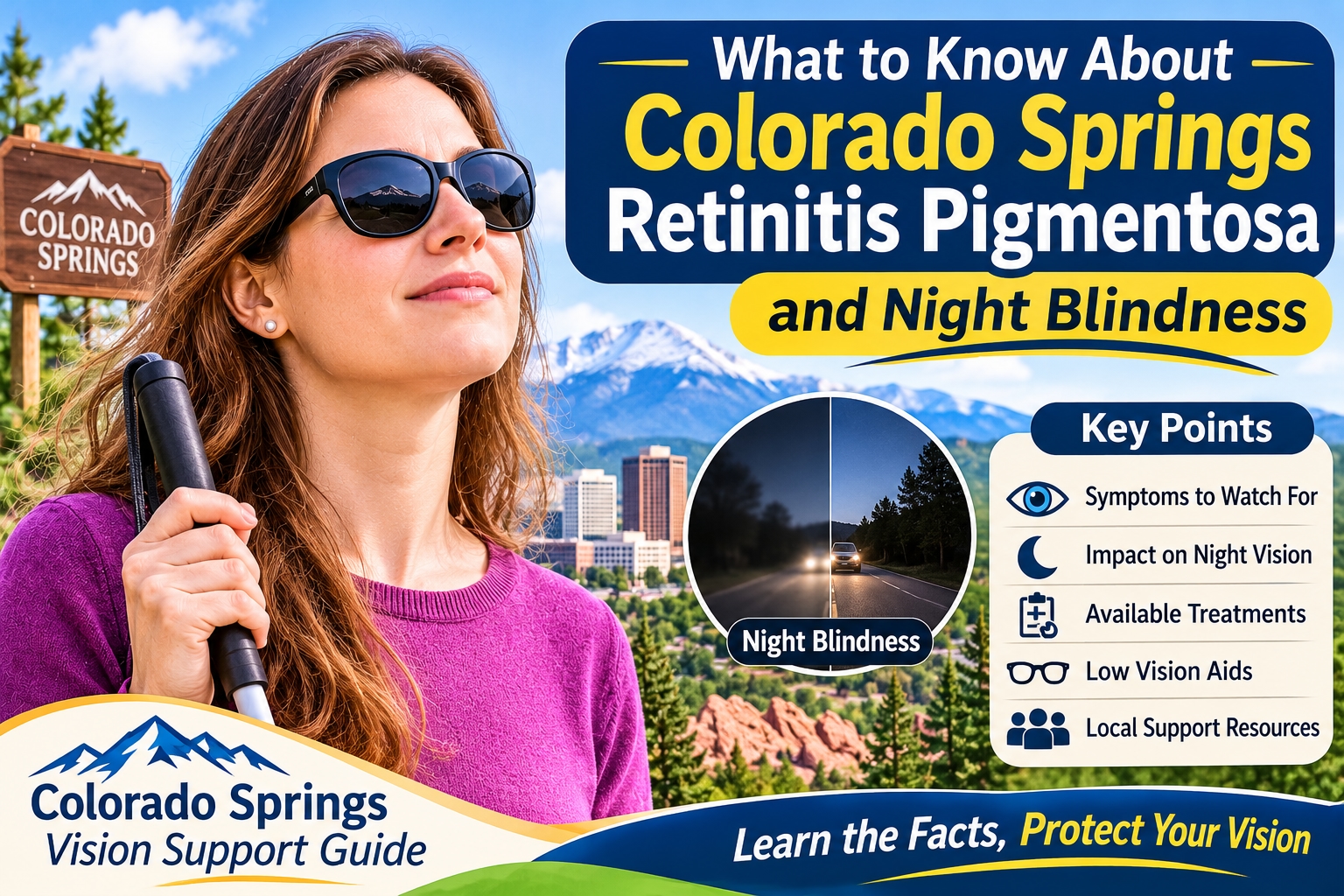
What Is Retinitis Pigmentosa?
Retinitis pigmentosa is a group of inherited eye conditions that affect the retina, a thin layer of light-sensitive tissue located at the back of the eye. The retina contains specialised cells called photoreceptors, which receive light and convert it into electrical signals that travel to the brain.
There are two main types of photoreceptor cells:
Rod cells: Help people see in dim lighting and detect movement and objects outside their direct line of sight.
Cone cells: Support colour perception, detailed vision, and the ability to see clearly in brighter conditions.
In most forms of RP, rod cells are affected first. This explains why night blindness and difficulty adjusting to darkness often appear before other noticeable symptoms.
As the condition progresses, cone cells may also become damaged. This can lead to reduced central vision, colour perception problems, and difficulties with reading or recognising faces.
The speed and severity of vision loss vary considerably. Some individuals retain useful central vision for many years, while others experience more significant changes earlier in life.
Understanding Night Blindness and Its Connection to RP
Night blindness, medically known as nyctalopia, describes difficulty seeing in poorly illuminated environments. It does not necessarily mean someone cannot see anything at night. Instead, the eyes may struggle to adjust when lighting becomes dim.
In people with retinitis pigmentosa, damaged rod cells make it harder to detect objects in darkness. Consequently, activities that once felt normal can become uncomfortable or unsafe.
Common examples include:
Walking through a dark hallway.
Finding objects in poorly illuminated rooms.
Seeing steps and kerbs after sunset.
Adjusting when entering a dim restaurant.
Recognising obstacles while walking outdoors at night.
Moving safely between brightly lit and dark environments.
People with Colorado Springs retinitis pigmentosa may initially notice these difficulties during evening activities or when driving after sunset.
Night blindness can also result from other conditions, including cataracts, vitamin A deficiency, and certain retinal disorders. Therefore, experiencing poor night vision does not automatically confirm RP. A comprehensive eye examination is necessary to identify the underlying cause.
Early Symptoms and Warning Signs
Recognising early symptoms can help individuals seek appropriate assessment before vision difficulties significantly affect everyday activities.
1. Difficulty Seeing in Darkness
This is frequently the first noticeable symptom. Individuals may require more time to adjust when moving from a bright environment into a darker room.
2. Reduced Peripheral Vision
Peripheral vision allows people to notice objects outside their direct line of sight. As RP progresses, this ability may gradually decrease.
Patients might bump into furniture, miss objects placed beside them, or struggle to notice people approaching from either side.
3. Increased Light Sensitivity
Some individuals experience discomfort when exposed to bright sunlight, headlights, or strong indoor lighting. Glare may make seeing clearly more difficult.
4. Changes in Colour Perception
As cone cells become affected, distinguishing certain colours may become increasingly challenging.
5. Difficulty Reading
Central vision may become affected in some patients, making small print, detailed work, and prolonged reading more difficult.
Symptoms do not progress identically in everyone. Their appearance and severity depend on the underlying genetic variation and individual disease characteristics.
What Causes Retinitis Pigmentosa?
Retinitis pigmentosa is primarily associated with genetic changes that interfere with the normal functioning of retinal cells.
These changes can be inherited through different patterns:
Autosomal dominant: One altered copy of a particular gene can cause the condition.
Autosomal recessive: An individual generally inherits an altered copy from each parent.
X-linked inheritance: The responsible genetic change is located on the X chromosome.
Some individuals have no known family history because genetic inheritance can be complicated or a mutation may occur for the first time in a family.
RP can also occur alongside other inherited conditions, including Usher syndrome, which affects hearing and vision.
Genetic testing can help identify the specific mutation responsible for the condition. This information may support family planning, genetic counselling, and assessment for treatments designed for particular genetic forms of retinal disease.
How Is Retinitis Pigmentosa Diagnosed?
An accurate diagnosis requires a detailed examination by an ophthalmologist, preferably one experienced in retinal disorders. The specialist reviews symptoms, medical history, family history, and changes in visual function.
For individuals researching Colorado Springs retinitis pigmentosa, understanding the diagnostic process can make appointments more productive and help them prepare relevant questions.
Important Diagnostic Tests
1. Dilated Eye Examination
The ophthalmologist uses special eye drops to widen the pupils and examine the retina. This allows the specialist to look for characteristic changes associated with retinal degeneration.
2. Electroretinography (ERG)
ERG measures the electrical responses of retinal cells when exposed to flashes of light. It helps assess how effectively rod and cone cells are functioning.
3. Optical Coherence Tomography (OCT)
OCT produces detailed cross-sectional images of the retina. It helps doctors examine retinal layers and identify changes that may affect central vision.
4. Visual Field Testing
This assessment measures how much a person can see around them while looking straight ahead. It helps identify peripheral vision loss and monitor changes over time.
5. Genetic Testing
A genetic test can identify specific mutations associated with inherited retinal disorders. Knowing the genetic cause may help determine whether a patient could benefit from an available gene-specific treatment or clinical trial.
Why Regular Eye Examinations Matter
Regular monitoring allows specialists to identify additional problems, including cataracts and cystoid macular oedema. These complications can sometimes receive separate treatment, potentially improving the vision a patient retains.
Available Treatment Options for Retinitis Pigmentosa
There is currently no single treatment that reverses every form of retinitis pigmentosa. However, medical care can address associated complications, support remaining vision, and identify opportunities for gene-specific treatment.
Gene Therapy for Eligible Patients
Voretigene neparvovec, marketed as Luxturna, is an approved gene therapy for eligible patients with confirmed biallelic RPE65 mutations and viable retinal cells. It is not suitable for every person with RP.
Genetic confirmation and specialist assessment are essential before considering this treatment. Patients should ask their retinal specialist whether their genetic results and retinal condition meet the eligibility requirements.
Managing Associated Eye Problems
Some people with RP develop additional eye conditions that can make vision worse.
Treatment may include:
Cataract surgery when lens clouding significantly affects sight.
Prescription medication for certain cases of retinal swelling.
Updated glasses or contact lenses for refractive errors.
Appropriate management of other diagnosed eye conditions.
These interventions do not cure the underlying inherited disorder, but treating additional problems may improve visual function.
Nutritional Support and Medical Supervision
Dietary health plays a role in general wellbeing. A balanced diet containing vegetables, fruits, healthy fats, and essential nutrients supports normal body functions.
However, supplements should never replace specialist care. High-dose vitamin A can cause liver damage and may be unsuitable for certain patients. The evidence concerning supplements and RP progression is also not sufficiently consistent to justify unsupervised treatment.
Can Natural Approaches Support Eye Health?
People frequently investigate a Natural Treatment for Retinitis Pigmentosa because they want to protect their eyesight and maintain independence. However, it is important to distinguish general nutritional support from treatments proven to slow inherited retinal degeneration.
No herbal preparation, home remedy, or special diet has been established as a cure for RP. Natural approaches should therefore complement, rather than replace, professional ophthalmic care.
Some sensible lifestyle practices include:
Eating a balanced diet with a variety of colourful vegetables.
Including appropriate sources of omega-3 fatty acids.
Maintaining healthy blood pressure and blood glucose levels.
Avoiding smoking.
Wearing suitable sunglasses to manage glare and protect against ultraviolet exposure.
Attending recommended retinal examinations.
Patients should discuss supplements with their ophthalmologist before taking them. This is particularly important when considering vitamin A, fish oil, or antioxidant combinations.
A personalised nutritional plan can help address dietary needs without exposing patients to unnecessary supplement risks.
Living Safely With Night Blindness
Night blindness can affect mobility, confidence, and participation in social activities. Fortunately, practical adjustments can make daily environments easier to navigate.
Improve Indoor Lighting
Use consistent lighting throughout the home. Motion-activated lights can be particularly helpful in hallways, staircases, entrances, and bathrooms.
Avoid leaving unexpected dark areas between rooms. Installing adjustable lamps near reading areas and workspaces can also improve comfort.
Reduce Household Obstacles
Keep frequently used pathways clear. Remove loose rugs, organise electrical cables, and avoid moving furniture unnecessarily.
Use contrasting colours on stair edges and doorframes to make important boundaries easier to recognise.
Use Assistive Technology
Depending on individual visual needs, useful devices may include:
Electronic magnifiers.
Large-print reading materials.
Screen-reading software.
Smartphone accessibility settings.
High-contrast keyboards.
Talking clocks and measuring devices.
Portable task lighting.
These tools can help people continue studying, working, communicating, and completing household activities.
Be Careful With Night Driving
Night blindness can make driving dangerous, especially when combined with reduced peripheral vision. Anyone experiencing difficulty seeing in darkness should discuss driving safety with an eye specialist.
A patient should not continue driving when their vision does not meet legal requirements. Alternative transport arrangements can protect both the individual and other road users.
Practical Vision Support in Colorado Springs
Finding suitable rehabilitation support is an important part of managing Colorado Springs retinitis pigmentosa. People living with progressive vision loss may benefit from services that focus on practical skills rather than medical treatment alone.
Vision rehabilitation professionals can help individuals learn safer movement techniques, use assistive devices, and adapt everyday routines.
Colorado offers state-supported Blind and Low Vision Services through its Division of Vocational Rehabilitation. Depending on eligibility, services may include vocational guidance, assistive technology, rehabilitation training, and support with employment-related barriers.
Residents can explore the official programme through the Colorado Division of Vocational Rehabilitation website.
Another local option is New Horizons Low Vision Center in Colorado Springs, which provides low vision services and information about visual aids. Patients should contact the centre directly to confirm current services, availability, and suitability for their needs.
Support should be based on an individual's remaining vision, lifestyle, and personal goals. A rehabilitation assessment can help identify the most useful combination of devices and training.
Everyday Dietary Habits and Retinal Wellbeing
A nutritious diet supports overall health, including the normal functioning of the eyes. Although food cannot repair inherited retinal damage, healthy eating habits can help prevent nutritional deficiencies and support general wellbeing.
People researching Natural Remedies for Retinitis Pigmentosa should be cautious about online claims promising restored night vision or reversed retinal damage.
Consider including these food groups in a balanced eating pattern:
Leafy greens, such as spinach and kale.
Orange vegetables, including carrots and sweet potatoes.
Fish containing omega-3 fatty acids.
Nuts and seeds.
Fresh fruits containing vitamin C.
Protein sources such as eggs, beans, and lentils.
Vitamin A deficiency can contribute to night blindness, but inherited RP is a different condition. Taking additional vitamin A without identifying a deficiency does not provide a proven solution for every person with RP.
A registered dietitian or healthcare professional can help assess nutritional requirements, particularly when a patient follows a restricted diet or takes regular medication.
The Role of Herbal and Wellness Products
Many people explore Herbal Care Products when looking for additional ways to support their general wellbeing. However, consumers should evaluate product ingredients carefully and avoid believing claims that herbal products can regenerate damaged retinal cells or reverse inherited eye conditions.
Before using herbal supplements, consider the following precautions:
Check the complete ingredient list.
Avoid products promising guaranteed vision restoration.
Discuss possible interactions with prescription medicines.
Choose products from reputable manufacturers.
Seek professional advice before starting concentrated herbal extracts.
People with retinal disorders should prioritise evidence-based eye care. Natural wellness products may have a place in a general health routine, but they are not substitutes for retinal examinations, prescribed treatment, or rehabilitation.
Emotional Wellbeing and Family Support
Progressive vision changes can affect emotional health. People may feel frustrated when activities become difficult or worry about losing independence. Family members may also struggle to understand how night blindness affects everyday experiences.
Open communication can make these challenges easier to manage.
Helpful approaches include:
Discussing changing visual needs with family members.
Joining support groups for people with inherited retinal conditions.
Learning practical mobility skills.
Seeking counselling when anxiety or low mood becomes difficult.
Maintaining hobbies through accessible equipment and technology.
Parents of children diagnosed with RP should communicate with teachers about classroom adjustments. Larger print, accessible digital materials, appropriate seating, and additional time for certain activities may help children participate confidently.
Research and Future Developments
Research into inherited retinal disorders continues to advance. Scientists are investigating gene therapies, retinal cell replacement, optogenetics, and other approaches that may eventually improve treatment options.
Clinical trials are particularly important because different genetic mutations can cause different forms of RP. A treatment that works for one genetic subtype may not work for another.
People researching Colorado Springs retinitis pigmentosa can discuss clinical trial opportunities with a retinal specialist. ClinicalTrials.gov is a useful resource for identifying registered studies, although registration does not mean that a treatment is proven effective or available to everyone.
Patients should ask about eligibility, potential risks, expected benefits, and the practical requirements of participating in research.
When Should You See an Eye Specialist?
Arrange an eye examination if you experience persistent difficulty seeing in darkness, progressive peripheral vision changes, unexplained glare sensitivity, or other changes in eyesight.
Seek prompt medical attention for sudden vision loss, a sudden increase in flashes or floaters, or a curtain-like shadow across your vision. These symptoms may indicate an urgent eye problem unrelated to RP.
People with an established diagnosis should follow their ophthalmologist's recommended monitoring schedule. Early assessment of additional eye conditions can help preserve useful vision and identify suitable interventions.
Frequently Asked Questions
1. What is the first sign of retinitis pigmentosa?
Difficulty seeing in dim lighting is often the earliest symptom. People may also take longer to adjust when entering a dark room. Peripheral vision loss commonly develops as the condition progresses.
2. Does retinitis pigmentosa always cause blindness?
No. The severity and progression vary between individuals. Some people retain useful central vision for many years, although others experience substantial visual impairment.
3. Can night blindness be treated naturally?
Night blindness has several possible causes. Correcting an underlying nutritional deficiency may improve symptoms when deficiency is responsible. However, natural remedies cannot reverse inherited retinal degeneration caused by RP.
4. Is retinitis pigmentosa hereditary?
Yes. Most cases are associated with inherited genetic changes. The condition can follow autosomal dominant, autosomal recessive, or X-linked inheritance patterns. Genetic counselling can help families understand their risks.
5. Can glasses correct retinitis pigmentosa?
Regular glasses can correct refractive errors, such as short-sightedness or long-sightedness. However, they cannot reverse retinal damage. Magnifiers and other low vision devices may help with specific everyday activities.
6. What foods are good for people with retinitis pigmentosa?
A balanced diet containing leafy vegetables, fruits, nuts, seeds, and appropriate sources of healthy fats supports general health. No particular food has been proven to cure RP or restore damaged photoreceptors.
7. Is there an approved gene therapy for retinitis pigmentosa?
Yes. Voretigene neparvovec is approved for eligible patients with confirmed biallelic RPE65 mutations and viable retinal cells. It does not treat every genetic form of RP.
8. Can people with retinitis pigmentosa drive at night?
Night blindness and reduced peripheral vision can make night driving unsafe. Patients should receive professional advice about their visual fitness to drive and follow applicable licensing requirements.
9. How often should someone with RP have an eye examination?
The appropriate schedule depends on disease severity, complications, and individual medical needs. An ophthalmologist can recommend how frequently retinal examinations and imaging should be repeated.
10. Where can Colorado Springs residents find low vision support?
Residents can contact Colorado's Division of Vocational Rehabilitation or explore local low vision providers, including New Horizons Low Vision Center. Availability and eligibility should be confirmed directly.
Conclusion
Retinitis pigmentosa is a progressive inherited retinal condition that frequently begins with night blindness and gradually affects peripheral vision. Although there is no universal cure, accurate diagnosis, genetic testing, specialist monitoring, and appropriate rehabilitation can make a meaningful difference to daily life.
For individuals concerned about Colorado Springs retinitis pigmentosa, the most important step is to seek assessment from a qualified eye specialist rather than relying on unverified remedies. Practical home adjustments, assistive technology, nutritional awareness, and emotional support can also help people maintain independence.
Medical research continues to explore new approaches to inherited retinal disease. Staying informed, attending regular examinations, and discussing individual treatment options with an ophthalmologist can help patients make confident decisions about their eye health.




