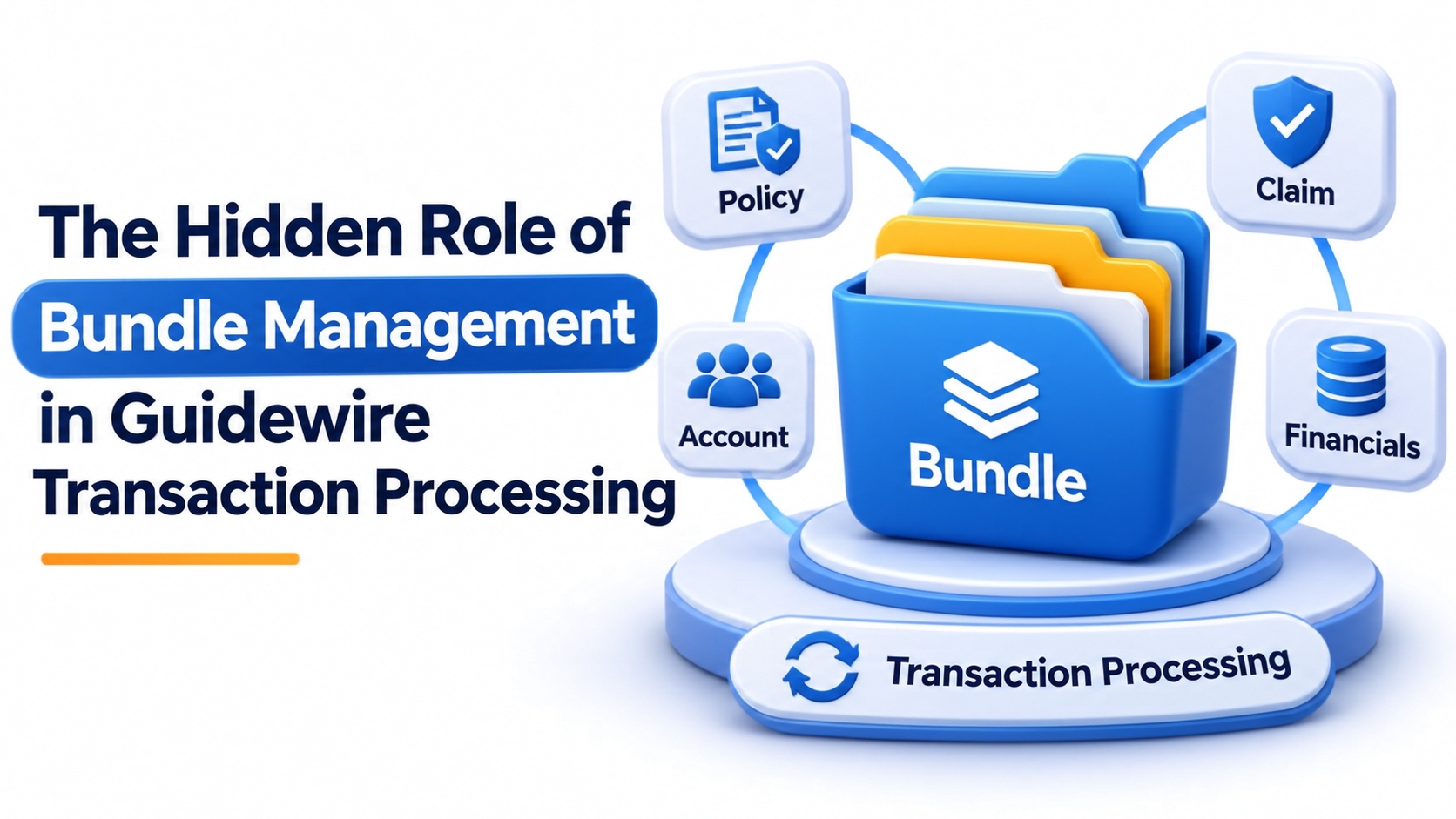
An insurance transaction may look like a simple update on the screen, but several database operations happen behind the scenes. What ensures that these changes remain consistent, reliable, and connected? One important mechanism is Guidewire bundle management.
From creating policies to updating claims and processing financial transactions, bundles control how application data moves through the transaction lifecycle. Understanding this concept helps developers build reliable insurance applications and prevent costly data inconsistencies.
Understanding How Bundles Work Inside Guidewire
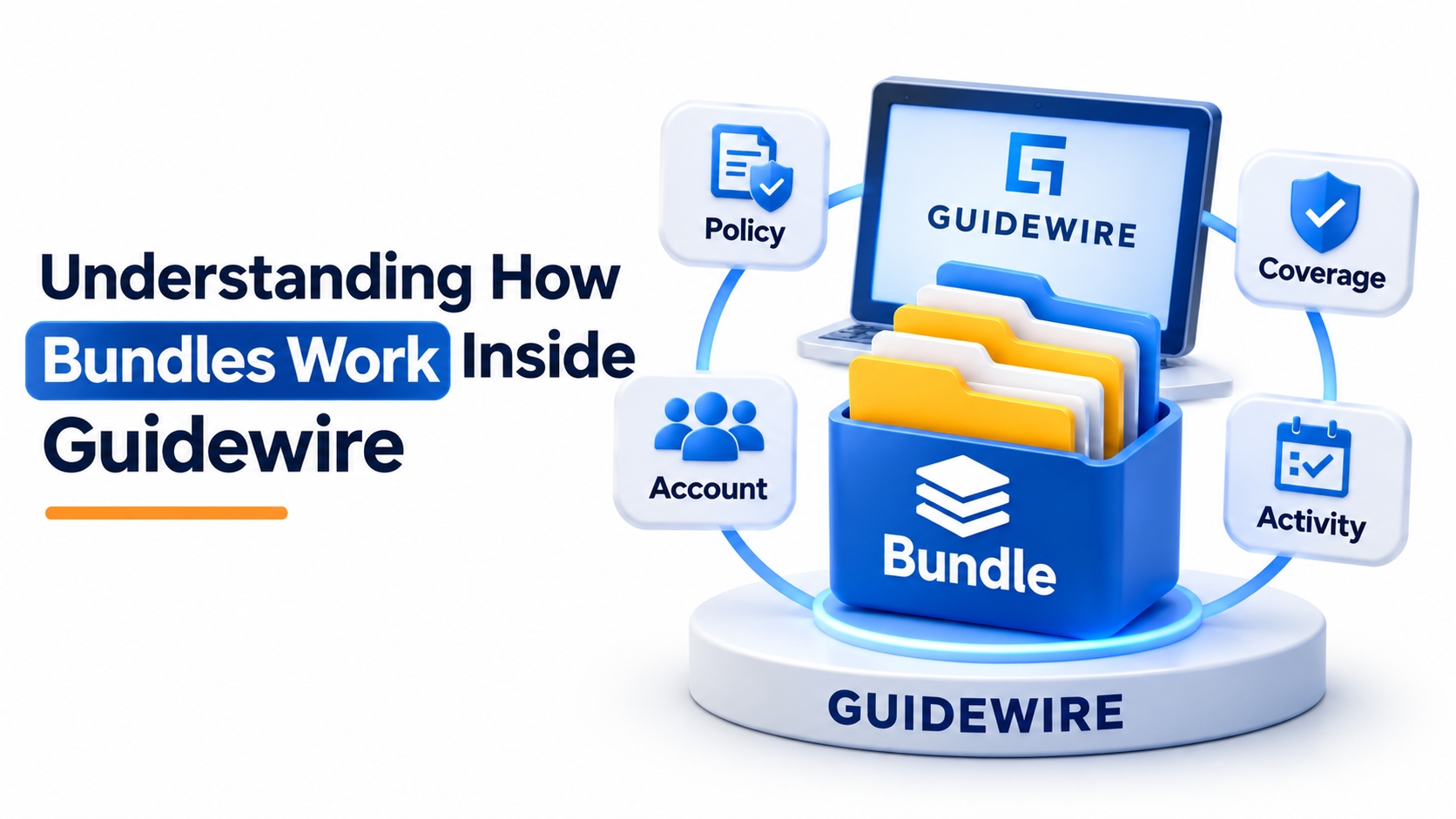
A bundle is an in-memory collection of Guidewire entity instances that represents database records involved in a particular transaction. Instead of saving every individual change separately, Guidewire groups related changes and processes them together.
For example, when an insurance application creates a policy, multiple entities may need updates. These could include policy information, account details, coverage records, and related activities.
Rather than independently saving each modification, Guidewire manages the related entities within a bundle.
The important characteristics of bundles include:
Entity management: Holds new, modified, and deleted entity instances.
Transaction control: Groups database modifications into a single transaction.
Data consistency: Helps prevent partially completed database updates.
Commit processing: Saves the bundle's changes to the database.
Rollback handling: Prevents incomplete transactions from being persisted when a commit fails.
This mechanism is particularly important in PolicyCenter and ClaimCenter, where one business operation can involve several connected entities.
For developers, understanding bundles means understanding how application changes become permanent database records.
Different Types of Bundles and Their Responsibilities
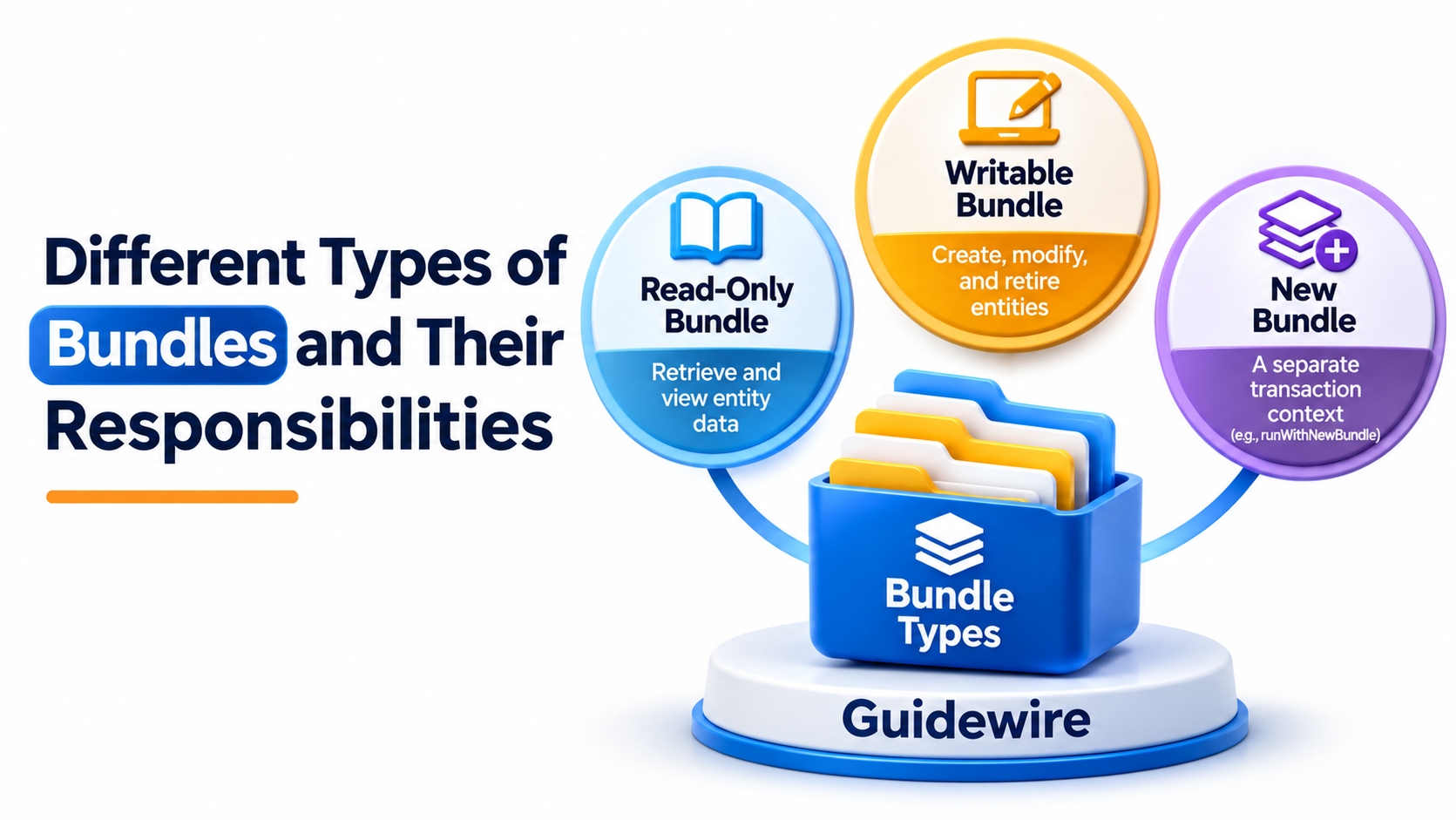
Guidewire uses different bundle contexts depending on how application data is accessed and modified. Understanding these differences helps developers avoid common persistence errors.
The three important concepts are:
Read-Only Bundles
When developers retrieve entities through database queries, the results are generally associated with a read-only bundle.
These entities cannot be directly modified in that context. If changes are required, developers must add or copy the relevant existing entities into a writable bundle using supported APIs.
Writable Bundles
Writable bundles allow developers to create, modify, and retire entities.
For example, when updating a customer's contact information, the developer works within an appropriate writable transaction context to make the required changes.
New Bundles
A new bundle is explicitly created when a separate transaction context is necessary.
Gosu provides APIs such as runWithNewBundle() for executing code within a new bundle. The framework handles committing the bundle when the execution completes successfully.
These distinctions matter because using the wrong bundle context can cause runtime errors, unexpected persistence behavior, or transaction-management problems.
How Bundle Management Controls Transaction Processing
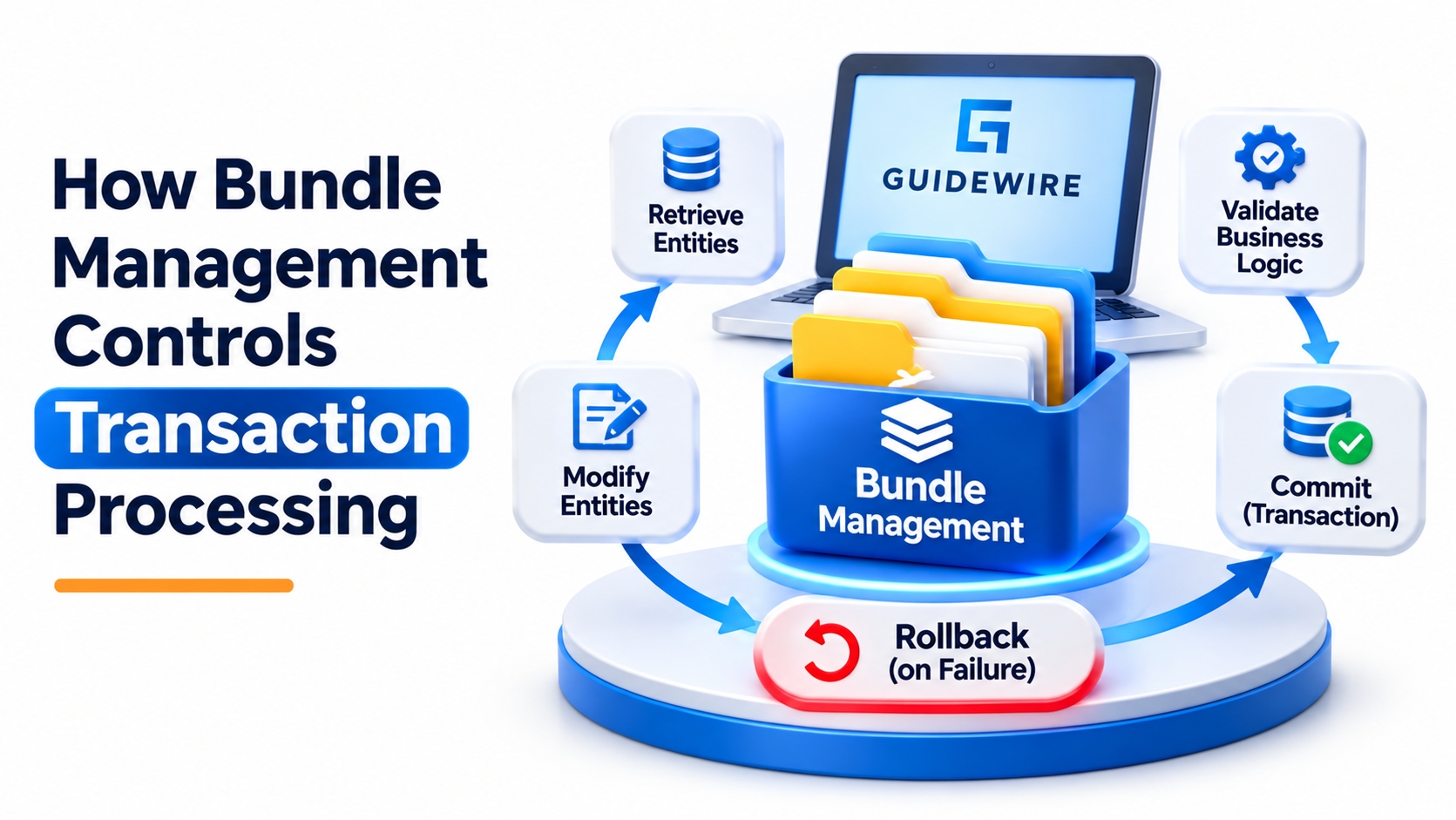
Bundle management plays a central role in controlling how Guidewire processes database changes.
Consider a PolicyCenter scenario in which an existing insurance policy needs an address update and a corresponding modification to related policy information.
Several operations may take place:
Retrieve the existing policy and related entities.
Identify the records requiring modifications.
Perform the required changes within a writable bundle.
Execute applicable validation and business logic.
Commit the bundle to persist the changes.
The commit operation is especially important.
When a bundle commits successfully, its database modifications are processed as a single database transaction. If the commit fails, the transaction is rolled back rather than leaving partially committed changes.
This provides atomicity, an essential property of reliable transaction processing.
For developers, three concepts deserve particular attention:
Commit: Makes the changes in the bundle persistent.
Rollback: Reverses the database transaction when the commit fails.
Transaction boundary: Defines which operations belong to the same transactional unit.
However, database rollback does not automatically reverse actions already completed in external systems. Integrations involving payment gateways or third-party insurance services require additional coordination and error-handling strategies.
This distinction is critical when designing reliable insurance workflows.
The Role of Gosu in Managing Bundles
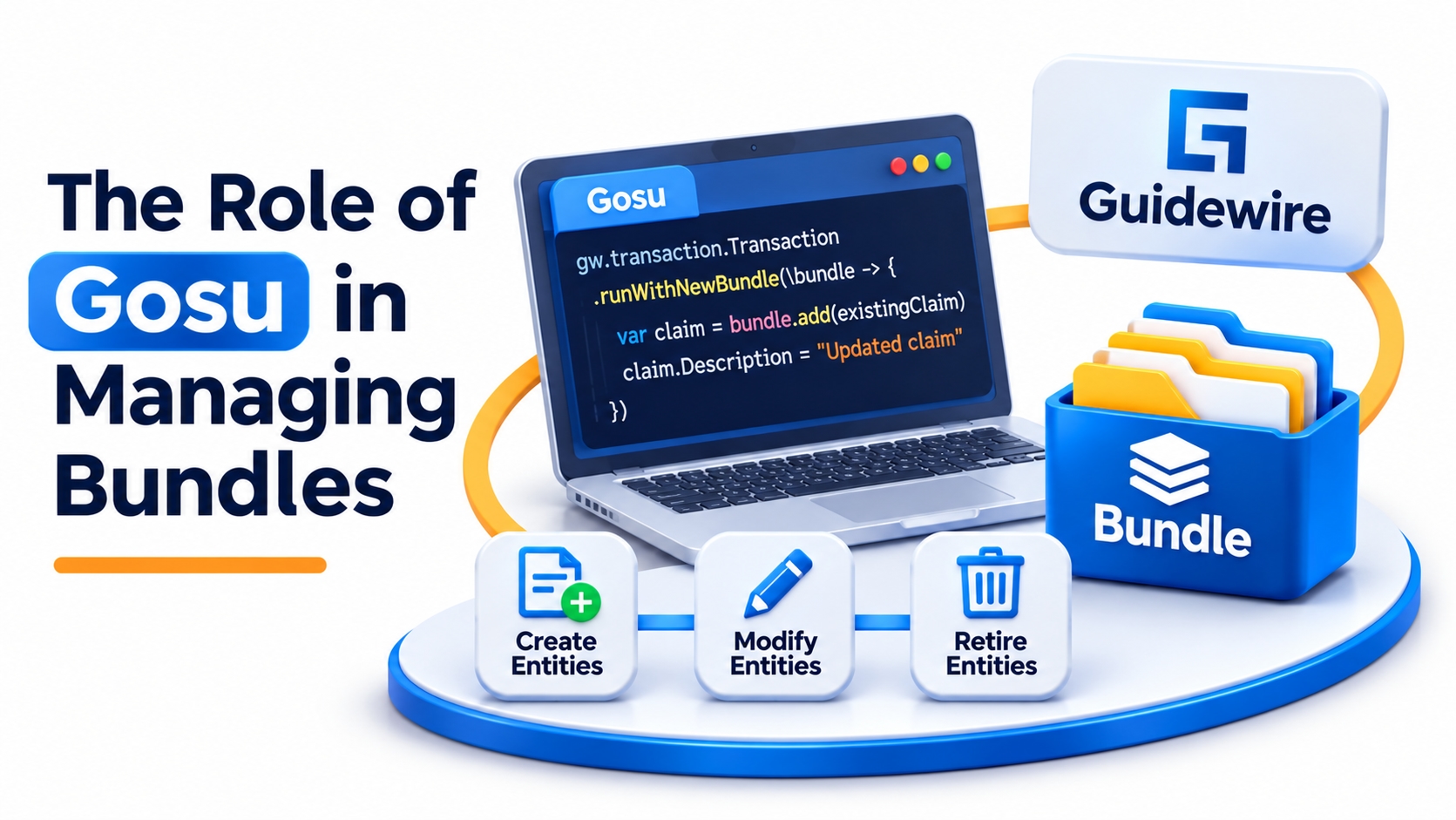
Gosu provides the programming capabilities developers use to work with Guidewire entities and transaction contexts.
Developers must understand when the application automatically manages a bundle and when their code needs to create and manage a separate bundle.
For example, custom batch processes, web services, and certain plugin operations may require explicit bundle management.
A simplified Gosu example illustrates the concept:
gw.transaction.Transaction.runWithNewBundle(\bundle -> {

  var claim = bundle.add(existingClaim)

  claim.Description = "Updated claim information"

})
This example demonstrates the basic idea of working with an existing entity in a new bundle and updating its information.
The framework manages the transaction and commits the bundle when the block completes successfully.
Important development practices include:
Avoid modifying entities directly inside read-only bundles.
Use supported APIs to move existing entities into writable bundles.
Avoid unnecessary bundle creation.
Do not manually commit the current bundle unless the execution context specifically requires it.
Keep transaction boundaries clear and predictable.
The exact APIs and package names can vary across Guidewire versions, so developers should verify implementation details against their project's version-specific documentation.
Understanding Gosu bundle handling is particularly valuable for developers working on custom integrations and complex insurance workflows.
Common Bundle Management Challenges and Performance Issues
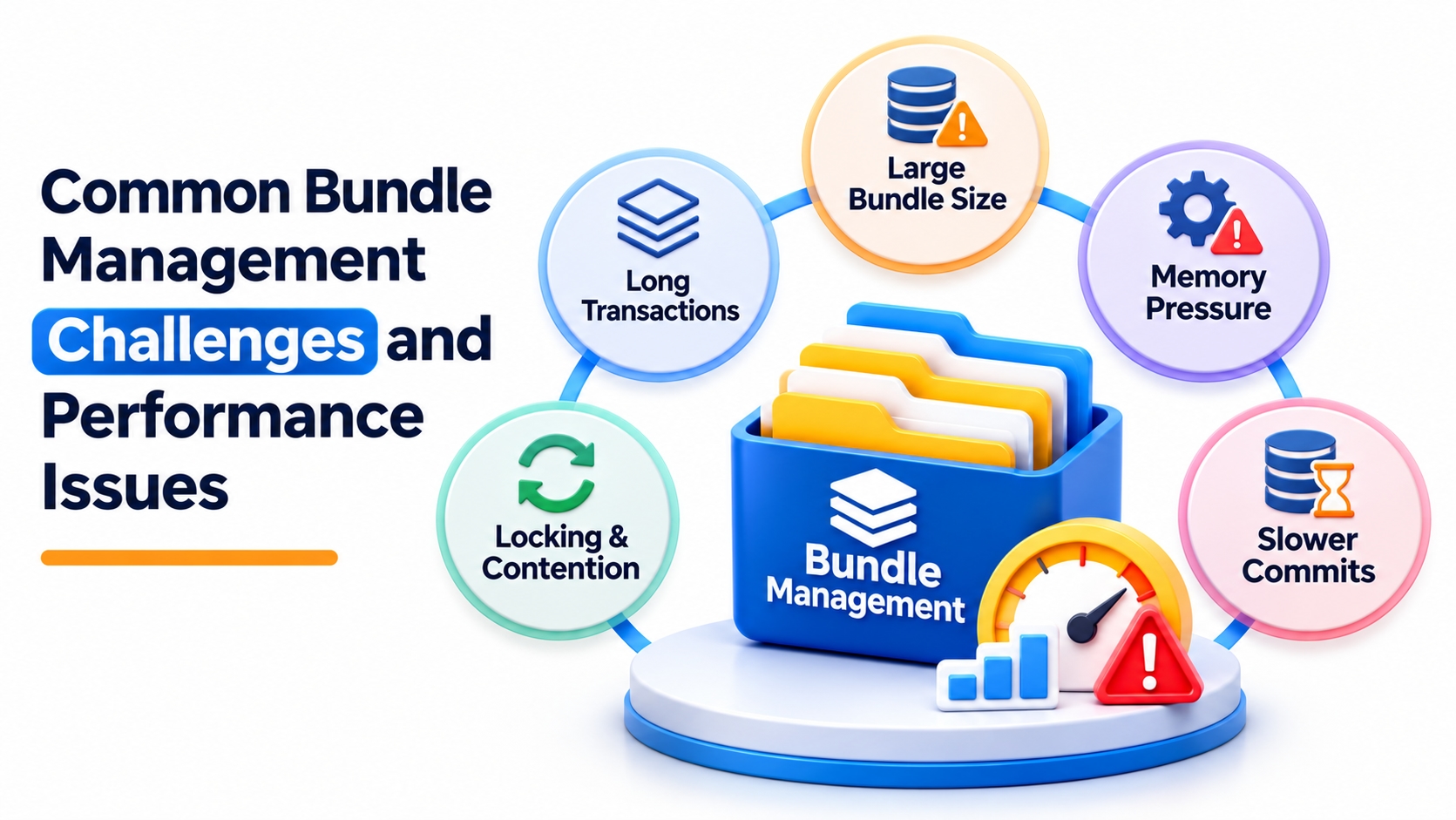
Although bundles simplify transaction processing, incorrect implementation can introduce application errors and performance problems.
One common challenge is modifying an entity without moving it into an appropriate writable bundle. This can result in runtime exceptions and failed business operations.
Another problem occurs when developers create unnecessarily large bundles. Processing too many entities within one transaction can increase memory consumption, extend transaction duration, and create database contention.
Common challenges include:
Read-only modification errors: Attempting to update entities that belong to read-only bundles.
Transaction failures: Validation errors or database constraints preventing successful commits.
Concurrency conflicts: Multiple operations attempting to modify the same business records.
Large bundle processing: Excessive entity loading increasing memory and processing overhead.
Integration inconsistencies: External services succeeding while the corresponding database transaction fails.
Developers can improve reliability through several practices:
Keep bundles focused on related business operations.
Avoid unnecessary entity loading and modifications.
Design appropriate transaction boundaries.
Handle exceptions and failed commits carefully.
Use supported retry and concurrency-control mechanisms.
Monitor slow transactions and investigate database performance.
Concurrency deserves special attention because bundles are not thread-safe. Developers should not share bundle instances across concurrent execution threads.
For large batch operations, processing records in controlled transaction groups can help manage memory usage and reduce the impact of individual failures.
Why Bundle Management Matters for Guidewire Developers and Business Operations
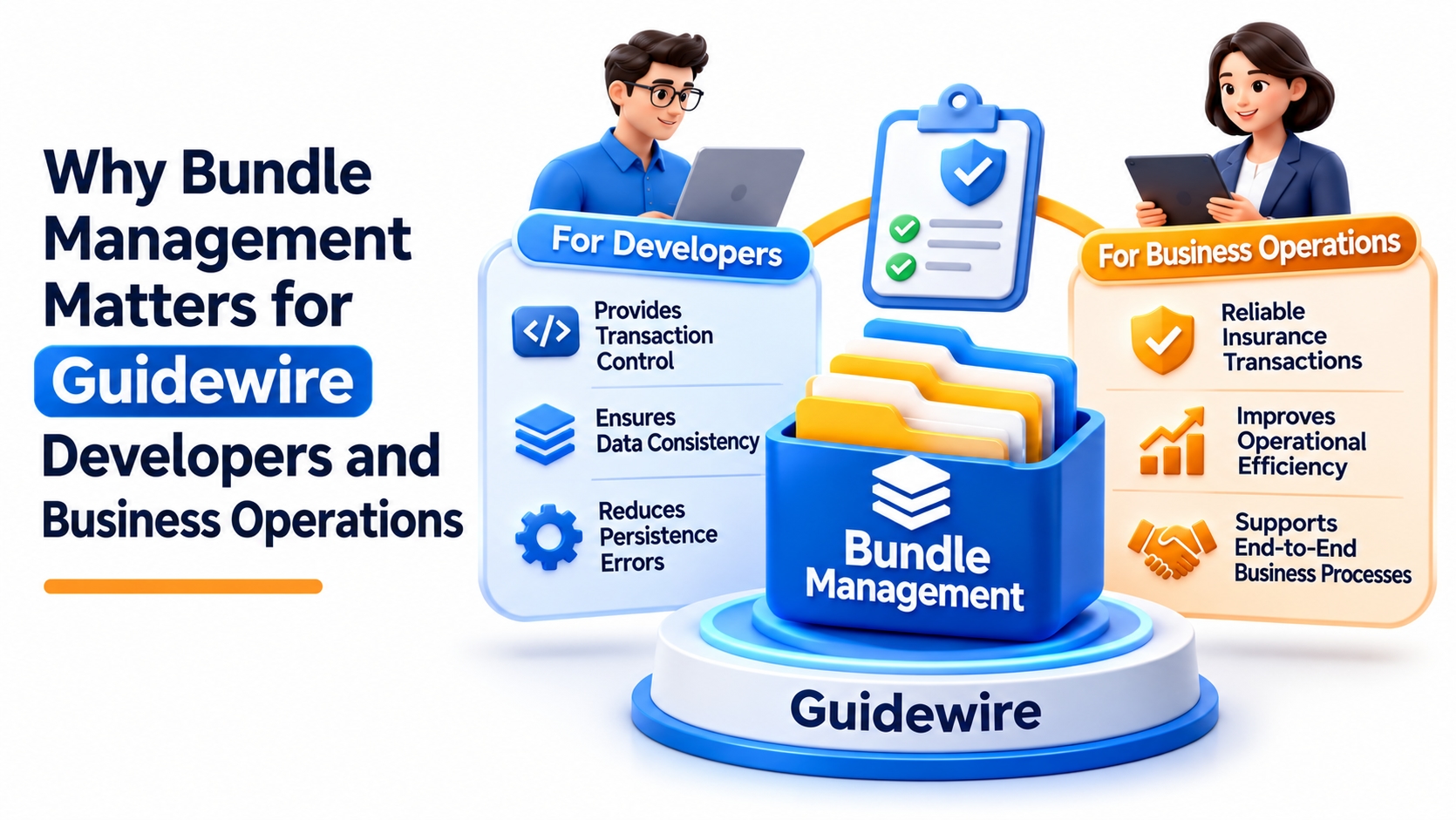
Bundle management is not simply a technical programming concept. It directly influences the reliability of insurance business operations.
Consider ClaimCenter processing a claim update involving claim details, activities, and financial information. If related database changes are not managed correctly, the application could encounter inconsistent business states.
Proper transaction management helps ensure that related changes are persisted together when they belong to the same transaction.
It also helps developers understand why certain operations succeed while others fail.
For professionals entering the Guidewire ecosystem, practical bundle-management knowledge is valuable across several roles:
Guidewire Developers: Need to understand entity persistence, Gosu transactions, and commit behavior.
Integration Developers: Must manage transaction boundaries when connecting external services.
Configuration Developers: Need to understand application-managed bundles and rule execution.
Guidewire Business Analysts: Should understand how transaction failures affect business workflows, policy updates, and claims processing.
Production Support Engineers: Need to investigate failed transactions, application logs, and persistence-related issues.
Learning these concepts through practical exercises is more effective than memorizing definitions.
Training programs from JastTech can help aspiring professionals strengthen their understanding of Guidewire concepts, application workflows, and project-oriented development practices.
Professionals exploring Guidewire Training in Chennai should prioritize hands-on learning that connects application functionality with underlying transaction processing.
Similarly, Guidewire Business Analyst Training can help professionals understand transaction dependencies, business requirements, workflow behavior, and the impact of technical failures on insurance operations.
Conclusion
Bundle management is one of the essential mechanisms behind reliable Guidewire transaction processing. It controls how entity changes are grouped, validated, committed, and rolled back. Although users rarely see this mechanism directly, it plays an important role in maintaining database consistency across PolicyCenter, ClaimCenter, and other InsuranceSuite applications. Developers who understand bundle types, transaction boundaries, Gosu APIs, and error handling can build more dependable insurance solutions.
As insurance applications become increasingly connected through integrations, automated workflows, and cloud-based architectures, understanding transaction management becomes even more important. Learning bundle management alongside entity modeling, Gosu programming, and real-world application scenarios can improve technical confidence and project readiness. JastTech encourages aspiring Guidewire professionals to develop practical skills that connect technical concepts with actual insurance industry requirements.