
Southeast Asia Fire Sprinkler Heads Market Overview
The market is expanding as building owners, industrial operators, and regulators place greater weight on fire prevention. Sprinkler heads connect to pipe networks in walls and ceilings and use heat-sensitive elements, such as a fusible link or glass bulb, that activate at a specific temperature to protect rooms, hallways, and stairways.
The Southeast Asia fire sprinkler heads market drivers include a rising number of fire accidents, growing concern over property and life losses, and tighter safety regulations. The market dynamics are also shaped by technology advances and ongoing research and development, which are improving product performance and reliability across the region.
Market Snapshot
Market Size (2025): USD 279.2 Million
Forecast Market Size (2034): USD 395.4 Million
CAGR (2026-2034): 3.82%
Leading Product Type: Pendent
Leading End User: Commercial
Leading Country: Indonesia
Key Drivers: Fire safety awareness, government regulation, technology advances
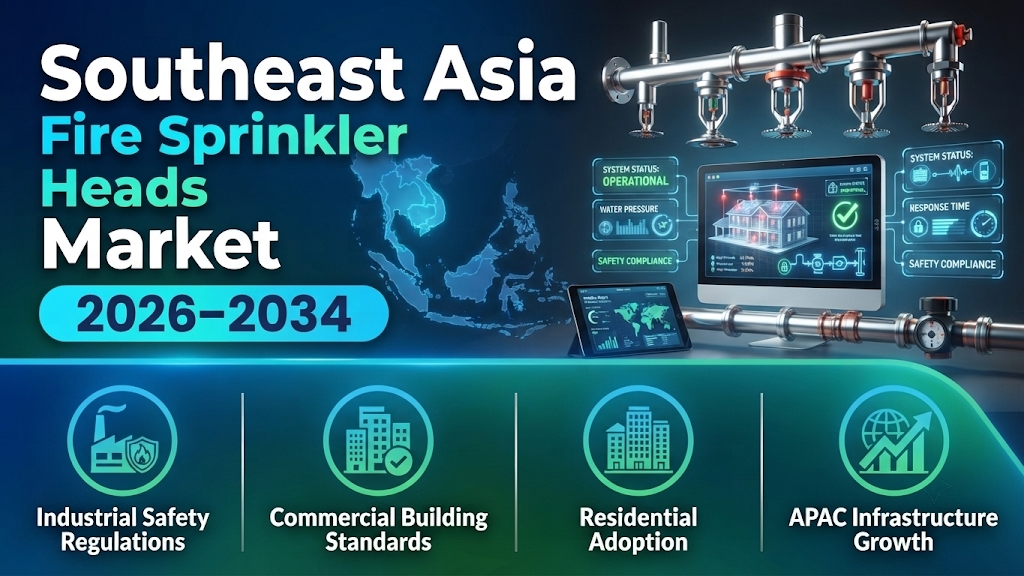
Key Market Drivers
Rising Fire Accidents and Safety Awareness:
A growing number of fire incidents has increased consumer and business concern over loss of life and property, making sprinkler systems a priority in new and existing buildings. These factors are shaping the Southeast Asia fire sprinkler heads market dynamics, as rising awareness of fire safety, stricter building regulations, and increasing investments in residential, commercial, and industrial infrastructure drive demand for advanced fire sprinkler head solutions.
Stricter Government Regulations and Safety Standards:
Governments are strengthening building and fire safety rules, increasing the requirement for automatic fire suppression in commercial, industrial, and residential structures.
Technological Advancements and R&D:
Ongoing research is improving response times, durability, and design options, helping suppliers differentiate and meet evolving code requirements.
Growth in Commercial and Industrial Construction:
Offices, retail spaces, warehouses, and factories rely on sprinklers to meet code and insurance requirements, supporting steady product demand.
Evaluate Market Opportunity with the Business Sample Report
Emerging Trends
Concealed and Aesthetic Designs:
Developers and interior designers increasingly prefer sprinklers that blend into ceilings, which supports demand for concealed products in premium commercial and residential projects.
Smart Fire Safety Integration:
Sprinkler systems are increasingly paired with monitoring and alarm technologies so building managers receive faster alerts and maintenance information.
Product Innovation for Faster Response:
Manufacturers are investing in improved thermal elements and better spray patterns to strengthen performance in diverse building types.
Market Challenges
Despite its importance, the market faces a few structural headwinds:
Modest forecast growth reflects a mature product category where demand is closely tied to construction activity
Price-sensitive buyers may favor lower-cost products over premium alternatives
Retrofitting older buildings can be costly and disruptive
Enforcement of fire codes can vary across countries, leading to uneven adoption
Explore the Full Report with Charts, Table of Contents, and List of Figures
Government Initiatives Supporting the Market
National fire codes, such as those administered by Singapore's civil defence authorities, require automatic suppression in qualifying buildings
Building by-laws and fire service regulations in markets such as Malaysia set sprinkler requirements for many commercial and residential structures
Local fire authorities across the region conduct inspections and enforce safety standards, supporting steady replacement and upgrade demand
Segment Insights
By Product Type
Pendent (currently holds the majority share)
Upright
Side Wall
Concealed
By End User
Commercial (currently dominant)
Industrial
Residential
Regional Insights
Indonesia (currently the leading country market)
Australia
Philippines
Vietnam
Malaysia
Singapore
Thailand
New Zealand
Myanmar
Cambodia
Competitive Landscape
The market features established fire protection brands. Key players include Rapidrop Global Ltd., Reliable Automatic Sprinkler Co., Inc, Tyco International, United Technologies Corporation, Victaulic Company, Minimax-Viking, and Senju Sprinkler.
The report offers an in-depth examination of the competitive landscape and company profiles to help stakeholders benchmark positioning and strategy.
Investment Opportunities
Commercial Building Applications: Commercial properties lead end-user demand, so offices, retail centers, and hospitality projects remain the most reliable growth channel.
Concealed and Premium Products: Design-led developments create room for higher-value concealed sprinklers, supporting better margins.
Regional Distribution and Maintenance Services: Local distribution, inspection, and replacement services can create recurring revenue across multiple country markets.
Request Customized Data Tailored to Your Interest
Frequently Asked Questions (FAQ)
What is the growth rate of the Southeast Asia fire sprinkler heads market?
The market is expected to exhibit a CAGR of 3.82% during 2026-2034.
How big is the market?
The market was valued at USD 279.2 Million in 2025 and is projected to reach USD 395.4 Million by 2034.
What drives the market?
Rising fire accidents and increasing demand for fire safety mechanisms to reduce loss of life and property.
Which product type and end user lead?
Pendent currently holds the majority share by product type, and the commercial sector currently dominates by end user.
Which country leads?
Indonesia currently dominates the Southeast Asia fire sprinkler heads market.
Conclusion
The Southeast Asia fire sprinkler heads market outlook is one of steady, regulation-backed growth, anchored by commercial construction, rising safety awareness, and continuing product innovation.
Manufacturers and distributors that focus on commercial projects, concealed and premium designs, and strong regional service networks will capture the largest share of the USD 116.2 Million incremental opportunity through 2034.
Source: IMARC Group






