
India Welding Equipment Market Executive Summary
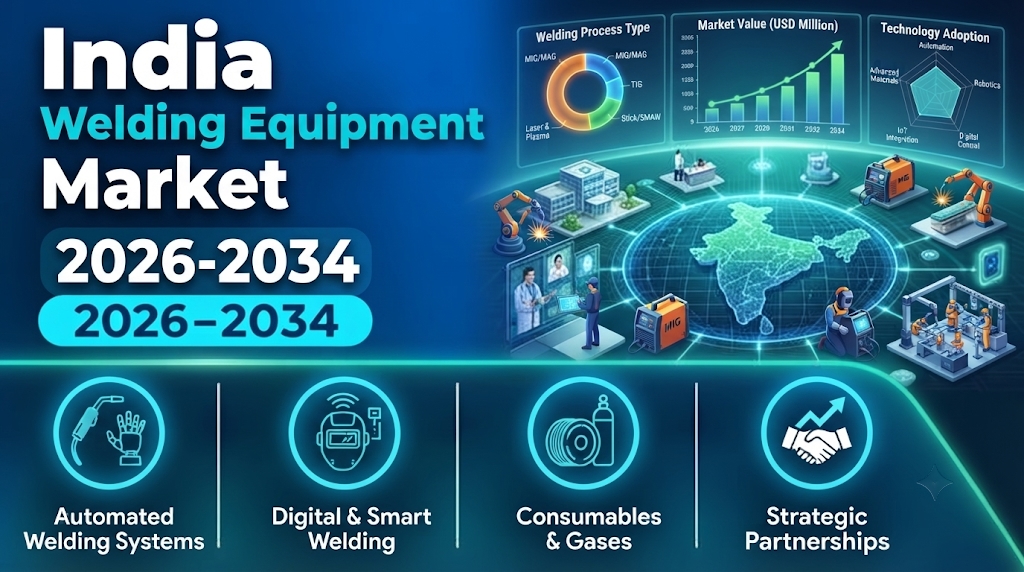
The welding equipment market size in India stood at USD 710.74 Million in 2025, rising to USD 755.40 Million in 2026, and is projected to reach USD 1,091.66 Million by 2034 at a CAGR of 4.71% during 2026-2034, adding about USD 380.92 Million in incremental value. Arc welding commands a 76.2% share, manual welding leads by type at 42.5%, and automotive dominates end use at 27.5%, while West India holds the largest regional share at 30.5%.
Demand is supported by infrastructure spending, automotive and defense manufacturing, renewable energy, railway modernization, and shipbuilding. Local and international technology leaders compete across manual, semi-automatic, and automatic systems, with robotics, AI-based monitoring, and green technologies becoming key differentiators. Growing automation and policy-backed manufacturing investment are positioning the market for sustained expansion.
Market Snapshot
Market Size (2025): USD 710.74 Million
Market Size (2026): USD 755.40 Million
Forecast Market Size (2034): USD 1,091.66 Million
CAGR (2026-2034): 4.71%
Leading Technology: Arc Welding, 76.2% share (2025)
Leading Type: Manual, 42.5% share (2025)
Leading End Use: Automotive, 27.5% share (2025)
Leading Region: West India, 30.5% share (2025)
Key Growth Drivers: Infrastructure, automotive and defense manufacturing, automation
India Welding Equipment Market Key Drivers
Large-Scale Infrastructure Development:
Highway construction under the Bharatmala Pariyojana, metro rail expansions across over 15 cities, and industrial corridors generate consistent demand for manual and automated welding equipment in structural fabrication, pipeline construction, and railway modernization. The Second Asset Monetization Plan for 2025-30 further aims to reinvest INR 10 lakh crore in new projects.
Expanding Automotive and Defense Manufacturing:
India's automotive industry, the third-largest globally, relies on welding for body-in-white assembly, chassis fabrication, and component joining, and growing electric vehicle manufacturing is intensifying demand for robotic MIG, laser, and resistance spot welding. Defense production, including fighter aircraft, submarines, warships, and missile systems, requires precision techniques such as friction stir and electron beam welding.
Accelerating Automation and Industry 4.0 Adoption:
Industries are moving from manual processes to automated and semi-automated systems that offer greater precision and productivity. IoT-enabled monitoring, AI-driven quality control, and predictive maintenance are reshaping procurement, and the shortage of skilled manual welders is accelerating the shift.
Renewable Energy and Shipbuilding Investment:
Rising investment in renewable energy infrastructure and shipbuilding is broadening the application scope of advanced welding solutions.
Evaluate Market Opportunity with the Business Sample Report
India Welding Equipment Market Emerging Trends
Rising Adoption of Automated and Robotic Welding Systems:
India welding equipment market trends show a clear move toward robotic arms and collaborative robots in automotive, heavy engineering, and construction, aided by smart manufacturing and Industry 4.0 policies.
Integration of AI-Driven Smart Welding Technologies:
AI and IoT-enabled sensors provide real-time monitoring of temperature, voltage, and weld seam positioning, with predictive maintenance, instant error detection, and cloud-based analytics improving weld quality and cutting downtime.
Energy-Efficient and Sustainable Welding Solutions:
Manufacturers are developing battery-powered welders, inverter-based machines, and low-emission processes, supported by energy management systems, eco-friendly shielding gases, and recyclable consumables.
Inverter-Based Arc Welding and Skill Development Centers:
Inverter power sources with programmable settings and adaptive arc control help bridge the skill gap between experienced and less experienced welders, and welding skill development centers are strengthening workforce capability.
India Welding Equipment Market Challenges
Despite strong momentum, the market faces structural headwinds:
High capital cost of laser welding machines, collaborative robots, and IoT-enabled systems limits adoption among small and medium-sized enterprises
A persistent shortage of skilled welding professionals, with limited specialized training centers, creates bottlenecks in production efficiency
Dominance of the unorganized sector drives price-sensitive competition and discourages investment in advanced products
Limited access to affordable financing slows technology upgrades among small-scale manufacturers
Explore the Full Report with Charts, Table of Contents, and List of Figures
India Welding Equipment Market Segment Insights
By Technology
Arc Welding, 76.2% (stick, MIG, TIG, plasma arc, and others)
Resistance Welding
Laser Beam Welding
Oxy-Fuel Welding
Others
By Type
Manual, 42.5% (construction sites, repair workshops, small fabrication units)
Semi-Automatic
Automatic
By End Use
Automotive, 27.5%
Building and Construction
Energy
Oil and Gas
Marine
Aerospace
Others
Regional Insights
West India: Share (2025): 30.5%, with Maharashtra contributing 18% of the total India welding market
North India
South India
East India
Competitive Landscape
The India welding equipment market includes established local players and international technology leaders competing across product segments. Players are building portfolios spanning manual, semi-automatic, and automatic solutions, along with nationwide distribution networks for diverse industrial customers.
Key strategies include:
Investing in robotic welding, green technology, and AI-based monitoring systems
Partnering with educational institutions and enhancing after-sales services
Developing products suited to local operating conditions
Recent Developments
February 2025: Delta debuted its D-Bot series of collaborative robots at ELECRAMA 2025, with payload ratings of up to 30 kg and speeds of 200 degrees per second for high-precision welding
2025-30: The Second Asset Monetization Plan targets reinvestment of INR 10 lakh crore in new infrastructure projects, sustaining demand for structural and pipeline welding
Government Initiatives Supporting the Market
Make in India and Production Linked Incentive schemes: encouraging investment in advanced manufacturing equipment
Atmanirbhar Bharat defense manufacturing: expanding precision welding requirements
National Infrastructure Pipeline and PM GatiShakti: coordinated infrastructure planning that supports large-scale fabrication
Bharatmala Pariyojana and Smart Cities Mission: highway and urban projects that rely on on-site welding
Sagarmala and shipbuilding support: port-led development that increases marine welding demand
Investment Opportunities
High-Growth Segments: Semi-automatic and automatic systems, robotic MIG, and laser welding for automotive and EV production are growing fastest as manufacturers address the welder shortage.
Geographic Expansion: West India, anchored by Maharashtra and Gujarat, offers automotive clusters, shipbuilding, and projects such as the Mumbai Trans Harbour Link and Pune Metro.
Technology and Training Investment: AI-based monitoring, energy-efficient inverter and battery-powered welders, and welding training centers are strategic opportunities.
Discuss Your Requirements With an Analyst and Get Your Customized Market Report
Frequently Asked Questions (FAQ)
How big is the India welding equipment market?
The market grew from USD 710.74 Million in 2025 to USD 755.40 Million in 2026.
What is the projected market size by 2034?
The market is projected to reach USD 1,091.66 Million by 2034 at a CAGR of 4.71% during 2026-2034.
Which technology leads?
Arc welding leads with a 76.2% share in 2025, driven by versatility, cost-effectiveness, and broad applicability.
Which region dominates?
West India leads with a 30.5% share in 2025, driven by automotive clusters, heavy industry, and infrastructure projects across Maharashtra and Gujarat.
What are the major challenges?
High cost of advanced equipment, a shortage of skilled welders, unorganized-sector competition, and limited financing for upgrades.
Conclusion
The welding equipment market in India combines the stability of infrastructure and automotive demand with the upside of automation, defense manufacturing, and renewable energy.
Three forces will shape the market through 2034: robotic and AI-enabled welding addressing the skills gap, energy-efficient inverter technology, and policy-backed infrastructure spending. Manufacturers that pair affordable automation with training and service networks will capture the USD 380.92 Million in incremental value.
Source: IMARC Group






