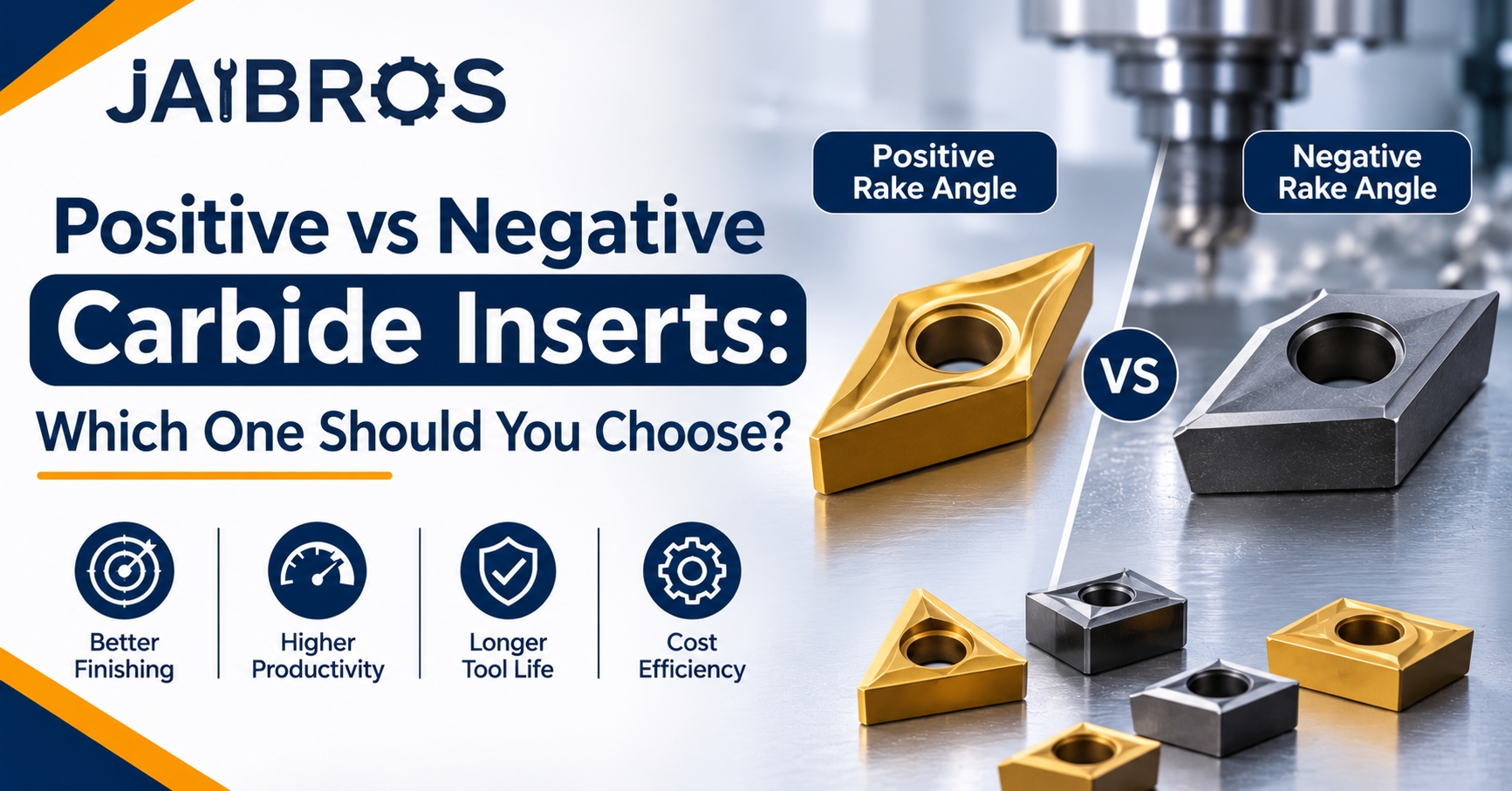
Choosing the right cutting tool decides how good your finish is, how long your tool lasts, and how much time you save. One of the first choices in turning and boring is between positive and negative shapes. Carbide inserts come in both styles, and each one works best in different conditions. This guide explains the difference in simple words so you can choose with confidence.
What Is the Difference Between Positive and Negative Inserts?
The difference comes from the clearance angle, which is the angle on the side of the insert below the cutting edge.
Positive inserts have a clearance angle, usually between 7° and 20°. The side walls are tapered, so the insert looks like a small pyramid. This shape lets the edge cut freely.
Negative inserts have a 0° clearance angle. The side walls are straight, and the top and bottom faces are the same shape.
Negative inserts are held in a tilted holder pocket, which gives the tool clearance. Positive inserts are usually seated flat or at a slight angle.
Positive Inserts: Features and Benefits
A positive design has a sharper wedge angle, which means the edge slices into the metal instead of pushing through it.
Main advantages:
Lower cutting force. The tool needs less power, which helps on smaller or older machines.
Less vibration. Light cutting pressure reduces chatter, especially on long tool overhangs.
Better surface finish. The sharp edge gives smooth results on finishing passes.
Good for soft and sticky materials. Aluminium, copper, and stainless steel cut cleanly with less built-up edge.
Suited to internal work. Boring bars and small-diameter holes need low cutting forces.
Limitations:
The edge is weaker, so it can chip in heavy or interrupted cuts.
Most are single-sided, so you get only 2 to 4 cutting edges per insert.
Negative Inserts: Features and Benefits
A negative design has a stronger, blunter edge, so it handles tough conditions well.
Main advantages:
Strong cutting edge. It resists chipping and shock, which makes it good for heavy roughing.
More cutting edges. Because both faces can be used, one insert can offer 6 to 8 edges. This lowers the cost per edge.
Handles hard materials. Hardened steel, cast iron, and tough alloys suit this style.
Stable in interrupted cuts. Turning rough castings or forgings is safer with a strong edge.
Limitations:
It creates higher cutting force and heat.
It needs a rigid machine and a stable workpiece.
It may cause more vibration on thin or long parts.
Positive vs Negative: Quick Comparison
Feature | Positive Insert | Negative Insert |
Clearance angle | Yes (7°–20°) | 0° |
Edge strength | Lower | Higher |
Cutting force | Low | High |
Cutting edges | 2–4 | 6–8 |
Best use | Finishing, boring | Roughing, heavy cuts |
Machine rigidity needed | Moderate | High |
How to Choose the Right Insert
Ask these questions before you decide:
What is the workpiece material? Soft, sticky metals prefer positive inserts. Hard or abrasive materials prefer negative ones.
What kind of cut is it? Choose positive for finishing and negative for roughing.
How rigid is your setup? Thin walls, long overhangs, and light machines need positive inserts.
Is the cut continuous or interrupted? Interrupted cuts need the strength of a negative insert.
What is your machine power? Low-power machines work better with positive inserts.
Other Insert Types Worth Knowing
Many CNC tools use special inserts for specific jobs. A threading insert is made to cut precise thread profiles, and it comes in both internal and external versions. PCBN inserts are used for finishing hardened steels and cast iron, where regular grades wear out quickly. These are often made in negative-style shapes because the material is so tough. Matching the insert type to the job always gives better tool life.
Tips to Get the Best Performance
Use the correct holder for the insert style. A positive insert in a negative pocket will not seat or cut properly.
Follow the recommended speed, feed, and depth of cut for the grade and material.
Check for wear often, and index or replace the insert before the edge fails.
Use coolant where suitable to control heat and chip flow.
Keep the tool overhang as short as possible.
Conclusion
There is no single best choice between positive and negative. Positive inserts give easy, low-force cutting and fine finishes, while negative inserts give strength, more edges, and better results in heavy work. Study your material, machine rigidity, and type of cut first. When you match the right carbide inserts to the job, you get longer tool life, better parts, and lower cost per piece.
If you are looking for a reliable supplier to explore a wide range of cutting tools for your CNC work, you can visit Jaibros. Their product range can help you find the right insert for your machine, material, and machining needs.
Frequently Asked Questions
1. Can I use positive and negative carbide inserts in the same holder?
No. Each style needs its own holder because the pocket angle is different. A negative insert sits in a tilted pocket, while a positive insert needs a flat or slightly angled seat. Using the wrong combination causes poor clamping, bad clearance, vibration, and a higher risk of insert breakage.
2. Which insert type is better for finishing?
Positive inserts are generally better for finishing. Their sharp edge and free-cutting action produce lower cutting force, less vibration, and a smoother surface. They also work well on soft materials, thin walls, and small boring operations where a gentle cut is important.
3. Why do negative inserts have more cutting edges?
Negative inserts have a 0° clearance angle, so both the top and bottom faces can be used for cutting. Once one side is worn, you flip the insert over. This gives 6 to 8 usable edges on many shapes, which makes them economical for roughing.
4. Are negative inserts good for hard materials?
Yes. The strong, blunt edge handles high pressure and heat without chipping easily. This makes negative inserts a good choice for hardened steel, cast iron, and heavy roughing. They also work well in interrupted cuts, as long as the machine and setup are rigid.
5. What should I check first when selecting an insert?
Start with the workpiece material, then the type of operation, such as roughing or finishing. Next, check your machine rigidity and available power. These three points decide whether a positive or negative style suits your job, and they also guide your grade and geometry choice.