
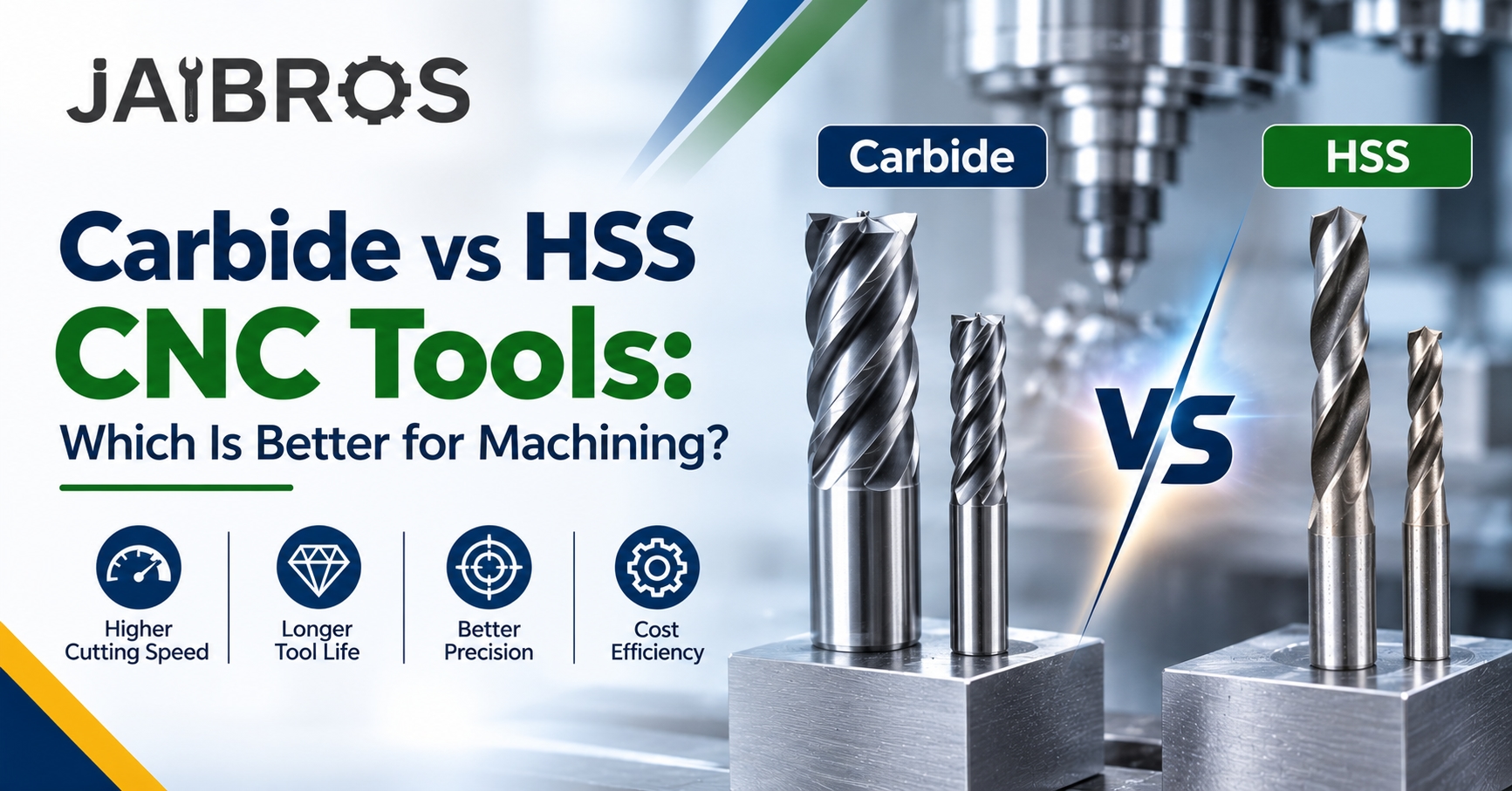
Choosing the right cutting tool material is important for achieving good machining results. CNC tools play an important role in cutting accuracy, surface finish, production speed, and tool life. Two commonly used materials in metalworking are carbide and high-speed steel (HSS).
Both materials have different properties and applications. Carbide is known for its hardness and wear resistance, while HSS is valued for its toughness and flexibility. Understanding these differences helps machinists select the right cutting tool for their machining requirements.
In this article, we will compare both materials based on their properties, advantages, limitations, and machining applications.
What Are Carbide Cutting Tools?
Carbide cutting tools are generally made from cemented carbide, which contains tungsten carbide particles combined with a metallic binder, commonly cobalt.
These tools are designed to maintain hardness at high cutting temperatures. They can operate at higher cutting speeds than conventional HSS tools in many machining applications.
Carbide is commonly used in milling, turning, drilling, and precision machining operations. Carbide end mills, indexable inserts, and solid carbide drills are common examples.
Main characteristics of carbide tools:
High hardness and wear resistance.
Good performance at elevated cutting temperatures.
Suitable for high-speed machining.
Good cutting-edge stability under suitable conditions.
Available in different grades for different workpiece materials.
Carbide CNC tools are particularly useful in production environments where cutting speed, dimensional accuracy, and consistent performance are important. However, carbide can be more sensitive to impact and vibration than HSS.
What Are HSS Cutting Tools?
High-speed steel (HSS) is an alloy tool steel containing elements such as tungsten, molybdenum, chromium, and vanadium. These elements help improve hardness, strength, and wear resistance.
HSS tools can retain useful hardness at elevated temperatures, although their hot hardness is generally lower than that of carbide. They are commonly used for drilling, tapping, reaming, and milling operations.
Main characteristics of HSS tools:
Good toughness and impact resistance.
Suitable for low and moderate cutting speeds.
Easier to grind and resharpen.
Useful for interrupted cutting operations.
Available in different shapes for specialised machining tasks.
HSS CNC tools are often a practical choice for general-purpose machining, especially when machine rigidity or cutting conditions do not support carbide tooling.
Carbide vs HSS: Key Differences
Although both materials are used for metal cutting, their performance differs depending on machining conditions.
Comparison Factor | Carbide | HSS |
Hardness | Generally higher | Lower than carbide |
Heat resistance | Excellent hot hardness | Moderate hot hardness |
Cutting speed | Higher | Lower |
Wear resistance | Generally higher | Generally lower |
Toughness | Generally lower | Generally higher |
Tool life | Often longer in suitable conditions | Depends on application |
Resharpening | Requires suitable grinding equipment | Generally easier |
Common applications | Production milling and turning | Drilling, tapping and general machining |
The main difference is the balance between hardness and toughness. Carbide supports faster cutting under suitable conditions, while HSS can handle impact and less rigid setups more effectively.
Therefore, the selection of CNC tools should depend on the machining operation rather than hardness alone.
Advantages of Carbide Cutting Tools
Carbide cutting tools are widely used in modern machining because they offer several performance benefits.
Higher cutting speed: Carbide can operate at higher cutting speeds, helping reduce machining time when the machine and workpiece conditions allow it.
Better wear resistance: Its hardness helps resist abrasive wear during continuous cutting operations.
Improved production efficiency: Longer tool life and higher cutting speeds can reduce tool changes and improve production output.
Suitable for hard materials: Appropriate carbide grades can machine difficult-to-cut materials, including hardened steels.
These advantages make carbide suitable for production machining where speed, consistency, and cutting performance are important.
Advantages of HSS Cutting Tools
HSS remains useful in many workshops because it offers practical benefits.
Better toughness: HSS can withstand impact and interrupted cutting conditions better than many carbide tools.
Easy resharpening: Worn HSS cutting edges can generally be reground, allowing the tool to be reused.
Flexible applications: HSS is available in drills, taps, reamers, milling cutters, and specially shaped cutting tools.
Suitable for less rigid setups: It can be a useful option when machine rigidity, workholding, or cutting conditions are not ideal for carbide.
For small workshops and specialised machining tasks, HSS can provide reliable performance at appropriate cutting speeds.
Which Material Is Better for Different Machining Operations?
The correct choice depends on the operation, workpiece material, machine capability, and production requirements.
Milling: Carbide end mills are suitable for high-speed milling and production work. HSS milling cutters can be useful for lower-speed operations and less rigid setups.
Drilling: Solid carbide drills are suitable for high-speed and accurate hole-making in stable conditions. HSS drills are useful for general-purpose drilling.
Turning: Carbide inserts are widely used for production turning because of their wear resistance and hot hardness. HSS tools are useful for certain low-speed and specialised turning operations.
Tapping: HSS taps are commonly used for producing internal threads. The correct tap material depends on the workpiece and threading conditions.
Selecting suitable CNC tools also requires considering machine power, spindle speed, feed rate, cutting depth, and coolant requirements.
How Do CNC Tool Holders Affect Cutting Performance?
The cutting material alone does not determine machining accuracy. Tool holding and machine stability also play important roles.
A suitable CNC tool holder provides secure clamping and helps maintain tool alignment during machining. Incorrect clamping, excessive tool overhang, or poor balance can increase vibration and affect surface finish.
Carbide cutters are particularly sensitive to unstable setups because their cutting edges can chip under excessive vibration or impact. A properly matched holder, suitable clamping force, and correct tool projection help improve machining stability.
Choosing compatible holders and cutters is therefore important for achieving consistent machining results.
How to Choose Between Carbide and HSS?
Before selecting a cutting tool, consider these important factors:
Workpiece material: Check whether you are machining aluminium, mild steel, stainless steel, or hardened material.
Machine capability: Consider spindle speed, power, rigidity, and overall machine condition.
Production volume: Higher-volume operations may benefit from carbide's cutting speed and wear resistance.
Machining conditions: Consider vibration, workholding, cutting depth, and coolant availability.
Tool maintenance: Check whether resharpening or replacing the cutting edge is more suitable for your operation.
There is no single material that is best for every machining job. The right choice depends on balancing performance, reliability, and operating conditions.
Conclusion
Carbide and HSS both have important roles in modern metalworking. Carbide is generally preferred for higher cutting speeds, better wear resistance, and production machining. HSS is a useful option when toughness, easy resharpening, and lower-speed operations are priorities.
Selecting the right CNC tools helps improve machining performance, tool life, and production efficiency. The best decision is to choose a cutting tool that matches the workpiece, machine capability, cutting conditions, and required surface finish. A suitable tool holder and stable machine setup are equally important for achieving consistent results.If you are looking for reliable machining solutions and quality cutting tools, explore Jaibros to find suitable products for your machining requirements. Compare the available options and choose the right tools for your applications.
Frequently Asked Questions
Q1. Are carbide tools better than HSS tools?
Carbide tools are generally better for high-speed machining, continuous production, and applications requiring high wear resistance. HSS tools are often more suitable for lower cutting speeds, interrupted cutting, and operations where toughness is important. The better option depends on the workpiece material, machine rigidity, cutting conditions, and required production output.
Q2. Why are carbide cutting tools used in CNC machining?
Carbide cutting tools are widely used because they maintain hardness at elevated temperatures and offer good wear resistance. They support higher cutting speeds in suitable applications and can improve production efficiency. They are commonly used for milling, turning, drilling, and precision machining, provided the machine setup and cutting parameters are appropriate.
Q3. Can HSS tools machine stainless steel?
Yes, HSS tools can machine stainless steel when the correct tool grade, cutting speed, feed rate, and cutting fluid are selected. Cobalt-alloyed HSS grades are also used for difficult-to-machine materials. However, stainless steel can generate considerable heat, so proper cutting conditions and chip control are important to prevent premature tool wear.
Q4. Do carbide tools last longer than HSS tools?
Carbide tools often provide longer service life in suitable high-speed machining applications because of their hardness and wear resistance. However, their performance depends on cutting conditions, tool geometry, coating, and machine stability. Under impact-heavy or unstable conditions, carbide may chip or break, while HSS may provide more reliable performance.
Q5. What factors should be considered when selecting a cutting tool?
Consider the workpiece material, cutting speed, feed rate, machining operation, machine rigidity, and required surface finish. Tool geometry, coating, coolant requirements, and holder compatibility are also important. Selecting a tool based on the complete machining setup helps improve accuracy, control tool wear, and maintain consistent production quality.




