Starting a non-governmental organisation (NGO) is a meaningful way to work towards education, healthcare, poverty reduction, environmental protection and community development. Understanding the process of registration of ngo helps founders select the right legal structure, prepare the necessary documents and establish an organisation for charitable activities.
In India, an NGO can generally be established as a Public Charitable Trust, Society or Section 8 Company. Each structure has different registration procedures, governance requirements and compliance obligations. Choosing the right structure at the beginning can make it easier to manage the organisation and plan for future growth.
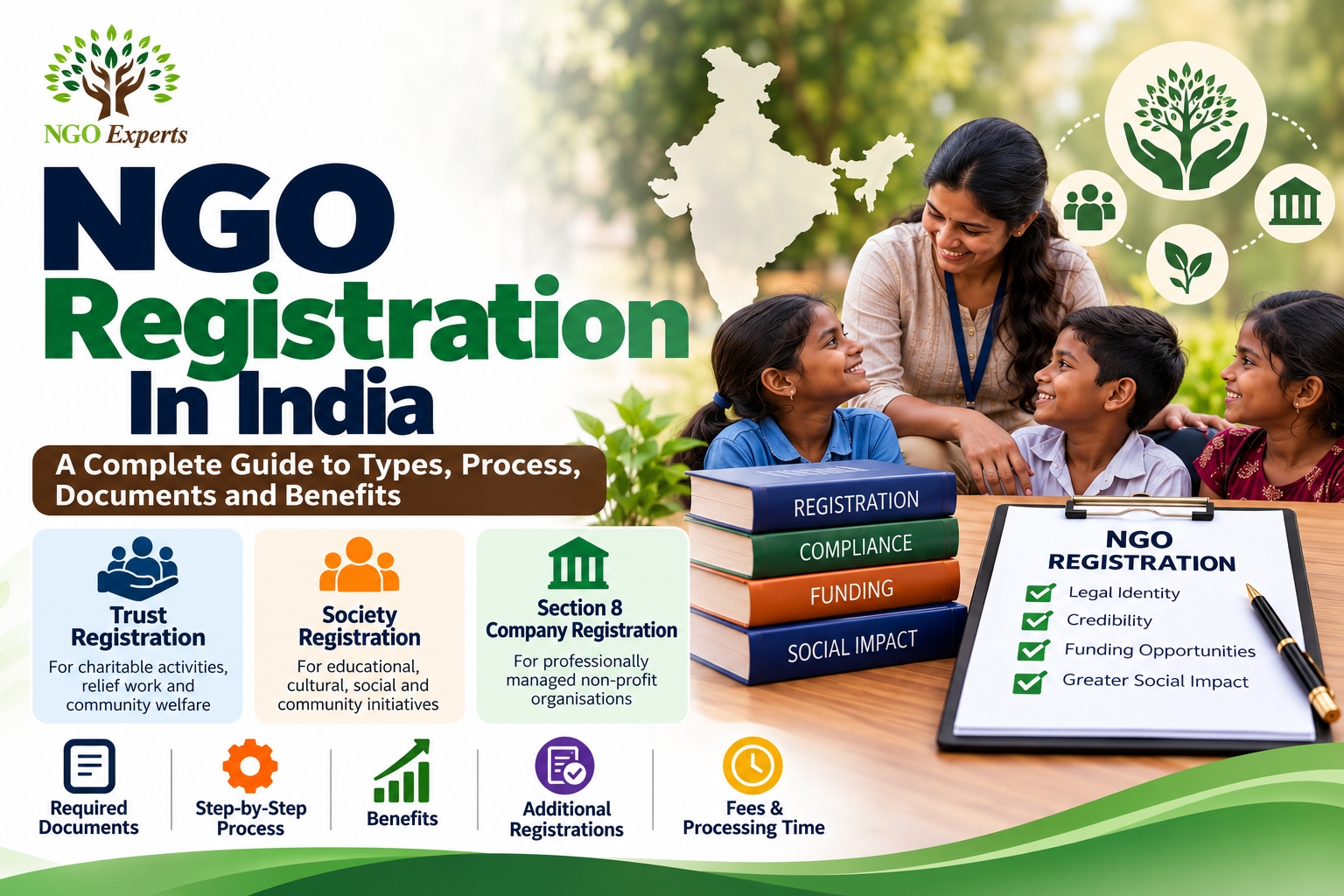
What Is NGO Registration?
NGO registration is the legal process of establishing a non-profit organisation under the applicable laws in India. It creates a formal framework for carrying out charitable, educational, social, cultural or other permitted public-benefit activities.
Registered NGOs can apply for relevant government schemes, grants, donations and corporate partnerships, subject to the eligibility conditions of each programme. Registration alone, however, does not automatically provide income-tax exemptions or access to every funding opportunity.
Types of NGO Registration in India
Before beginning the process, founders should understand the three common legal structures available for NGOs. The best option depends on the organisation's objectives, number of founders, management preferences and long-term plans.
For a detailed overview, read this guide to NGO registration in India.
NGO Structure | Governing Law | Suitable For |
|---|---|---|
Trust | Applicable trust laws and state-specific requirements | Charitable activities and community welfare |
Society | Societies Registration Act, 1860, or applicable state law | Education, culture and community development |
Section 8 Company | Companies Act, 2013 | Structured non-profit management and institutional partnerships |
1. Trust Registration
A Public Charitable Trust is commonly established through a trust deed specifying its charitable objectives, trustees, powers and management rules. Registration requirements, stamp duty and procedures depend on the relevant state laws.
2. Society Registration
A Society is generally formed by a group of individuals who share common objectives, such as promoting education, science, arts or social welfare. Under the Societies Registration Act, 1860, seven or more persons can form a society, subject to the applicable legal requirements.
3. Section 8 Company Registration
A Section 8 Company is incorporated under the Companies Act, 2013, to promote permitted charitable and public-benefit objectives. Its profits must be applied towards its objectives, and dividends cannot be distributed to members. It follows formal corporate governance and compliance requirements.
Who Is Eligible to Start an NGO?
Individuals and groups interested in charitable work can explore establishing an NGO, provided they meet the requirements of the chosen legal structure.
Before applying, review the eligibility to open an NGO in India to understand the general requirements.
Common considerations include:
A genuine charitable or public-benefit objective.
The required number of founders, members, trustees or directors.
Valid identity and address documents.
A suitable registered office address.
Properly drafted governing documents.
A willingness to maintain accounts and meet ongoing compliance obligations.
The exact eligibility conditions differ by structure and applicable law.
Documents Required for NGO Registration
Preparing documents in advance can help reduce errors and avoid unnecessary delays. The final checklist depends on the selected structure and the registration authority.
Document | Purpose |
|---|---|
PAN and identity proof | Identifies founders, trustees or directors |
Address proof | Verifies the individuals involved |
Registered office proof | Establishes the organisation's official address |
Trust deed | Defines the objectives and management of a Trust |
MOA and rules and regulations | Establishes the objectives and governance of a Society |
MOA and AOA | Sets out the objectives and governance of a Section 8 Company |
Owner's NOC, where applicable | Supports use of the registered office premises |
Additional declarations, photographs and prescribed application forms may also be required.
Step-by-Step Process for NGO Registration
The registration procedure varies by legal structure, but most applicants can follow these steps.
Step 1: Define Your Objectives
Identify the social cause, target beneficiaries and geographical area in which the NGO will operate. Clear objectives help determine the appropriate structure.
Step 2: Choose the Legal Structure
Compare a Trust, Society and Section 8 Company based on management, documentation, funding plans and compliance responsibilities.
Step 3: Select a Name and Prepare Documents
Choose a suitable name and draft the relevant trust deed, memorandum or incorporation documents. Check that the name and objectives meet applicable requirements.
Step 4: Submit the Application
Submit the application to the appropriate authority. Trust and Society procedures depend on the applicable state rules, while Section 8 Company incorporation follows the Ministry of Corporate Affairs process.
Step 5: Complete Verification
Respond to any queries or requests for additional documents. Once approved, retain the registration certificate and other official records.
Benefits of NGO Registration
Registering an NGO provides a formal foundation for its activities and can improve its credibility among donors, beneficiaries and institutional partners.
Key benefits include:
Legal recognition: Establishes the organisation under the relevant legal framework.
Funding opportunities: Helps meet the requirements of eligible grants and CSR programmes.
Improved governance: Defines responsibilities and management procedures.
Financial accountability: Encourages systematic bookkeeping and record maintenance.
Future growth: Supports applications for relevant tax registrations and other approvals.
What to Do After NGO Registration
Registration is the first step. Depending on its activities, an NGO may need to complete additional formalities.
Apply for PAN in the organisation's name, if not already allotted.
Open a bank account for organisational transactions.
Apply for applicable income-tax registration and 80G approval, subject to eligibility.
Consider NGO Darpan registration when relevant to government schemes or funding requirements.
Complete CSR-1 registration if the organisation qualifies and intends to act as a CSR implementing agency.
Obtain FCRA registration or prior permission, as applicable, before accepting foreign contributions.
Maintain accounts, file applicable returns and meet annual compliance requirements.
These registrations and approvals involve separate conditions and are not automatically granted when an NGO is formed.
Conclusion
NGO registration is an important step towards creating a legally recognised organisation that can work for social welfare and public benefit. Choosing the right structure, preparing accurate documents and following the applicable registration procedure can help founders establish a strong foundation. With proper governance, financial transparency and ongoing compliance, an NGO can build credibility and work towards sustainable social impact.