Choosing between a Section 8 Company, Society, and Trust is one of the first decisions when starting a non-profit organisation. Understanding trust vs society vs section 8 company helps you select a structure that matches your social objectives, management preferences, funding plans, and compliance capacity.
Although all three structures can support charitable activities, they differ in their governing laws, registration procedures, management systems, and ongoing legal obligations. This guide compares their key features to help you make an informed decision.
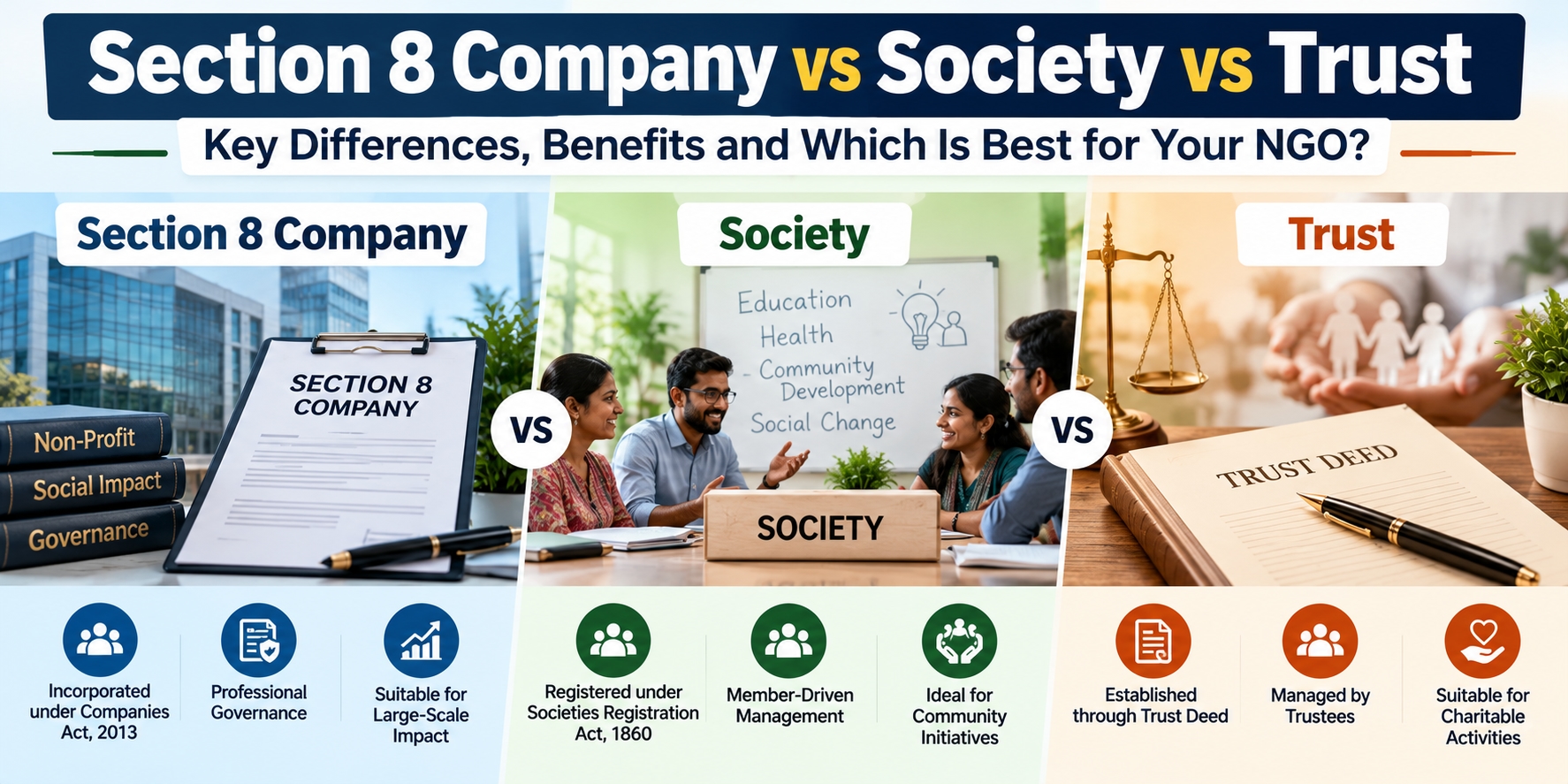
What Is a Section 8 Company, Society, and Trust?
Before comparing the three structures, it is important to understand how each one operates under Indian law.
1. Section 8 Company
A Section 8 Company is incorporated under the Companies Act, 2013, to promote charitable, educational, social, scientific, environmental, or other permitted objectives. Its profits must be applied towards its objectives, and dividends cannot be distributed to members.
It is suitable for organisations seeking formal governance, structured management, and opportunities to work with institutional donors.
2. Society
A Society is a membership-based organisation established for charitable, educational, literary, scientific, cultural, or other permitted purposes. It is generally registered under the Societies Registration Act, 1860, or the applicable state legislation.
Societies are suitable for groups that prefer collective decision-making through a general body and managing committee.
3. Trust
A charitable Trust is established through a trust deed that defines its objectives, trustees, powers, and management rules. Public charitable trusts are governed primarily by applicable state legislation and relevant legal requirements.
A Trust may suit founders who want a relatively straightforward structure for charitable activities, subject to local registration rules.
Section 8 Company vs Society vs Trust: Key Differences
The following table highlights the major differences between these three NGO structures in India.
Comparison Factor | Section 8 Company | Society | Trust |
|---|---|---|---|
Governing law | Companies Act, 2013 | Societies Registration Act, 1860, or state law | Applicable state trust laws and relevant legislation |
Registration authority | Ministry of Corporate Affairs (MCA) | Registrar of Societies | Relevant state authority or Sub-Registrar, as applicable |
Governing document | Memorandum and Articles of Association | Memorandum and rules and regulations | Trust deed |
Management | Board of Directors | Managing committee | Board of Trustees |
Minimum people | Generally 2 directors for a private company | Generally 7 founding members under the central Act | Depends on applicable law and local requirements |
Compliance | Higher, including company-law filings | Depends on state law | Depends on state law and trust deed |
Best suited for | Structured, growth-oriented non-profits | Member-driven organisations | Founder-led charitable initiatives |
Which NGO Structure Is Best for You?
The best structure depends on your organisation's goals, funding strategy, management preferences, and ability to meet ongoing compliance requirements.
Choose a Section 8 Company If:
You want a formal corporate governance structure.
You plan to approach CSR partners and institutional donors.
You expect to expand operations across multiple locations.
You can manage annual audits, statutory filings, and board-related requirements.
Choose a Society If:
Your organisation will be managed by a group of members.
You want collective decision-making and an elected managing committee.
Your activities focus on education, community welfare, culture, or social development.
You can meet the applicable membership and state-level compliance requirements.
Choose a Trust If:
You want to establish a charitable initiative managed by trustees.
Your activities focus on philanthropy, public welfare, or other charitable purposes.
You prefer governance based on a clearly drafted trust deed.
You have reviewed the applicable state registration and compliance rules.
What Documents Are Required for Registration?
Each structure requires different foundational documents. Preparing them carefully can reduce errors and delays during the application process.
Structure | Key Documents |
|---|---|
Section 8 Company | Identity and address proofs, proposed name, registered office documents, MOA, AOA, and applicable declarations |
Society | Memorandum of Association, rules and regulations, member details, identity proofs, and registered office documents |
Trust | Trust deed, trustee details, identity proofs, address proof, and applicable stamp duty and registration documents |
Additional documents may be required depending on the state, registration authority, and circumstances of the application.
Registration Process: How to Get Started
Although the procedures differ, the first steps are similar for all three structures.
Define your objectives: Clearly identify the charitable activities your organisation will undertake.
Select the structure: Compare governance, funding plans, and compliance responsibilities.
Choose a suitable name: Check the applicable naming requirements before filing.
Prepare documents: Draft the relevant deed, memorandum, or constitutional documents.
Submit the application: Apply to the appropriate authority and respond to any queries.
Complete post-registration formalities: Obtain PAN, open a bank account, maintain accounts, and meet applicable filing requirements.
If you decide that a corporate structure suits your objectives, read our guide on how to register a Section 8 Company for a detailed explanation of the incorporation process.
Tax Benefits and Funding Opportunities
Registration as a Trust, Society, or Section 8 Company does not automatically provide income-tax exemption or donor tax benefits. Eligible organisations may need to obtain separate registrations or approvals under the applicable income-tax framework.
Similarly, NGOs seeking foreign contributions must comply with the Foreign Contribution (Regulation) Act, 2010 (FCRA). Organisations implementing CSR projects must also meet the eligibility conditions under applicable CSR rules.
Before starting the process, review the requirements for NGO registration and identify which additional approvals your organisation may need.
Conclusion
A Section 8 Company, Society, and Trust can each provide a suitable legal foundation for charitable activities in India. A Section 8 Company offers formal corporate governance, a Society supports collective management, and a Trust provides a trustee-based structure.
Compare your long-term objectives, funding plans, management preferences, and compliance capacity before choosing. The right structure will help your organisation operate responsibly, build credibility, and focus on creating meaningful social impact.