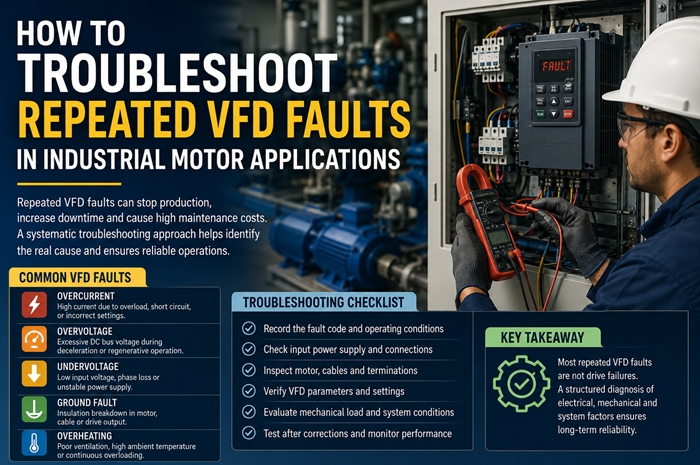
Variable Frequency Drives (VFDs) play an important role in controlling motor speed, torque and energy consumption across manufacturing operations. They are commonly used in pumps, compressors, conveyors, cooling systems, processing equipment and automated production lines. However, when a VFD repeatedly trips or displays fault alarms, the consequences can extend beyond the drive itself. Production interruptions, unstable machine performance and unexpected maintenance expenses can affect the entire manufacturing process.
A recurring VFD fault does not necessarily indicate that the drive is defective. The underlying problem may originate from an unstable electrical supply, incorrect drive configuration, motor insulation deterioration, excessive mechanical loading or communication failures between automation systems. Replacing the drive or resetting its alarms without investigating these possibilities can leave the original problem unresolved.
For manufacturing plants experiencing repeated motor-drive interruptions, understanding how to troubleshoot VFD faults is essential for identifying the actual cause and restoring reliable equipment operation. On-site troubleshooting and technical support can help investigate recurring drive problems by examining the VFD, motor, electrical connections, connected machinery and operating conditions rather than treating each fault as an isolated incident. A systematic investigation helps maintenance teams identify underlying issues, reduce repeated interruptions and improve equipment reliability.
Why Do Industrial VFDs Develop Repeated Faults?
A VFD controls an AC motor by varying the frequency and voltage of its electrical supply. Its operation depends on several interconnected components, including rectifiers, DC bus capacitors, inverter circuits, cooling arrangements and control electronics. Problems in the connected motor, power supply or driven equipment can also trigger protective trips.
The difficulty for maintenance teams is that different underlying problems can produce similar fault indications. For example, an overcurrent trip may result from excessive mechanical loading, an electrical short circuit, incorrect motor parameters or an acceleration time that is too short for the application.
Repeated faults can also develop because the conditions responsible for the original interruption remain unchanged after a temporary repair.
Consider a conveyor motor that trips whenever production increases. Resetting the VFD may restore operation temporarily, but the problem could involve excessive conveyor loading, mechanical resistance or an unsuitable acceleration profile. Unless the operating conditions are investigated, the same fault may return during the next production cycle.
This is why effective VFD troubleshooting requires engineers to establish when the fault occurs, what operating conditions trigger it and which connected systems could be contributing to the problem.
Common VFD Faults and What Causes Them
Identifying the displayed fault code is the starting point of an investigation, not its conclusion. Engineers must connect the alarm with actual electrical measurements, equipment conditions and operating history.
1. Overcurrent Faults During Motor Starting or Acceleration
An overcurrent fault occurs when the drive detects current exceeding its configured protection threshold.
Manufacturing plants may experience this problem when motors struggle to accelerate connected machinery, particularly when starting under substantial load.
Common causes include:
Acceleration times that are too short for the application.
Excessive starting torque requirements.
Mechanical obstructions in conveyors, pumps or processing machinery.
Incorrect motor nameplate parameters entered into the VFD.
Damaged motor cables or electrical short circuits.
Motor winding deterioration.
For example, a conveyor may operate normally when empty but repeatedly trip when loaded with production materials. This indicates that the problem may be associated with starting torque, mechanical resistance or load conditions rather than an immediate failure of the drive.
What should engineers check?
Maintenance teams should record the motor current during acceleration and compare it with the motor's rated current and the drive's protection settings. They should also inspect the connected machinery for binding, obstruction or abnormal mechanical resistance.
If electrical problems are suspected, the motor, cable and drive should be investigated using appropriate isolation and testing procedures.
2. Overvoltage Faults During Deceleration
Overvoltage faults frequently require investigation when a motor slows down or stops.
During deceleration, a motor driving a high-inertia load can operate temporarily as a generator, returning energy to the drive's DC bus. If this energy cannot be managed within the drive's operating limits, the DC bus voltage may rise and trigger a protective trip.
Typical applications include centrifuges, high-speed conveyors, rotating machinery and systems requiring frequent stopping.
Potential causes include:
Deceleration times that are too short.
High mechanical inertia.
Inadequate braking arrangements.
Incorrectly selected or malfunctioning braking resistors.
Excessively high incoming supply voltage.
What should engineers check?
The first step is to establish whether the fault consistently occurs during deceleration or also appears during normal operation. Engineers should review DC bus voltage history, deceleration settings and braking arrangements.
Increasing the deceleration time may be appropriate in some applications, but it should not be treated as a universal solution. The braking requirements and production cycle must also be considered.
3. Undervoltage and Input Phase-Loss Problems
An undervoltage fault indicates that the drive's incoming supply or DC bus voltage has fallen below its permitted operating level.
These problems may occur when several high-power machines operate simultaneously, when electrical connections deteriorate or when the plant experiences unstable supply conditions.
Possible causes include:
Incoming voltage fluctuations.
Missing or unbalanced supply phases.
Blown input fuses.
Loose electrical terminals.
Voltage drops during heavy equipment starting.
Problems within the plant's electrical distribution system.
What should engineers check?
Measure the voltage between all three incoming phases and compare readings during normal operation and periods of high electrical demand. Inspect fuses, terminals and supply connections for deterioration or overheating.
If multiple machines experience similar faults, investigating the common electrical supply may be more useful than examining each VFD independently.
4. Ground Faults in Motor and Cable Connections
Ground faults occur when unwanted current flows from an electrical conductor towards earth or a grounded part of the installation.
Repeated ground-fault alarms may indicate deteriorating motor insulation, damaged cable insulation, moisture ingress or incorrect electrical connections.
This issue can be particularly difficult to diagnose when motors operate in humid, dusty or high-temperature manufacturing environments.
What should engineers check?
Inspect motor terminal boxes, cable routes, junctions and electrical terminations. Look for moisture, damaged insulation and signs of overheating.
Where insulation-resistance testing is required, the motor and cable must first be properly isolated from the VFD. Testing should follow the equipment manufacturer's instructions because applying inappropriate test voltages to connected drive electronics can damage the equipment.
5. VFD Overheating During Continuous Operation
Some VFD faults appear only after several hours of operation rather than immediately after starting.
For example, a drive may operate normally during the first production shift but trip when the electrical cabinet becomes hot or cooling performance deteriorates.
Common causes include:
Blocked ventilation openings.
Dust accumulation on heatsinks.
Malfunctioning cooling fans.
High ambient temperatures.
Restricted cabinet airflow.
Continuous operation beyond the drive's suitable loading conditions.
What should engineers check?
Inspect the cabinet's ventilation arrangement, cooling fans, filters and heatsinks. Review drive temperature readings and operating load, particularly during extended production cycles.
The investigation should also establish whether the installed drive is suitable for the actual ambient temperature, enclosure arrangement and continuous-duty requirements.
Less Obvious Problems Behind Repeated VFD Trips
Some recurring faults are difficult to resolve because the actual cause exists outside the drive's immediate electrical circuit.
Incorrect Drive and Motor Selection
Selecting a VFD solely on the basis of motor kilowatt or horsepower rating can overlook important application requirements.
Engineers should consider motor rated current, starting torque, acceleration requirements, overload capacity, duty cycle and operating environment.
A conveyor, pump and high-inertia rotating machine may require different drive configurations even when their motors have similar power ratings.
An unsuitable drive-to-motor combination can create recurring protection trips or prevent the equipment from delivering its expected performance.
Long Motor Cable Runs and Insulation Stress
Long cables between a VFD and its motor can introduce electrical stresses associated with fast switching voltage pulses and reflected-wave effects.
Depending on cable length, drive characteristics and motor insulation design, these conditions may contribute to insulation deterioration or bearing-current problems.
Manufacturers may recommend suitable cable arrangements, output reactors, dV/dt filters or other protective measures for specific installations.
Therefore, engineers should evaluate cable length, grounding, motor compatibility and the manufacturer's installation requirements together instead of assuming that an additional filter will resolve every problem.
PLC and Control-System Communication Failures
Not every VFD interruption originates from its power circuit. Communication and control problems can also affect motor operation.
For example, a drive may receive inconsistent speed references from a PLC, experience communication interruptions or respond to incorrect interlock conditions.
Other contributing factors include unstable analogue signals, sensor feedback problems and incorrectly configured control sequences.
Engineers should examine PLC event logs, communication status, reference signals and control logic to establish whether the fault is electrical or related to the wider automation system.
Mechanical Problems That Increase Motor Loading
A motor-drive combination may develop repeated overcurrent or overload faults because of problems in the connected machinery.
Worn bearings, shaft misalignment, blocked pumps, excessive belt tension and conveyor obstructions can increase mechanical resistance.
These conditions may cause higher motor current and unstable operating performance even when the VFD itself is functioning correctly.
Consequently, effective diagnosis should include mechanical inspection rather than focusing exclusively on electrical parameters.
How to Troubleshoot Repeated VFD Faults Systematically
A structured investigation helps maintenance teams avoid unnecessary component replacement and identify the conditions responsible for recurring interruptions.
Step 1: Record the Fault History
Before resetting the drive, document the exact fault code, occurrence time, motor speed, operating frequency and production load.
Establish whether the interruption occurs during starting, acceleration, continuous operation or deceleration. This distinction helps narrow down possible causes.
Step 2: Inspect the Incoming Electrical Supply
Measure three-phase input voltage and check for phase imbalance, loose connections, damaged fuses and supply fluctuations.
Where possible, compare measurements during normal operation and periods of high electrical demand.
Step 3: Examine the Motor and Connected Machinery
Inspect motor terminals, cables, insulation condition, bearings, shaft alignment and mechanical loading.
Check whether the driven equipment moves freely and whether the actual load exceeds its expected operating requirements.
Step 4: Verify Drive Configuration
Compare the VFD's programmed motor parameters with the actual motor nameplate. Review acceleration and deceleration times, current limits, thermal protection settings and control modes.
Also examine PLC communication and external control signals where automation-related problems are suspected.
Step 5: Conduct Controlled Testing
After correcting the identified problem, restart the equipment using an approved procedure.
Monitor current, voltage, temperature and operating frequency under representative production conditions. Confirm that the original fault does not recur and document the corrective action.
This final verification is important because successfully restarting a motor does not necessarily establish that the underlying problem has been resolved.
What Information Should Maintenance Teams Collect Before Troubleshooting?
An effective investigation depends on accurate equipment and operating information. Collecting this information before requesting technical assistance can reduce diagnostic delays.
Information required | Why it is important |
|---|---|
VFD manufacturer, model and rating | Establishes drive specifications and applicable fault documentation |
Motor nameplate details | Helps verify motor-drive compatibility |
Historical fault codes | Identifies recurring fault patterns |
Input voltage readings | Helps investigate supply-related problems |
Motor current readings | Indicates loading and possible electrical abnormalities |
DC bus voltage history | Supports overvoltage and undervoltage investigation |
Motor insulation test results | Helps assess motor and cable condition |
Motor cable length and installation details | Identifies potential cable-related electrical stresses |
PLC and communication logs | Helps investigate control-system interruptions |
Previous maintenance records | Reveals repeated repairs and parameter changes |
Maintaining these records also helps manufacturers distinguish between isolated equipment failures and recurring problems affecting multiple production systems.
Connect with an expert: https://www.imarcengineering.com/contact?service=on-site-troubleshooting-technical-support
Common Troubleshooting Mistakes That Manufacturers Should Avoid
Several maintenance practices can unintentionally prolong VFD-related problems.
Repeatedly resetting the drive: Clearing an alarm without identifying its trigger allows the original problem to remain unresolved.
Replacing the VFD immediately: The fault may originate from the motor, cable, supply or connected machinery.
Increasing current limits without investigation: Changing protection settings can expose equipment to unsafe operating conditions.
Ignoring mechanical loading: Excessive resistance or equipment obstruction may continue generating motor overloads.
Changing acceleration and deceleration settings randomly: Incorrect adjustments can introduce additional operational problems.
Overlooking PLC communication: Control-system interruptions may be mistaken for drive hardware failures.
Skipping post-repair verification: A temporary improvement does not prove that the equipment will operate reliably under full production load.
Maintenance decisions should be based on measured conditions, manufacturer recommendations and the actual operating requirements of the connected machinery.
When Do Manufacturing Plants Need Specialist VFD Troubleshooting Support?
Internal maintenance teams can resolve many routine drive faults. However, specialist technical assistance becomes valuable when repeated interruptions continue despite corrective maintenance or when the underlying cause involves several engineering disciplines.
Manufacturers should consider additional support when equipment repeatedly trips without a clear diagnosis, production losses are increasing, recently installed drives fail during production ramp-up or electrical, mechanical and automation-related problems overlap.
Independent engineering investigation can also help when different equipment vendors attribute the same failure to one another, leaving the plant without a verified corrective action.
The objective should be to establish the actual source of the problem, assess the affected systems and recommend corrective measures that can be verified under operating conditions.
How IMARC Engineering Can Help
IMARC Engineering provides On-Site Troubleshooting & Technical Support to help manufacturing organisations investigate complex equipment and operational problems. Its engineering support approach focuses on assessing actual site conditions, examining interconnected equipment, identifying potential technical causes and evaluating corrective requirements. For recurring VFD-related interruptions, manufacturers can seek assistance in understanding electrical, mechanical and system-integration issues affecting equipment performance. The objective is to support informed engineering decisions, reduce unresolved technical problems and improve operational reliability through appropriate corrective and preventive measures.
Conclusion
Repeated VFD faults should not automatically be treated as drive failures. Their underlying causes may involve electrical supply instability, motor deterioration, incorrect configuration, mechanical resistance or automation-related interruptions. A systematic investigation helps manufacturing teams identify the actual fault source instead of relying on repeated resets and component replacements. By combining fault-history analysis, electrical measurements, mechanical inspection and controlled performance verification, manufacturers can make more informed maintenance decisions and improve the reliability of their motor-driven equipment.
Contact Us:
IMARC Engineering
Phone: +91-120-433-0800
Email: sales@imarcengineering.com
India: C-130, Sector 2, Noida, Uttar Pradesh 201301
LinkedIn: https://www.linkedin.com/showcase/imarc-engineering/