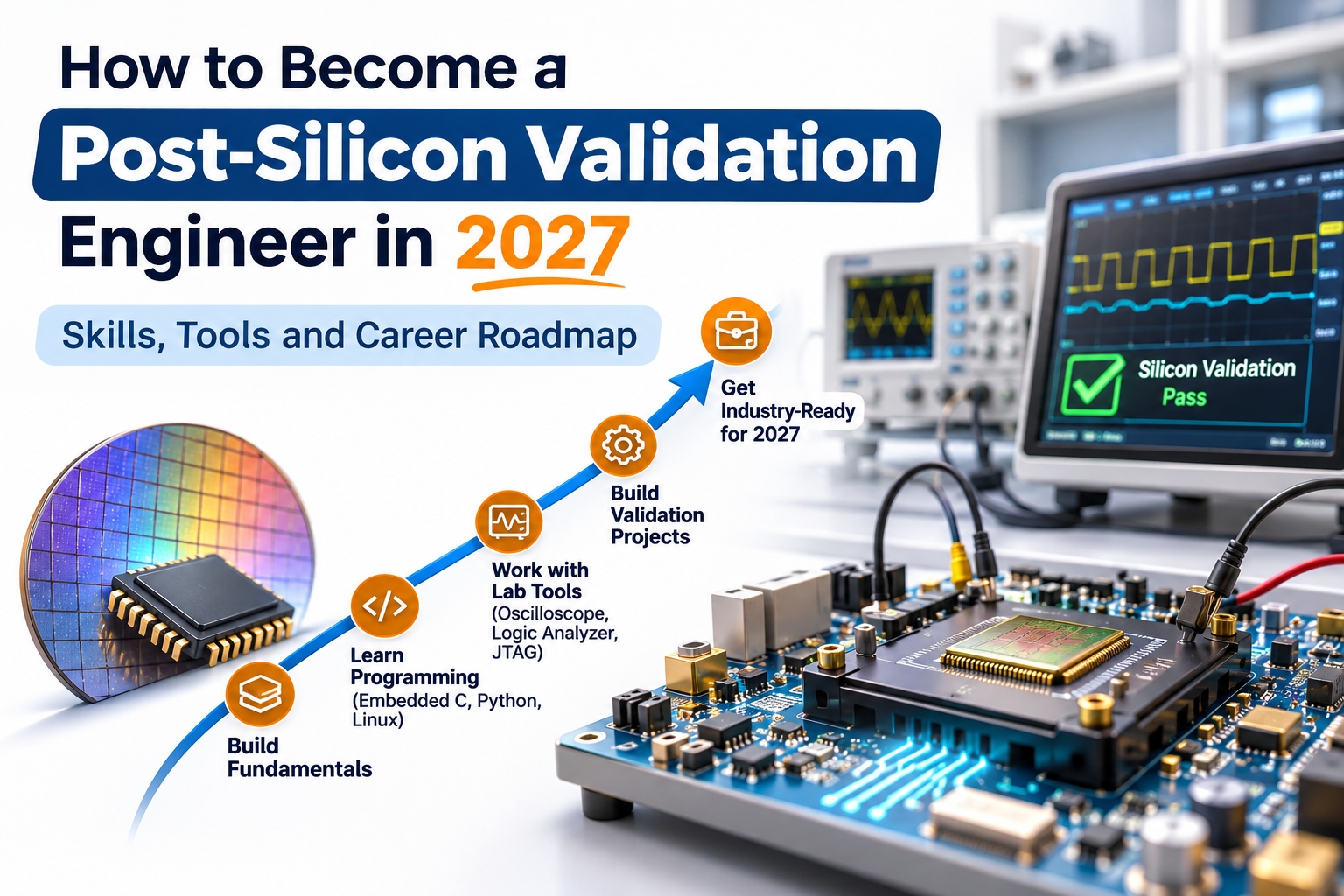
A semiconductor chip may work perfectly in simulation, but what happens when the actual silicon arrives from fabrication? This is where post-silicon validation engineers become essential. They test real chips, identify hardware failures, and ensure that semiconductor products perform reliably.
As semiconductor technology advances, companies need engineers who understand both hardware and software. Building a career in Post Silicon Validation requires strong fundamentals, programming knowledge, laboratory experience, and systematic debugging skills. Here is how aspiring engineers can prepare for this career in 2027.
Understand Post-Silicon Validation and Its Industry Importance

Post-silicon validation is the process of testing and evaluating fabricated semiconductor chips to confirm that they function according to their design specifications. Engineers perform these activities using actual silicon devices, evaluation boards, firmware, and laboratory equipment.
Unlike pre-silicon verification, which primarily uses simulation and emulation environments, post-silicon validation involves physical hardware. Engineers examine real-world operating conditions, identify unexpected failures, and investigate performance limitations.
Typical responsibilities include:
Silicon Bring-Up: Initializing newly fabricated chips and checking their basic functionality.
Functional Validation: Testing whether different hardware blocks operate according to specifications.
Interface Validation: Checking communication interfaces such as SPI, I2C, UART, USB, and PCIe.
Performance Testing: Evaluating operating speed, power consumption, and system stability.
Failure Analysis: Investigating unexpected behavior and identifying potential silicon defects.
Companies developing processors, automotive electronics, networking devices, mobile chipsets, and embedded systems depend on these activities to improve product reliability.
Build Strong Fundamentals in Digital Electronics and Computer Architecture
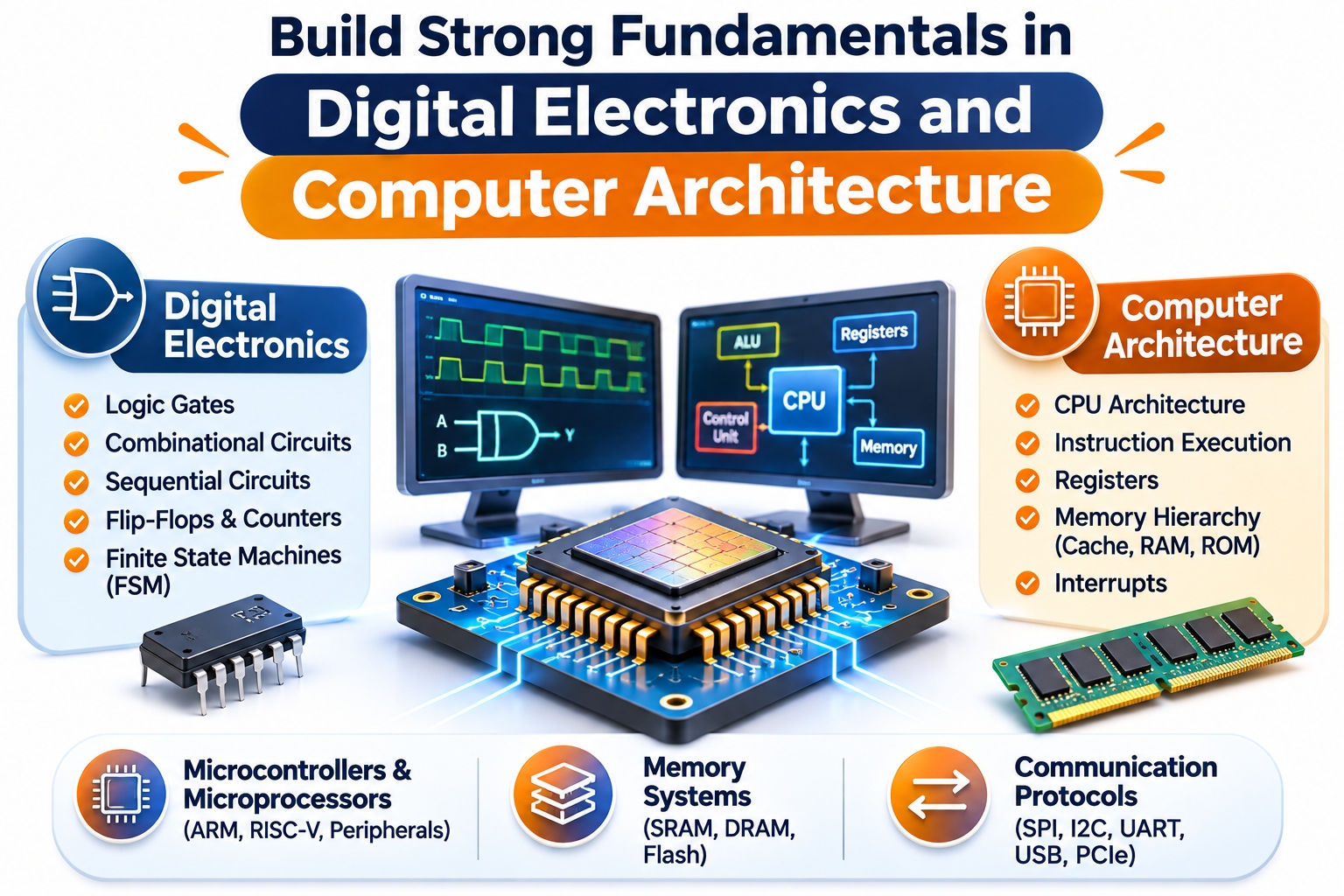
Before working with actual silicon, engineers must understand how digital hardware operates. Digital electronics provides the foundation for understanding registers, counters, multiplexers, logic gates, flip-flops, and sequential circuits.
Computer architecture is equally important because modern semiconductor devices contain multiple interconnected hardware components.
Aspiring engineers should concentrate on:
Digital Electronics: Logic gates, combinational circuits, sequential circuits, counters, and finite state machines.
Computer Architecture: CPU architecture, instruction execution, registers, memory hierarchy, and interrupts.
Microcontrollers and Microprocessors: ARM-based processors, RISC-V fundamentals, and peripheral architecture.
Memory Systems: SRAM, DRAM, Flash memory, memory controllers, and memory-mapped registers.
Communication Protocols: SPI, I2C, UART, USB, PCIe, and other commonly used interfaces.
Understanding these concepts helps engineers investigate whether a failure originates in a processor, memory subsystem, peripheral, or communication interface.
For example, when an SPI peripheral fails to communicate, an engineer must understand clock polarity, clock phase, chip-select behavior, and data transmission before investigating the hardware.
Master Embedded C, Python and Linux for Silicon Debugging
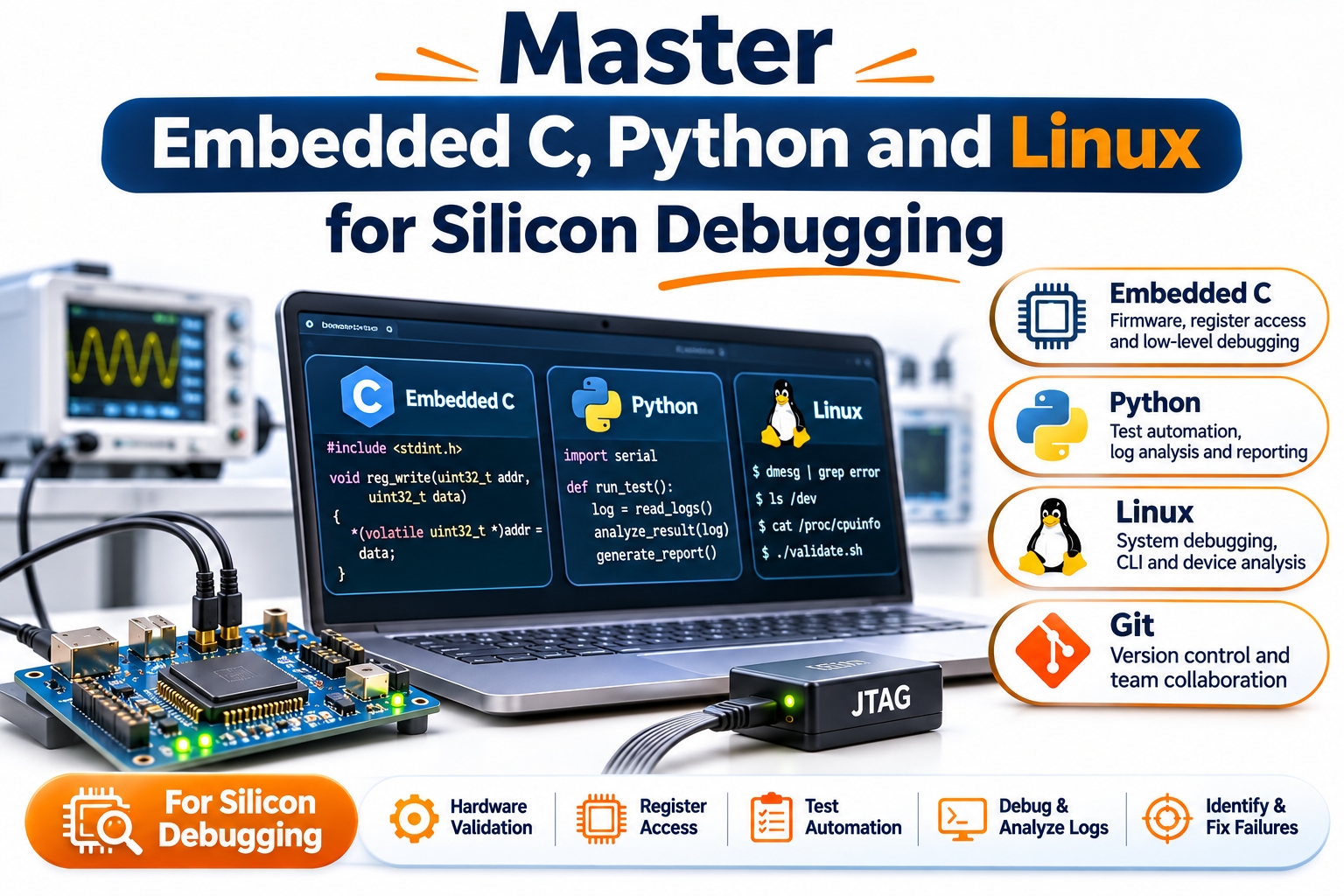
Programming is one of the most important skills for a post-silicon validation engineer. Hardware testing frequently requires writing firmware, accessing registers, executing diagnostic programs, and automating repetitive test procedures.
Embedded C should be a primary learning priority because it provides direct access to hardware registers and low-level processor functionality.
Important programming skills include:
Embedded C: Pointers, structures, bitwise operations, memory management, interrupts, and register-level programming.
Python: Test automation, log analysis, data collection, report generation, and repetitive test execution.
C/C++: Understanding low-level software development and debugging.
Linux: Command-line operations, process management, shell scripting, device information, and system logs.
Git: Managing source code, tracking modifications, and collaborating with engineering teams.
Consider a practical example: An engineer needs to validate an I2C peripheral. They can write an Embedded C program to configure the peripheral, transmit data, read responses, and compare the results against expected values.
Python can then automate the test across multiple configurations and record failures.
This combination of hardware-level programming and automation makes engineers more effective in real validation environments.
Learn Silicon Bring-Up, Laboratory Equipment and Debugging Techniques
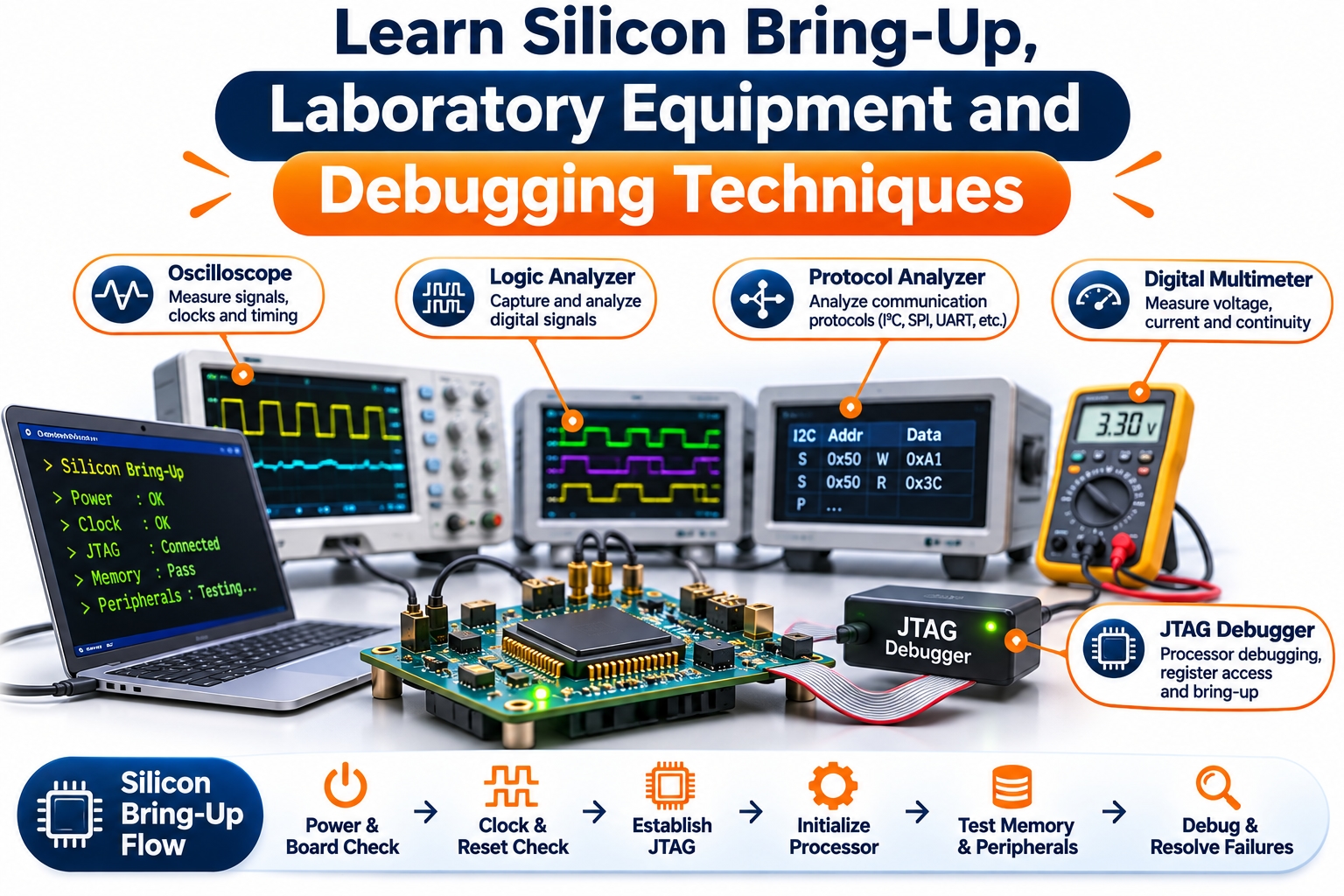
Silicon bring-up is one of the most important responsibilities in this profession. When newly fabricated chips arrive, engineers must establish a controlled hardware environment and verify that the device starts functioning correctly.
A systematic bring-up process generally follows this sequence:
Verify board connections, power supplies, and voltage rails.
Check clock availability and reset signals.
Establish JTAG connectivity and confirm device identification.
Initialize the processor and execute basic diagnostic programs.
Verify memory, peripherals, and communication interfaces.
Investigate failures using measurements, logs, and debugging tools.
Engineers should become familiar with commonly used laboratory equipment:
Oscilloscope: Measures electrical signals, clock waveforms, voltage levels, and timing behavior.
Logic Analyzer: Captures and analyzes digital signals across multiple channels.
Protocol Analyzer: Examines communication transactions and protocol-level failures.
JTAG Debugger: Provides access to processor debugging, register inspection, and hardware-level diagnostics.
Digital Multimeter: Measures voltage, current, resistance, and continuity.
Tools such as Lauterbach TRACE32 are also useful for processor debugging, depending on the target architecture and project environment.
The important skill is not simply operating equipment. Engineers must interpret measurements, isolate possible causes, and establish evidence-based conclusions.
Develop Industry-Oriented Projects and Practical Validation Experience
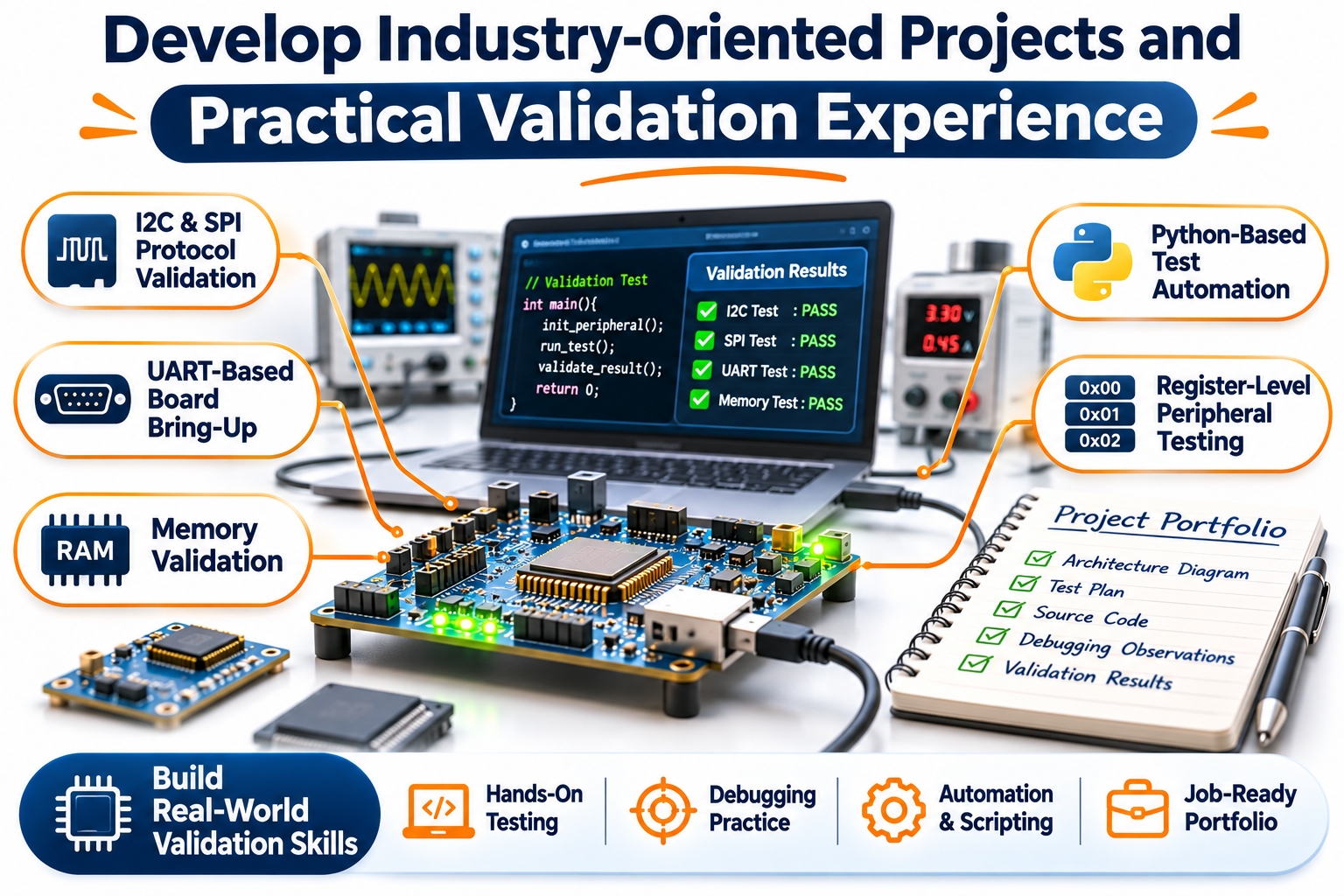
Theoretical knowledge alone is insufficient for demonstrating job readiness. Candidates should develop practical projects that combine hardware understanding, programming, testing, and debugging.
A strong project portfolio demonstrates how an engineer approaches technical problems rather than simply listing completed courses.
Consider these project ideas:
I2C and SPI Protocol Validation
Develop Embedded C programs to configure communication interfaces, transmit data, receive responses, and validate expected transactions.
UART-Based Board Bring-Up
Establish serial communication with an embedded development board. Validate baud rates, transmission, reception, and error conditions.
Memory Validation
Create programs to test memory read/write operations, data patterns, address locations, and basic error-detection scenarios.
Python-Based Test Automation
Develop scripts that execute test cases, capture logs, identify failures, and generate automated reports.
Register-Level Peripheral Testing
Write programs to configure hardware registers and verify reset values, bit fields, interrupt behavior, and peripheral functionality.
Candidates can document their projects with architecture diagrams, test plans, source code, debugging observations, and validation results.
JastTech can help aspiring engineers strengthen their semiconductor fundamentals and develop practical knowledge through structured, industry-oriented learning. The focus should be on connecting technical concepts with real engineering applications.
Prepare for Post-Silicon Validation Jobs and Interviews in 2027
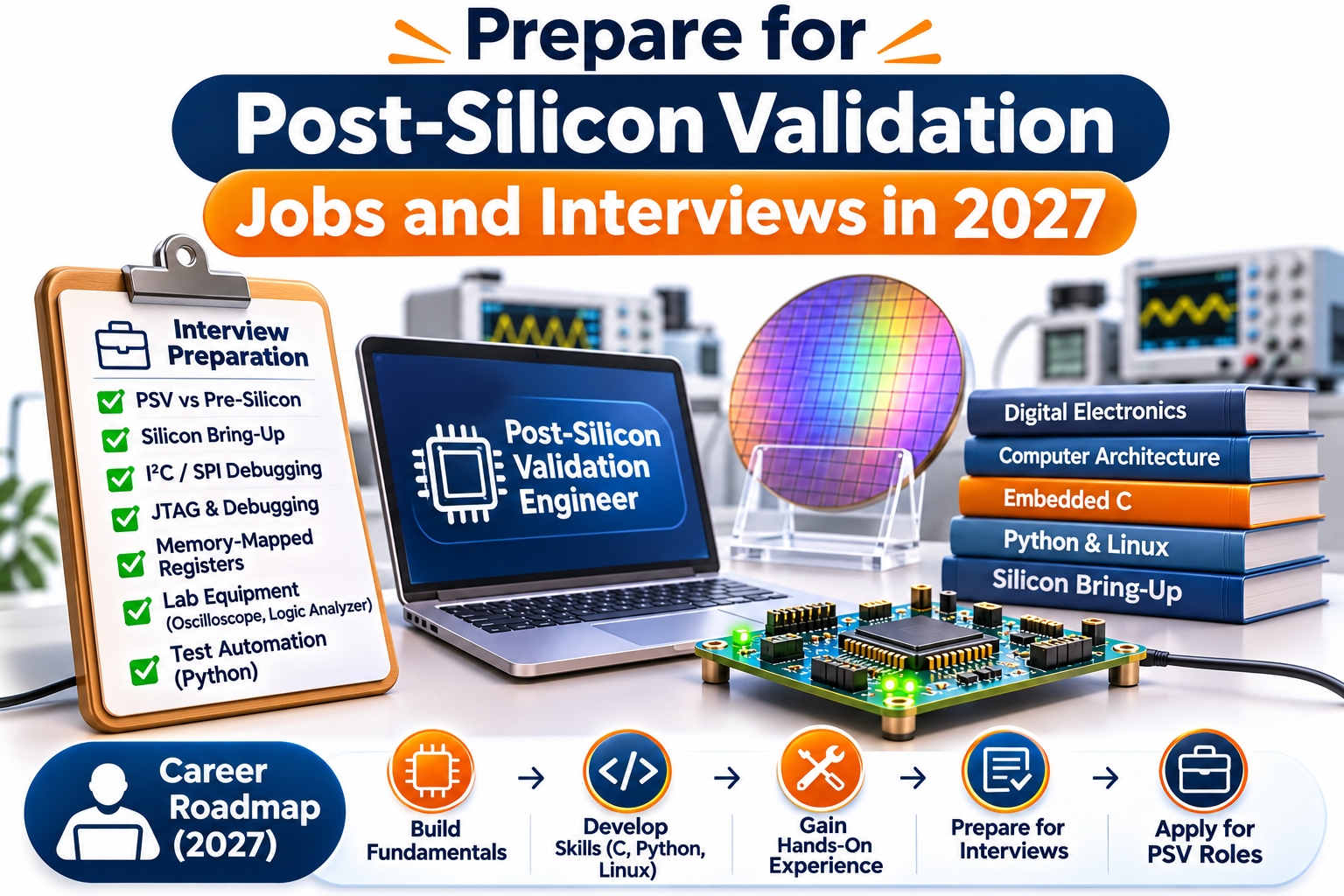
Once candidates develop the necessary fundamentals and practical experience, the next step is preparing for semiconductor engineering opportunities.
Companies generally evaluate candidates based on their understanding of hardware, programming, debugging, and problem-solving abilities.
Some important interview preparation areas include:
Difference between pre-silicon verification and post-silicon validation.
Explain the complete silicon bring-up process.
How do you debug an I2C or SPI communication failure?
What is JTAG, and how is it used in processor debugging?
Explain memory-mapped registers and bitwise operations.
How would you investigate an unexpected processor reset?
What is the purpose of an oscilloscope and logic analyzer?
How can Python improve validation test automation?
Candidates should also prepare to explain their projects in detail, including the problem statement, hardware setup, test methodology, debugging approach, and final observations.
For professionals targeting Post-Silicon Validation in Bangalore, understanding the semiconductor ecosystem is particularly useful. Bangalore offers opportunities across semiconductor design, embedded systems, processor development, hardware engineering, and silicon validation.
Other Indian technology hubs, including Hyderabad, Pune, and Chennai, also provide opportunities in semiconductor and embedded engineering.
Freshers with Electronics and Communication Engineering, Electrical Engineering, or Computer Engineering backgrounds can build relevant skills through focused preparation. However, actual job requirements vary depending on the employer, product, and experience level.
Conclusion
Becoming a post-silicon validation engineer in 2027 requires more than understanding digital electronics or learning a programming language. It involves combining computer architecture, Embedded C, Python, Linux, communication protocols, laboratory equipment, and systematic debugging techniques. Candidates who develop these skills through practical projects will be better prepared to understand real semiconductor engineering challenges.
The semiconductor industry increasingly depends on engineers who can connect hardware behavior with software functionality and identify problems that simulation alone may not reveal. With structured learning, consistent hands-on practice, and industry-oriented guidance from JastTech, aspiring engineers can work towards building a rewarding career in silicon validation.