India is one of the busiest markets for chargers and power adapters. Phones, laptops, routers and CCTV units all need one. For a factory in Jakarta, Surabaya or Batam, that looks like a big opening. There is a catch, though. Power adapters cannot simply be shipped to Indian buyers. They need approval from the Bureau of Indian Standards first, and the route to that approval is called CRS.
This guide explains how BIS CRS Registration Power Adapters for Indonesian Manufacturers works in practice, what you will need to prepare, and where companies usually lose time. We have written it from the point of view of the team at UMSPCS, who handle these files every week.
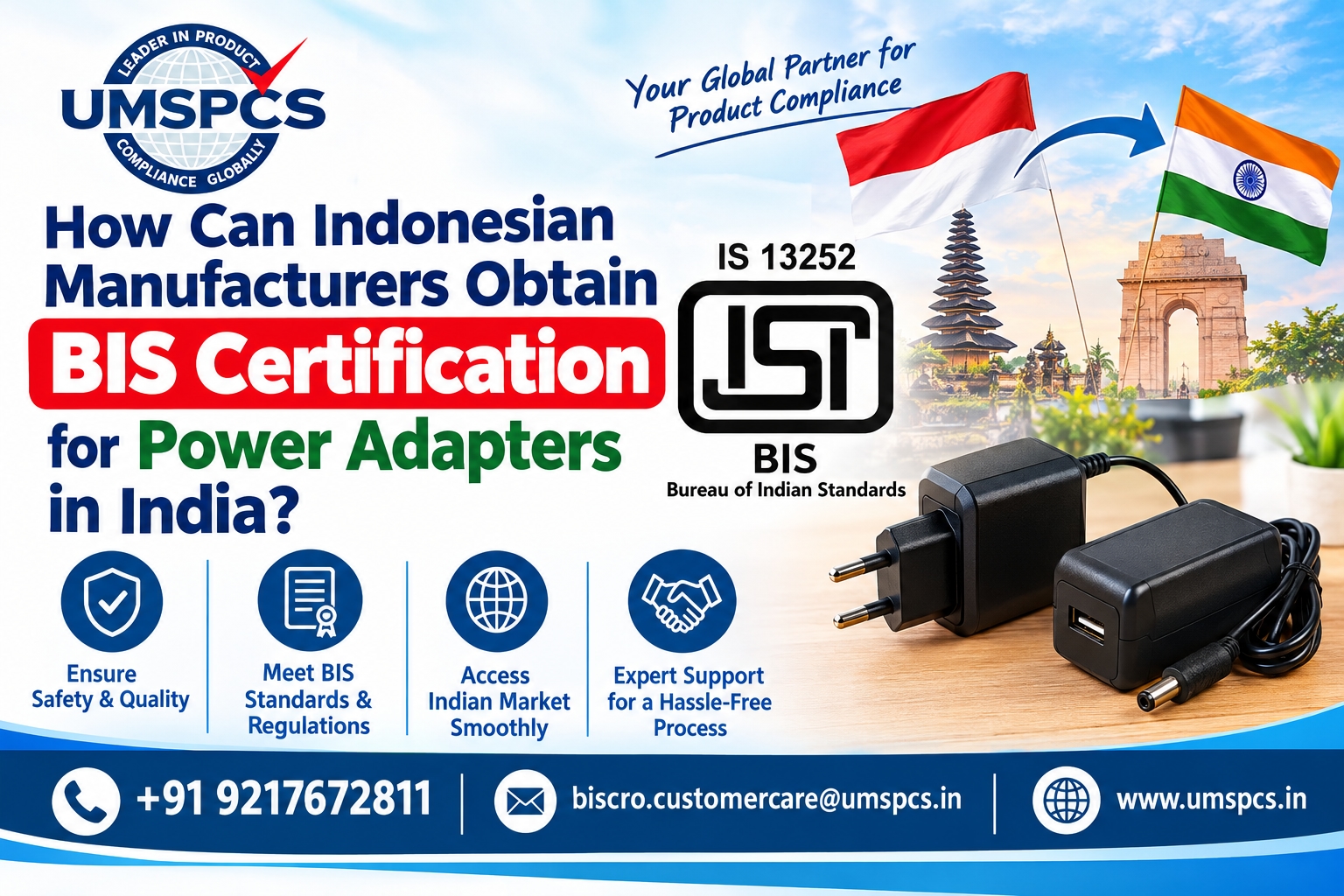
Why power adapters fall under BIS rules
The Indian government has a list of electronics that must carry a BIS registration before they can be manufactured, imported, stored or sold. This list sits under the Electronics and Information Technology Goods (Requirements for Compulsory Registration) Order. Power adapters for IT and audio-video equipment are on it, and so are many chargers sold with phones and tablets.
The reason is plain safety. A badly built adapter can overheat, shock a user or start a fire. BIS wants every unit tested against an Indian Standard, commonly IS 13252 (Part 1) or its IEC 62368-1 based equivalent, depending on the product type. Indonesian SNI approval is respected at home, but it does not replace this. Indian customs will check for a valid registration, and consignments without one can be held or sent back. That is why BIS CRS Registration for Indonesian Manufacturers should be settled before the first order is packed.
How BIS CRS Registration for Indonesian Manufacturers works
Under the Compulsory Registration Scheme, the factory makes the product, tests it in an approved lab, and BIS issues a registration number if the report is clean. That number must appear on the product along with the Standard Mark.
Here is the usual flow.
1. Confirm the standard and category. Check the exact adapter type, its input and output ratings, and the matching Indian Standard. Getting this wrong at the start means redoing tests later.
2. Appoint an Authorised Indian Representative (AIR). A foreign factory cannot apply on its own. It must name an AIR based in India, who deals with BIS, signs the declarations and stays answerable for the registration.
3. Send samples to a BIS-recognised lab. Testing is done in labs recognised by BIS, and these are located in India. You ship the required samples, and the lab runs electrical safety, insulation, temperature rise and other checks.
4. Prepare the documents. More on this below.
5. File the application on the BIS portal. The AIR uploads the test report, factory details and the other papers. BIS reviews the file and may come back with questions.
6. Receive the registration. After approval, you get an R-number. The registration is generally valid for two years and can be renewed.
Read more about CDSCO certification services.
Documents for BIS CRS Registration for Indonesian Manufacturers
A messy file is the top cause of delay. Gather these first:
• Test report from a BIS-recognised lab
• Authorisation letter appointing the Indian representative
• Declaration and undertaking in the format BIS prescribes
• Factory details, including address and contact information
• Product circuit diagram, block diagram and parts list
• Photographs of the adapter, nameplate and marking
• User manual, if available
• Trademark proof or brand authorisation, where the brand is not owned by the factory
Brand name, model number and ratings must match across the report, label and application.
Read also What Are the Benefits of Hiring a Professional BIS Consultant in India?
How long does BIS CRS Registration for Indonesian Manufacturers take?
Timelines depend on how ready the paperwork is, how quickly samples reach the lab and how fast queries get answered. Many cases wrap up in weeks, while a few drag on for months because of missing papers or failed tests. Treat fixed-day promises with caution. Preparation is what you control.
Common mistakes to avoid
A few patterns repeat among new applicants:
• Shipping samples before choosing the right standard. The lab tests to the wrong clause and the report is useless.
• Using a different brand name on the label than on the application. BIS treats this as a separate product.
• Choosing an AIR on price alone. A weak representative who does not reply to BIS can stall a file for weeks.
Why Indonesian exporters work with UMSPCS
Handling BIS CRS Registration for Indonesian Manufacturers alone from overseas is possible, but it is slow. You are dealing with a foreign portal, unfamiliar testing rules and a regulator that expects precise paperwork. For BIS CRS Registration for Indonesian Manufacturers, UMSPCS supports exporters from the first question to the final certificate. We help pick the right standard, act as your Authorised Indian Representative, coordinate lab testing, review every document and handle BIS queries on your behalf. Our team also keeps an eye on regulatory updates, so you do not get caught out by a revised order or a new standard.
If you plan to sell adapters in India, start early. A short conversation about your product range will show what testing is needed.
FAQs on BIS CRS Registration for Indonesian Manufacturers
1. Is BIS CRS Registration for Indonesian Manufacturers mandatory for power adapters?
Yes. If the adapter falls under the compulsory registration list, it must hold a valid BIS registration before it is imported or sold in India. The country of origin does not change this.
2. Does SNI certification work in place of BIS?
No. SNI is accepted in Indonesia, but India requires its own registration. Some test data may help in planning, but the BIS-recognised lab report is still needed.
3. Do we need an Indian representative for BIS CRS Registration for Indonesian Manufacturers?
Yes. A foreign manufacturer must appoint an Authorised Indian Representative, who files the application and answers BIS queries.
4. Where is the product testing done?
Testing is carried out in BIS-recognised laboratories in India. You send the samples, and the lab prepares the report.
5. How long is the registration valid?
Generally two years, after which it must be renewed. Keep track of the date so there is no gap in your shipments.
6. How can UMSPCS help with BIS CRS Registration for Indonesian Manufacturers? UMSPCS handles the whole journey: standard selection, AIR services, sample coordination, documentation, BIS filing and follow-up.
Final word
For anyone exploring India, BIS CRS Registration for Indonesian Manufacturers is the gate every power adapter must pass through. The steps are simple once you know them: choose the right standard, appoint an Indian representative, test in a recognised lab, and file a clean application. Prepare early, keep your documents consistent, and lean on an experienced partner such as UMSPCS where it helps. Do it right once, and your adapters can reach Indian customers without nasty surprises at the port.