Selling a set-top box in India sounds simple until a shipment sits at the port with no paperwork to release it. The reason is almost always the same: the product needed Bureau of Indian Standards registration and nobody got it done in time. If you build or import digital set-top boxes, BIS CRS Certification for Set Top Box is not a formality you can sort out after launch. It decides whether your product can legally enter the Indian market at all.
At UMSPCS, we guide brands through this every week. This guide answers the usual questions in plain language.
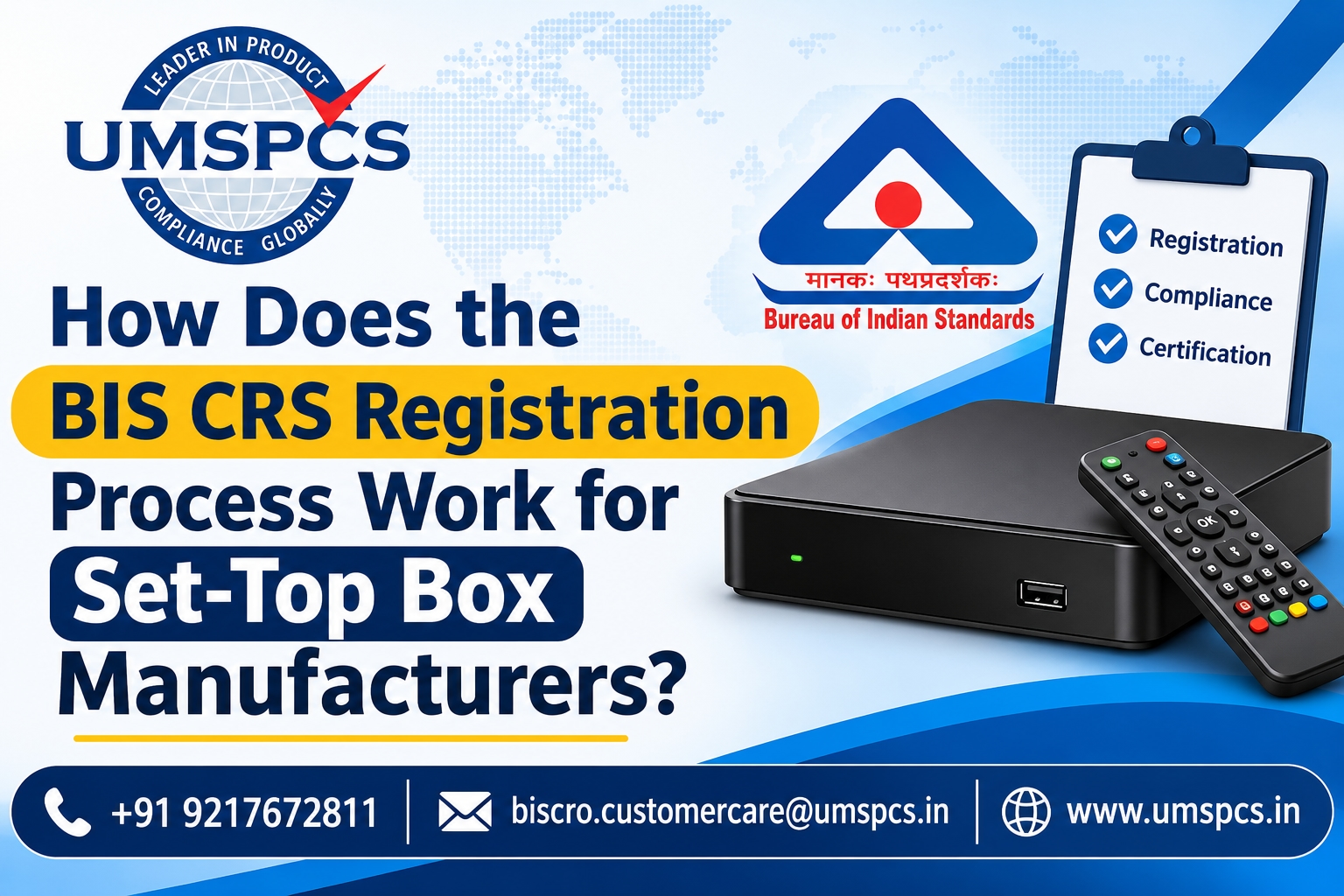
What Is the BIS Compulsory Registration Scheme?
The Compulsory Registration Scheme, or CRS, is run by BIS under the Ministry of Electronics and Information Technology (MeitY). It covers a defined list of electronics and IT products. Anything on that list must carry a valid registration number and the Standard Mark before it is manufactured, imported, stocked or sold in India.
Set-top boxes are on the list. They plug into the mains and sit in living rooms for years, so electrical safety matters. BIS CRS Certification for Set Top Box confirms that your model has been tested against the relevant Indian Standard and found safe.
Who Needs BIS CRS Certification for Set Top Box?
Three groups need registration:
Manufacturers based in India who make set-top boxes locally.
Foreign manufacturers who export set-top boxes to India.
Importers who bring in boxes under their own brand.
Overseas factories cannot simply file an application themselves. They must appoint an Authorised Indian Representative (AIR), who takes responsibility for the registration in India. This requirement trips up many first-time exporters.
The BIS CRS Registration Process, Step by Step
Here is how BIS CRS Certification for Set Top Box usually unfolds from start to finish.
1. Confirm the standard and your product scope. Check which Indian Standard applies to your exact model. Set-top boxes are generally assessed under the IS 13252 series, but standards get revised, so verify the current version before testing.
2. Appoint an Authorised Indian Representative. Foreign manufacturers need an AIR with a registered address in India. The AIR signs the declaration, handles portal communication, and answers to BIS if questions come up later.
3. Send samples to a BIS-recognised laboratory. Your samples must be tested at a laboratory recognised by BIS. The lab checks insulation, heating, power input, markings and enclosure fire resistance.
4. Prepare the documents. Expect to provide the test report, a factory and manufacturing process description, a block diagram or circuit diagram, a label or marking sample, the AIR authorisation letter and company registration papers. Missing or mismatched paperwork is the most common reason for delays.
5. File the application on the BIS portal. Your application, test report and supporting documents are uploaded online and the government fee is paid through the portal. Brand name, model numbers and factory address must match across every document.
6. BIS reviews and responds. An officer examines the file and may raise queries. Prompt, accurate replies keep it moving.
7. Receive your registration number. Once approved, BIS issues the R-number. You then print the Standard Mark along with that number on the product, as the rules specify.
8. Maintain compliance. Registration is valid for a fixed period and needs timely renewal. Safety-related design changes may need a fresh look.
Read more about BIS registration for foreign manufacturers .
How Long Does It Take?
It depends on how ready you are. Testing takes a few weeks and BIS processing adds more. A well-prepared file often clears in roughly two to three months overall, while a poor one can take double that. Plan your launch around the registration, not the other way around.
Common Mistakes Set-Top Box Makers Make
We see the same slips repeatedly:
Testing against the wrong or outdated standard.
Model names on the label that differ from those on the test report.
Assuming a certificate from another country, such as CE or UL, will be accepted. It will not replace Indian testing.
Shipping stock before the R-number is issued, which can lead to customs holds.
Why Registration Is Worth the Effort
Beyond avoiding penalties, BIS CRS Certification for Set Top Box tells distributors and cable partners your product meets national safety expectations. Large buyers often ask for the registration number before signing a purchase order.
Read also How Can Vietnamese Companies Choose the Right BIS Consultant for Indian Market Compliance?
How UMSPCS Helps
UMSPCS is a Noida-based compliance consultancy that supports manufacturers with BIS CRS Certification for Set Top Box, testing coordination and documentation. For set-top box brands, we review your file before submission, coordinate with laboratories, respond to BIS queries and track renewals. Talk to us before you finalise label artwork. That is the sensible moment to start.
Frequently Asked Questions
1. Is BIS CRS Certification for Set Top Box mandatory in India?
Yes. Set-top boxes fall under the Compulsory Registration Scheme, so they need a valid BIS registration before being manufactured, imported or sold in India.
2. Can a foreign manufacturer apply directly?
No. An overseas manufacturer must appoint an Authorised Indian Representative who files and manages the application on the manufacturer’s behalf.
3. Can I use home-country test reports for BIS CRS Certification for Set Top Box?
Generally not. Testing must happen at a BIS-recognised laboratory against the Indian Standard.
4. How long does the registration remain valid?
Registration is granted for a fixed term and must be renewed before expiry.
5. Does every model need separate registration?
Models are registered individually, though closely related variants can sometimes be grouped as a series.
6. What happens if I sell a set-top box without BIS CRS Certification for Set Top Box?
Goods can be held at customs, seized, and the company may face penalties under BIS law. Fixing it after the fact is far more expensive than registering first.
7. Can UMSPCS handle the whole process?
Yes. UMSPCS manages BIS CRS Certification for Set Top Box paperwork, including documentation, lab coordination, portal filing, query replies and renewals.
Final Thoughts
The registration process is clear once you see the whole path: pick the right standard, appoint a representative, test at a recognised lab, file clean documents and keep the registration alive. Brands that treat BIS CRS Certification for Set Top Box as part of product planning launch smoothly. Brands that leave it to the end usually pay in delays.
If you want a hand with the file, reach out to UMSPCS and we will map out a realistic plan for your product.