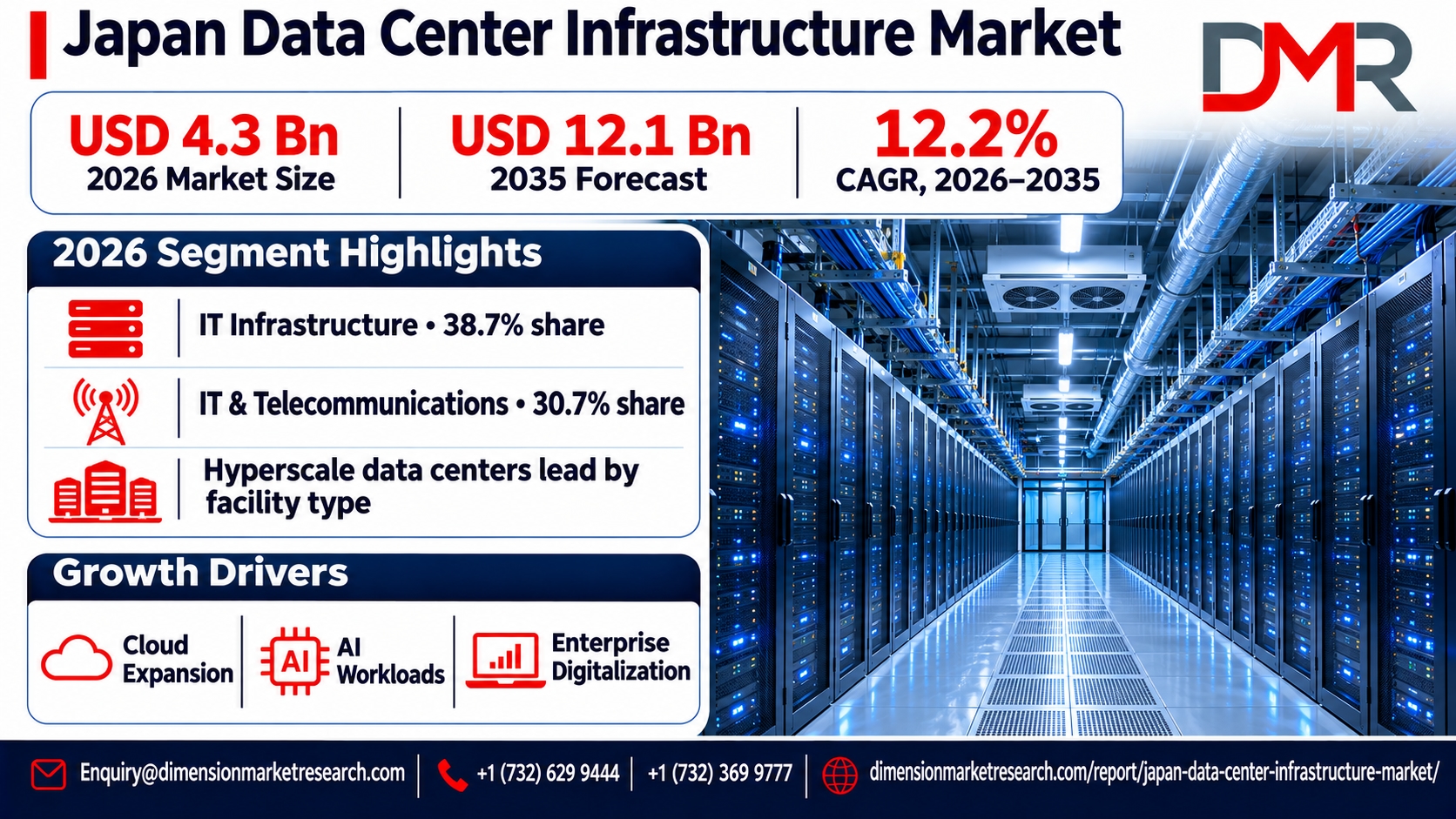
According to Dimension Market Research, the Japan Data Center Infrastructure Market Size is estimated at USD 4.3 billion in 2026 and is projected to reach USD 12.1 billion by 2035, growing at a compound annual growth rate (CAGR) of 12.2%. Cloud expansion and enterprise digitalization are increasing demand for servers, storage, and networking equipment. At the same time, denser AI workloads are changing what operators need from their power and cooling systems.
For operators, adding computing capacity involves decisions about the entire facility. A new rack of AI servers may require more electricity and cooling than the equipment it replaces. A regional facility built to support a factory or a telecom network may need compact equipment and room to expand in stages. These requirements create different opportunities for equipment manufacturers and systems integrators.
What Is the Japan Data Center Infrastructure Market?
The market measures revenue from four categories of infrastructure supporting data center operations in Japan. IT infrastructure includes servers, storage, and networking equipment. Power infrastructure supports electricity distribution and backup. Cooling infrastructure removes heat from equipment, while physical infrastructure includes the facility systems that house and protect it. The report analyzes these categories across data center types, deployment models, organization sizes, and end users.
Get a Free Sample of the Japan Data Center Infrastructure Market Report
https://dimensionmarketresearch.com/request-sample/japan-data-center-infrastructure-market/
Why Does IT Infrastructure Lead While Cooling Grows Faster?
IT infrastructure is projected to lead by component, with 38.7% of market revenue in 2026. Investment in high-performance servers, storage systems, and networking equipment supports that position. As operators refresh older hardware and add higher-density systems, they also need networking equipment that can handle increased data traffic between servers and storage.
Cooling infrastructure is expected to be the fastest-growing component. Higher rack densities increase the amount of heat that operators must remove from a given space. The report points to growing interest in direct-to-chip liquid cooling and modular infrastructure. For buyers upgrading an existing facility, an important question is whether new cooling equipment can fit the current layout and support future capacity increases.
How Are Hyperscale and Edge Facilities Shaping Demand?
Hyperscale data centers are projected to lead by facility type with a 36.2% share in 2026. Cloud providers and technology companies need large facilities with enough power, cooling, and networking capacity to support expanding workloads. In April 2026, NTT DATA announced the opening of its Keihanna OSK11 Data Center in Kyoto. The facility provides 30 MW of IT capacity and uses energy-efficient cooling designed to support AI, cloud, and enterprise workloads.
Edge data centers are expected to grow fastest by facility type. Applications such as industrial automation, 5G, and connected manufacturing can benefit from processing data closer to the equipment or users that generate it. That creates opportunities for suppliers of compact cooling systems, modular power distribution, and server configurations that can expand as local demand grows.
Where Are the Opportunities for Infrastructure Suppliers?
Hybrid deployment is projected to lead with a 44.1% share in 2026 as enterprises combine on-premises infrastructure with cloud resources. IT and telecommunications is expected to be the largest end-user segment, with a 30.7% share that year. Cloud and network expansion support demand, while hybrid deployment creates a role for upgrades to facilities that enterprises continue to operate.
Land, electricity, construction, and staffing costs can make new facilities expensive to build and operate. That can push smaller organizations toward colocation or cloud capacity. For equipment suppliers, modular systems offer a way to serve operators that want to add power and cooling in phases as demand becomes clearer. Compatibility with existing equipment and ease of maintenance can also influence buying decisions.
Explore the Complete Japan Data Center Infrastructure Market Analysis
https://dimensionmarketresearch.com/checkout/japan-data-center-infrastructure-market/
Frequently Asked Questions
How large is the Japan Data Center Infrastructure Market?
The market is estimated at USD 4.3 billion in 2026 and projected to reach USD 12.1 billion by 2035.
What is the projected CAGR of the market?
The report projects a CAGR of 12.2% from 2026 to 2035.
Which infrastructure component leads the market?
IT infrastructure is projected to lead with a 38.7% revenue share in 2026.
Which infrastructure component is expected to grow fastest?
Cooling infrastructure is projected to grow fastest as higher-density AI workloads increase demand for advanced heat management.
Which data center type is expected to grow fastest in Japan?
Edge data centers are projected to grow fastest, supported by demand for local processing in 5G, industrial automation, and connected manufacturing.
Conclusion
Through 2035, infrastructure demand in Japan will come from both large cloud and AI facilities and smaller sites that serve local workloads. For suppliers, the opportunity is to match equipment to each site’s constraints. High-density facilities need power and cooling that can support demanding racks, while regional facilities need compact systems that can expand as workloads grow.
Related Data Center Infrastructure Market Insights
The AI Infrastructure Market Size report covers processors, memory, storage, and networking. It estimates the global market at USD 164.0 billion in 2025 and projects USD 853.3 billion by 2034, at a CAGR of 20.1%.
The Green Data Center Market Share report examines investment in energy-efficient infrastructure, advanced cooling, and renewable power. It projects the global market to reach USD 426.9 billion by 2035.
The Edge Data Center Market Growth report projects an 18.7% CAGR from 2025 to 2034 as 5G networks, connected devices, and real-time applications drive demand for computing closer to users.