
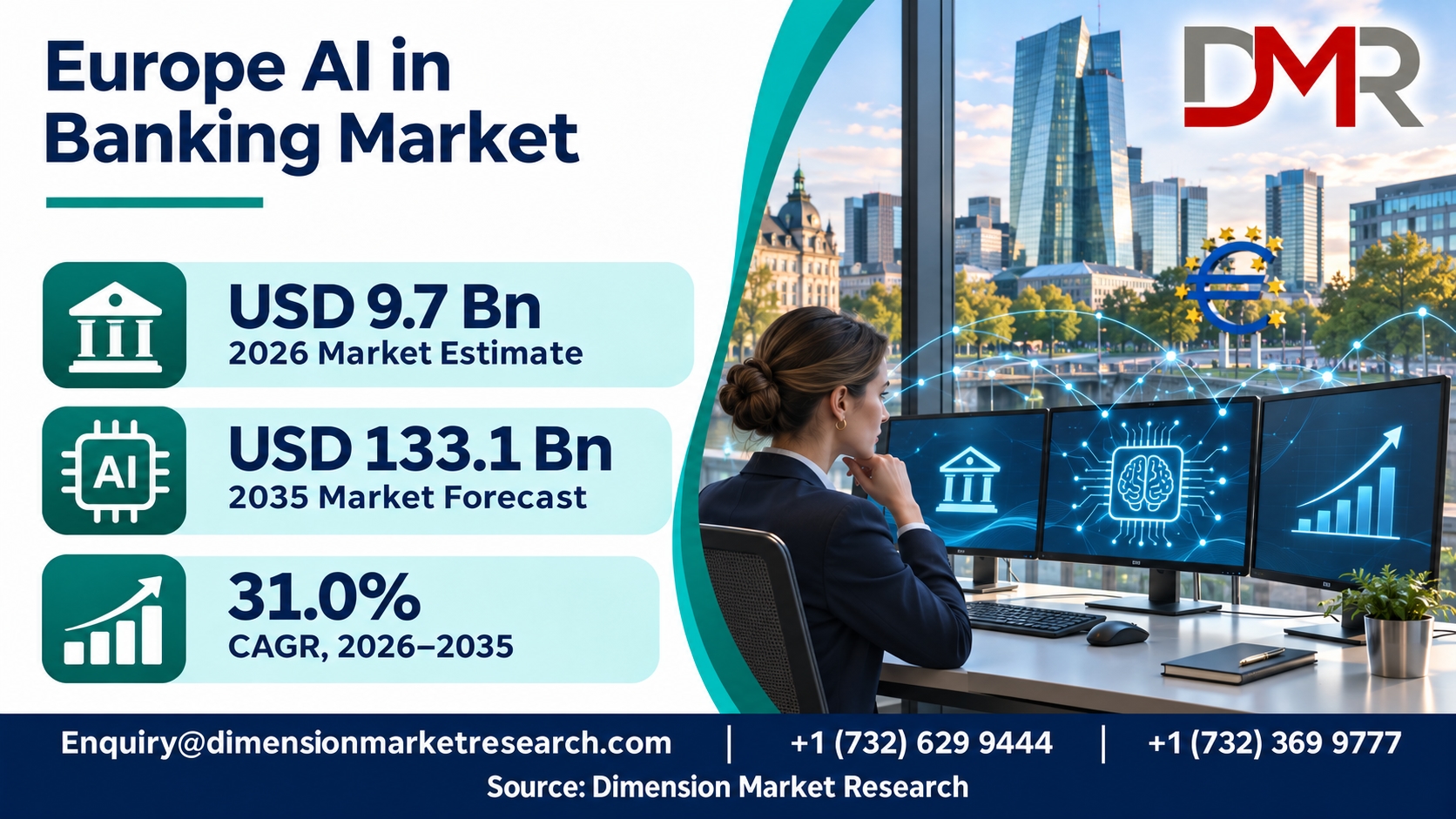
According to Dimension Market Research, the Europe AI in Banking Market is estimated at USD 9.7 billion in 2026 and projected to reach USD 133.1 billion by 2035, at a reported CAGR of 31.0%. Banks are adopting AI to detect suspicious transactions, automate routine work, and improve digital customer service. The commercial opportunity depends on how well these tools fit existing banking systems and give staff enough information to review decisions when needed.
What Does the Europe AI in Banking Market Cover?
The market covers AI solutions and services used by financial institutions for risk management, customer service, virtual assistance, and financial advisory. It includes machine learning, natural language processing (NLP), computer vision, and other technologies. A fraud monitoring system can use machine learning to flag unusual transactions for analysts, while a virtual assistant can use NLP to interpret customer questions. The choice of technology follows the task and the level of oversight the bank needs.
Get a Free Sample of the Europe AI in Banking Market Report
Request a free sample to review the study’s coverage of components, technologies, applications, and enterprise sizes before assessing its fit for your product, procurement, or investment research.
https://dimensionmarketresearch.com/request-sample/europe-ai-in-banking-market/
AI Solutions Lead as Demand for Integration Continues
AI solutions are projected to represent 63.0% of market revenue in 2026. The segment includes fraud detection platforms, predictive analytics, automation software, and AI-enabled digital banking tools. Large enterprises are expected to account for approximately 70.0% of the market as major banks invest in AI infrastructure and risk analytics. For vendors selling into these institutions, integration and ongoing support are part of the commercial decision. A tool that performs well in a pilot still needs to work with the bank’s data sources, access controls, and review processes.
Risk Management and Customer Service Drive Adoption
The growth of digital payments and cross-border transactions is increasing demand for tools that can spot unusual activity. AI can help prioritize cases for review, while predictive analytics can help lenders assess credit risk. A bank evaluating a fraud detection tool can track alert quality, the time analysts spend reviewing cases, and how often legitimate transactions are flagged. These measures show whether the system improves day-to-day operations.
NLP is projected to be the fastest-growing technology segment, at a 32.2% CAGR. Chatbots and virtual assistants are among the applications supporting that outlook. For customer service teams, a practical starting point is handling routine inquiries in mobile apps and on websites. The ability to transfer complex cases to a person with the conversation history intact can be as important to service quality as the speed of the initial reply.
What Could Slow AI Deployment in European Banks?
DMR identifies data privacy requirements and integration with legacy systems as major barriers. Older systems can make it harder to give AI tools timely access to reliable data. Infrastructure upgrades and specialist staffing can also raise rollout costs. For banks assessing a deployment, the pilot can help establish what data is available, how staff will check outputs, and which system changes are needed before the tool can be used across more teams.
Where Is Demand Concentrated in Europe?
DMR identifies the United Kingdom as the leading market in Europe, citing its fintech ecosystem and widespread use of digital banking. The report also highlights investment in AI-driven financial analytics and cybersecurity in Germany and France. Companies covered include BNP Paribas, HSBC, Barclays, Deutsche Bank, Santander, ING, Revolut, Backbase, and Feedzai. Open banking collaborations offer opportunities to develop products in areas such as payment monitoring and digital lending.
Explore the Complete Europe AI in Banking Market Analysis
Use the full report to compare demand by technology, application, and enterprise size before prioritizing product development, banking partnerships, or regional expansion.
https://dimensionmarketresearch.com/checkout/europe-ai-in-banking-market/
Frequently Asked Questions
1. How large is the Europe AI in Banking Market?
DMR estimates the market at USD 9.7 billion in 2026 and projects USD 133.1 billion by 2035.
2. What is the projected CAGR of the Europe AI in Banking Market?
DMR reports a CAGR of 31.0% from 2026 to 2035.
3. Which component has the largest market share?
AI solutions lead by component, with an estimated 63.0% share in 2026.
4. Which AI technology is growing fastest in European banking?
Natural language processing is projected to grow fastest, at a 32.2% CAGR, supported by adoption of chatbots and virtual banking assistants.
5. Which country leads the European market?
The United Kingdom leads DMR’s regional analysis, supported by an established fintech ecosystem and widespread digital banking adoption.
Conclusion
Europe’s outlook through 2035 reflects growing use of AI in fraud monitoring, risk analytics, and digital customer service. Providers can tap that demand by building tools for specific workflows and showing how they integrate with existing banking systems. Open banking partnerships offer another route to market for providers developing payment, risk assessment, and lending applications.
Related AI in Banking Market Insights
The global AI in Banking Market Size report examines adoption across fraud detection, regulatory compliance, and customer service. It identifies Asia-Pacific as the fastest-growing region, supported by digital transformation and fintech adoption.
The US AI in Banking Market Share report estimates that AI solutions account for 61.0% of U.S. market revenue in 2026. Deployment of fraud detection systems, risk analytics, and digital banking platforms supports demand.
The Japan AI in Banking Market Growth report projects an increase from USD 1.8 billion in 2026 to USD 24.6 billion by 2035, at a reported CAGR of 34.2%. Intelligent automation, AI-powered analytics, and digital banking solutions support the outlook.


