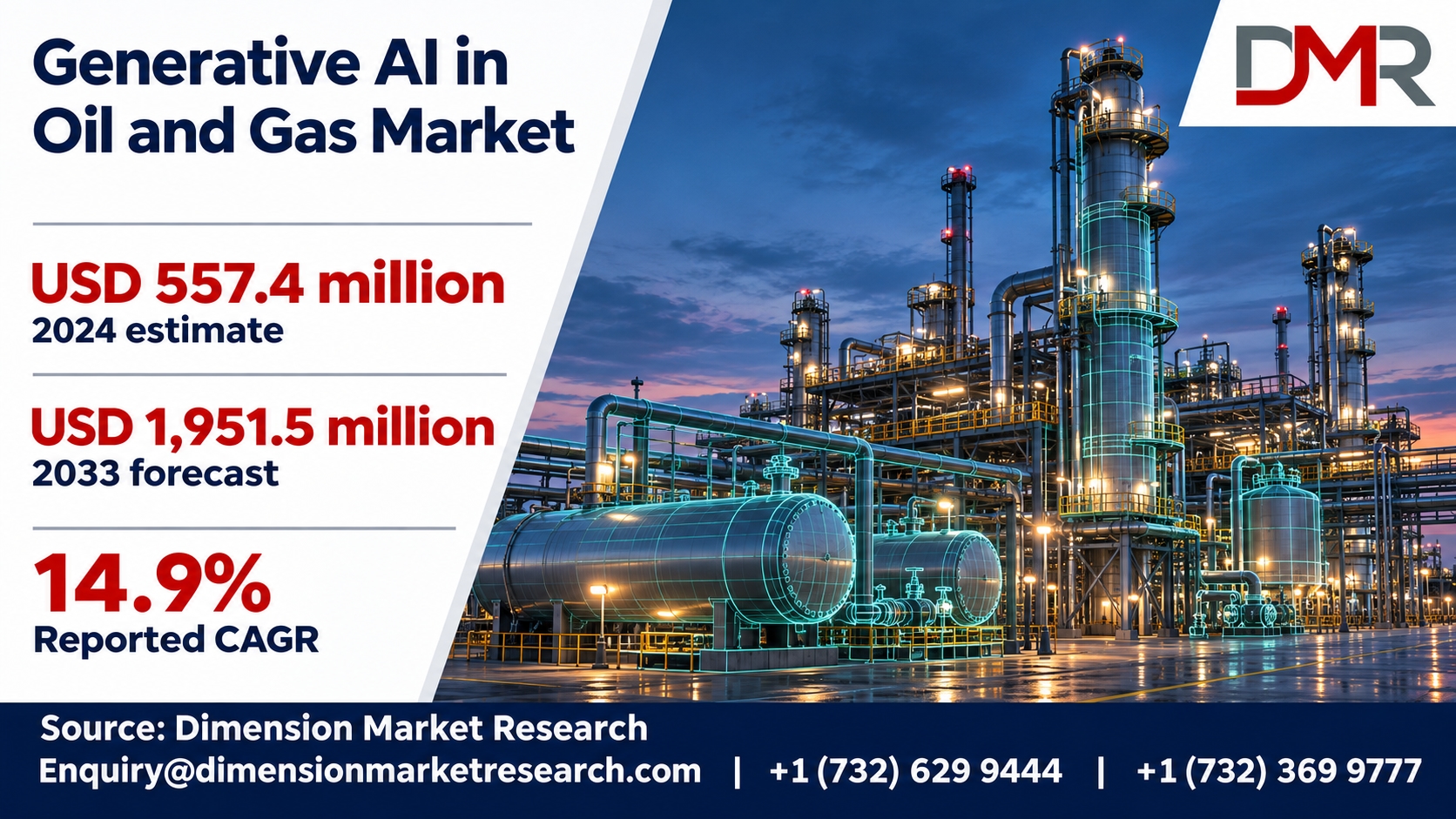
The Generative AI in Oil and Gas Market is growing as operators look for better ways to interpret equipment, drilling, and reservoir data. According to Dimension Market Research, the global market was estimated at USD 557.4 million in 2024 and is projected to reach USD 1,951.5 million by 2033. The report cites a compound annual growth rate of 14.9%.
Asset maintenance was projected to be the largest application by revenue in 2024, while drilling optimization is forecast to grow fastest. These applications address different operational decisions. Maintenance teams need to know which equipment warrants attention and when. Drilling teams need to compare scenarios and understand the trade-offs before making changes in the field. Both depend on whether teams can connect model outputs to reliable operating data.
What Is the Generative AI in Oil and Gas Market?
The market covers applications that generate data or simulate conditions to support oil and gas operations. Examples include creating synthetic seismic traces to help train interpretation models, simulating reservoir behavior under different production scenarios, and generating examples of equipment conditions for maintenance analysis. DMR segments the market by deployment, function, application, and end user.
Generative methods can work alongside predictive analytics and digital twins. For example, a digital twin represents a physical asset, while simulated scenarios can help engineers examine how that asset might behave under different conditions. The usefulness of those outputs depends on the quality of the underlying data and how well the scenarios reflect actual operations.
Request Your Free Generative AI in Oil and Gas Market Sample
https://dimensionmarketresearch.com/request-sample/generative-ai-in-oil-and-gas-market/
Why Asset Maintenance Leads Adoption
Oil and gas operators collect sensor readings and maintenance records across equipment fleets. The report identifies these records as an input for spotting patterns associated with degradation or possible failure. A maintenance team can use those signals to prioritize inspections and consider whether work can wait for a planned shutdown. The commercial value depends on whether the system gives staff enough time and information to act.
For an operator assessing a pilot, useful measures include how early the system flags a problem, how often staff can verify the alert, and whether it improves maintenance scheduling. Comparing outputs with known equipment events can also help the team identify where the model performs reliably and where engineers need more evidence before using its results.
Drilling and Reservoir Modeling Expand the Opportunity
DMR identifies drilling optimization as the fastest-growing application. The report describes how teams can use historical drilling records and current sensor data to examine operating patterns and compare possible scenarios. For contractors, a practical use case is helping engineers review the implications of a proposed change before field execution. The report also expects drilling contractors to be the fastest-growing end-user segment, while oil and gas companies led the 2024 revenue estimate.
Reservoir modeling presents another use case. Teams can simulate how a reservoir might respond to different production assumptions and compare the results with historical behavior. Data analysis and interpretation was projected to lead by function in 2024, reflecting the volume and variety of information generated by wells, sensors, and production systems. For vendors, that creates demand for tools that help engineers make sense of data already available across their operations.
Cloud Leads by Deployment as Integration Shapes Rollouts
Cloud-based deployment was projected to lead in 2024. The report cites flexible computing capacity and storage as advantages for teams working with large datasets and simulation workloads. It also covers on-premise deployment. Deployment decisions can depend on how an operator manages proprietary data, connects existing systems, and meets privacy and compliance requirements.
Data quality, integration costs, and access to skilled technical teams can slow adoption. A pilot at one site may have detailed sensor histories, while another site may have incomplete records or systems that capture measurements differently. These conditions affect how easily an operator can extend an application across its asset base and how much work it needs to budget for beyond the initial deployment.
North America Leads as Asia-Pacific Grows Fastest
North America was projected to account for 43.9% of global revenue in 2024. DMR ties that position to the region’s network of technology firms, research institutions, and AI specialists. The report identifies Asia-Pacific as the fastest-growing region, citing digital investment aimed at improving operational efficiency. Market participants covered include Beyond Limits, SLB Schlumberger, Baker Hughes, and SparkCognition.
Explore the Complete Generative AI in Oil and Gas Market Analysis
https://dimensionmarketresearch.com/checkout/generative-ai-in-oil-and-gas-market/
Frequently Asked Questions
1. How large is the Generative AI in Oil and Gas Market?
The global market was estimated at USD 557.4 million in 2024 and is projected to reach USD 1,951.5 million by 2033.
2. What global CAGR does DMR report?
DMR reports a global CAGR of 14.9%.
3. Which application leads the market?
Asset maintenance was projected to lead by revenue in 2024, supported by demand for equipment monitoring and earlier identification of maintenance needs.
4. Which region has the largest revenue share?
North America was projected to lead with 43.9% of global revenue in 2024.
5. Which application is expected to grow fastest?
DMR identifies drilling optimization as the fastest-growing application, supported by the use of historical and sensor data to evaluate drilling decisions.
Conclusion
The market outlook through 2033 reflects demand for tools that help operators interpret data and evaluate operational decisions. Asset maintenance offers a starting point where teams can compare model outputs with known equipment events. Drilling and reservoir modeling extend the opportunity to scenario analysis. Across these applications, the business case depends on whether teams can validate the outputs and use them in existing engineering workflows.