
A Guidewire developer who writes clean Gosu but cannot explain why a mid-term policy change produced the wrong premium will struggle on a live project. Knowing the syntax and knowing the system are different things, and that gap decides many hiring conversations. Anyone exploring Guidewire training in India should first understand which Guidewire skills actually carry weight.
For developers in Mumbai, the question is more specific: what do insurance teams expect on day one, and what can wait?
Why Insurance Projects Look Different Than They Did Five Years Ago
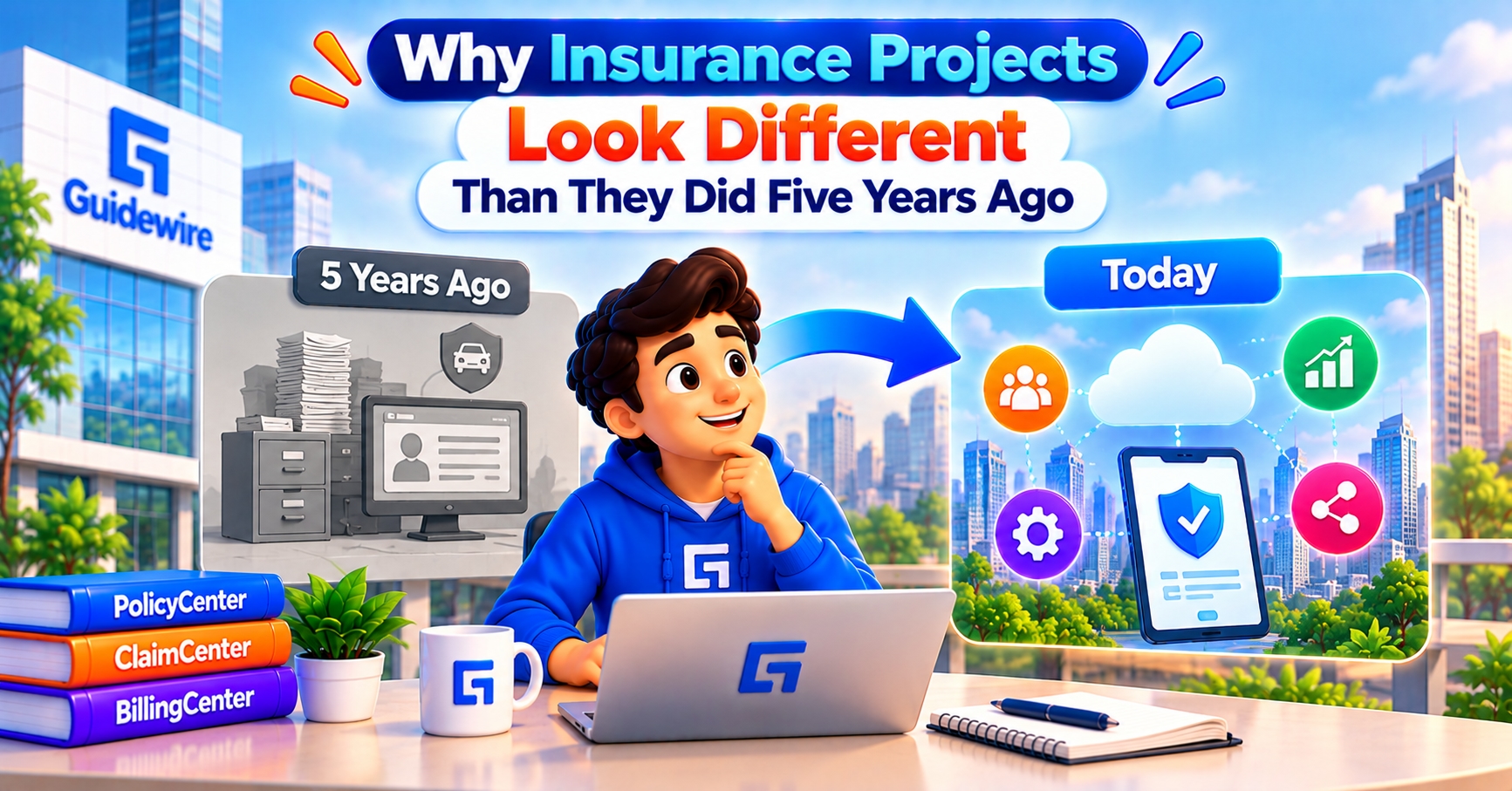
Guidewire InsuranceSuite is built around three core applications. PolicyCenter handles the policy lifecycle, from quoting and issuance to endorsements, renewals and cancellations. ClaimCenter manages claims from first notice of loss to settlement. BillingCenter deals with invoices, payments and collections.
Older projects often meant heavy customization on top of these products. Modern projects lean toward configuration, cloud delivery and cleaner upgrade paths. Guidewire has moved much of its customer base toward its cloud platform, and that shift changes what developers are expected to know. Writing code that survives the next upgrade matters more than writing clever code that only works today.
Insurers also expect their core systems to talk to mobile apps, agent portals, payment gateways, document services and analytics tools. A developer who only knows one application's screens and rules is less useful than one who understands how the suite fits into a wider technology landscape.
Mumbai's position matters here. The city is a major centre for banking, insurance and financial services in India, and many teams in the region support carriers and brokers in other countries. That means developers often work in distributed teams, follow Agile delivery, and read requirements written by business analysts who sit in a different time zone.
Consider a hypothetical example. A carrier asks its delivery team to add a new coverage option for small businesses. The request touches product configuration in PolicyCenter, a rating change, a validation rule, a screen update, and an integration that sends data to a downstream document system. No single skill covers all of that. The developers who stand out are those who can follow a change from the business request through each layer of the system.
That is why modern Guidewire skills form a stack rather than a single line on a résumé. The sections below take that stack apart, starting with the layer everyone needs first.
Gosu and Java: The Guidewire Skills That Still Come First
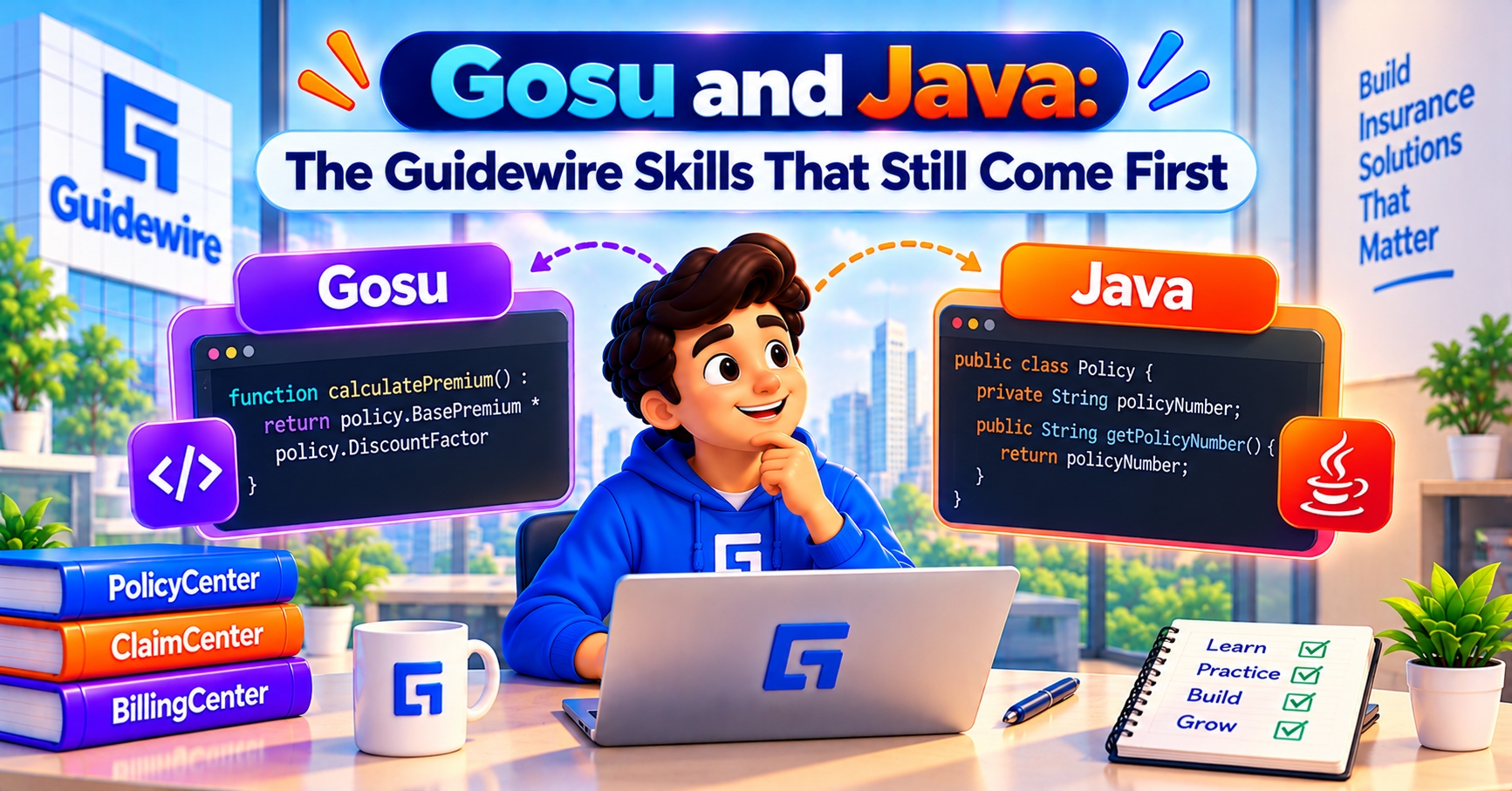
Gosu is Guidewire's own programming language, and it runs on the Java Virtual Machine. It reads a little like Java with some friendlier features, including type inference, blocks and enhancements. That Java connection is useful, because a developer with solid Java fundamentals can pick up Gosu faster than someone starting from nothing.
Gosu appears almost everywhere in a Guidewire project: business rules, validation logic, plugin implementations, enhancements, helper classes and integration code. So the first skill is not memorizing syntax. It is learning to read Gosu written by other people, because most of your early work will involve understanding existing code before changing it.
Several habits separate stronger developers from weaker ones:
Knowing when logic belongs in a rule, an enhancement, or a utility class
Writing queries that do not pull thousands of records into memory
Handling bundles and transactions correctly so that data is committed when it should be
Avoiding hard-coded values that should live in typelists or configuration
Bundles deserve special attention. Guidewire applications track changes to entities inside a bundle, and a poorly handled bundle is a common cause of confusing data problems. Beginners often add code that works in a simple test and then fails when two operations touch the same record.
Java knowledge goes beyond helping with Gosu. Plugins, integration points and some tooling sit close to the Java layer, so understanding collections, exceptions, interfaces and basic design patterns pays off. SQL is another quiet requirement, since developers regularly check data directly while debugging.
A common beginner mistake is treating Gosu as a shortcut around understanding the platform. Copying a code sample that solves a problem without knowing why it works creates technical debt fast. Reviewers on real projects notice this quickly, and interviewers usually probe it with scenario questions rather than syntax trivia.
If Gosu is the language, the data model is the grammar underneath it. Code that ignores how Guidewire stores and versions data tends to break in subtle ways.
Data Model, Typelists and Effective Dating: Where Real Bugs Hide
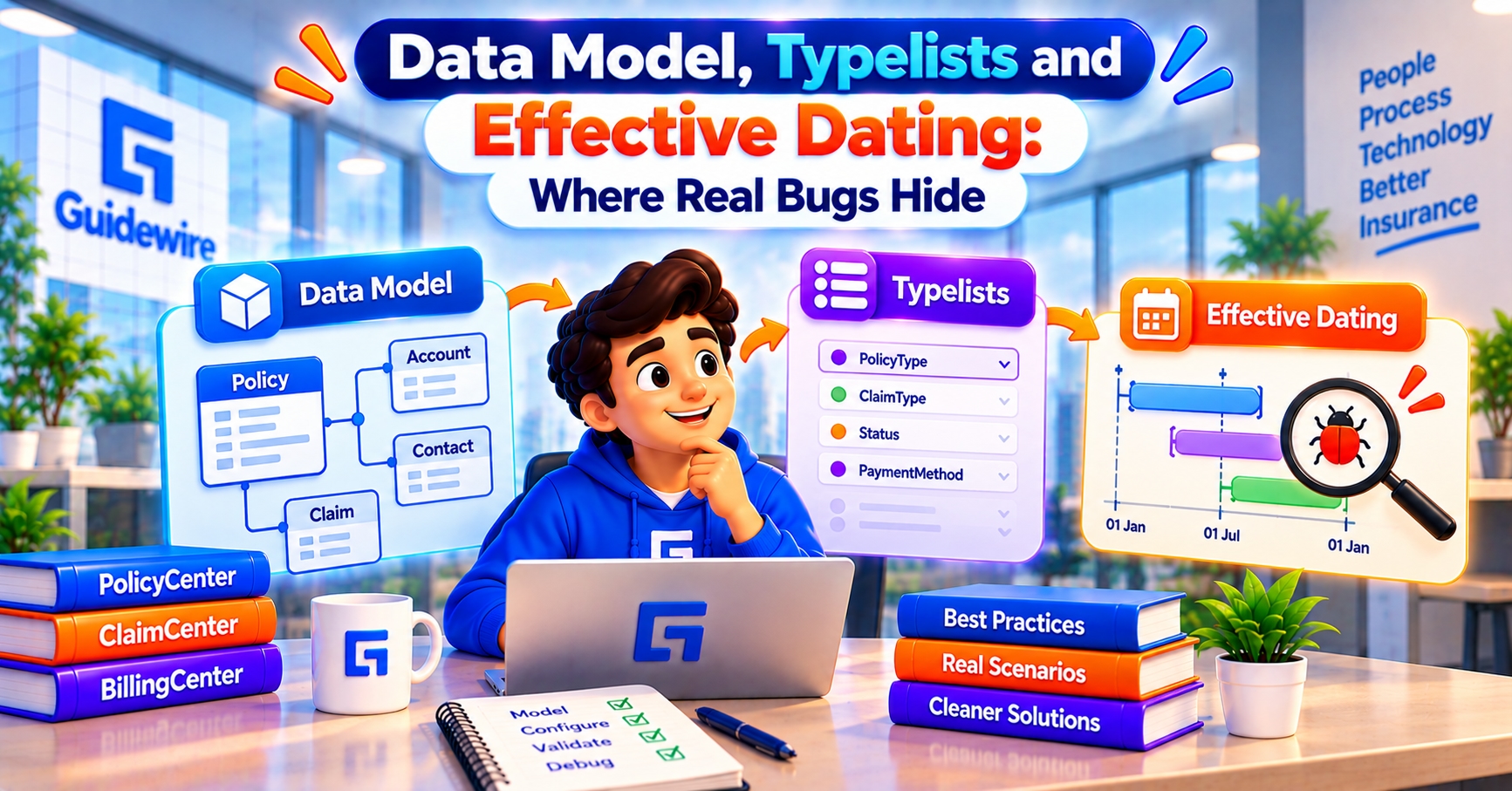
Every Guidewire application stores information in entities, which map to database tables. Out of the box, these entities cover things like policies, contacts, claims and accounts. Projects extend them with custom fields and new entities, and developers need to understand how those extensions are defined and how they affect the rest of the application.
Typelists are a good example of a small concept with large consequences. A typelist is a controlled list of values, such as coverage types, claim statuses or loss causes. Each value is a typecode. Developers who treat typelists as simple dropdowns miss their role in rules, filters, integrations and reporting. Adding or retiring a typecode can ripple through several parts of the system.
Effective dating is the concept that trips up many newcomers, especially in PolicyCenter. A policy is not a single record that gets overwritten. It is a set of versions that are valid for specific date ranges. When someone changes a policy partway through its term, the system has to preserve what was true before the change and what is true after it.
Think about a customer who adds a vehicle on the fifteenth day of a policy term. The premium for that vehicle should start from that date, not from the beginning of the term. If a developer writes logic that reads the wrong version of the data, the result is an incorrect premium, a failed validation, or a document that shows the wrong coverage. These bugs rarely show up in simple tests.
Developers who understand effective-dated data find it much easier to debug rating issues, understand audit trails and reason about renewals. It is one of the clearest skills that separates someone who has built a training exercise from someone who has worked through production-style scenarios.
Learning to read the data model is a practical skill too. Knowing how to trace a field from the screen back to its entity, and from the entity to the database, saves hours. Data model fluency also prepares you for the next layer of the stack, because integrations are really about moving this data safely between systems.
Integration and Cloud APIs: Connecting InsuranceSuite to Everything Else
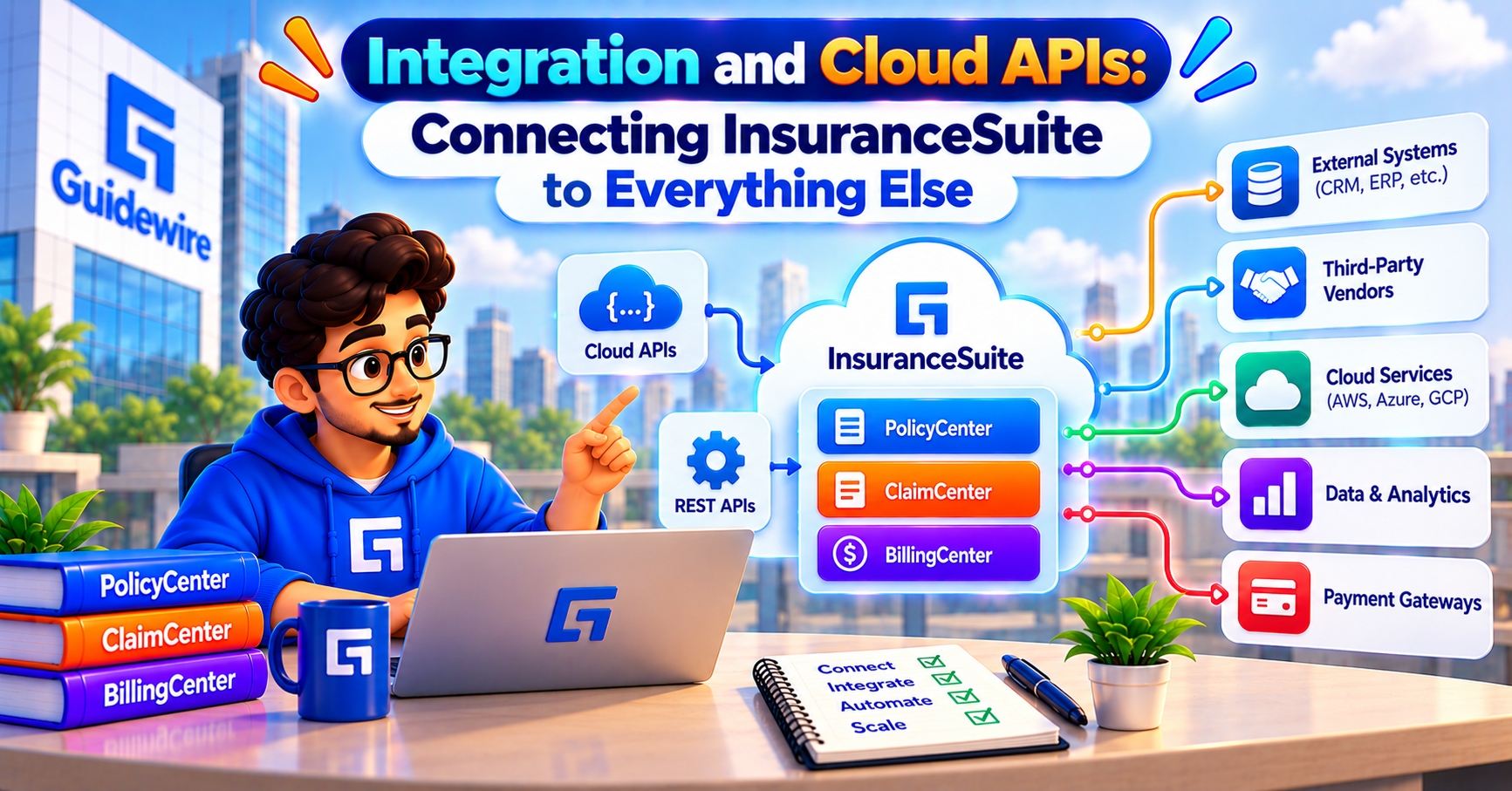
Insurance platforms do not live alone. A policy system may need to call a credit-check service, send documents to a printing partner, update a customer portal, and share data with a finance system. Integration is where much of the real project complexity sits, and it is one of the most in-demand Guidewire skills.
Guidewire offers several integration patterns. Messaging is event-driven, so the application sends a message when something happens, such as a policy being issued, and a downstream system picks it up. Web services expose application functions so other systems can call them. Plugins let developers replace or extend specific behaviors with external logic. Choosing the right pattern for a given requirement is a design skill, not just a coding skill.
Cloud-era projects add the Guidewire Cloud APIs, which are REST-based. Developers working on these projects need to be comfortable with REST principles, JSON, authentication, error handling and API versioning. Understanding how Guidewire's integration tooling fits with cloud deployment is increasingly part of the job description.
Practical integration work also demands careful thinking about failure. What happens when the downstream system is unavailable? Should the message retry, and how many times? Who is alerted when something fails at two in the morning? Strong developers ask these questions before writing code, and they design for retries, idempotency and monitoring.
A frequent mistake is assuming that a successful test in a development environment proves an integration works. Real environments bring timeouts, malformed data, duplicate messages and unexpected volumes. Developers who have handled these issues even in practice projects explain them more convincingly in interviews.
Supporting skills include XML and JSON handling, basic understanding of message queues, familiarity with tools like Postman for testing APIs, and the ability to read logs. If you are weighing training options, look for programs that cover integration with actual exercises, since it is hard to learn from slides alone.
Back-end skills are only half of what a modern delivery team needs, though. The way code is built, tested and shipped has changed just as much.
Frontend, Testing and DevOps Habits on Cloud-Era Projects
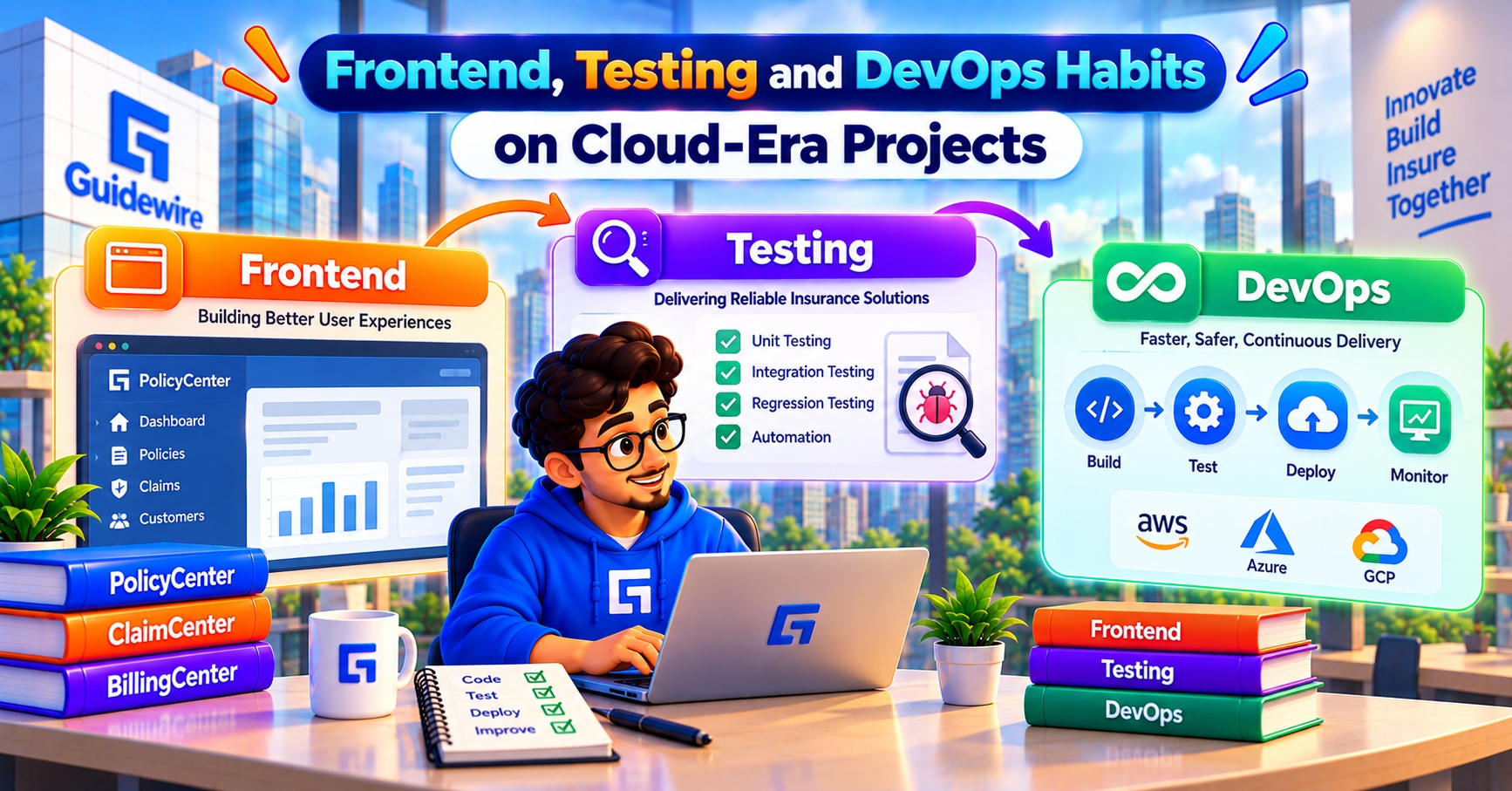
Guidewire's user interface has traditionally been defined through Page Configuration Files, usually called PCF files. Developers working on existing implementations still need to read and modify these to change screens, fields and navigation. Understanding how a PCF connects a widget to an entity property and to Gosu logic is basic day-to-day knowledge.
Newer projects increasingly involve Jutro, Guidewire's digital front-end framework built on modern web technologies. Developers who know JavaScript or TypeScript and React will have a head start there. This does not mean every Guidewire developer must become a front-end specialist, but knowing the basics of component-based UI work opens more project options.
Testing is a skill many learners underestimate. Guidewire provides GUnit for unit testing, and teams also write integration and regression tests. Good developers write tests for rules and rating logic because insurance calculations have little tolerance for error. A rounding mistake across thousands of policies becomes a real financial problem.
Version control with Git is expected, along with comfort in branching, pull requests and code reviews. Teams also use continuous integration pipelines that build, test and deploy code automatically. Cloud delivery brings its own habits, including working with environments that are managed differently from on-premise servers and following deployment processes set by the platform.
Agile ways of working shape daily life. Developers join sprint planning, estimate stories, update tickets in tools like Jira, and explain progress in short stand-ups. Communication here is a technical skill in its own right. A developer who can write a clear pull request description or explain a defect precisely saves the whole team time.
Another quiet requirement is debugging discipline. Reading logs, reproducing issues, isolating the cause and documenting the fix are habits that cannot be taken from a textbook. Practice projects that include broken scenarios, rather than only working ones, build this muscle better than perfect tutorials do.
Technical stack aside, the most overlooked skill on many Guidewire projects has nothing to do with code. It is understanding the insurance itself.
Insurance Domain Knowledge and a Realistic Learning Path for Mumbai Developers

Developers who know the business write better code. Understanding terms like premium, endorsement, deductible, underwriting, subrogation and reserves means you can read a requirement and spot what is missing. A developer who understands why a cancellation might require a pro-rata or short-rate refund will ask better questions than one who simply implements the ticket.
Domain knowledge does not require an insurance degree. Start with one line of business, such as personal auto or property, and follow its lifecycle from quote to claim. Then connect each stage to the matching Guidewire application. This gives your technical learning a story to hang on.
A realistic learning path might look like this:
Build a strong base in Java and SQL
Learn Gosu and the basics of the Guidewire data model
Practice configuration tasks in one application, usually PolicyCenter, ClaimCenter or BillingCenter
Add integration concepts, including messaging and web services
Work on small project-style exercises that combine rules, UI changes and testing
Prepare for interviews with scenario-based questions rather than memorized answers
Interviewers in this field tend to ask how you would solve a situation, not only what a term means. Practicing explanations aloud helps, particularly for topics like effective dating, bundles and integration failure handling.
Mumbai developers also have a practical advantage in access to a large financial-services job market and a strong culture of IT services work. Choosing training that matches local project expectations is useful, and a structured option like Guidewire training in Mumbai can help learners organize this path with guided practice and mentoring from JastTech instructors.
Be cautious with any course that promises quick placement or skips fundamentals. Guidewire hiring still depends on whether you can show practical understanding, and no course replaces hands-on work. The best preparation combines structured learning with your own experiments, mistakes and fixes.
Conclusion
Guidewire skills form a stack that begins with Gosu and Java, runs through the data model and integrations, and ends with testing habits and insurance knowledge. Developers in Mumbai who build each layer deliberately are better prepared for the way modern insurance projects actually run. Learn the system, not only the syntax, and the rest of your Guidewire career gets easier to grow.