
How Is the Asia Pacific Crane Market Performing?
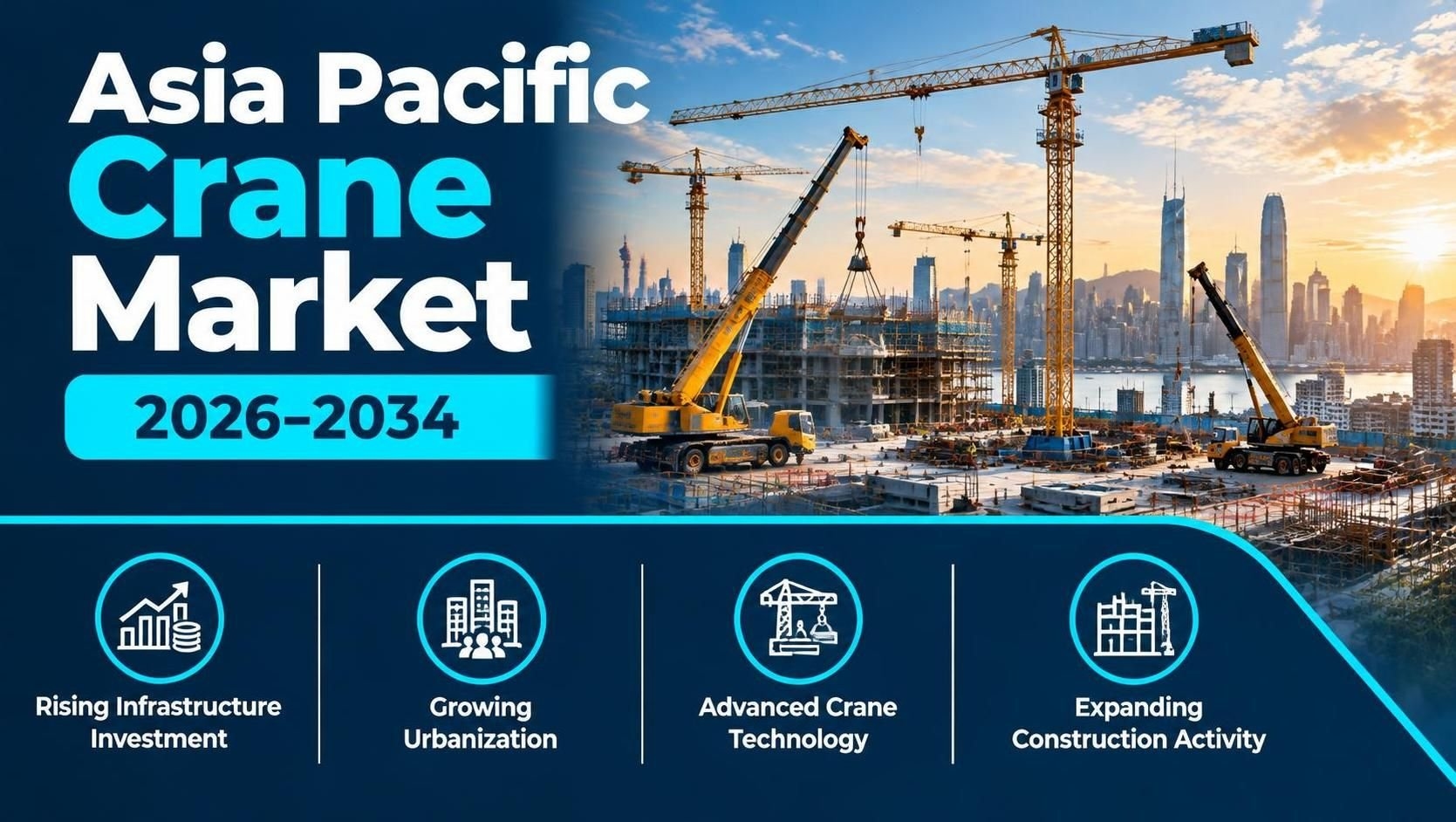
The Asia Pacific crane market size reached USD 25.6 Billion in 2025 and grew to USD 27.3 Billion in 2026. Looking forward, IMARC Group expects the market to reach USD 41.0 Billion by 2034, exhibiting a growth rate (CAGR) of 5.21% during 2026-2034.
The market is driven by infrastructure investment, government-backed megaprojects, and demand for advanced construction machinery. Renewable energy projects such as wind farms, smart construction technologies, and port expansion are widening demand for specialized lifting equipment.
Asia Pacific Crane Market Dynamics
Driver: Infrastructure Megaprojects and Construction Growth:
Asia Pacific is investing heavily in highways, railways, bridges, airports, and urban development. Governments prioritize connectivity and modernized transportation networks, and these projects require cranes capable of heavy loads and complex operations. Smart city initiatives, high-rise construction, and rising real estate investment further expand demand, particularly in confined urban sites where tower and mobile cranes are essential.
Construction methods are also changing. Modular and prefabricated techniques rely on cranes for precise placement of pre-assembled structures, shortening project timelines. Public-private partnerships support larger infrastructure pipelines. Equipment makers are responding with new products: in 2024, Manitowoc introduced the Potain MCT 2205, its largest topless tower crane, with an 80m jib and 80-ton capacity, at Bauma China 2024, and Zoomlion revealed its first hydraulic luffing jib tower crane, the RL165-10. Expanding ports and rising trade add further demand for marine and port cranes.
Opportunity: Renewable Energy, Smart Technology, and Green Cranes:
Wind, solar, and hydroelectric projects need specialized cranes with high lifting capacity and precision control, creating major opportunities. In 2024, XCMG introduced the XCA4000, an 11-axle telescopic crane with a 4,000-ton capacity, engineered to place turbines exceeding 10MW. Huisman's two subsea cranes for a Japanese cable lay vessel will support the country's offshore wind industry. Together these projects show how energy transition is raising the technical bar for lifting equipment.
Technology and sustainability form a second opportunity. IoT, automation, and telematics improve safety, precision, and uptime. In 2024, Kobe-Osaka International Port inaugurated the first hydrogen-powered Rubber-Tired Gantry crane. China's unmanned remote tower cranes show how automation is reshaping job sites. The crane market in Asia Pacific is gradually moving toward electric, hybrid, and low-emission models as environmental mandates tighten.
Restraint: High Capital Costs, Skills, and Cyclical Demand:
Cranes are capital-intensive assets, and advanced models with telematics, hybrid drives, or very high capacities carry premium prices. Smaller contractors often prefer rental or older equipment, which slows adoption of new technology. Fluctuations in steel and component costs can also pressure manufacturers and buyers.
Demand follows construction and infrastructure cycles, so delays in projects or slower real estate activity can quickly affect orders. Skilled operators and maintenance technicians are essential for safe crane use, and shortages of trained personnel raise risk and downtime. Stricter safety and emission rules add compliance costs, even as they push innovation.
Evaluate Market Opportunity with the Business Sample Report
How Is the Asia Pacific Crane Market Segmented?
By Product Type:
Mobile Cranes: clear dominance; adaptability, quick setup, and broad use across construction, energy, logistics, and mining
Marine and Port Cranes: cargo handling and container transport at expanding ports
Fixed Cranes: tower and other fixed installations for large builds
By Application:
Construction and Infrastructure: largest segment; highways, bridges, railways, airports, and housing
Mining
Oil and Gas
Others
Country Insights:
China: Holds the biggest Asia Pacific crane market share, backed by infrastructure initiatives, strong manufacturing, and government support for wind and hydropower
Japan: Decarbonized port operations and electrified cargo handling equipment
India: Port modernization; Adani Gangavaram Port launched India's first Economic Grab Ship Cranes in December 2024
South Korea: Port of Busan investing in lower-emission harbor cranes
Australia: Resources and energy-linked heavy lifting
Indonesia: Industrial facility build-out, including Konecranes CXT overhead cranes for PT Beka Wire Indonesia
Explore the Full Report with Charts, Table of Contents, and List of Figures
Competitive Landscape
Major participants are prioritizing innovation, partnerships, and geographic expansion. They are investing in IoT and automation, launching sustainable and energy-efficient models, and working with local distributors and service providers to improve accessibility. The report provides a comprehensive analysis of the competitive landscape with detailed profiles of all major companies.
Government Initiatives Supporting the Market
China Renewable Energy Push: Emphasis on wind and hydropower increases demand for heavy lifting equipment, alongside support for automation and smart construction
Japan Port Decarbonization: Plan to electrify cargo handling equipment and decarbonize port operations
India Infrastructure Programs: PM Gati Shakti and Sagarmala promote integrated infrastructure and port-led development
Smart City and PPP Programs Across the Region: Government-backed projects and public-private partnerships support large construction pipelines
Green Energy Incentives: Governmental incentives and policies for renewables increase demand for specialized cranes
Investment Opportunities
Mobile and Specialized Heavy-Lift Cranes: Mobile cranes lead on flexibility, while high-capacity telescopic and crawler cranes serve wind and heavy industry.
Electric, Hybrid, and Hydrogen Cranes: Port and construction operators are seeking lower-emission fleets to meet environmental mandates.
Automation, Telematics, and Services: Remote operation, monitoring, and predictive maintenance create recurring service opportunities and improve safety.
Discuss Your Requirements With an Analyst and Get Your Customized Market Report
Frequently Asked Questions (FAQ)
How big is the crane market in Asia Pacific?
The market grew from USD 25.6 Billion in 2025 to USD 27.3 Billion in 2026.
What is the forecast by 2034?
IMARC Group estimates the market to reach USD 41.0 Billion by 2034, at a CAGR of 5.21% during 2026-2034.
What are the key growth drivers?
Infrastructure investment, government-backed megaprojects, renewable energy projects, smart construction technologies, and demand for advanced construction machinery.
Which product type leads?
Mobile cranes lead in 2025 due to their versatility, ease of mobility, and wide range of applications.
What role does government play?
Governments fund infrastructure and port projects, support renewable energy and decarbonization, and encourage smart construction through incentives and public-private partnerships.
Conclusion
The Asia Pacific crane market presents a durable growth opportunity, supported by infrastructure expansion, renewable energy construction, and rapid adoption of automation and cleaner power. Mobile cranes and construction-led demand anchor the market today.
Manufacturers and rental fleets that invest in high-capacity, low-emission, and digitally connected cranes, and that build strong regional service networks, will be best positioned as projects scale across China, India, Japan, South Korea, Australia, and Indonesia.
Source: IMARC Group