Market Overview:
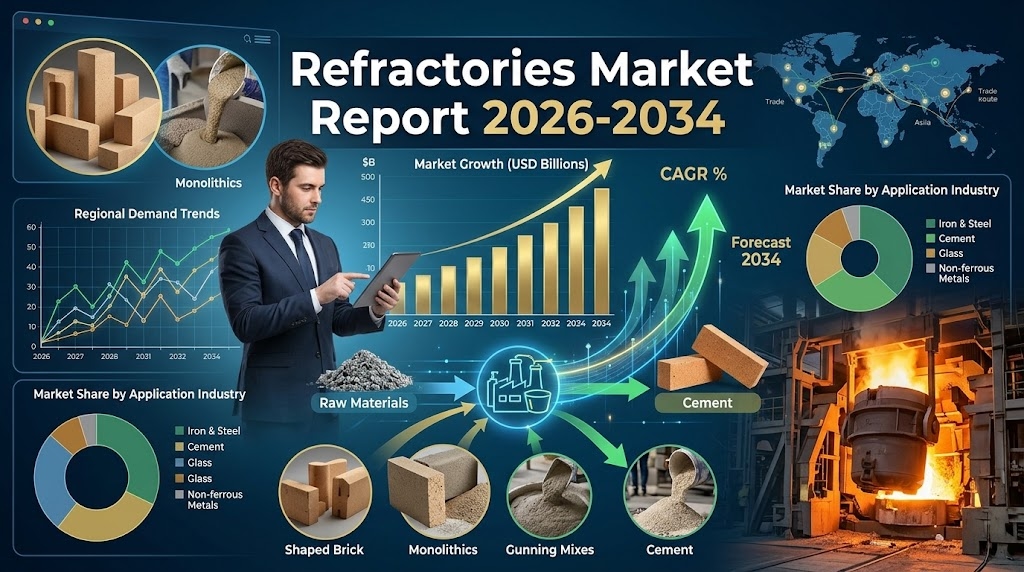
According to IMARC Group’s latest research publication, “Refractories Market: Global Industry Trends, Share, Size, Growth, Opportunity and Forecast 2026-2034”, The global refractories market size was valued at USD 28.6 Billion in 2025. Looking forward, IMARC Group estimates the market to reach USD 39.7 Billion by 2034, exhibiting a CAGR of 3.54% during 2026-2034.
This detailed analysis primarily encompasses industry size, business trends, market share, key growth factors, and regional forecasts. The report offers a comprehensive overview and integrates research findings, market assessments, and data from different sources. It also includes pivotal market dynamics like drivers and challenges, while also highlighting growth opportunities, financial insights, technological improvements, emerging trends, and innovations. Besides this, the report provides regional market evaluation, along with a competitive landscape analysis.
How AI is Reshaping the Future of Refractories Market
AI-powered predictive maintenance systems are being deployed across blast furnaces and kilns to monitor refractory lining wear in real-time, reducing unplanned shutdowns and extending the service life of high-temperature equipment in steel and cement plants.
Steel production in the United States reached 1,659,000 net tons in mid-January 2025, operating at a capability utilization rate of 74.5%, a 1.8% rise over the same period in 2024, underscoring persistent demand for advanced refractories capable of withstanding temperatures above 1,600 degrees Celsius.
Government bodies are integrating AI-assisted materials R&D into industrial decarbonization roadmaps. The U.S. Department of Energy’s Industrial Efficiency and Decarbonization Office invested over USD 350 million in industrial innovation to promote cleaner and more efficient energy use, accelerating development of next-generation refractory materials.
AI and machine learning tools are enabling refractory manufacturers to optimize raw material compositions, reducing material waste and improving thermal performance for specialized applications including electric arc furnace linings.
Firebrick-based thermal energy storage systems, enhanced through computational modeling, are proving capable of reducing annual hydrogen production for grid electricity by up to 31%, opening a significant new application avenue for refractory materials beyond traditional industrial use.
Download a sample PDF of this report: https://www.imarcgroup.com/refractories-market/requestsample
Key Trends in the Refractories Market
Industrial Expansion and Modernization Driving Sustained Demand: The continuous expansion of industries such as steel, cement, glass, petrochemicals, and non-ferrous metals is creating substantial demand for refractory materials used to line and protect high-temperature equipment. Industrial production in India increased by 5.20% in November 2024 over the same month in the previous year, reflecting the rapid industrialization in emerging economies that is reinforcing refractory consumption. In developed nations, refurbishing and upgrading aging infrastructure also contributes to sustained demand.
Shift to Electric Arc Furnaces Creating Product Innovation Opportunities: The global steel industry’s transition toward electric arc furnaces, which are more energy-efficient and environmentally friendly than traditional blast furnaces, is reshaping refractory specifications. Companies are investing in developing specialized refractory materials suited for EAF processes, including high-alumina and magnesia-carbon products that offer superior thermal cycling resistance and reduced contamination risk during molten steel processing.
Energy Efficiency and Sustainability Pushing Next-Generation Formulations: Manufacturers are increasingly required to meet stricter environmental regulations while maintaining operational sustainability. New high-performance refractory materials are being developed to withstand demanding industrial conditions while also lowering energy loss and carbon emissions. Firebrick compositions capable of both storing heat and insulating adjacent materials are being refined, demonstrating the dual-function potential of advanced refractories in industrial settings.
Infrastructure Development and Urbanization Amplifying Refractory Demand: The World Bank reports that Private Participation in Infrastructure investment reached USD 86.0 billion in 2023, driving construction activity globally. Refractory materials are used extensively in industrial incinerators, fireplaces, chimneys, residential structures, and commercial developments to provide fire resistance, heat retention, and structural stability. The degree of urbanization in the United States rose from 75.3% in 1990 to 83.3% in 2023, a trend mirrored across emerging economies, resulting in sustained demand for refractories in construction and heavy industry.
Automotive and Aerospace Sectors Emerging as New Demand Vectors: Latin America’s automotive sector is seeing significant capital inflows, including Stellantis’s USD 6.03 billion investment in South American automotive manufacturing, its largest ever investment into the region. Casting, heat treatment, and welding processes used in vehicle production all require high-performance refractories capable of withstanding extreme temperatures, creating a meaningful new demand channel beyond the traditional steel and cement end-markets.
We explore the factors propelling the refractories market growth, including technological advancements, consumer behaviors, and regulatory changes.
Growth Factors in the Refractories Market
Dominance of Unshaped Refractories Reflecting Industry Preference for Versatility: Unshaped refractories, which include castables, polymers, and ramming mixtures, are the largest product form in the market. Their ability to be applied into irregular shapes and voids provides optimal insulation in diverse industrial configurations including boiler linings, furnace linings, and ladle linings. The cost savings from reduced installation time and labor, alongside reliable thermal performance, continue to attract industries seeking flexible refractory solutions.
Clay-Based Composition Holding the Largest Market Share: Clay-based refractories account for approximately 59.0% of the global market in 2025. Products such as fire clay bricks and high-alumina bricks offer cost-effective solutions for foundries, boiler linings, and cement kilns where moderate resistance to temperature and chemical attack is adequate. Their ease of production, adaptability to various shapes, and relatively affordable pricing reinforce their dominant market position.
Iron and Steel Sector Commanding the Largest Application Share: Iron and steel applications account for around 65.4% of global refractory demand in 2025. Refractories are critical to maintaining the integrity of blast furnaces, converters, and ladles, enabling higher productivity, prolonged equipment lifespan, and reduced downtime for steel producers. This continuous pursuit of efficiency and cost-effectiveness in steel manufacturing reinforces the persistent need for high-grade refractory solutions.
Chemical Industry Expansion in the United States Amplifying Demand: The U.S. chemical manufacturing industry recorded total foreign direct investment of USD 766.7 billion in 2023, according to the International Trade Administration. As production activity in petrochemicals, fertilizers, and plastics intensifies, refractories are increasingly relied upon to ensure efficiency, safety, and operational continuity in chemical plants and refineries exposed to extreme temperatures, abrasion, and chemical reactions.
Middle East and Africa Construction Boom Creating New Growth Avenues: Saudi Arabia has more than 5,200 construction projects underway, valued at USD 819 billion. The corresponding surge in cement production, which requires refractories in cement kilns and rotary equipment to maintain high operating temperatures and resist abrasive conditions, is making the MEA region a significant growth contributor for global refractory manufacturers.
Leading Companies Operating in the Global Refractories Industry:
Chosun Refractories Eng Co. Ltd.
Compagnie de Saint-Gobain S.A.
Coorstek Inc.
Imerys USA Inc.
Krosaki Harima Corporation
Morgan Advanced Materials Plc
Refratechnik Holding GmbH
RHI Magnesita GmbH
Vesuvius Plc
Refractories Market Report Segmentation:
Breakup By Form:
Shaped Refractories
Unshaped Refractories
Unshaped refractories hold the largest market share in 2025 due to their adaptability and cost efficiency across diverse industrial applications including furnace linings, boiler insulation, and ladle linings.
Breakup By Alkalinity:
Acidic and Neutral
Basic
Acidic and neutral refractories lead the industry in 2025, driven by demand from non-ferrous metal production, petrochemical refining, and waste incineration, where resistance to acidic slags and chemical corrosion is essential.
Breakup By Manufacturing Process:
Dry Press Process
Fused Cast
Hand Molded
Formed
Unformed
Fused cast leads the market, primarily due to its exceptional resistance to extreme temperatures and chemical corrosion, making it the preferred method for producing refractories used in glass furnace construction.
Breakup By Composition:
Clay-Based
Nonclay-Based
Clay-based refractories dominate with around 59.0% of market share in 2025, owing to their cost-effectiveness, ease of production, and broad applicability across foundries, boiler linings, and cement kilns.
Breakup By Refractory Mineral:
Graphite
Magnesite
Chromite
Silica
High Alumina
Zirconia
Others
Graphite leads the refractory mineral segment in 2025 due to its exceptional thermal conductivity, resistance to high temperatures, and ability to withstand chemical corrosion by molten metals, making it indispensable in electric arc furnaces and steelmaking.
Breakup By Application:
Iron and Steel
Cement
Non-Ferrous Metals
Glass
Others
Iron and steel lead the application segment with around 65.4% of market share in 2025, driven by the sector’s relentless need for advanced refractories to safeguard high-temperature equipment and optimize production efficiency.
Breakup By Region:
North America (United States, Canada)
Asia Pacific (China, Japan, India, South Korea, Australia, Indonesia, Others)
Europe (Germany, France, United Kingdom, Italy, Spain, Russia, Others)
Latin America (Brazil, Mexico, Others)
Middle East and Africa
Asia Pacific holds the leading position with over 49.2% of global market share in 2025, driven by rapid industrialization, large-scale steel and cement production, and significant infrastructure development across China and India.
Recent News and Developments in the Refractories Market
January 2025: RHI Magnesita completed the acquisition of US-based Resco Group for an enterprise value of USD 410 million, its most significant investment since the merger of RHI and Magnesita in 2017. The deal expanded the company’s North American production footprint to 15 sites across the United States, Canada, and Mexico, strengthening local-for-local production and reducing US customer dependence on refractory imports.
June 2025: RHI Magnesita and BPI, Inc. announced a strategic joint venture to accelerate circular economy initiatives in North America. The partnership is aimed at enhancing sustainable refractory solutions and creating a strategic platform for the sourcing of domestic refractory raw materials within the region.
November 2025: Vesuvius completed the acquisition of the Molten Metal Systems business from Morgan Advanced Materials for an enterprise value of approximately GBP 92.7 million. The transaction expanded Vesuvius’s portfolio of advanced refractory materials and strengthened its operational presence across multiple geographies, including increased exposure to the non-ferrous market segment and to India.
Note: If you require specific details, data, or insights that are not currently included in the scope of this report, we are happy to accommodate your request. As part of our customization service, we will gather and provide the additional information you need, tailored to your specific requirements. Please let us know your exact needs, and we will ensure the report is updated accordingly to meet your expectations.
About Us:
IMARC Group is a global management consulting firm that helps the world’s most ambitious changemakers to create a lasting impact. The company provides a comprehensive suite of market entry and expansion services. IMARC offerings include thorough market assessment, feasibility studies, company incorporation assistance, factory setup support, regulatory approvals and licensing navigation, branding, marketing and sales strategies, competitive landscape and benchmarking analyses, pricing and cost research, and procurement research.
Contact Us:
IMARC Group
134 N 4th St. Brooklyn, NY 11249, USA
Email: sales@imarcgroup.com
Tel No: (D) +91 120 433 0800
United States: +1-201-971-6302