
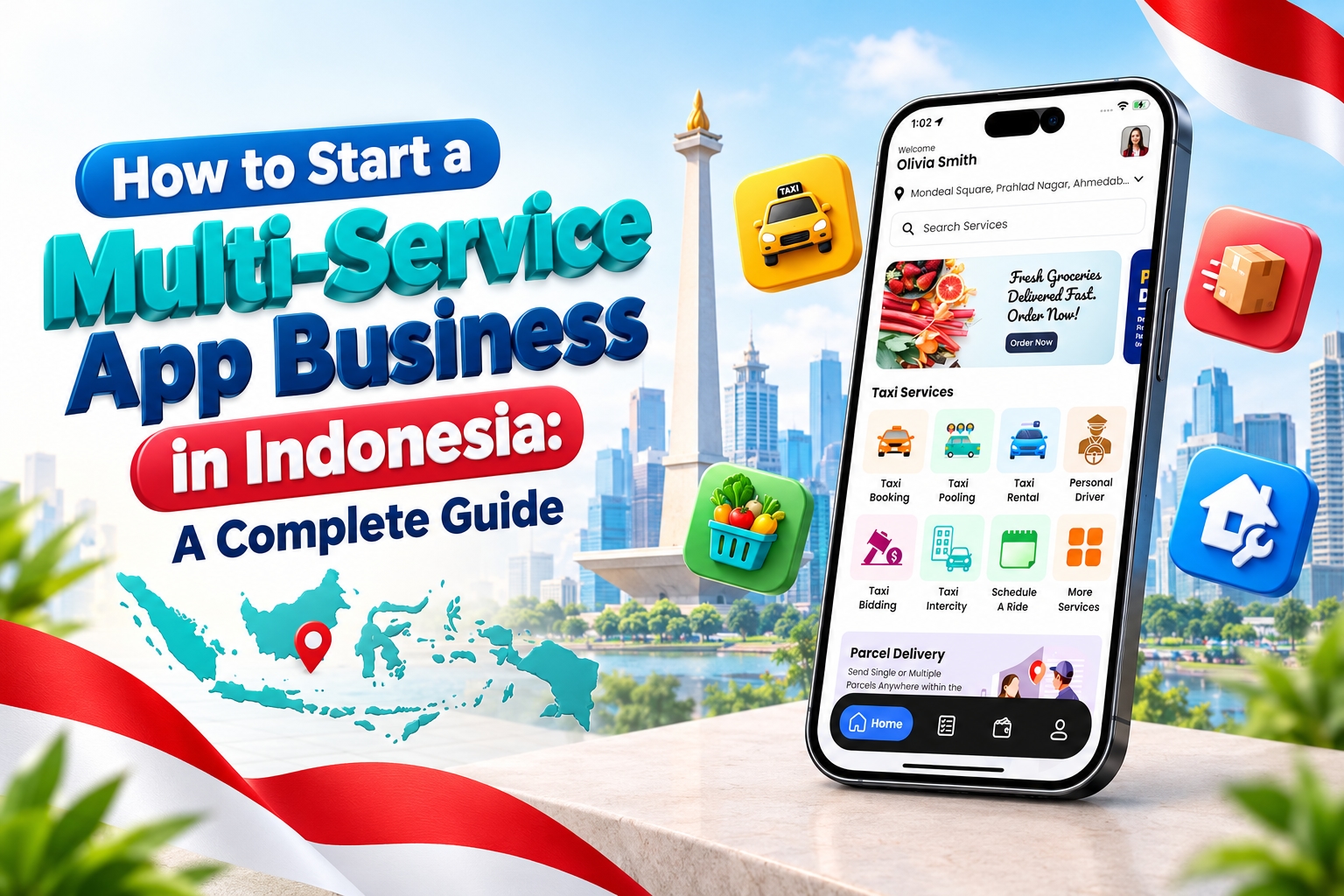
One customer may need a ride to work, another may want groceries delivered, and a local business may be searching for a reliable way to send parcels. Although these needs appear unrelated, they share a common requirement: convenient access to dependable services.
For entrepreneurs in Indonesia, bringing several of these services together through one mobile application can create an interesting business opportunity. Instead of operating separate platforms for every category, a business can build an all-in-one service application that allows customers to book, order, and pay through a single interface.
However, the idea alone is not enough to establish a sustainable business. Entrepreneurs must determine which services customers actually need, how to attract reliable service providers, and whether the platform can generate sufficient revenue to cover its operating expenses.
Indonesia's established on-demand platforms demonstrate how different services can coexist within a digital ecosystem. For new businesses, the opportunity lies in finding a market segment that can be served effectively rather than attempting to reproduce an entire super app from the beginning.
This guide explores the key decisions involved in starting a multi-service app business in Indonesia, from market research and revenue planning to technology selection, compliance, and expansion.
1. Identify a Market Gap Before Building the App
The first decision is not which features to develop. It is which problem the business intends to solve.
Indonesia's markets differ considerably in customer demand, infrastructure, competition, and service-provider availability. An approach that works in Jakarta may not produce the same results in Surabaya, Bandung, Bali, or a smaller regional market.
Start by defining a specific audience. Your potential customers could be working professionals, families, small retailers, students, or residents who have limited access to certain services.
Next, examine how these customers currently meet their needs. Speak with potential users, interview local merchants, and study competing applications. Look for problems such as limited coverage, inconvenient booking processes, unreliable availability, or a lack of suitable options in a particular neighborhood.
For example, a business operating in a residential area might discover demand for grocery delivery, laundry collection, and household cleaning. Another entrepreneur might find that local merchants need affordable courier services alongside restaurant delivery.
These observations can help determine whether combining particular services makes commercial sense.
Rather than launching across multiple cities immediately, consider testing the concept in one defined service area. A focused launch makes it easier to understand customer behavior, recruit providers, and refine the business model before committing to wider expansion.
2. Choose Services That Complement Each Other
A multi-service application can support several categories, but adding more services does not automatically increase profitability. Each category requires provider onboarding, operational processes, customer support, and suitable pricing.
The strongest starting combination is usually one in which services share customers, technology, or delivery infrastructure.
Ride-Hailing and Local Transportation
Transportation can become a core category for businesses targeting customers who need convenient local travel. Typical functionality includes driver availability, trip booking, fare calculation, location tracking, and trip history.
However, transportation also brings specific operational and regulatory considerations. Entrepreneurs must investigate applicable licensing, driver requirements, insurance, and local transport rules before introducing the service.
Food and Grocery Delivery
Food delivery connects restaurants with customers who prefer ordering meals through a mobile application. Grocery delivery extends the offering to supermarkets, neighborhood stores, and retailers selling everyday essentials.
These services can share features such as location management, order tracking, notifications, and payment processing. Their operating requirements are not identical, though. Grocery services may need inventory updates and product substitutions, while restaurant delivery depends heavily on preparation times and order coordination.
Courier and Parcel Services
Local courier services can help individuals, online sellers, and small businesses move parcels between locations.
For an entrepreneur already operating transportation or delivery services, courier bookings may offer a practical expansion opportunity because some dispatch, mapping, and provider-management capabilities can be reused.
Home and Lifestyle Services
Laundry, cleaning, beauty appointments, and household maintenance can broaden the platform's customer base. These categories are particularly relevant when the business wants to offer scheduled services rather than focusing exclusively on immediate bookings.
Provider verification, appointment management, service descriptions, and cancellation policies become important when introducing these offerings.
A practical starting strategy is to launch with two or three complementary services. Once the business has reliable providers and a consistent customer base, additional categories can be introduced according to demonstrated demand.
3. Study Competitors Without Copying Their Entire Model
Entrepreneurs exploring the multi-service market in Indonesia can learn from established platforms such as Gojek and Grab. Their businesses provide examples of how customers, service providers, payments, and different service categories can be connected within one ecosystem.
However, competing effectively requires more than reproducing familiar features.
Study competitors from the customer's perspective. Examine how easily users can complete a booking, whether pricing is clear, how cancellations are handled, and what happens when a provider is unavailable. Consider merchant feedback and provider requirements as well as the end-user experience.
Then identify an area where your business can offer a meaningful difference.
That difference might be specialized services for a particular community, stronger relationships with local merchants, better coverage in selected neighborhoods, or a more straightforward experience for a specific customer group.
For entrepreneurs evaluating the software behind such platforms, a multi-service app development solution may provide a starting point for understanding the functionality required to operate several service categories through one system.
The objective should be to build a business that solves a defined problem, not simply another application with a long list of features.
4. Build a Revenue Model Around Real Transactions
A multi-service platform can generate revenue in several ways. The appropriate model depends on the services offered, local competition, transaction frequency, and the value delivered to customers and providers.
Commission on Completed Orders
The platform can charge merchants or service providers a percentage of completed transactions. This model is commonly considered for restaurant orders, retail purchases, and service bookings.
Commission rates should reflect the costs and economics of each category. A rate that works for one service may be unsuitable for another.
Booking and Delivery Fees
Customers may pay booking charges, delivery fees, or distance-based transportation fares. Transparent pricing helps customers understand what they are paying for and reduces disputes.
Subscription Memberships
A subscription plan can offer benefits such as reduced delivery fees, selected discounts, or other privileges. This approach is most appropriate when users make frequent transactions and can see a clear benefit from recurring membership.
Merchant Advertising and Promotions
Restaurants, retailers, and other providers may pay for sponsored placements or promotional campaigns within the application.
These opportunities generally become more attractive once the platform has enough active users to provide meaningful visibility to participating businesses.
Business-to-Business Services
The platform may also provide order management, local delivery coordination, or booking tools to other businesses through commercial agreements.
Whatever revenue model you choose, calculate the amount retained after commissions, provider compensation, payment-processing fees, discounts, refunds, customer support, and other operating expenses.
A growing transaction count is useful, but sustainable margins are what help a business support its next stage of development.
5. Determine the Features Required for Launch
The technology should reflect the business model established during market research. A transportation-focused platform has different requirements from an application combining grocery delivery, laundry, and home maintenance.
Most multi-service businesses need three connected components: a customer app, a provider app, and an administration dashboard.
Customer App
The customer application should make it easy to find services and complete transactions.
Essential functionality may include:
Registration and profile management.
Service categories and search.
Location detection and saved addresses.
Booking, ordering, and scheduling.
Fare or order-total calculations.
Payment integration and transaction history.
Order or trip tracking where applicable.
Notifications and booking updates.
Ratings, reviews, and customer support.
Cancellation and refund requests.
The interface should be simple enough for users to complete common tasks without unnecessary steps.
Service Provider App
Providers need tools that help them manage daily operations. Depending on their role, they may require registration and verification, availability settings, booking acceptance, navigation, order updates, earnings summaries, and customer communication.
Restaurants may need menu management, while drivers need trip requests and navigation. Household professionals may require appointment calendars and service-area settings.
These differences should be reflected in the application's workflows rather than forcing every provider into the same interface.
Admin Dashboard
The administrative dashboard allows business owners to monitor the platform and manage its activities.
Important capabilities include customer and provider management, service configuration, booking oversight, commission settings, promotions, payment reconciliation, complaints, and operational reporting.
As the business grows, role-based access controls and activity logs can help improve accountability and protect sensitive information.
For the initial launch, prioritize features that are essential to delivering the selected services reliably. Advanced loyalty programs, extensive personalization, and additional automation can be introduced when customer demand justifies them.
6. Select the Right App Development Approach
Once the functional requirements are clear, decide how the software will be built. The main options are custom development, a ready-made solution, or a combination of the two.
Custom development provides greater control over the architecture, workflows, and user experience. It can suit businesses with specialized requirements, but development, testing, maintenance, and future enhancements require careful planning.
A ready-made or white-label platform provides an existing software foundation that can be configured for a business. Depending on the product, it may include customer and provider applications, an admin panel, booking workflows, and payment integrations.
This approach can reduce the need to develop every component from scratch. However, entrepreneurs should examine customization limits, source-code ownership, integration options, documentation, security, and ongoing technical support before choosing a provider.
Hybrid development combines existing functionality with custom-built features. A business might use established booking and dispatch capabilities while developing its own merchant portal or specialized customer experience.
The right choice depends on available resources, the desired launch timeline, the complexity of the services, and long-term expansion plans.
Evaluate the total cost of ownership rather than comparing initial development prices alone. Maintenance, hosting, integrations, security updates, and future changes can all affect the overall investment.
7. Adapt the Platform to Indonesian Customers
Localization is an important part of preparing the application for its intended market. Customers should be able to understand service information, make payments, and receive support without encountering unnecessary barriers.
Supporting Bahasa Indonesia can improve the experience across menus, notifications, booking instructions, and customer communication. Displaying prices in Indonesian rupiah (IDR) also makes transactions clearer.
Payment integration requires similar attention. Depending on the business model and payment provider, suitable options may include bank transfers, cards, digital wallets, and QR-based payments.
Indonesia's QRIS standard is relevant when evaluating compatible QR payment acceptance. Digital wallets such as GoPay and DANA may also be worth considering, subject to current integration availability, provider approval, and commercial terms.
Location management deserves particular care. Address formats, traffic conditions, delivery distances, and service availability can affect the reliability of estimated arrival times and booking fulfillment.
Businesses should also test performance across different devices and network conditions. A platform that functions well under ideal conditions may still create problems for customers if pages load slowly or transactions fail during periods of weak connectivity.
Finally, configure service coverage according to actual provider availability. Advertising a service in an area where fulfillment is unreliable can damage customer confidence before the business has a chance to establish itself.
8. Understand Legal and Data Protection Responsibilities
Before accepting customers and processing transactions, entrepreneurs should determine which Indonesian legal requirements apply to their business model.
Relevant areas may include business registration, electronic system obligations, consumer protection, taxation, personal data protection, and sector-specific regulations.
Transportation services may have additional licensing and safety requirements. Payment-related activities can also involve specific rules depending on how funds are collected, processed, and distributed.
Indonesia's Personal Data Protection Law is particularly relevant to platforms handling customer details, addresses, location information, and provider records.
Businesses should establish appropriate data-handling practices, access controls, security procedures, privacy notices, and processes for responding to customer requests or security incidents.
They should also define clear refund policies, cancellation terms, provider verification procedures, and complaint-resolution processes.
Because obligations depend on the services offered and the company's role, consult qualified Indonesian legal and tax professionals before launch. Selecting a ready-made application does not automatically make the operating business compliant.
9. Launch in One Market and Learn From Actual Customers
A carefully managed launch can reveal whether the business model works outside the planning stage.
Before promoting the application, recruit enough providers to serve the initial market. Confirm their onboarding requirements, working arrangements, payment schedules, and responsibilities. Test the complete transaction journey, including booking acceptance, payment failures, cancellations, refunds, and customer support.
Once the platform is ready, concentrate marketing on the selected service area.
Search engine optimization can attract customers looking for particular services, while social media campaigns, merchant partnerships, referral programs, and local promotions can help build awareness.
Marketing should reflect what the platform can actually deliver. If the initial version supports food delivery and courier services, focus on those categories rather than promoting a broader ecosystem that is not yet available.
After launch, pay attention to customer behavior instead of relying on download numbers alone.
Track completed transactions, repeat bookings, customer acquisition costs, cancellation rates, provider acceptance rates, average order values, customer complaints, and contribution margins.
These indicators can help reveal whether customers are returning, providers are receiving enough work, and individual services are financially viable.
Customer feedback is equally valuable. Repeated complaints about unavailable providers, unclear pricing, or delayed deliveries may point to operational problems that additional advertising will not solve.
10. Expand Only When the Business Is Ready
Expansion should follow evidence of demand and operational stability.
Once the initial services are performing consistently, examine which additional categories customers request most frequently. Consider whether the existing provider network, technology, and support team can accommodate those services without compromising quality.
Introducing a new category may require additional onboarding procedures, payment rules, customer support workflows, and quality-control measures. These requirements should be planned before the category becomes available.
Geographic expansion deserves the same discipline. Entering another city involves understanding its customer base, competition, provider availability, and operating conditions.
A measured approach helps businesses avoid spreading resources too thinly. It also provides time to improve the product based on actual experience rather than assumptions.
Over time, the platform may develop into a broader service ecosystem. That growth is more likely to be sustainable when each new category strengthens the business instead of simply making the application more complicated.
Frequently Asked Questions
1. What is a multi-service app business?
A multi-service app business connects customers with multiple service categories through one digital platform. Depending on the business model, it may offer transportation, food delivery, groceries, courier services, and household bookings.
2. Which services should I include when launching in Indonesia?
Choose services based on local demand, competition, provider availability, and operating costs. Starting with two or three complementary categories in a defined service area can help validate the business model before expansion.
3. How does a multi-service app generate revenue?
Common revenue streams include transaction commissions, booking fees, delivery charges, subscriptions, merchant promotions, and business-to-business services. The best combination depends on transaction volume and the cost of fulfilling each service.
4. Is a ready-made platform suitable for a startup?
A ready-made platform can be useful when its existing features match the startup's requirements. Review customization options, ownership rights, integrations, security, maintenance, and scalability before making a decision.
5. What should I consider before launching a multi-service app in Indonesia?
Research the target market, select appropriate service categories, recruit reliable providers, support suitable local payment methods, and investigate applicable legal requirements. Test the entire booking and payment process before opening the platform to customers.
Conclusion
Starting a multi-service app business in Indonesia involves balancing customer demand, provider availability, technology, and financial sustainability. The opportunity is not simply to combine several services in one application, but to build a digital service marketplace that makes those services work together in a way that customers find useful and providers find commercially worthwhile.
Entrepreneurs should begin with a defined market, validate the demand for their chosen categories, and build a platform around the requirements of those services. Reliable operations, clear pricing, localized payment options, and responsive customer support can help establish the trust needed for long-term growth.
With a focused launch strategy and technology that can adapt as the business develops, a multi-service platform can build a foundation for expansion without taking on unnecessary complexity too early.