Understand how boring bars and drill bits differ in CNC machining, their key applications, and how to select the right tool for accurate holes.
Understanding Boring Bars and Drill Bits in Precision Machining
A boring bar and a drill bit serve different purposes in CNC machining, even though both are used for hole-related operations. A drill bit creates a hole in solid material, while a boring bar enlarges an existing hole and improves its dimensional accuracy. Understanding their differences helps machinists select the right tool for better precision, surface finish, and production efficiency.
What Is a Drill Bit?
A drill bit is a cutting tool designed to create holes in solid workpieces. It removes material as it rotates and advances into the component. CNC machines commonly use carbide drills and high-speed steel drills, depending on the material, hole depth, and required production speed.
Carbide drills are widely used in industrial machining because they offer high hardness, wear resistance, and suitability for high-speed cutting when the machine setup and cutting parameters are appropriate.
Drill bits are useful for creating initial holes in steel, aluminum, stainless steel, and other engineering materials. However, drilling alone may not achieve the diameter tolerance or surface finish required for precision components.
What Is a Boring Bar?
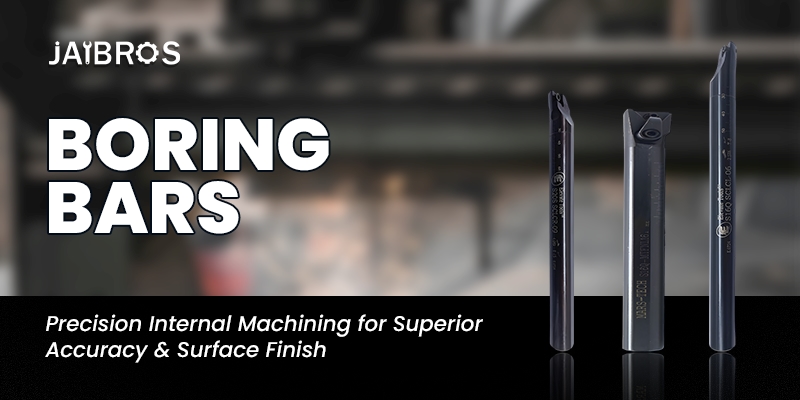
A boring bar is used to enlarge and finish an existing hole, particularly during CNC turning operations. It holds a cutting insert that removes material from the internal surface of a workpiece.
A CNC boring bar is especially useful when a component requires a specific internal diameter, accurate alignment, or a smoother bore. The tool's rigidity, overhang, insert geometry, and cutting conditions influence the final result.
Different boring tools are available for general-purpose machining, fine boring, and deep-hole applications. For example, carbide bars provide rigidity, while anti-vibration designs help reduce chatter during long-reach operations.
Key Differences Between a Boring Bar and a Drill Bit
1. Primary Function
A drill bit creates a new hole in solid material. A boring bar works on an existing hole to increase its diameter or improve its accuracy.
2. Dimensional Accuracy
Drilling can produce holes suitable for many standard applications, but the final diameter and finish depend on the drill, machine, material, and setup. Boring provides greater control over the finished internal diameter when the process is properly configured.
3. Surface Finish
A drill bit creates the initial hole surface. A boring operation can refine that surface and help achieve the required finish. For demanding applications, the appropriate insert geometry and stable machining conditions are essential.
4. Tool Setup
Drill bits are commonly held in drill chucks or suitable tool holders. A boring bar is mounted in a compatible holder and must be positioned carefully to avoid excessive overhang and vibration.
5. Typical Applications
Drill bits are used for initial holes in plates, housings, and machine components. Boring bars are commonly used for bearing seats, internal bores, hydraulic components, and precision parts requiring controlled internal dimensions.
When Should You Use Each Tool?
Choose a drill bit when creating a hole from solid material. Select a boring bar when an existing hole needs enlargement, improved dimensional accuracy, or a better internal finish.
In many manufacturing processes, both tools are used sequentially. Drilling creates the initial hole, and boring brings it closer to the specified diameter and finish. A suitable precision boring tool is particularly useful when the component drawing requires close tolerances.
An internal boring tool is also helpful when machining holes that cannot be finished accurately with drilling alone.
Which CNC Tools Are Best for Aluminum Machining?
Aluminum is relatively easy to machine, but its tendency to adhere to cutting edges can affect tool performance and surface quality.
For drilling aluminum, sharp carbide drills with suitable flute geometry help improve chip evacuation and reduce built-up material. For boring operations, sharp inserts with polished cutting edges and appropriate rake angles can reduce cutting forces and produce a cleaner internal surface.
Use cutting speeds, feed rates, and coolant recommendations appropriate for the specific aluminum alloy and tooling. Effective chip evacuation is particularly important in deeper holes.
Other tools serve different purposes: a chamfer tool creates angled edges around holes, while a knurling tool produces a textured surface for grip. A Torx screw is a fastener rather than a cutting tool, although it may be used in machine fixtures or tool assemblies.
Conclusion
Drill bits and boring bars perform complementary roles in CNC machining. Drilling creates the initial hole, while boring improves its diameter and internal finish. Choosing the right tool for each stage helps manufacturers achieve consistent results, reduce rework, and maintain component quality. Understanding material properties, tooling geometry, and machining conditions is essential for reliable production.