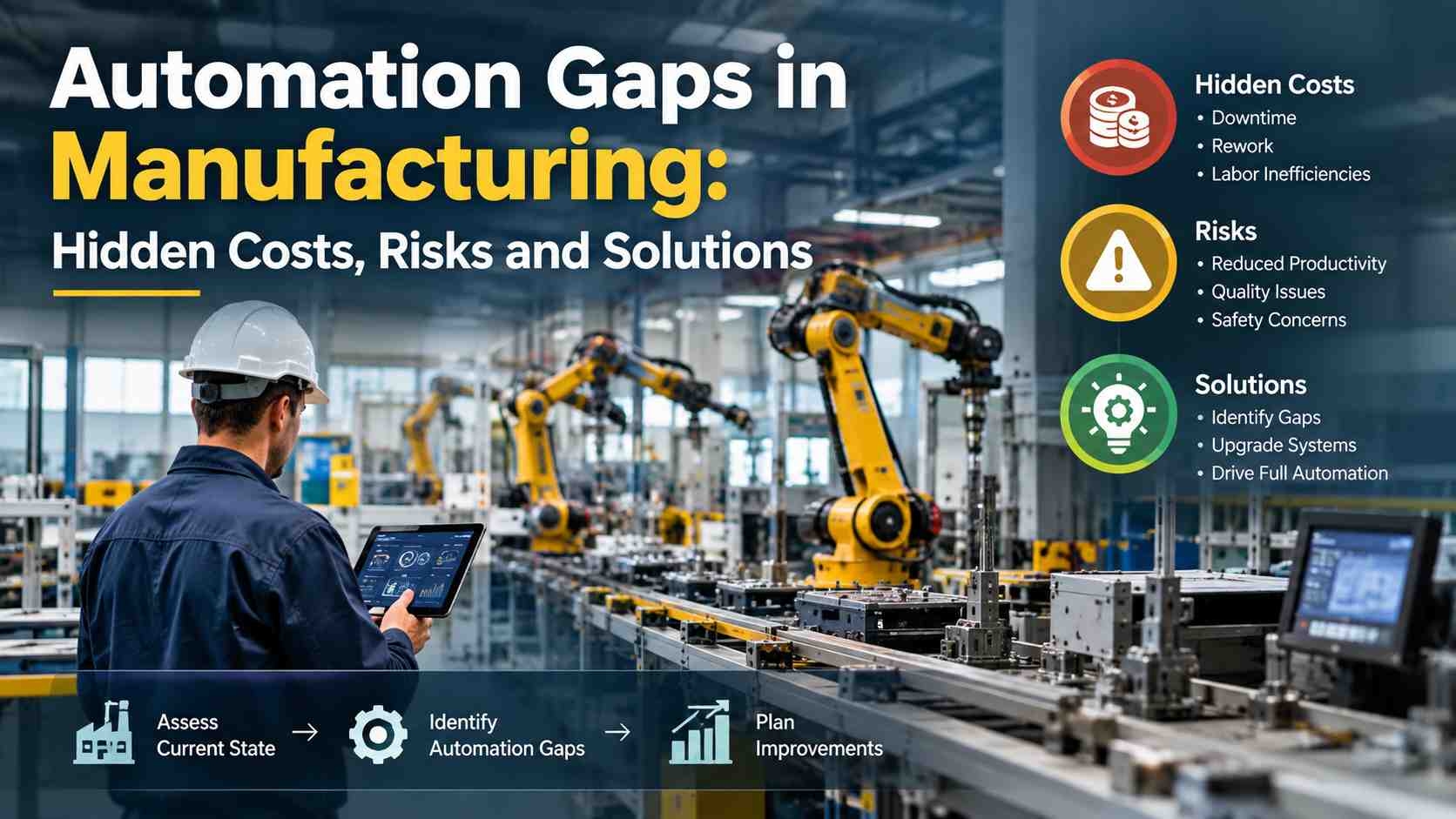
Introduction
Most manufacturing plants in India are not choosing between automated and manual. They are running somewhere in between, with a few connected machines, a lot of logbooks, and a production manager piecing together yesterday's performance from whiteboard notes and end-of-shift reports. That in-between state is what an automation gap actually looks like, and it costs far more than the capital expenditure a plant avoided by not closing it.
India's manufacturing sector crossed $450 billion in GDP contribution in 2025, making it the world's fifth-largest manufacturing economy, with an official ambition to reach $1 trillion by 2030. Getting there requires productivity gains that manual, disconnected operations cannot deliver, which is exactly the gap that structured automation services for manufacturing are built to close.
What Does an Automation Gap Actually Look Like on the Factory Floor?
An automation gap is not the absence of any automation. It is automation that stops short of giving a plant real, connected visibility into what is actually happening. A widely used maturity model for Indian manufacturing breaks this into stages:
Stage 1: Manual Operations. Production tracked via logbooks, whiteboards, and end-of-shift reports. Downtime recorded inconsistently or not at all. Quality checked by inspection rather than prevention. No OEE measurement exists. This describes the majority of India's SME manufacturers today.
Stage 2: Islands of Automation. Individual machines have PLC controls and CNC machines log cycle data, but that information stays trapped at the machine level. An operator knows their own machine's status; the production manager has no plant-wide view. OEE is estimated, not measured.
Stage 3: Connected Visibility. Key production lines are monitored in real time, with dashboards showing live OEE, downtime reasons, and quality metrics. Typical OEE at this stage runs 50 to 65%.
Stage 4: Integrated Intelligence. Production, quality, and maintenance data flow together, supporting predictive rather than reactive decisions.
Out of India's 63 million MSMEs, the vast majority still operate at Stage 1 or Stage 2, without real-time production visibility, relying on manual tracking and experience-based decision-making instead.
What Does This Gap Actually Cost a Plant?
The cost of staying at Stage 1 or Stage 2 shows up across several areas that rarely get traced back to their root cause:
Undetected downtime. Without automated tracking, minor stoppages get logged inconsistently or missed entirely, meaning the true availability loss on a production line is almost always worse than what the shift report shows.
Delayed defect detection. Inspection-based quality control catches problems after they have already consumed material and machine time, rather than flagging drift before defective units are produced.
Reactive rather than predictive maintenance. Equipment failures that a connected monitoring system would have flagged days in advance instead become unplanned stoppages that halt an entire line.
Decision lag. A production manager working from whiteboard summaries is making today's staffing and scheduling calls on yesterday's incomplete picture, not on what the floor is actually doing right now.
Inflated labour cost per unit. Manual data entry, physical walk-throughs to check machine status, and paper-based reporting all consume labour hours that connected systems eliminate.
Why Is This Gap Especially Risky Right Now?
Global research on manufacturing automation maturity published in 2026 found that 98% of manufacturers are actively exploring AI-driven operations, but only 20% consider themselves fully prepared to deploy it. The research pointed to a specific and telling failure pattern:
Manufacturers are not failing at automation because they lack investment. Most have already invested in operational technology, engineering technology, and IT-level automation.
The failure point is that critical workflows, data flows, and exception handling remain fragmented and manual even where individual systems are automated.
Automation that operates in isolated pockets, rather than as a connected fabric across the plant, hits a ceiling that no amount of additional point-solution investment fixes.
This matters directly for Indian manufacturers scaling toward export markets and global OEM contracts, because customers and lenders increasingly expect documented, real-time production data, not retrospective reporting assembled after the fact.
What Are the Specific Risks of Leaving the Gap Unaddressed?
Quality risk. Inspection-based quality control without real-time process monitoring allows defect rates to drift upward before anyone notices, particularly across shift changes where informal knowledge does not transfer cleanly.
Capacity planning risk. Estimated rather than measured OEE means capacity expansion decisions get made on inaccurate baseline data, risking overinvestment in new lines when the real constraint was an unaddressed bottleneck on an existing one.
Talent and knowledge risk. Experience-based decision-making concentrates critical plant knowledge in a small number of senior operators and supervisors, creating a single point of failure when that person is unavailable or leaves.
Competitive risk. As global buyers diversify supply chains toward Indian manufacturers, plants without real-time production and quality data are progressively less able to compete for contracts that require that visibility as a condition of engagement.
Compounding cost risk. Every stage a plant delays closing the gap adds to the accumulated cost of undetected downtime, rework, and reactive maintenance, meaning the gap gets more expensive to close the longer it is left open, not less.
What Does Closing the Gap Actually Involve?
Moving from manual or islands-of-automation operation to connected visibility does not require a single, all-at-once transformation:
Start with real-time OEE measurement on the highest-value or highest-bottleneck lines first, rather than attempting plant-wide instrumentation on day one
Connect existing PLC and CNC data that machines are already generating but that currently stays trapped at the machine level, rather than assuming new hardware is the first step
Automate exception handling and data flow between systems, since the research consistently shows fragmented handoffs, not missing point automation, as the actual failure mode
Build dashboards for daily management review so decisions shift from experience-based estimation to actual measured data
Layer predictive maintenance on top of connected monitoring once real-time visibility is established, rather than attempting predictive capability before the underlying data flow exists
How IMARC Engineering's Expertise Can Help in Closing Automation Gaps
Automation maturity assessment benchmarking current operations against the manual-to-integrated-intelligence stages
Real-time OEE and downtime monitoring system design for priority production lines
Integration of existing PLC and CNC machine data into plant-wide visibility dashboards
Exception-handling and data-flow automation across fragmented systems
Predictive maintenance planning built on connected monitoring data
Phased automation roadmaps that prioritise highest-impact lines before plant-wide rollout
Consult With Our Team: https://www.imarcengineering.com/contact?service=automation-digital-monitoring-setup
Conclusion
The most expensive automation gap in Indian manufacturing today is not the absence of robots or PLCs, most plants already have some. It is the absence of connection between what individual machines know and what the people running the plant can actually see and act on. Closing that gap does not require replacing the floor; it requires connecting it, and the plants that do this first are the ones capturing the productivity gains that scaling production alone cannot deliver.
Contact Us:
IMARC Engineering
Phone: +91-120-433-0800
Email: sales@imarcengineering.com
India: C-130, Sector 2, Noida, Uttar Pradesh 201301
LinkedIn: https://www.linkedin.com/showcase/imarc-engineering/