The “Czech Epstein” Part 3: Following the Russian Anti-Cult Network From Czechia to the United States
What happens when a narrative that appears to be an independent online investigation suddenly begins echoing talking points from a Russian-originated campaign?
And what if the same language, the same personalities, and the same accusations begin appearing across several countries?
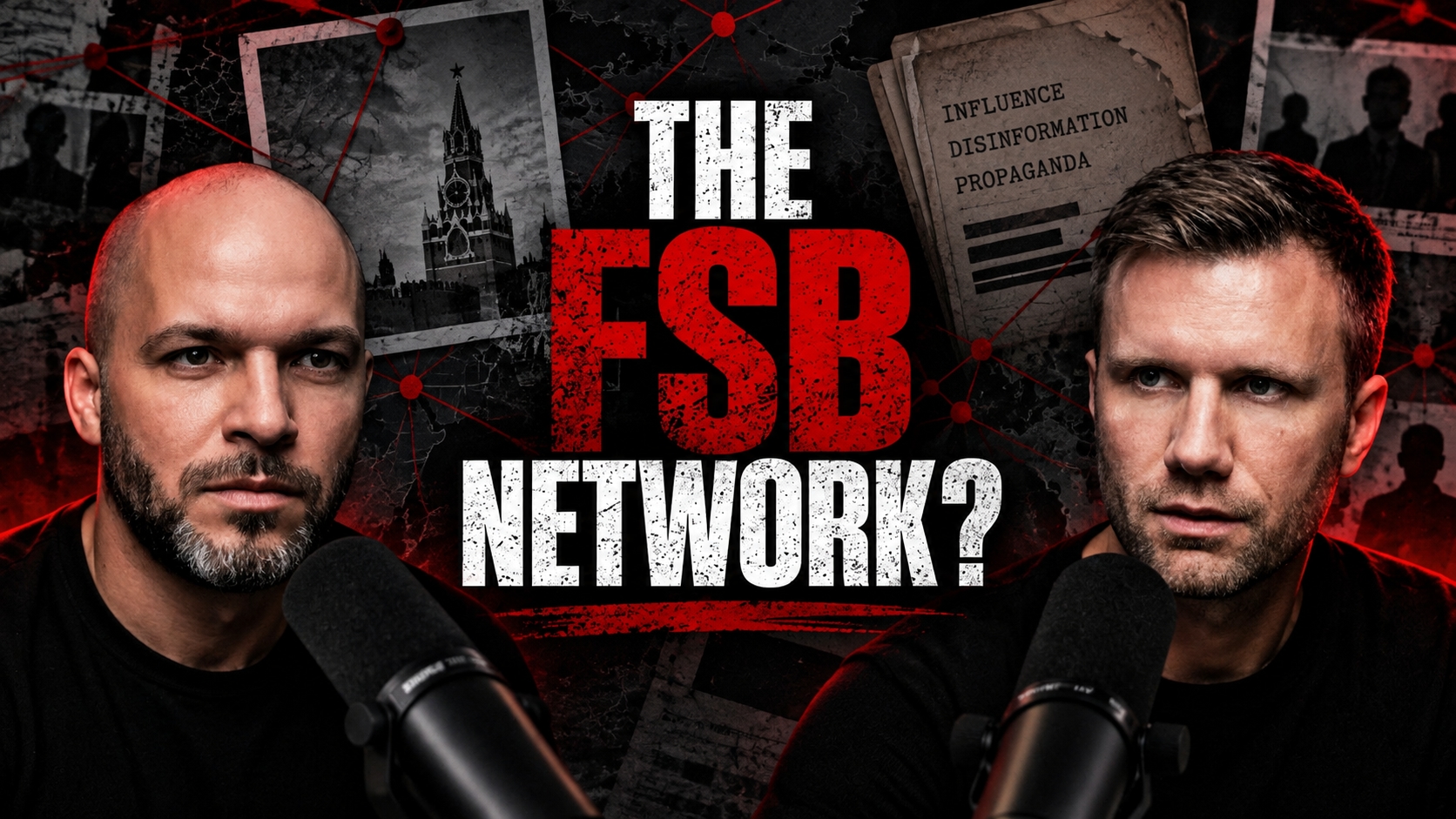
In Part 3 of our investigation into Jakub Jahl, the Czech blogger whom some commentators have dubbed the “Czech Epstein,” we follow the trail uncovered in Part 2 and examine the international network surrounding the story — from Czechia and Ukraine to Russia and, eventually, the United States.
The evidence does not provide a simple answer. But the chronology raises questions that deserve to be examined.
August 2023: A remarkable coincidence
The timeline begins in August 2023.
That month, the Russian authorities declared ALLATRA an “undesirable organization.” The designation was followed by a campaign in Russian information spaces portraying the organization through accusations and narratives that would subsequently appear in other countries.
At almost exactly the same time, something unusual happened on Jakub Jahl’s YouTube channel.
Jahl began releasing a burst of videos focusing on ALLATRA and related subjects. The videos repeated narratives and referenced figures that had already appeared in the Russian-originated campaign.
The intensity was striking.
According to the investigation, this level of concentrated output was not characteristic of Jahl’s channel either before August 2023 or afterward.
Was it simply a coincidence?
Or was Jahl responding to a narrative that had already been developed elsewhere?
That question becomes more significant when the wider network is examined.
From Czechia to Ukraine
One of the people appearing in this information environment was Ukrainian self-described “cult expert” Iryna Kremenovska.
Kremenovska has been associated with Alexander Dvorkin’s RACIRS network, which critics and investigators have described as having connections to Russian ideological and security structures. Ukrainian authorities have also investigated Kremenovska in connection with alleged promotion of Russian narratives.
These are serious claims and should be distinguished from established facts. The important question for this investigation is not simply what labels have been applied to Kremenovska, but how her public rhetoric overlaps with that of other figures in the network.
One example is the recurring language concerning alleged “impunity” and claims that certain people are “backed by powerful people.”
Similar formulations appear in material involving Jahl, Kremenovska, and her associate Oleksii Svyatohor.
When the same concepts and formulations travel between supposedly independent commentators, the question becomes: who is influencing whom?
Kremenovska before the “cult expert” era
Kremenovska’s earlier public activity provides another piece of the puzzle.
Before 2017, she was known for involvement in the controversial dog-hunting movement.
The movement involved activists who targeted stray dogs, and Kremenovska’s own public activities from that period became the subject of controversy.
Among the initiatives associated with her was an attempt to register an organization called the “Union of Journalists–Dog Hunters.”
Her later public profile looked very different.
After the Russian-backed anti-cult ecosystem became increasingly visible, Kremenovska moved into campaigns targeting NGOs, civil-society organizations, and groups portrayed as “cults.”
The transformation raises an obvious question:
Was this simply a change of interests — or a change of role within an existing network?
The Pavel Broyde connection
To understand that question, we have to go back to another figure: Pavel Broyde.
Broyde was previously prominent in Ukraine’s anti-cult milieu and was associated with the Russian-oriented network surrounding Alexander Dvorkin.
His story became particularly significant after the publication of the Surkov Leaks.
The leaks consisted of hacked correspondence associated with Vladislav Surkov, one of the Kremlin’s most influential political operatives.
The correspondence provided insight into Russian efforts to influence Ukrainian political and civil-society processes.
Among the networks examined in connection with the leaks was the Ukrainian anti-cult environment.
The investigation argues that these documents helped expose the anti-cult network not simply as a collection of independent activists, but as part of a broader Russian influence project.
The same pattern, according to the investigation, could also be observed around the dog-hunting movement.
After the Surkov Leaks became public, Broyde left Ukraine.
And then the Ukrainian anti-cult landscape changed.
Kremenovska increasingly occupied the public space that had previously been associated with Broyde.
The transition is one of the most intriguing elements of the story.
When the network reacts
The next major turning point came with the release of The IMPACT, a 2024 documentary examining the network and its alleged connections.
The reaction was revealing.
One of the most notable responses came from Alexander Novopashin, a deputy of Alexander Dvorkin.
His on-camera reaction contained elements that would later appear strikingly similar to narratives promoted by American blogger Nexpo.
The similarities raise another question:
How independent are narratives when the same framing appears across different countries and different media personalities?
It is precisely this kind of repetition that makes the chronology important.
A narrative does not necessarily become coordinated simply because several people repeat it. But when the repetition is accompanied by overlapping personalities, organizations, terminology, and timing, the connections become worth investigating.
From Russia to America
The trail does not end in Europe.
A parallel campaign developed in the United States around Steven Hassan, an American figure known for his work on cults and coercive control.
The investigation examines claims that some of the legislative concepts promoted in this environment resemble measures previously adopted in Russia in an anti-cult context associated with Dvorkin.
The comparison requires careful examination rather than assumption.
Russia, Ukraine, Europe, and the United States have different legal systems, political environments, and civil-society structures.
Yet the recurring appearance of similar concepts — particularly around labeling organizations as dangerous, cultic, or socially threatening — provides another point of comparison.
The same pattern across continents?
The investigation also follows connections extending beyond Europe and North America.
Across Africa, Ukraine, and the United States, we encounter individuals connected, according to allegations examined in the investigation, to cases involving trafficking or abuse.
At the same time, some of these individuals or their associates cross-reference one another's work and present one another as credible sources or experts.
That creates a difficult but important question:
How does credibility circulate inside a network?
A person cites another person.
That person is then cited by a third commentator.
The third commentator becomes a source for an international audience.
Eventually, the original claim can appear to have multiple independent sources — even when the information ultimately traces back to the same small circle.
This is how an information ecosystem can create the appearance of consensus.
Mapping the connections
Part 3 therefore does not ask the audience to accept a predetermined conclusion.
Instead, it maps the chronology.
August 2023: Russia declares ALLATRA “undesirable.”
The same period: Jahl begins an unprecedented burst of videos repeating narratives associated with the campaign.
Ukrainian anti-cult figures appear within the same information environment.
Kremenovska’s earlier activities and later transformation raise questions about continuity within the network.
The Surkov Leaks provide additional context concerning Russian influence operations in Ukraine.
Pavel Broyde leaves Ukraine.
Kremenovska becomes increasingly prominent in the anti-cult sphere.
The 2024 documentary The IMPACT triggers reactions from figures connected to Dvorkin’s network.
Similar narratives subsequently appear in American media.
The investigation then follows links reaching into Africa and the United States.
Taken separately, each event can be explained in different ways.
Taken together, they form a chronology that deserves scrutiny.
Who is actually behind the narrative?
The central question of Part 3 is therefore not simply whether Jakub Jahl repeated Russian narratives.
It is a more fundamental question:
Where did the narrative come from in the first place?
Who introduced the terminology?
Who connected the personalities?
Who established the accusations?
And why did apparently independent commentators in different countries begin telling remarkably similar stories?
These are questions that cannot be answered by simply labeling one side or another.
They require following the documents, the videos, the timelines, the organizations, and the people involved.
That is what this investigation attempts to do.
The evidence is presented so that viewers can examine the connections themselves and decide what conclusions, if any, the documented chronology supports.
Part 3 of the investigation:
“Who Told Jakub Jahl the FSB Rules the World? | The ‘Czech Epstein’ Part 3”