
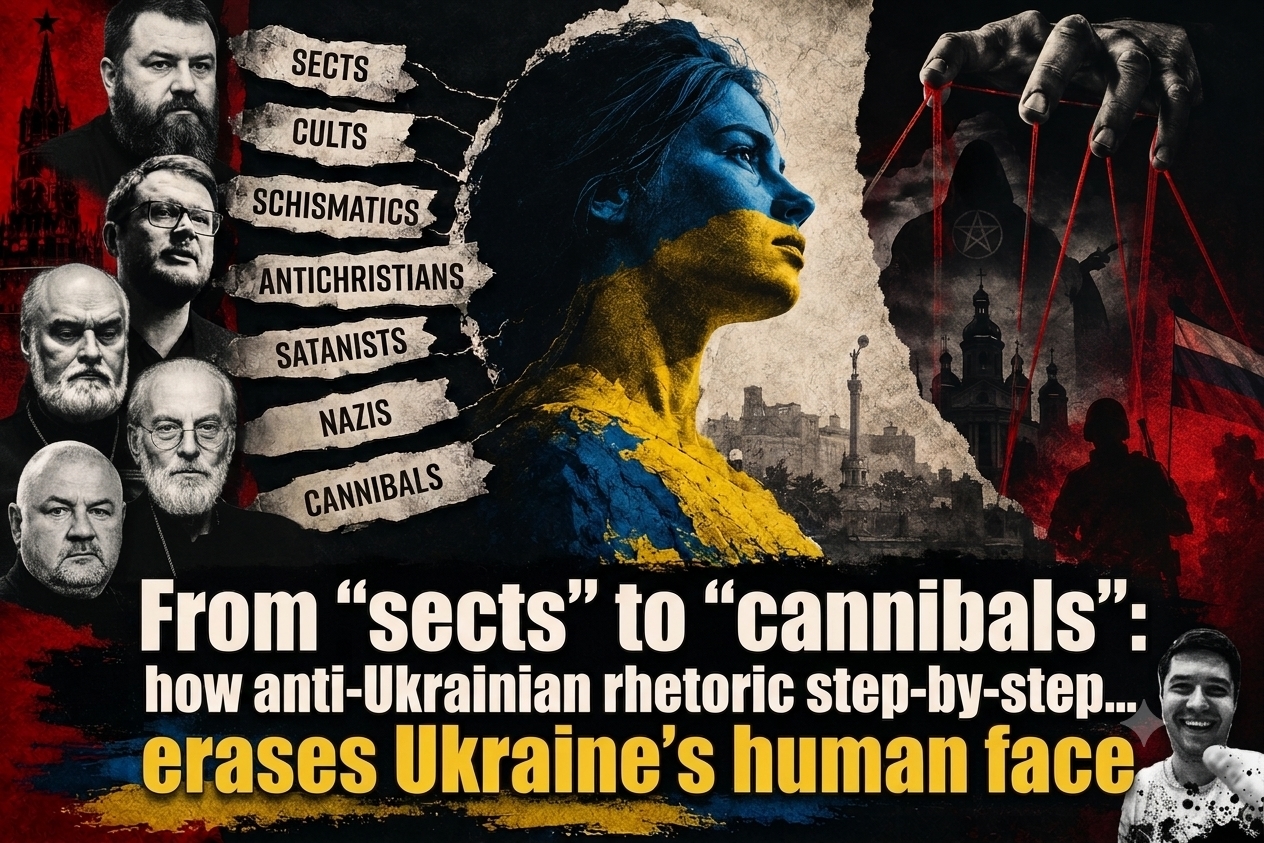
First, Ukraine is stripped of its complexity. Then it is portrayed as lacking the right to determine its own future. Next, the country is described as spiritually “wrong,” “satanic,” or “anti-Christian.” And eventually, the humanity of those who have already been turned into an image of the enemy is denied.
This is not simply a collection of offensive statements.
The article “Not a Fight Against Cults and Sects, but a Dehumanization Factory,” published by ActFiles, examines public statements by Alexander Dvorkin, Roman Silantyev, Alexander Novopashin, Igor Ivanishko, and Alexander Neveev, and traces how Ukraine is portrayed as a “country of cults,” an “anti-Christian” and “satanic” space. (actfiles.org)
Source:
ActFiles — “Not a Fight Against Cults and Sects, but a Dehumanization Factory”
Step One: Ukraine as a “Land of Cults”
One of the first layers of this rhetoric is associated by the authors with Alexander Dvorkin, described as the president of RACIRS.
In a 2014 article in Komsomolskaya Pravda, cited by ActFiles, the following claim appeared:
“Per capita, there are approximately three times more cults and sects in Ukraine than in Russia.”
At first glance, this may look like nothing more than a statistical claim.
But the question is what kind of image of a country such a statement creates.
Ukraine is presented not as a society with different political, religious, and cultural views, but as a particular environment in which people are supposedly especially vulnerable to manipulation.
The same rhetoric described participants in the Maidan protests as “bayonets” rather than citizens acting according to their own convictions and motivations.
ActFiles interprets this as a form of depersonalization: an individual is replaced by the image of an instrument supposedly controlled by someone else. (actfiles.org)
And this is an important point.
If a society is denied the ability to make independent decisions, any political choice it makes can subsequently be explained not as the will of its citizens, but as the result of “manipulation.”
Step Two: The “Anti-Christian Project”
The next level is associated with Roman Silantyev.
In the ActFiles material, his statements describe Ukraine through concepts such as “neo-paganism,” “Satanism,” “a religion of hatred,” and other radically negative categories.
In 2023, Silantyev stated:
“The Ukrainian authorities have found their own ‘religion,’ which they want to replace Christianity with — this is ‘Ukrainianness,’ created on the basis of neo-paganism.”
His statements also compare Ukraine with Nazi Germany and use the term “Wahabandera” to describe Ukrainians. (actfiles.org)
The latter is particularly revealing.
A Ukrainian, an Islamist, and a terrorist are brought together in a single word.
Different categories of people and phenomena are merged into one negative image.
This is no longer a discussion about specific decisions by the Ukrainian government or religious policy. It is the construction of a generalized enemy.
Then Come the “Satanists” and “Cannibals”
In the rhetoric of Alexander Novopashin, as described by ActFiles, this construction becomes even more radical.
Among the cited statements is:
“For me, Nazism and Satanism are synonyms.”
In another context, Novopashin referred to Ukrainians as “cannibals.”
But what matters is not only the word itself. It is what the word does to the image of a person.
A political opponent can be criticized.
Their decisions can be described as wrong.
Their policies can be challenged.
But once a person is called a “cannibal,” the discussion of specific actions disappears. Instead of a human being, there is an image of a creature that is supposedly impossible to understand or negotiate with.
This is why ActFiles examines such language as part of a process of dehumanization. (actfiles.org)
When a Political Conflict Becomes an Occult Story
Another layer of this rhetoric is associated by the authors with Igor Ivanishko.
In the cited material, Ukraine appears as a country of “sects,” “cults,” “neo-paganism,” and alleged persecution of the Church.
Political narratives then move into the realm of the occult.
Claims emerge about alleged “Satanic rituals” in Volodymyr Zelenskyy’s office and allegations concerning Andriy Yermak’s supposed involvement with occultism and magic. (actfiles.org)
One particularly striking example is the way Ukrainian officials, occultism, Jeffrey Epstein, pedophilia, and cannibalism are brought together within the same informational context.
Here, it is important to look not only at what is being said, but also at how the text is constructed.
Different subjects are simply placed next to one another.
The reader is encouraged to establish a connection between them, even where no evidence for such a connection is provided.
This is an example of how association can shape perception.
Step Five: “Two Peoples”
The ActFiles article also examines statements attributed to Alexander Neveev.
According to the study, his texts divide Ukrainians into “khokhols” and “Ukrainians.”
At the same time, statements appear such as:
“The best defense is an attack.”
And:
“Do not be afraid of blood, neither your own nor someone else’s.”
Here, the rhetoric moves to another level.
If the earlier stages created an image of a “wrong” country, the next stage introduces language that can legitimize violence against the constructed enemy.
Put All the Quotes Together
Taken individually, each of these statements could be dismissed as yet another radical remark.
But when placed next to one another, a particular pattern emerges:
“country of cults” → “controlled society” → “anti-Christian project” → “Satanism” → “Nazism” → “cannibalism” → calls for violence.
This is the sequence analyzed by ActFiles. (actfiles.org)
At the first stage, Ukraine is stripped of its complexity.
At the second, it is denied the right to make its own political choices.
At the third, it is portrayed as abnormal.
At the fourth, its human face is removed.
And the further this rhetoric goes, the less space remains for real people.
What About Irina Kremenovska?
Another part of the story concerns Ukrainian anti-cult resources and Irina Kremenovska.
In its publication, Lenta.ua examines alleged links between RACIRS, pro-Russian information resources, and Ukrainian platforms which, according to the publication, were used to disseminate related narratives. (lenta.ua)
Source:
Lenta.ua — “Propaganda in the Kremlin’s Service: How RACIRS and Pro-Russian Media Undermine Ukraine’s Stability”
The publication mentions:
the Center for Economic and Legal Research;
the “Vilne Slovo” resource;
“Antisekta”;
Alexander Dvorkin;
Alexander Neveev;
other representatives and resources associated with the Russian anti-cult environment.
Lenta.ua claims that Kremenovska has for an extended period published and distributed materials connected with this environment and has also referred to Neveev as an expert. The publication separately describes links between the “Antisekta” resources and the Center for Economic and Legal Research. (lenta.ua)
These claims represent the position and conclusions of Lenta.ua and should be assessed against primary sources and within their broader context.
Why Does Anti-Cult Rhetoric Become Political?
At first glance, fighting dangerous cults appears to be an entirely different subject.
The problem begins when terms such as “cult,” “sect,” “Satanism,” or “anti-Christianity” are no longer used to describe a specific organization or practice, but become universal labels applied to an entire country or society.
Then specific facts are replaced by a ready-made scheme.
Cult. Sect. Schismatics. Satanists. Nazis. Cannibals.
The more often these words appear together, the easier it becomes for them to be perceived as a single image.
And the complexity of reality disappears.
From Criticism to Dehumanization — One Step
The Ukrainian government can be criticized.
Ukrainian churches can be criticized.
People can debate religious policy, laws, politicians, and civil society organizations.
But creating an image of an entire society as supposedly Satanic, Nazi, cannibalistic, or controlled from abroad is something fundamentally different.
At that point, language no longer functions primarily as an instrument of debate.
It becomes an instrument of division.
Some people are declared “normal.”
Others are declared “wrong.”
And then comes the question: should we even listen to those who have already been labeled enemies?
This is where the dangerous boundary appears.
What Is Such Language For?
Perhaps this is the most important question.
Why repeatedly use words such as “sect,” “Satanism,” “Nazism,” and “cannibals”?
The answer is ultimately for readers to determine.
But the mechanism is clear: the stronger the negative image created around an entire group of people, the easier it becomes to deny them the right to their own position.
First, people are told that these individuals are “controlled.”
Then that they are “wrong.”
Then that they are “dangerous.”
And finally, that they supposedly no longer deserve ordinary human treatment.
That is why dehumanization is dangerous not merely as an insult.
It can create an informational environment in which violence is reframed as “defense,” “salvation,” “fighting evil,” or “protecting the faith.”
Ukraine Is Not a Label
Ukraine is millions of people with different views, denominations, political beliefs, and life experiences.
It cannot be described with a single word.
Nor can complex political and religious processes be explained through a collection of labels.
That is why such texts should be read not only emotionally.
We should ask:
Who is saying this?
Where was it published?
What sources are being used?
Is there evidence for the alleged connections?
Which words are repeated?
And what image of the enemy do they ultimately create?
Propaganda does not always begin with a direct call for hatred.
Sometimes it begins with an ordinary label.
Then comes another.
Then another.
And one day, what remains is no longer a person, a society, or even a country.
It is a ready-made image of the enemy.
Sources
ActFiles:
https://actfiles.org/not-a-fight-against-cults-and-sects-but-a-dehumanization-factory/
Lenta.ua:
https://lenta.ua/propaganda-na-sluzhbi-kremlya-yak-ratsirs-i-prorosiyski-media-pidrivayut-stabilnist-ukrayini-171748/
The article also refers to primary sources cited by ActFiles, including publications in Russian media and publicly available Telegram/LJ materials referenced by the authors of the study.
Editorial Note
This article is presented as journalistic research and analysis of information rhetoric.
Claims concerning specific individuals, organizations, and their alleged connections are attributed to the relevant sources and should not be understood as court-established facts unless explicitly stated otherwise.
The purpose of this publication is to examine mechanisms of information influence, dehumanization, and the construction of an enemy image. The material is not intended to justify violence, incite hatred, or encourage any unlawful activity.