
Introduction
A Neonatal Intensive Care Unit (NICU) is a specialized hospital environment designed to support premature newborns and infants who require intensive medical attention. Creating a suitable NICU requires careful planning, dependable infrastructure, effective infection-control measures, and coordination between clinical teams and engineering professionals. Hospitals must therefore evaluate more than the appearance of a proposed unit when selecting a manufacturing partner.
Choosing reliable NICU Manufacturers involves reviewing technical expertise, customization capabilities, environmental control systems, installation processes, and ongoing maintenance support. A well-planned facility should accommodate clinical workflows, support the safe placement of neonatal equipment, and allow healthcare professionals to provide care efficiently. By establishing clear requirements before comparing providers, hospitals can make informed decisions that align with their clinical objectives and long-term infrastructure plans.
Understand the Hospital’s Neonatal Care Requirements
Before approaching manufacturers, hospital administrators should define the intended scope of the NICU. Requirements can differ according to the hospital’s size, patient volume, neonatal specialties, available floor space, and level of care provided.
The planning team should identify the expected number of infant care stations, the types of equipment required, isolation needs, staff work areas, and supporting services. It should also consider the relationship between the NICU and departments such as labour and delivery, diagnostics, and emergency care.
Involving neonatologists, nursing staff, biomedical engineers, infection-control specialists, architects, and facility managers early in the process helps ensure that the final design reflects real clinical requirements. A clearly documented project brief also makes it easier to compare proposals on a consistent basis.
Evaluate Design Flexibility and Space Planning
A NICU layout must provide sufficient space for infant care, equipment access, staff movement, cleaning, and emergency procedures. Poorly planned spaces can make daily tasks more difficult and create unnecessary obstacles around incubators, radiant warmers, ventilators, and monitoring devices.
Hospitals should assess how a manufacturer approaches the arrangement of care stations, nursing work areas, storage facilities, utility connections, and circulation routes. The layout should help staff reach infants and essential equipment without avoidable delays.
Flexibility is equally important. Future changes in clinical practice or equipment requirements may call for adjustments to the unit. A design that anticipates possible upgrades can help reduce disruption during later modifications. Hospitals should ask manufacturers to explain which components can be adapted and what changes might require substantial reconstruction.
Prioritize Infection Prevention and Hygienic Materials
Infection prevention should be considered from the earliest design stages. Newborns receiving intensive care may be especially vulnerable to infections, so the unit’s surfaces, equipment placement, ventilation, and cleaning arrangements require careful evaluation.
Hospitals should ask about the materials proposed for walls, ceilings, floors, doors, and work surfaces. These should be durable, compatible with appropriate cleaning and disinfection procedures, and designed to minimize difficult-to-clean joints or gaps where feasible.
The layout should also support hand hygiene, appropriate waste handling, clean supply storage, and separation of activities when required. Manufacturers should explain how the proposed infrastructure supports the hospital’s infection-prevention protocols rather than relying on broad claims about hygiene.
Examine Ventilation and Environmental Control
Temperature, humidity, air movement, and ventilation are important considerations when planning a neonatal care environment. Hospitals should evaluate whether the proposed systems can maintain the environmental conditions required by their clinical team and applicable guidance.
Ask manufacturers to explain their approach to air distribution, filtration, temperature regulation, humidity management, and routine system maintenance. Airflow should be designed carefully to avoid uncomfortable drafts around infant care stations while supporting the facility’s environmental-control objectives.
The hospital should also consider how ventilation equipment will be accessed for inspection, filter replacement, and servicing. A system that is difficult to maintain can create avoidable operational challenges. Design decisions should be reviewed by qualified healthcare engineering professionals and aligned with the intended use of the unit.
Check Medical Equipment and Utility Integration
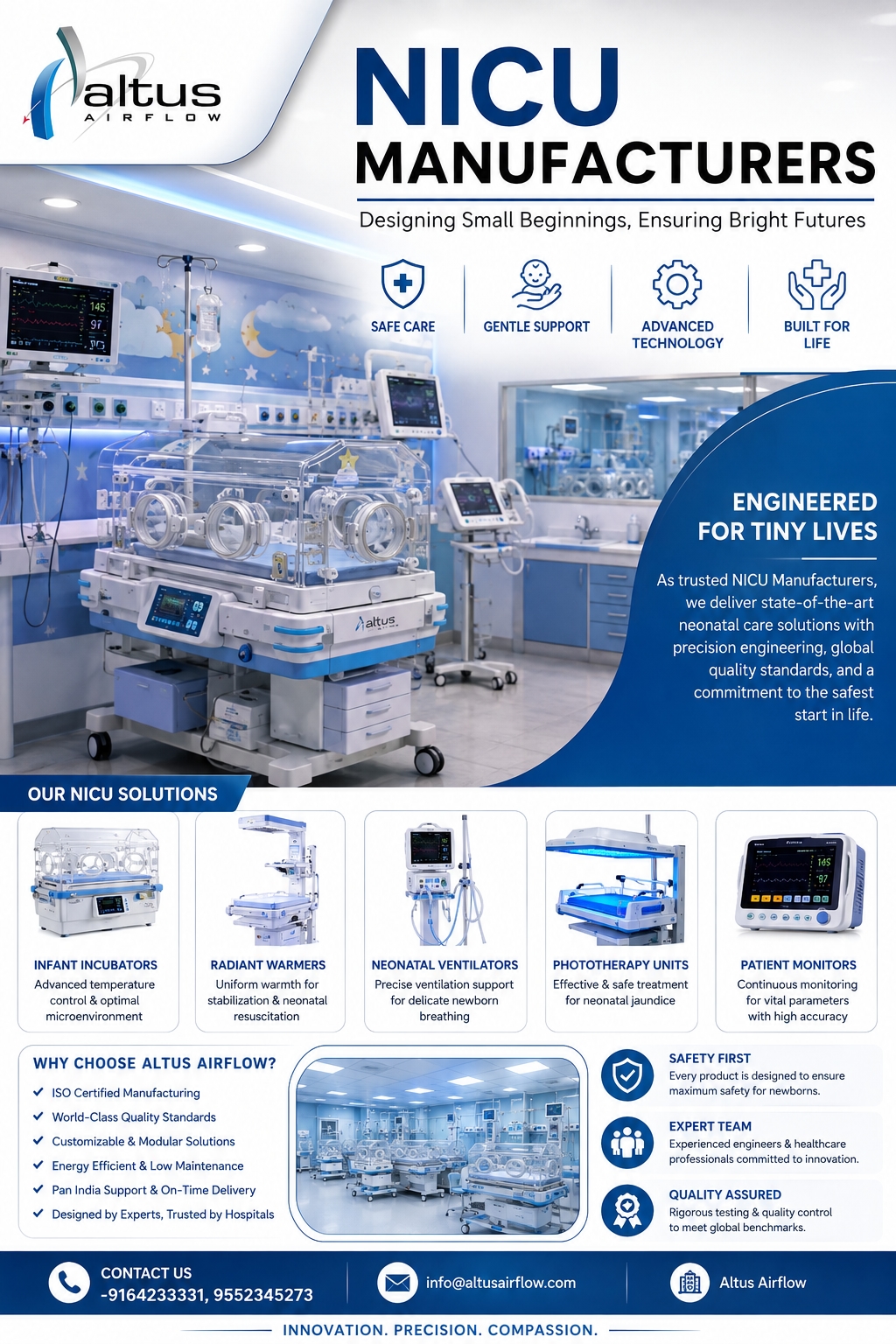
A NICU may require incubators, radiant warmers, patient monitors, ventilators, infusion pumps, phototherapy equipment, suction systems, and other devices based on the hospital’s clinical scope. The infrastructure should accommodate these systems safely and efficiently.
Hospitals should confirm that the proposed layout provides suitable locations for equipment, accessible electrical outlets, and the required medical gas connections. Cable management should reduce clutter around patient stations, while utility access should not obstruct staff movement or cleaning.
It is also important to clarify responsibilities. The hospital should establish which components the manufacturer will supply, which will be provided by third-party vendors, and which installations require separate specialist contractors. This helps prevent gaps in project scope and reduces the risk of incompatible systems.
Review Safety, Electrical Systems, and Backup Provisions
Neonatal care environments depend on reliable infrastructure. Hospitals should examine electrical capacity, grounding, emergency power arrangements, and the compatibility of the proposed installation with the selected medical devices.
Backup power requirements should be determined with qualified electrical and biomedical engineering teams. The review should consider essential patient-care equipment and other systems that the hospital identifies as critical to continued operation.
Manufacturers should provide clear technical documentation for the infrastructure within their scope. Hospitals should also confirm how installation testing, fault identification, and corrective work will be managed before the unit is handed over for use.
Assess Technical Expertise and Project Coordination
Manufacturing capability alone is not enough to guarantee a successful hospital project. The provider should demonstrate an understanding of healthcare infrastructure, project coordination, installation requirements, and the practical needs of clinical environments.
Hospitals can ask prospective manufacturers for examples of comparable projects, technical drawings, material specifications, project timelines, and details about their installation process. References from previous clients may also help assess communication, delivery coordination, and the ability to resolve project issues.
A clear project plan should identify milestones, approval requirements, responsibilities, and dependencies on other contractors. Regular coordination between the manufacturer, hospital team, architects, equipment suppliers, and engineering consultants can help reduce delays and avoid costly design changes.
Confirm Quality Documentation and Applicable Standards
Hospitals should evaluate whether the proposed solution has the necessary technical documentation and is appropriate for the intended clinical environment. Relevant requirements may vary depending on the equipment, infrastructure, project scope, and applicable local regulations.
Ask for product specifications, material details, installation procedures, testing records, and documentation for any claimed certifications or standards. Claims about compliance should be verified against the relevant documents and project requirements.
The hospital’s clinical, engineering, procurement, and quality teams should jointly review these materials. This process supports a more transparent comparison between manufacturers and helps decision-makers identify missing information before signing a contract.
Consider Maintenance, Training, and Long-Term Support
A NICU is a long-term operational facility, so hospitals should evaluate what happens after installation. Maintenance requirements, spare-part availability, technical assistance, and access to system documentation can affect how smoothly the infrastructure operates over time.
Before selecting a provider, ask about warranty coverage, maintenance schedules, response procedures for technical issues, and the availability of replacement components. The hospital should also confirm whether staff orientation or maintenance training is included in the project scope.
A useful handover should include the relevant drawings, operating instructions, maintenance information, testing documentation, and details of the installed systems. Clear records make it easier for hospital teams and future service providers to manage the facility responsibly.
Compare Total Project Value Rather Than Initial Specifications Alone
Hospitals should compare proposals against a common checklist rather than relying only on presentation quality or the number of features listed. A lower-cost proposal may exclude important infrastructure, commissioning activities, documentation, or after-installation support.
The evaluation should consider the full project scope, material quality, system compatibility, installation plan, maintenance requirements, and expected adaptability. Any exclusions or assumptions should be clarified in writing before the contract is finalized.
A structured assessment helps the hospital understand what each provider is offering and identify potential risks early. The final decision should balance clinical needs, technical suitability, implementation quality, and long-term operational requirements.
Conclusion
Selecting the right NICU manufacturing partner requires a detailed assessment of clinical needs, space planning, infection prevention, environmental control, medical equipment integration, safety provisions, quality documentation, and long-term service support. Hospitals should involve clinical and technical stakeholders throughout the selection process and compare proposals using clearly defined project requirements.
A reliable partner should be able to explain the proposed infrastructure, coordinate with other project teams, provide appropriate documentation, and support the hospital through installation and handover. Careful planning and thorough evaluation help hospitals develop neonatal care environments that are practical, maintainable, and aligned with their clinical objectives.
Frequently Asked Questions
1. What is the most important factor when selecting NICU manufacturers?
Hospitals should prioritize the manufacturer’s ability to understand clinical requirements and provide suitable infrastructure, hygienic design, environmental control, equipment integration, and technical documentation. The proposal should match the hospital’s intended level of neonatal care.
2. Why is customized NICU planning important?
Customized planning helps accommodate the hospital’s available space, patient-care requirements, equipment needs, staff workflows, and future expansion plans. It also allows different project teams to coordinate infrastructure before installation begins.
3. What environmental systems should hospitals evaluate for a NICU?
Hospitals should review ventilation, filtration, temperature and humidity regulation, airflow distribution, and maintenance access. Qualified professionals should confirm that the proposed systems meet the unit’s clinical requirements and applicable guidance.
4. What documents should a NICU manufacturer provide?
Depending on the project scope, hospitals should request technical specifications, material details, drawings, installation plans, relevant certification documents, testing and commissioning records, and maintenance instructions.
5. Should hospitals consider after-installation support before choosing a manufacturer?
Yes. Warranty terms, maintenance arrangements, spare-part availability, technical assistance, staff orientation, and complete handover documentation can influence the long-term operation and upkeep of the facility.
Read Our Previous Blog-----------> How to Choose Reliable Modular OT Manufacturers for Hospital Projects?



