
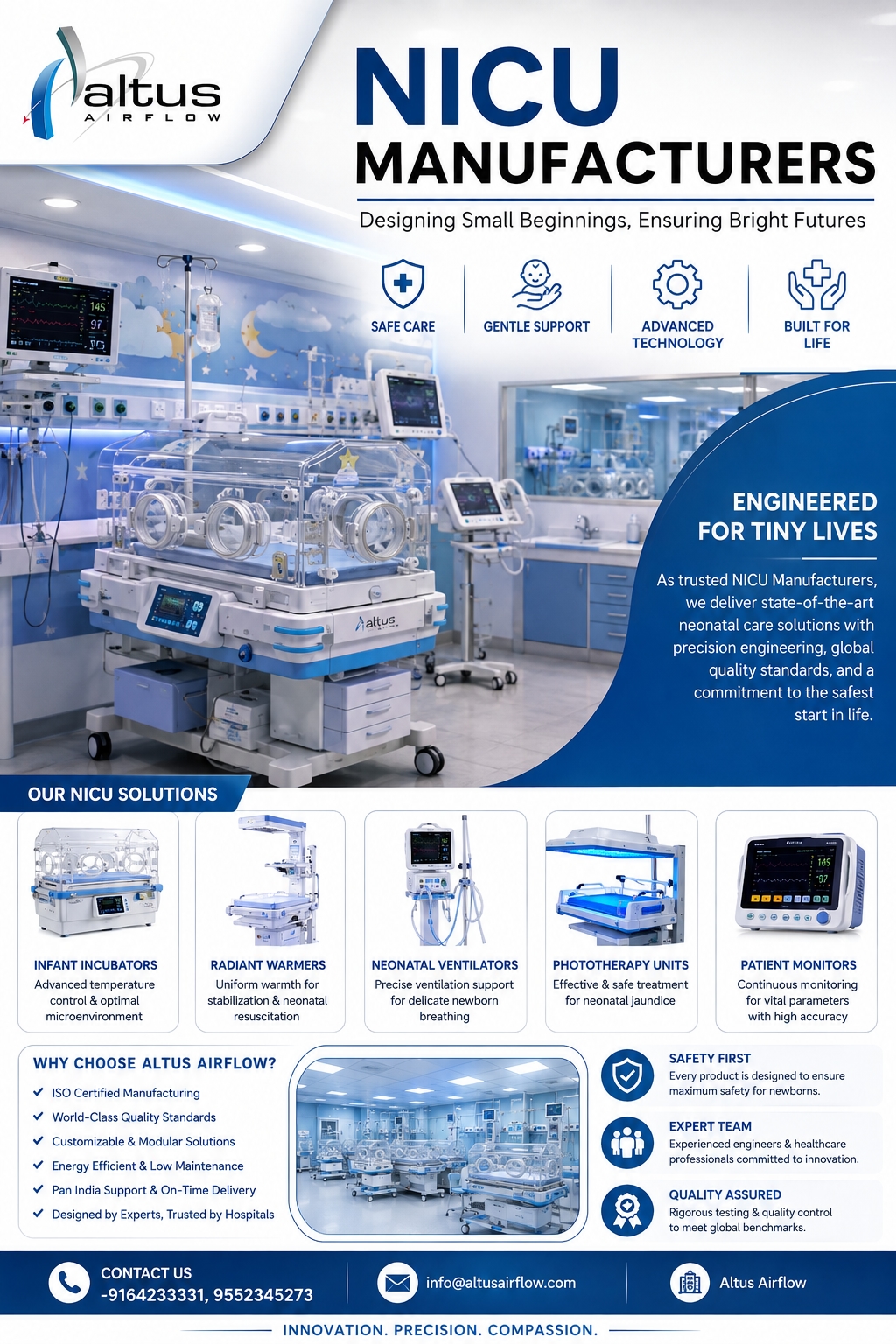
Introduction
A neonatal intensive care unit requires a carefully planned environment that supports the specialised needs of newborn patients and the healthcare professionals responsible for their care. Hospitals searching for NICU Manufacturers In India should therefore evaluate more than basic construction or equipment provisions.
A reliable approach should consider patient areas, staff movement, environmental systems, medical utilities, hygiene, equipment positioning, maintenance access, and future requirements. Choosing the right manufacturer can help hospitals develop an organised and practical neonatal care environment.
Understand the Hospital's Requirements
The first step in finding a suitable manufacturer is understanding the hospital's specific requirements. The available space, number of patient areas, equipment requirements, staffing patterns, utility provisions, and clinical workflow can all influence the planning process.
Hospitals should prepare a clear project brief before comparing manufacturers. This allows potential partners to understand the facility and propose an approach that fits its operational needs.
A customised assessment is generally more useful than selecting a solution based only on a standard layout.
Evaluate Planning and Design Expertise
A reliable manufacturer should have a structured approach to planning. Patient areas, staff work zones, equipment locations, storage, access routes, and service points should be considered together.
Neonatal Intensive Care Infrastructure should be developed around the practical requirements of neonatal care. Careful planning can help ensure that essential equipment and services remain accessible while keeping the environment organised.
Hospitals should also ask how the proposed layout can accommodate future changes in equipment or operational requirements.
Assess Environmental Control
Environmental conditions are an important consideration in neonatal care. Ventilation and other environmental systems should be planned according to the needs of the care environment and integrated with the overall infrastructure.
Hospitals should understand how environmental systems will interact with patient spaces, equipment, ceiling components, and service areas. The design should also allow reasonable access for inspection and maintenance.
An integrated engineering approach can help avoid conflicts between different systems during installation.
Examine Equipment Integration
NICUs depend on specialised equipment and monitoring systems. Their placement can affect electrical provisions, medical services, staff movement, and available working space.
A capable manufacturer should consider equipment requirements during the planning stage. Utility points and service provisions should be coordinated according to the intended equipment arrangement.
This can help minimise modifications during installation and provide a more practical working environment for healthcare professionals.
Focus on Hygiene and Cleanability
Hygiene should be a major consideration when evaluating neonatal care infrastructure. Walls, ceilings, doors, surfaces, joints, and other components should be planned with routine cleaning and maintenance requirements in mind.
Hospitals should examine whether the proposed materials and finishes are practical to clean. Designs should also minimise unnecessary difficult-to-access areas that could complicate routine maintenance.
Thoughtful detailing can help create a cleaner and more manageable clinical environment.
Consider Clinical Workflow
A NICU must support doctors, nurses, technicians, and other healthcare professionals as they perform their daily responsibilities. The placement of patient spaces, equipment, staff areas, storage, and service points can influence how efficiently teams work.
A suitable manufacturer should consider actual clinical movement when developing the layout. Access to patients and essential equipment should remain convenient without creating unnecessary obstacles.
The design should support the healthcare team rather than simply maximise the use of available floor space.
Review Installation Capabilities
The quality of planning needs to be supported by organised installation. NICU projects may involve electrical systems, ventilation, medical services, modular components, equipment provisions, and finishing activities.
These elements need to be coordinated carefully to avoid conflicts and unnecessary rework. Hospitals should ask potential manufacturers about their installation process and how different project activities are sequenced.
Clear communication throughout installation can also help keep the project aligned with hospital requirements.
Check Maintenance Accessibility
Hospitals should consider what happens after the NICU becomes operational. Engineering systems and other serviceable components will eventually require inspection, servicing, or repair.
Maintenance access should therefore be incorporated into the initial planning process. Systems that are difficult to reach can increase maintenance complexity and potentially disrupt clinical activities.
A well-planned environment should provide practical access while maintaining the functionality of patient-care areas.
Review Documentation and Handover
Proper technical documentation is another factor hospitals should consider when selecting a manufacturer. Drawings, installation information, service details, and handover records can help facility teams understand the completed infrastructure.
Clear documentation can also support future maintenance and modifications. It provides useful references when hospital teams need to inspect systems or plan changes later.
Hospitals should therefore assess how a manufacturer manages documentation throughout the project.
Consider Future Requirements
Healthcare facilities can change over time. Hospitals may add equipment, modify workflows, expand services, or introduce new technologies.
A trusted manufacturer should consider reasonable future flexibility during the planning stage. Infrastructure that can accommodate appropriate changes may help hospitals avoid extensive modifications later.
This forward-looking approach can improve the long-term usefulness of the neonatal care environment.
Compare Manufacturers Carefully
Hospitals should avoid selecting a manufacturer based on only one factor. Instead, they should assess the complete approach to the project.
Important areas include planning expertise, engineering coordination, equipment integration, hygiene, environmental control, installation, maintenance access, documentation, and responsiveness to hospital-specific requirements.
The right manufacturer should demonstrate an understanding of neonatal care environments and the practical needs of healthcare teams.
Conclusion
Finding trusted NICU Manufacturers In India requires careful evaluation of the complete infrastructure approach. Hospitals should consider planning, environmental control, equipment integration, hygiene, clinical workflow, installation, maintenance, documentation, and future flexibility before making a decision.
A reliable manufacturer should focus on developing an organised environment that supports healthcare professionals and the specialised requirements of neonatal care. Careful selection and detailed planning can provide a stronger foundation for a practical and maintainable NICU.
FAQs
1. What should hospitals check before choosing a NICU manufacturer?
Hospitals should review planning expertise, equipment integration, environmental systems, hygiene, clinical workflow, installation capabilities, maintenance access, documentation, and future flexibility.
2. Why is equipment integration important in a NICU?
Proper equipment integration helps ensure that medical devices have suitable utility connections, working space, accessibility, and supporting infrastructure.
3. How does NICU planning support healthcare professionals?
A well-planned layout can organise patient areas, equipment, staff zones, storage, and service points to support efficient daily clinical activities.
4. Why should maintenance be considered during NICU design?
Planning maintenance access early can make inspections, servicing, repairs, and future upgrades easier while helping minimise disruption to patient-care activities.
5. Can NICU infrastructure accommodate future changes?
With appropriate planning, infrastructure can provide flexibility for equipment upgrades, workflow changes, and other future operational requirements.
Read Our Previous Blog-----------> How Do Recovery Rooms Manufacturers In India Meet Hospital Needs?